
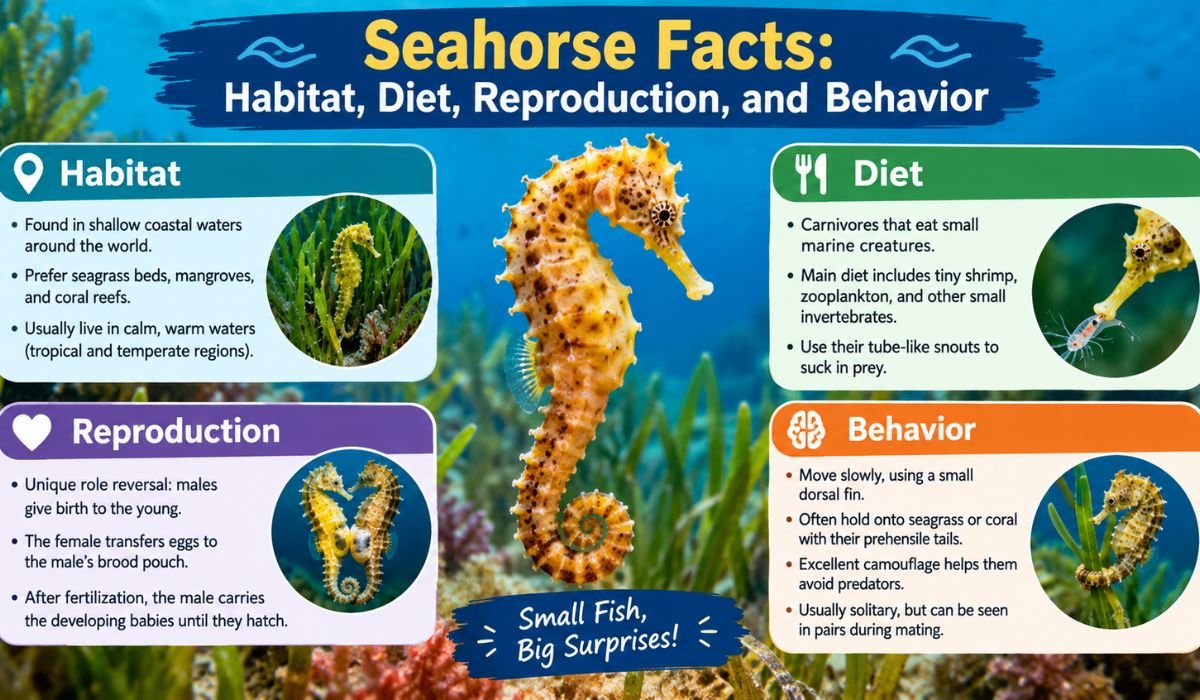
Seahorses are among the most unusual animals found in the ocean. With their horse-like heads, curled tails, upright swimming posture, and distinctive bodies, they are easy to recognize. These small marine fish belong to the genus Hippocampus and live mainly in shallow coastal waters. Learning seahorse facts reveals fascinating details about their feeding habits, reproduction, movement, and survival strategies.
Unlike many fish, seahorses are relatively slow swimmers. Instead of traveling long distances, they often use their prehensile tails to hold onto seagrass, coral, or other underwater structures. Their unique biology also makes them particularly interesting to scientists and marine enthusiasts.
What Are Seahorses?
Seahorses are bony fish belonging to the family Syngnathidae, which also includes pipefish and seadragons. There are many recognized seahorse species, and they vary considerably in size, color, and habitat.
One of the most interesting seahorse facts is that their bodies are covered by bony plates rather than overlapping scales like those of many other fish. Their rigid body shape gives them a distinctive appearance while providing protection.
Seahorses have a long snout that they use to capture tiny prey. They also have a curled tail that can grip underwater vegetation and other objects. Their small fins help them move and maintain their position in the water.
Seahorse Habitat
Seahorses are found in coastal marine environments in different parts of the world. Depending on the species, they may live around seagrass meadows, mangroves, coral reefs, estuaries, and rocky coastal areas.
Many species prefer habitats where there are plenty of structures to cling to. Because seahorses are not powerful swimmers, vegetation and other underwater features can provide shelter from currents and predators.
Habitat conditions are an important part of understanding seahorse facts. Healthy seagrass beds, mangroves, and coral ecosystems can provide food, shelter, and breeding areas.
Some seahorse species have relatively small home ranges. Rather than constantly traveling through the ocean, they may remain in a particular area when suitable food and shelter are available.
What Do Seahorses Eat?
Seahorses are carnivorous animals that mainly eat very small marine organisms. Their diet can include tiny crustaceans, planktonic animals, fish larvae, and other small prey.
A seahorse does not have teeth or a traditional stomach. Instead, it uses its long snout like a small tube. When prey comes within range, the seahorse can rapidly draw it into its mouth.
Because food passes through their digestive system relatively quickly, seahorses need to feed frequently. Young seahorses can be especially dependent on a regular supply of tiny prey.
One of the useful seahorse facts to remember is that these fish are active predators despite their gentle appearance. Their specialized feeding system allows them to capture tiny animals with impressive precision.
How Do Seahorses Reproduce?
Seahorse reproduction is one of the most remarkable features of these animals. Unlike most animals, seahorses have a reproductive system in which the male carries developing embryos.
During mating, the female transfers her eggs into a specialized brood pouch on the male’s body. The male then fertilizes the eggs and carries them while they develop.
The length of pregnancy and the number of young produced can vary between species. Eventually, the male releases fully formed young seahorses into the surrounding water.
This unusual reproductive system is one of the most famous seahorse facts. Male pregnancy distinguishes seahorses from most other fish and has made them an important subject of biological research.
After birth, young seahorses are generally independent and must find food and shelter on their own. Their small size makes the early stages of life particularly challenging.
Read Related Post: Wolf Facts: Habitat, Diet, Behavior, and Social Life
Seahorse Behavior
Seahorses are generally slow-moving animals that spend much of their time among underwater vegetation and other structures. Their behavior is strongly influenced by their environment, food availability, and reproductive cycle.
Their curled tails are especially useful. A seahorse can wrap its tail around seagrass or another object to remain in place, particularly when water movement becomes stronger.
Some species also display courtship behaviors involving changes in color, coordinated movements, and interactions between mates. These behaviors can help strengthen pair bonds and coordinate reproduction.
Another interesting aspect of seahorse facts is their ability to change color in certain situations. Color changes may be associated with communication, camouflage, courtship, or environmental conditions, although the exact function varies between species and circumstances.
How Do Seahorses Swim?
Seahorses are not built for speed. Their body shape and upright posture make them very different from streamlined fish.
They primarily use a small dorsal fin to move forward, while other fins help with steering and stability. Their fins can move rapidly, allowing them to maintain control despite their slow overall movement.
Seahorses can also use their tails to anchor themselves. This combination of swimming and gripping allows them to remain within suitable habitats without constantly fighting ocean currents.
Their limited swimming ability is one reason why suitable habitat is so important. Losing vegetation or other structures can make it more difficult for seahorses to find shelter and maintain their position.
Seahorse Adaptations
Seahorses have several adaptations that help them survive in their marine environments.
Their prehensile tail is one of their most important features. It allows them to hold onto vegetation and other structures instead of being carried away by currents.
Their eyes can move independently, somewhat like the eyes of a chameleon. This allows a seahorse to observe different directions while remaining relatively still.
Camouflage is another important adaptation. Many seahorses can blend into their surroundings, making them more difficult for predators and prey to detect.
Their snout is also highly specialized for feeding. Rather than chasing prey over long distances, seahorses can remain still and use their rapid suction-feeding mechanism when a suitable food item approaches.
These adaptations show how seahorse facts connect their unusual appearance with their survival strategy.
Seahorse Size and Appearance
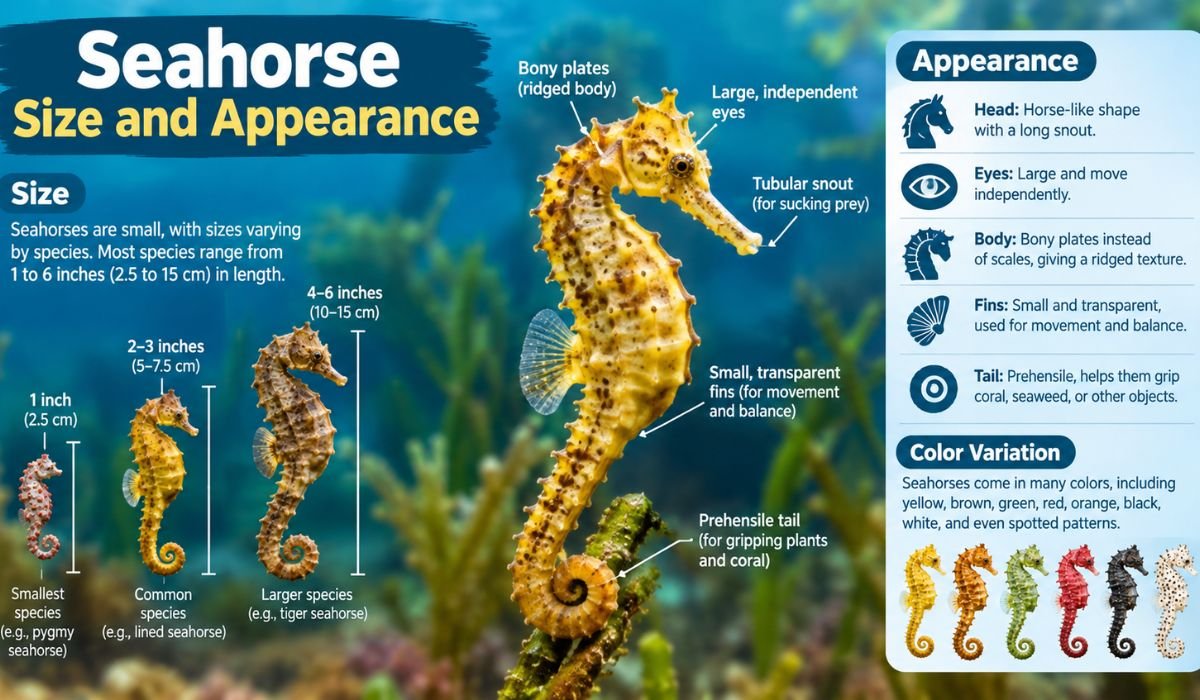
Seahorses come in different sizes depending on the species. Some are only a few centimeters long, while others can grow considerably larger.
Their bodies have a distinctive upright shape, a horse-like head, a long snout, a curled tail, and bony body plates. They also have a dorsal fin and smaller fins that help them move through the water.
Seahorses can occur in a wide range of colors. Depending on the species and environment, individuals may appear brown, yellow, orange, gray, green, or other shades.
Their appearance can sometimes change, making them better suited to their surroundings or allowing them to communicate during social and reproductive interactions.
What Eats Seahorses?
Seahorses face threats from various marine predators. Larger fish, crabs, rays, and other ocean animals may prey on them, particularly when they are young.
Their camouflage and ability to remain attached to vegetation provide important protection. Their bony body plates may also offer some defense.
However, camouflage cannot eliminate every danger. Young seahorses are especially vulnerable because of their small size and limited ability to escape predators.
Understanding these seahorse facts also highlights why healthy coastal habitats are important. Vegetation can provide both food sources and places where seahorses can hide.
Threats to Seahorses
Seahorses can be affected by environmental changes and human activities. Habitat destruction, pollution, coastal development, and changes to marine ecosystems can reduce suitable places for them to live and reproduce.
Some seahorse species have also been affected by collection and trade. The level of concern varies among species and regions, so conservation assessments are generally made on a species-by-species basis.
Protecting seagrass beds, mangroves, coral reefs, and other coastal habitats can benefit seahorses as well as many other marine organisms.
Conservation efforts can include habitat protection, responsible fishing practices, monitoring wild populations, and reducing damage to coastal ecosystems.
Interesting Seahorse Facts
Here are some quick seahorse facts that make these animals especially fascinating:
- Seahorses are fish, even though their body shape looks very different from typical fish.
- They swim in an upright position.
- Their tails can grip underwater objects.
- Male seahorses carry developing embryos in a specialized brood pouch.
- Seahorses use suction feeding to capture tiny prey.
- Their eyes can move independently.
- Many species live in shallow coastal habitats.
- Seahorses are generally slow swimmers.
- Their bodies are protected by bony plates.
- Different species vary widely in size, appearance, and habitat.
FAQ’s
What are the most interesting seahorse facts?
Some of the most interesting seahorse facts include male pregnancy, their ability to grip objects with their tails, their upright swimming position, and their specialized suction-feeding system.
Where do seahorses live?
Seahorses generally live in coastal marine habitats such as seagrass meadows, mangroves, coral reefs, estuaries, and rocky areas. Their preferred habitat depends on the species.
What do seahorses eat?
Seahorses eat tiny marine animals, including small crustaceans, planktonic organisms, and fish larvae. They use their specialized snouts to suck prey into their mouths.
Do male seahorses give birth?
Yes. The female places eggs into the male’s brood pouch, where the eggs are fertilized and develop. The male eventually releases the young seahorses into the water.
Can seahorses change color?
Some seahorses can change color. Color changes may help with camouflage, communication, courtship, or responses to their surroundings.
How do seahorses protect themselves?
Seahorses rely on camouflage, their bony body plates, and their ability to grip vegetation or other structures with their tails. These adaptations can help them avoid predators.
Conclusion
Seahorses are remarkable marine fish with a combination of features rarely seen in other animals. Their horse-like heads, curled tails, upright swimming posture, specialized feeding system, and unusual reproductive strategy make them especially distinctive.
The most memorable seahorse facts include the male’s role in carrying developing young, their ability to anchor themselves with their tails, and their dependence on suitable coastal habitats. Protecting seagrass beds, mangroves, reefs, and other marine ecosystems is important for maintaining healthy environments where seahorses and other ocean species can survive.

Hi, I’m Amelia, an SEO and content specialist with several years of experience researching and creating informative content for online audiences. At Animal Attack Facts, I focus on animal behavior, animal attacks on humans, and interesting facts about land animals, marine animals, birds, reptiles, and insects. My goal is to provide clear, useful, and engaging information that helps readers better understand wildlife and stay informed about animal encounters.
1 thought on “Seahorse Facts: Habitat, Diet, Reproduction, and Behavior”