
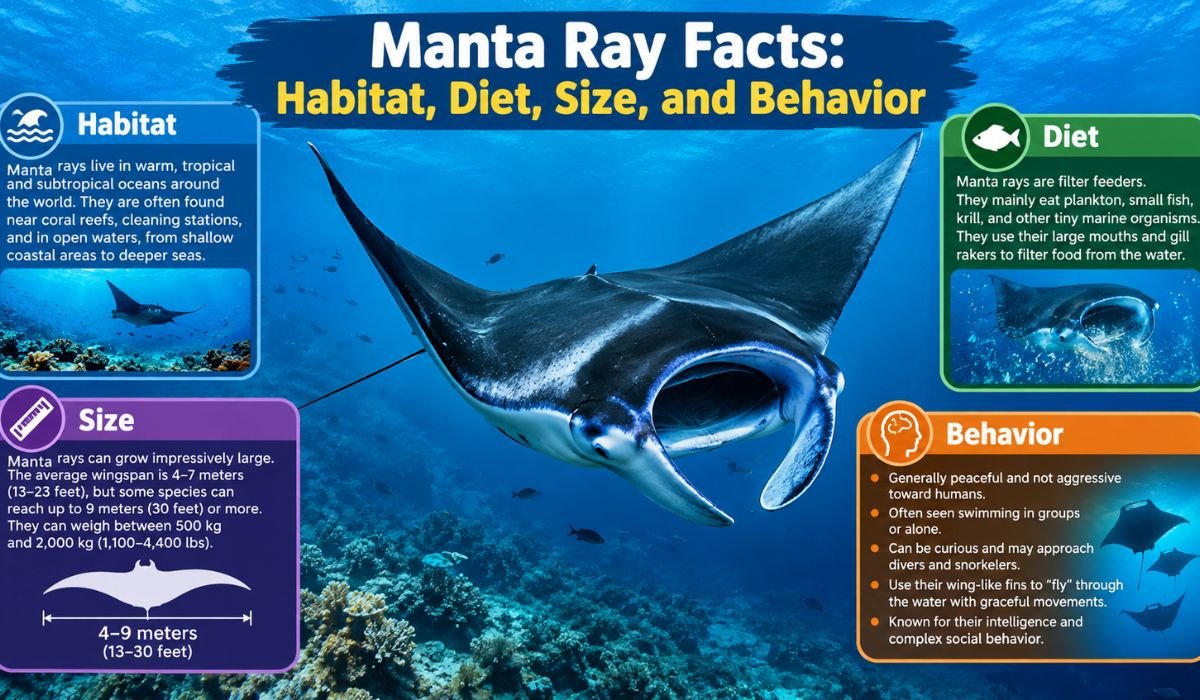
Manta rays are among the most fascinating animals found in the world’s oceans. These large marine animals are known for their wide, wing-like fins, graceful swimming style, and impressive size. Unlike many people assume, manta rays are generally gentle filter feeders that spend much of their time feeding on tiny organisms in the water.
Learning manta ray facts can help explain how these remarkable animals live, feed, reproduce, and survive in different marine environments.
What Are Manta Rays?
Manta rays are large cartilaginous fish belonging to the family Mobulidae. They are closely related to sharks and other rays, but their body shape and feeding habits are quite different from those of many predatory rays.
One of the most recognizable manta ray facts is that mantas have enormous pectoral fins that extend from both sides of their flattened bodies. They use these fins to move through the water with smooth, powerful movements.
Manta rays have broad heads and specialized structures called cephalic fins near their mouths. These fins help direct water and food toward the mouth while the animal is feeding.
There are two recognized manta ray species: the giant oceanic manta (Mobula birostris) and the reef manta (Mobula alfredi). Although both species have similar body shapes, they differ in habitat preferences, size, and behavior.
Manta Ray Habitat
Manta rays live in tropical and subtropical parts of the world’s oceans. Their exact habitat depends on the species.
Reef mantas are often associated with coastal waters and coral reef environments. They may regularly visit cleaning stations where small cleaner fish remove parasites and dead tissue from their bodies.
Giant oceanic mantas are more widely distributed and can travel through open ocean environments. They may also visit productive coastal areas when food is abundant.
An important manta ray fact is that these animals do not necessarily stay in one small area throughout their lives. Some individuals travel considerable distances between feeding and breeding areas.
Where Do Manta Rays Live?
Manta rays can be found in several tropical and subtropical regions, including parts of the Pacific, Indian, and Atlantic Oceans.
They are commonly associated with areas where plankton concentrations are high. Ocean currents, seasonal changes, and water temperature can influence where mantas are found.
Manta Ray Size and Appearance
Manta rays are famous for their impressive size. Their large pectoral fins give them a wingspan that can reach several meters.
Giant oceanic mantas are the larger of the two species and can reach wingspans of more than 6 meters in exceptional individuals. Reef mantas are generally smaller, although they can still reach impressive sizes.
Their bodies are usually dark on the upper surface and lighter underneath, although coloration varies between individuals.
Another interesting manta ray fact is that researchers can sometimes identify individual mantas by the unique patterns on the underside of their bodies. These natural markings can work somewhat like an identification pattern.
Read Related Post: Bear Facts: Types, Habitat, Diet, and Behavior
What Do Manta Rays Eat?
Manta rays are filter feeders. Instead of hunting large prey, they swim through the water with their mouths open and filter tiny organisms from the surrounding water.
Their primary food is plankton, including tiny crustaceans and other microscopic marine organisms. When plankton concentrations are high, manta rays may gather in feeding areas.
Mantas can use different swimming patterns while feeding. They may swim in circles, make repeated passes through dense plankton, or move in coordinated groups.
One of the most interesting manta ray facts is that an animal weighing hundreds of kilograms can survive mainly by filtering tiny organisms from seawater.
How Do Manta Rays Feed?
When a manta ray encounters a dense concentration of plankton, it opens its large mouth and moves through the water. Water enters the mouth while specialized structures inside the mouth help separate food particles from the water.
The filtered food is then swallowed, while the water passes back out through the gill openings.
This feeding strategy allows manta rays to consume enormous numbers of tiny organisms without chasing individual prey.
Manta Ray Behavior
Manta rays are known for their graceful swimming and relatively complex behavior. They can travel alone, in pairs, or in groups depending on environmental conditions.
They sometimes gather in areas where food is plentiful. Groups may also form around cleaning stations, where cleaner fish remove parasites from their bodies.
Some manta ray facts are especially interesting because researchers have observed signs of individual recognition and repeated use of particular locations. Their behavior continues to be studied as scientists learn more about their intelligence and social interactions.
Mantas are also capable of performing impressive movements in the water. They may roll, dive, and change direction quickly despite their large size.
Are Manta Rays Dangerous?
Manta rays are generally not considered dangerous to humans. They are filter feeders and do not have the aggressive hunting behavior associated with some predatory marine animals.
They also lack the venomous tail spine found in stingrays.
However, manta rays are still large wild animals, so divers and swimmers should give them adequate space and avoid touching or chasing them. Respecting their natural behavior helps reduce stress for the animals and makes encounters safer for everyone.
How Do Manta Rays Reproduce?
Manta rays reproduce through internal fertilization. Unlike many fish that release eggs into the water, female mantas give birth to live young.
The developing embryo receives nourishment from an egg yolk inside the mother’s body. After development, the young manta is born as a miniature version of an adult.
Mantas generally produce very few young compared with many other marine animals. This reproductive strategy means populations can be slow to recover when large numbers of animals are lost.
This is an important manta ray fact because it helps explain why protecting adult manta rays is important for maintaining healthy populations.
Manta Ray Lifespan
The exact lifespan of manta rays is difficult to determine because these animals are challenging to study over long periods.
Research suggests that manta rays can live for several decades. Their slow growth and relatively low reproductive output mean that population recovery can take time.
Scientists use identification photographs, tagging, and long-term observations to learn more about manta ray growth, movement, and survival.
Manta Rays and Cleaner Fish
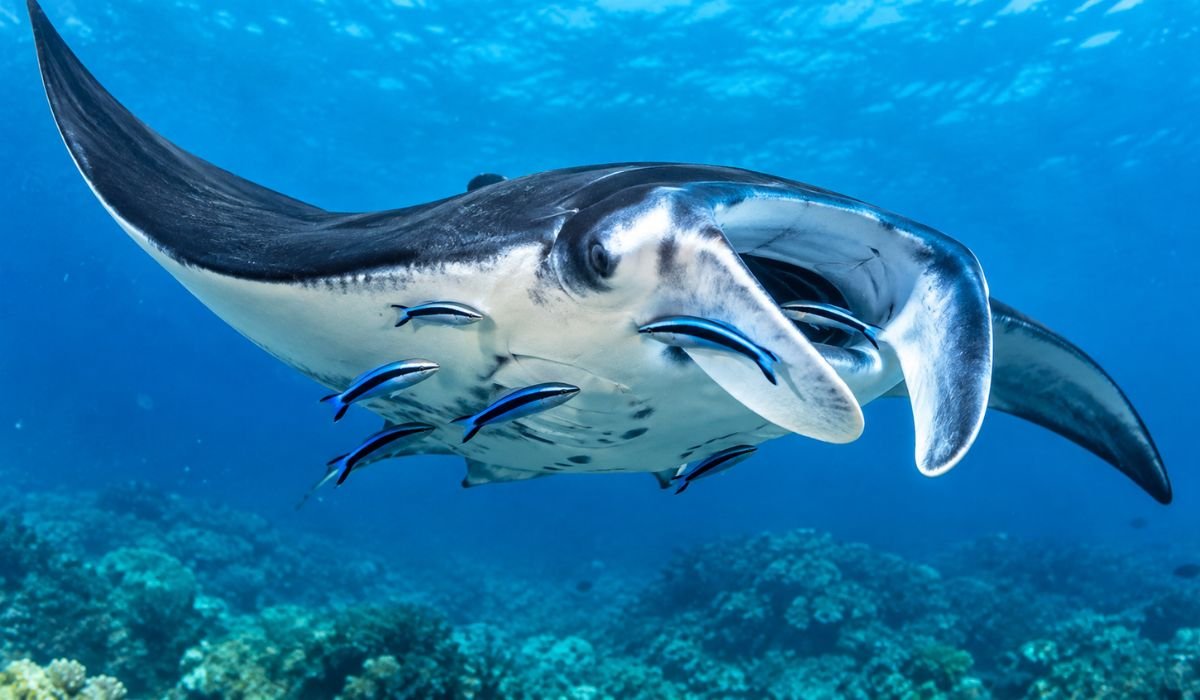
Manta rays often visit cleaning stations in coral reef environments. At these locations, small cleaner fish feed on parasites and other material from the manta’s skin.
The relationship benefits both animals. The cleaner fish obtain food, while the manta receives a form of cleaning service.
Mantas may return to the same cleaning areas repeatedly, making these locations particularly valuable for researchers studying their behavior.
Threats to Manta Rays
Manta rays face several threats in the world’s oceans. One major concern is accidental capture in fishing gear. Some mantas are also deliberately targeted in certain fisheries.
Other threats include habitat degradation, marine pollution, boat activity, and changes in ocean conditions.
Because manta rays grow relatively slowly and produce few young, excessive mortality can have significant effects on populations.
Conservation programs around the world aim to improve protection, reduce harmful fishing practices, and better understand manta ray populations.
Interesting Manta Ray Facts
Here are some quick manta ray facts that highlight what makes these animals unique:
- Manta rays are cartilaginous fish, like sharks.
- They are filter feeders rather than large-prey hunters.
- Giant oceanic mantas can have wingspans of more than 6 meters.
- Mantas have large cephalic fins near their mouths.
- Their diet mainly consists of plankton and other tiny organisms.
- Manta rays do not have the venomous tail spine found in stingrays.
- They can travel long distances through the ocean.
- Some mantas repeatedly visit cleaning stations.
- Individual mantas can have distinctive markings on their undersides.
- Female manta rays give birth to live young.
- Mantas can live for several decades.
- Their populations can be vulnerable because they reproduce relatively slowly.
Why Are Manta Rays Important?
Manta rays are an important part of marine ecosystems. Their feeding movements can influence the distribution of nutrients and plankton in the water.
They also contribute to marine tourism in many regions because divers and snorkelers travel to places where manta rays regularly gather.
Protecting these animals can therefore benefit both marine ecosystems and communities that depend on healthy ocean environments.
Frequently Asked Questions About Manta Ray Facts
How big can manta rays get?
One of the most impressive manta ray facts is their enormous size. Giant oceanic mantas can reach wingspans of more than 6 meters, while reef mantas are generally smaller.
What do manta rays eat?
Manta rays mainly eat plankton and other tiny organisms. They feed by swimming through the water with their mouths open and filtering food from seawater.
Are manta rays dangerous to humans?
Manta rays are generally gentle filter feeders and are not considered a major threat to humans. However, people should still observe them from a respectful distance and avoid touching or chasing them.
Where do manta rays live?
Manta rays live mainly in tropical and subtropical oceans. Reef mantas often stay near coastal reefs, while giant oceanic mantas can travel through much larger areas of open ocean.
Do manta rays have teeth?
Manta rays do not rely on teeth to capture prey. Their feeding system is adapted for filtering tiny organisms such as plankton from seawater.
How do manta rays have babies?
Female manta rays give birth to live young. The developing embryo grows inside the mother before being born as a young manta ray.
Conclusion
Manta rays are remarkable marine animals with enormous wingspans, specialized feeding systems, and fascinating behaviors. From their plankton-based diet to their long-distance movements, manta ray facts show how well these animals are adapted to life in tropical and subtropical oceans.
Their slow reproduction and vulnerability to fishing pressure also make conservation important. By protecting important feeding and cleaning areas and reducing harmful human activities, people can help manta ray populations continue to thrive in healthy oceans.

Hi, I’m Amelia, an SEO and content specialist with several years of experience researching and creating informative content for online audiences. At Animal Attack Facts, I focus on animal behavior, animal attacks on humans, and interesting facts about land animals, marine animals, birds, reptiles, and insects. My goal is to provide clear, useful, and engaging information that helps readers better understand wildlife and stay informed about animal encounters.
1 thought on “Manta Ray Facts: Habitat, Diet, Size, and Behavior”