
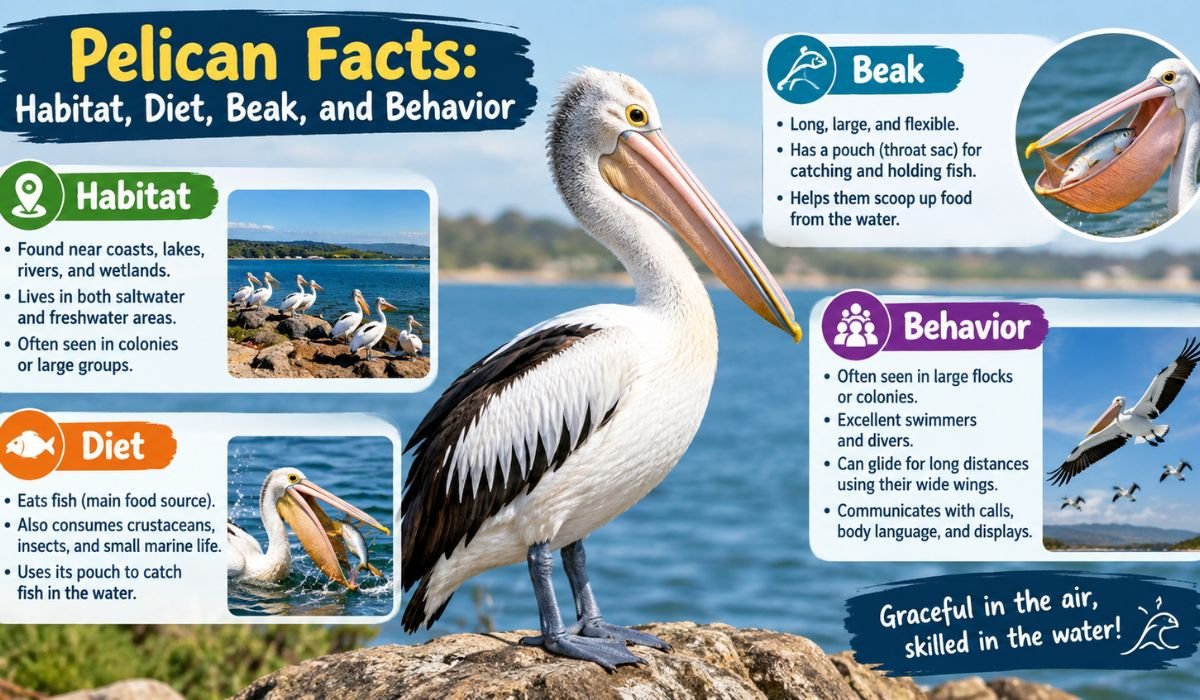
Pelicans are large waterbirds famous for their enormous bills, expandable throat pouches, broad wings, and graceful flight. They live around coasts, lakes, rivers, wetlands, and estuaries. Some species scoop fish from the water, while Brown Pelicans can plunge headfirst into the sea to catch prey.
Pelicans belong to the family Pelecanidae. Species differ in size, color, habitat, and feeding style, but they share webbed feet, broad wings, and specialized bills and pouches.
Pelican Facts: What Is a Pelican?
A pelican is a large waterbird adapted for life around water. Pelicans are members of the order Pelecaniformes and are recognized by their long bills and expandable throat pouches.
Many pelicans are social and may travel, rest, feed, and breed in groups. American White Pelicans can even cooperate while feeding. Although they look awkward on land, pelicans are strong swimmers and capable fliers.
Their webbed feet help them move through water, while their wide wings allow them to glide and soar efficiently.
Pelican Facts About Habitat and Range
Pelicans live on several continents and use both marine and freshwater habitats. Depending on the species, they can be found along ocean coasts, estuaries, bays, islands, rivers, lakes, marshes, and shallow wetlands.
Brown Pelicans are strongly associated with coastal environments. They commonly live along shorelines, estuaries, and islands and may rest on sandbars, rocks, jetties, pilings, and other structures near the water. American White Pelicans have a different pattern: they often breed on islands in freshwater lakes and wetlands before spending winter around coastal bays and estuaries.
Pelicans usually choose places with plentiful food and suitable resting or nesting sites. Many species gather in colonies, especially during breeding, and isolated islands can provide protection from some land predators.
Pelican Facts About Their Amazing Beak
The pelican beak is one of the bird’s most recognizable features. It is long, broad, and strong enough to help capture aquatic prey. Beneath the lower part of the bill is a flexible throat pouch called a gular pouch.
The pouch works like a fishing net. A pelican scoops up prey and water, then drains the water before swallowing.
Pelicans do not normally carry food around in the pouch while flying. The catch is swallowed after excess water drains away.
The pouch can also have another important function. In hot conditions, some pelicans use movements of the pouch area to help release heat. This behavior, known as gular fluttering, can help cool the bird.
Read Related Post: Manta Ray Facts: Habitat, Diet, Size, and Behavior
Pelican Facts About Diet and Feeding
Most pelicans eat fish, making them important predators in aquatic food webs. However, their diets are not limited to fish. Depending on the species and habitat, pelicans may also eat crustaceans, amphibians, and other aquatic animals.
American White Pelicans commonly feed on small fish such as minnows, carp, and suckers. They may also eat salamanders, tadpoles, and crayfish when these prey are available. Their diet can change according to local water conditions and prey abundance.
Brown Pelicans mainly eat small schooling fish, including species such as anchovies, herring, mullet, and menhaden. They can also consume some invertebrates and may occasionally scavenge or take food from other birds.
Different species use different hunting techniques. American White Pelicans usually feed from the water’s surface, dipping their bills and scooping up prey. Groups may work together to herd fish toward shallow water.
Brown Pelicans have one of the most dramatic feeding methods. They can spot fish from above, fold their wings, and plunge into the water headfirst. Air sacs beneath their skin help cushion the impact of these dives. They then use the expandable pouch to catch fish and drain away water before swallowing.
Pelican Facts About Size and Appearance
Pelican size varies by species. The American White Pelican is one of the largest North American birds, with a wingspan that can reach roughly 8 to 9.5 feet. Brown Pelicans are smaller but still have large bodies and broad wings.
American White Pelicans have mostly white plumage with black flight feathers that show when the wings are spread. Brown Pelicans have gray-brown bodies with pale neck areas and distinctive breeding-season coloring. Young birds develop adult plumage as they mature.
Pelican Facts About Flight and Behavior
Pelicans are surprisingly graceful in the air. Their broad wings allow them to soar on rising air currents, and they can travel considerable distances without constantly flapping. They often fly in lines or formations, sometimes close to the surface of the water.
On land, their movement can appear clumsy because of their large bodies and webbed feet. In water, however, they are capable swimmers.
Pelicans are generally social birds. They often rest in groups and may gather in large colonies during breeding. Some species cooperate while feeding, coordinating their movements to concentrate fish.
When not hunting, pelicans may spend long periods resting, preening, or socializing on rocks, beaches, sandbars, docks, or other spots near water.
Pelican Facts About Nesting and Family Life

Pelicans commonly breed in colonies. Depending on the species, nests may be placed on islands, the ground, shrubs, or trees, usually close to water and food.
Parents work together to care for their young. Brown Pelicans commonly lay two to four eggs, and both parents participate in incubation and feeding. Young pelicans hatch helpless and depend on adults for food and protection. As they grow, they develop the strength to swim and fly and eventually become independent.
Are Pelicans Dangerous?
Pelicans are wild birds and should be observed from a respectful distance. They are not generally aggressive toward people, but a large bird with a powerful bill can cause injury if it feels threatened or is handled.
Avoid touching, chasing, feeding, or cornering wild pelicans. Giving them space reduces stress for birds and people.
Pelican Facts and Conservation
Some pelican populations have faced habitat disturbance, pollution, hunting, fishing equipment, and other human-related threats. The Brown Pelican is a notable conservation success.
Brown Pelicans suffered major declines during the 20th century, partly because DDT caused eggshell thinning. After DDT was banned in the United States and protections were introduced, populations recovered strongly. The species was removed from the U.S. Endangered Species List in 2009.
Today, discarded fishing line, hooks, marine debris, habitat disturbance, and other hazards can still threaten pelicans. Protecting wetlands, coastal habitats, nesting areas, and clean water helps support healthy populations.
Interesting Pelican Facts
There are many unusual things about these birds:
- Pelicans have expandable throat pouches used for catching food.
- Brown Pelicans can plunge-dive into water to catch fish.
- American White Pelicans often feed cooperatively in groups.
- Pelicans have webbed feet for swimming.
- Their broad wings help them soar.
- Some use gular fluttering to cool themselves.
- Their diets can change depending on available prey.
- Young pelicans depend on their parents for food and protection.
- The Brown Pelican is a notable conservation success story.
FAQ’s
Pelican Facts: What Do Pelicans Eat?
Pelicans mainly eat fish, but some species also consume crayfish, salamanders, tadpoles, crustaceans, and other aquatic prey. Their diet depends on the species and the food available in their habitat.
Pelican Facts: How Does a Pelican Use Its Beak?
A pelican uses its long bill and expandable throat pouch to scoop up fish and water. It then drains excess water before swallowing its prey.
Pelican Facts: Can Pelicans Fly?
Yes. Pelicans are strong fliers with broad wings. They can soar for long distances and often travel in groups or lines.
Pelican Facts: Where Do Pelicans Live?
Pelicans live in coastal and freshwater environments, including oceans, estuaries, lakes, rivers, marshes, wetlands, islands, and shallow bays.
Pelican Facts: How Big Are Pelicans?
Pelican size varies by species. American White Pelicans can have wingspans of roughly 8 to 9.5 feet, while Brown Pelicans are smaller but still large waterbirds.
Pelican Facts: Do Pelicans Store Fish in Their Pouches?
No. Their pouch is mainly used to catch prey. After scooping up fish and water, they drain the water and swallow the fish.
Pelican Facts: Are Pelicans Social Birds?
Yes. Many pelicans are highly social and commonly rest, fly, feed, and breed in groups. Some species form large breeding colonies.
Conclusion
Pelicans are remarkable waterbirds with specialized bodies that help them survive around oceans, lakes, rivers, wetlands, and estuaries. Their huge bills and expandable pouches make them excellent fish-catching tools, while their broad wings allow them to soar efficiently.
From the dramatic plunge-diving Brown Pelican to the cooperative feeding behavior of the American White Pelican, different species have developed fascinating ways to find food and live in aquatic environments. Learning more about pelicans also highlights the importance of protecting clean water, healthy wetlands, coastal habitats, and safe nesting areas for these distinctive birds.

Hi, I’m Amelia, an SEO and content specialist with several years of experience researching and creating informative content for online audiences. At Animal Attack Facts, I focus on animal behavior, animal attacks on humans, and interesting facts about land animals, marine animals, birds, reptiles, and insects. My goal is to provide clear, useful, and engaging information that helps readers better understand wildlife and stay informed about animal encounters.
1 thought on “Pelican Facts: Habitat, Diet, Beak, and Behavior”