
Penguins are fascinating seabirds known for their upright posture, black-and-white feathers and remarkable ability to survive in challenging environments. When people think about penguin habitat, they often picture the frozen landscapes of Antarctica. However, penguins live in a much wider range of environments, from icy Antarctic coasts to temperate islands and rocky shores.
There are more than a dozen recognized penguin species, and each has adapted to the conditions of its particular environment. Some live in extremely cold regions, while others inhabit relatively mild coastal areas. Their bodies, behavior, diet, and breeding habits are closely connected to where they live.
Understanding penguin habitat helps explain how these flightless birds survive, find food, raise their young, and avoid predators in some of the world’s most demanding environments.
Where Do Penguins Live?
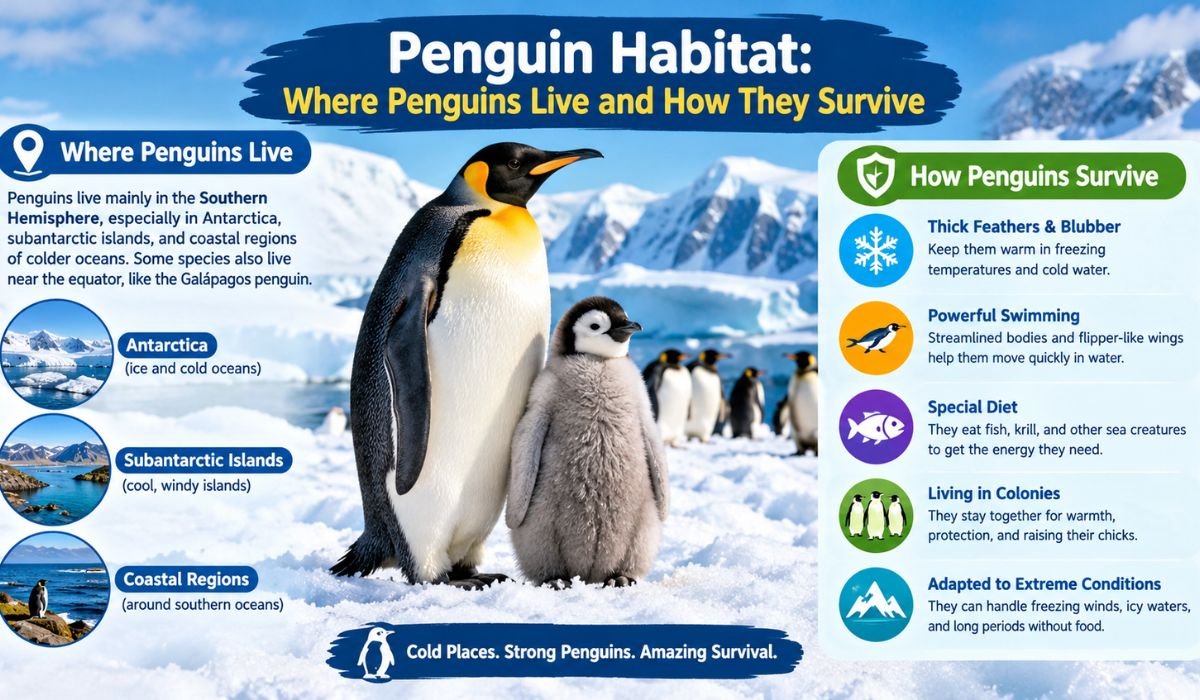
The natural penguin habitat is almost always associated with the Southern Hemisphere. Penguins are found along the coasts and islands of Antarctica, South America, southern Africa, Australia, and New Zealand. Several species also live on islands in the southern Atlantic and Indian Oceans.
Contrary to a common misconception, not all penguins live on ice. Species such as African penguins live in relatively warm coastal environments, while Galápagos penguins live close to the equator.
Most penguins depend on two major environments: land for resting and breeding, and the ocean for feeding. They spend a large portion of their lives at sea, where they hunt fish, squid, krill, and other marine animals.
Antarctic Penguin Habitat
Antarctica provides some of the most extreme conditions found anywhere on Earth. The penguin habitat here includes sea ice, rocky coastal areas, snow-covered landscapes, and islands surrounding the continent.
Emperor penguins are especially adapted to Antarctic conditions. They breed during the Antarctic winter, when temperatures can become extremely low and strong winds sweep across the ice.
Adélie penguins also live in Antarctica and depend heavily on sea ice and coastal areas. Their colonies may be located on rocky ground where exposed land becomes available during the warmer months.
These penguins have several adaptations that help them survive the cold, including dense feathers, a layer of body fat, and behaviors that help conserve heat.
Penguin Habitat Outside Antarctica
Although Antarctica is strongly associated with penguins, many species live far beyond the frozen continent.
For example, African penguins live along the southwestern coast of Africa and on nearby islands. Their environment includes rocky shorelines, beaches, coastal vegetation, and marine waters.
Galápagos penguins have an unusual penguin habitat because they live near the equator. They are able to survive there partly because cool ocean currents bring relatively cold, nutrient-rich water to the region.
Little penguins, sometimes called fairy penguins, live around southern Australia and New Zealand. They often use coastal areas, beaches, rocky shorelines, and sheltered nesting sites.
This variety demonstrates that penguins are not simply animals of snow and ice. Different species have evolved to cope with very different climates.
What Is the Ideal Penguin Habitat?
An ideal penguin habitat provides access to both suitable breeding areas and productive feeding grounds. Penguins need safe places where they can rest, lay eggs, raise chicks, and avoid excessive disturbance.
Access to the ocean is particularly important because penguins depend on marine ecosystems for food. Productive waters can provide fish, squid, krill, and other prey.
The exact requirements differ between species. Some penguins prefer rocky coastal areas, while others depend on sea ice. Some nest in burrows or vegetation, whereas others build simple nests from stones or use exposed ground.
The availability of food is one of the most important factors determining where penguins can successfully live.
Read Related Post: Orca Facts: Habitat, Diet, Behavior, and Adaptations
How Penguins Survive in Cold Habitats
Penguins have several physical adaptations that allow them to survive in cold environments.
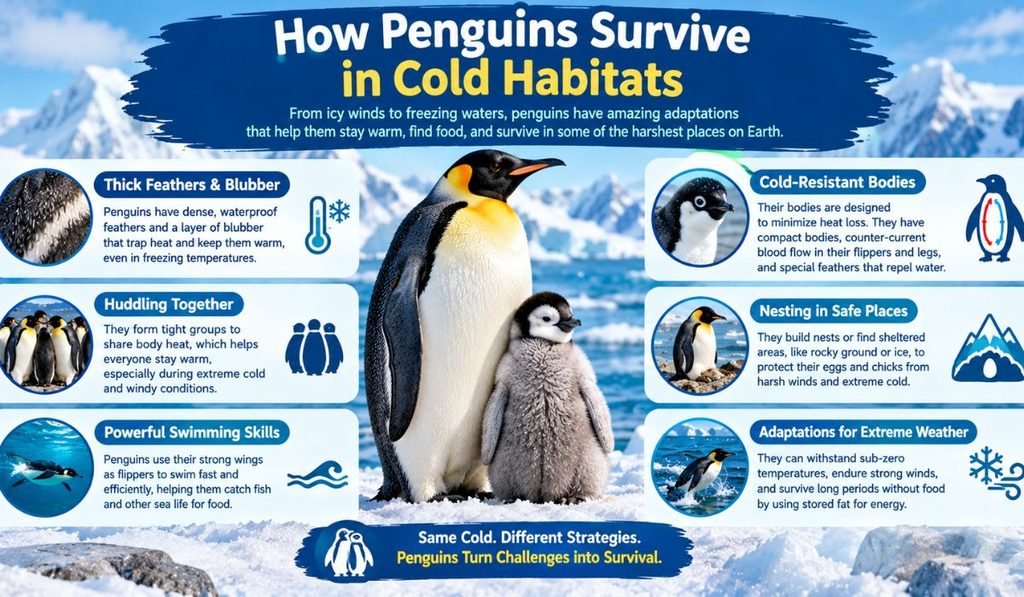
Their feathers are short, dense, and closely packed. This creates an insulating layer that helps keep body heat inside. Penguins also have a layer of fat beneath their skin that provides additional insulation.
Their body shape helps them conserve heat as well. A compact body reduces the amount of surface area exposed to cold air and water compared with a less streamlined shape.
Penguins can also regulate blood flow to their flippers and feet. This helps reduce heat loss when they are standing on cold surfaces or swimming in cold water.
In some Antarctic colonies, penguins also use social behavior to conserve warmth. Emperor penguins, for example, form tightly packed groups during harsh winter conditions.
How Penguins Survive in Water
Water is just as important as land in a penguin habitat. Penguins are highly adapted for swimming and spend significant amounts of time in the ocean.
Their wings have evolved into strong flippers that allow them to move efficiently underwater. Their streamlined bodies reduce resistance, helping them chase prey and travel through the water.
Penguins also have excellent swimming abilities that allow them to dive beneath the surface in search of food. Depending on the species, diving ability can vary considerably.
Their feathers provide insulation and help create a layer that keeps cold water away from the skin. Penguins also preen their feathers to maintain their condition and water resistance.
What Do Penguins Eat in Their Habitat?
Food availability is a major part of every penguin habitat. Most penguins are carnivorous and obtain their food from the ocean.
Their diets can include fish, krill, squid, crustaceans, and other small marine animals. The exact diet depends on the species and the food available in its local waters.
Penguins are excellent underwater hunters. They use their streamlined bodies and flipper-like wings to pursue prey. Some species can travel considerable distances while searching for food.
When penguins return to their colonies, adults may bring food back for their chicks. Successful breeding therefore depends heavily on having productive feeding grounds nearby or within reachable distance.
Penguin Breeding and Nesting Habitats
A suitable penguin habitat must also provide a place for reproduction. Different species use different nesting strategies.
Some penguins build nests from stones, while others nest in burrows, under vegetation, or in naturally sheltered spaces. Emperor penguins have an especially unusual breeding strategy because they raise their chicks on Antarctic sea ice.
Penguin colonies can contain large numbers of individuals. Living in colonies can provide advantages such as increased opportunities to find mates and coordinated protection against predators.
However, crowded colonies also require sufficient food and suitable space. If environmental conditions change significantly, breeding success can be affected.
Threats to Penguin Habitats
Penguin habitats face several environmental pressures. Climate change can alter sea-ice conditions, ocean temperatures, and the distribution of marine prey.
Changes in ocean conditions may affect where fish, krill, and other prey are found. When food becomes less available near breeding colonies, adult penguins may need to travel farther to feed.
Coastal development, pollution, fishing activity, introduced predators, and human disturbance can also affect certain penguin populations.
Some species have experienced substantial population declines, while others have more stable populations. The threats vary depending on the species and region.
Protecting marine ecosystems and important breeding areas is therefore an important part of penguin conservation.
How Climate Change Affects Penguin Habitat
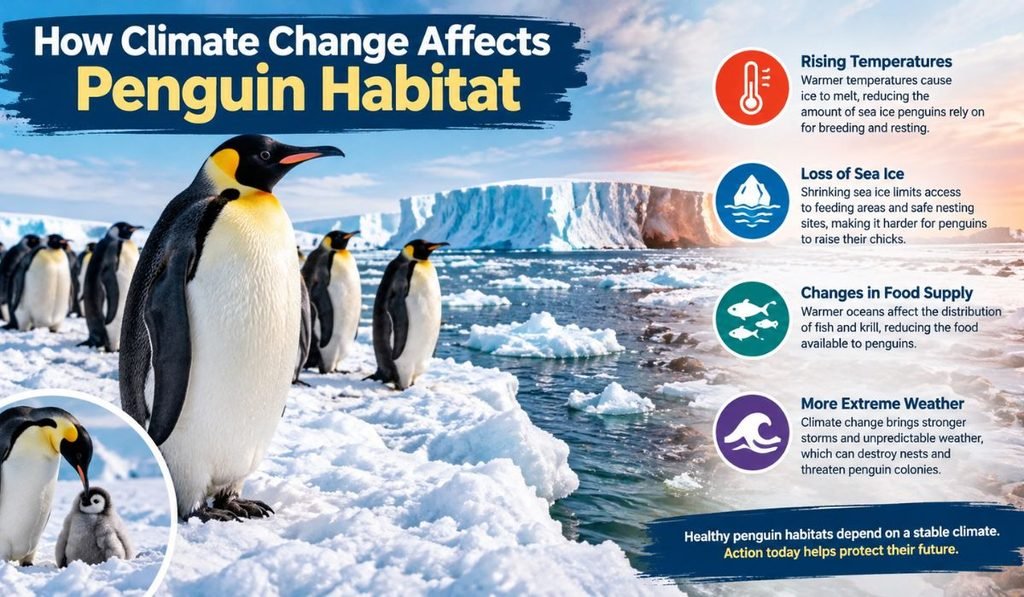
Climate change can have a particularly strong influence on species that depend on sea ice. Changes in the timing, amount, and location of sea ice can affect feeding and breeding conditions.
For species that rely less on ice, warming oceans can still create problems by changing the distribution of prey. Penguins may have to travel farther to find enough food.
The effects are not identical for every species. Different penguins occupy different environments and respond differently to changes in temperature, sea ice, food availability, and weather patterns.
Scientists continue to monitor penguin populations and their environments to understand how these changes are affecting different species.
Why Penguin Habitats Matter
A healthy penguin habitat supports much more than penguins themselves. Coastal and marine ecosystems contain many interconnected species, and changes affecting penguins can reflect broader changes in the environment.
Penguins are also important predators within marine food webs. Their feeding relationships connect them with fish, squid, krill, and other marine organisms.
Protecting their habitats can therefore help preserve the wider ecosystems on which many animals depend.
FAQ’s
Where is the main penguin habitat?
The main penguin habitat is in the Southern Hemisphere, particularly around Antarctica, southern South America, southern Africa, Australia, New Zealand, and several southern ocean islands.
Do all penguins live in Antarctica?
No. Antarctica is home to several penguin species, but many others live elsewhere. African penguins, Galápagos penguins, and little penguins are examples of species that live outside Antarctica.
What kind of habitat do penguins need?
Penguins need access to suitable breeding and resting areas as well as productive marine feeding grounds. The specific requirements vary by species.
Can penguins live in warm places?
Yes. Some penguins live in relatively warm environments. Galápagos penguins live near the equator, while African penguins inhabit coastal areas of southern Africa.
Why is the ocean important to penguins?
The ocean provides most of the food penguins need. It is an essential part of the penguin habitat, supplying prey such as fish, squid, and krill.
How do penguins survive in Antarctica?
Penguins survive Antarctic conditions through adaptations such as dense feathers, body fat, streamlined bodies, and behaviors that reduce heat loss. Some species also gather closely together to conserve warmth.
Conclusion
The penguin habitat is much more diverse than the frozen landscapes commonly associated with these birds. Penguins live in Antarctica, on temperate southern coasts, and even near the equator. Each species has developed adaptations that allow it to survive in its particular environment.
From dense feathers and insulating body fat to powerful swimming abilities, penguins are remarkably suited to life on land and in the ocean. Their survival depends on healthy breeding areas, accessible food, and functioning marine ecosystems.
Protecting coastal environments, marine food sources, and important breeding grounds is essential for maintaining penguin populations and the ecosystems they represent.

Hi, I’m Amelia, an SEO and content specialist with several years of experience researching and creating informative content for online audiences. At Animal Attack Facts, I focus on animal behavior, animal attacks on humans, and interesting facts about land animals, marine animals, birds, reptiles, and insects. My goal is to provide clear, useful, and engaging information that helps readers better understand wildlife and stay informed about animal encounters.
1 thought on “Penguin Habitat: Where Penguins Live and How They Survive”