
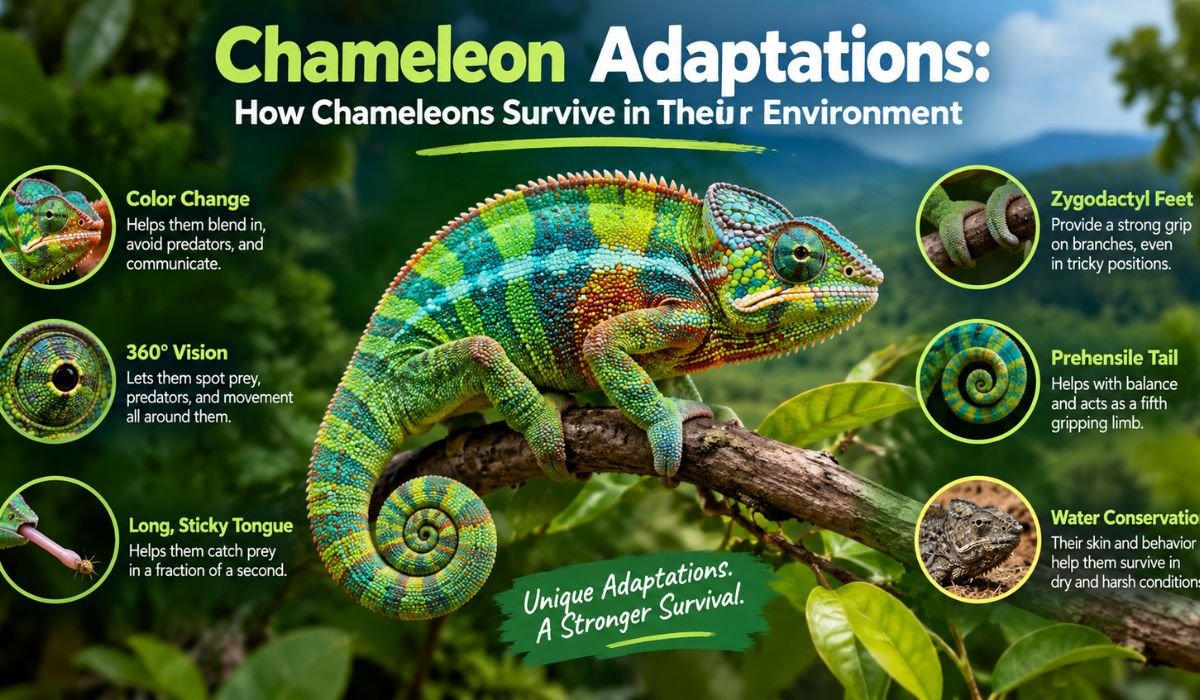
Chameleons are remarkable reptiles known for their ability to change color, move their eyes independently, and catch insects with their long, specialized tongues. These unique features help them survive in forests, woodlands, grasslands, and other natural habitats. Chameleon adaptations include physical characteristics and behaviors that allow these reptiles to find food, avoid predators, regulate body temperature, and move safely through vegetation.
From specialized feet to effective camouflage, each adaptation plays an important role in their survival. Understanding these features helps explain how chameleons thrive in different environments.
1. Color Changing for Survival
One of the most famous chameleon adaptations is the ability to change skin color. Although many people believe chameleons change color only to match their surroundings, this ability serves several purposes.
Chameleons change color to communicate with other chameleons, respond to temperature changes, and display their physical condition. For example, some male chameleons develop brighter colors during courtship or territorial disputes.
Specialized skin cells containing microscopic nanocrystals help many chameleons change how their skin reflects light. Adjusting the spacing between these crystals allows them to produce different colors and patterns.
Color changes may also help with temperature regulation. Darker colors can help absorb more solar heat, while lighter colors may reflect more sunlight under certain conditions.
However, chameleons cannot perfectly match every background. Their color-changing abilities depend on the species, its surroundings, and its physical state.
2. Independently Moving Eyes
Chameleons have unusual eyes that can move independently of each other. This adaptation provides a wide field of vision and allows them to monitor their surroundings without constantly turning their heads.
Each eye can focus on a different area, helping a chameleon search for insects while remaining alert to potential predators.
When a chameleon identifies prey, both eyes can focus on the target. This helps the animal judge distance before extending its tongue to capture the insect.
Excellent vision is especially valuable for chameleons because many species rely on remaining still for long periods. By detecting movement around them, they can identify feeding opportunities and respond to threats.
3. Long, Sticky Tongue for Catching Prey
Another important chameleon adaptation is its specialized tongue. Many species possess a long, muscular tongue that can extend rapidly to catch insects.
The tongue has a specialized tip that helps secure prey when it makes contact. Its rapid movement allows the chameleon to capture insects without chasing them over long distances.
Chameleons commonly eat flies, crickets, grasshoppers, moths, and other small invertebrates. Larger species may occasionally consume small vertebrates, depending on their size and natural diet.
This hunting method is particularly useful for an animal that often stays motionless among branches and leaves. It can capture nearby prey while minimizing unnecessary movement.
4. Specialized Feet for Climbing
Chameleons are well adapted to climbing trees and shrubs. Their feet have toes arranged into opposing groups that grip branches securely.
This arrangement works like a natural clamp, allowing chameleons to hold onto narrow branches while moving through vegetation.
Their strong grip helps prevent falls and provides stability when reaching for nearby branches. Many chameleons also have prehensile tails that can curl around branches for additional support.
These features are especially useful for species that spend much of their lives in trees. Specialized feet and gripping tails help them navigate their habitats and reach places where food and shelter are available.
Read Related Post: Parrot Facts: Habitat, Diet, Behavior, and Intelligence
5. Camouflage to Avoid Predators
Camouflage is another important feature that helps chameleons survive. Their colors and patterns can help them blend into leaves, branches, and other natural surroundings.
Remaining difficult to notice can protect chameleons from predators such as birds and snakes. Camouflage may also help them approach insects without being detected too early.
The effectiveness of camouflage depends on the species, its current coloration, and the environment. A green chameleon resting among green leaves may be less noticeable than one sitting against a contrasting background.
Slow movement and remaining still can make camouflage more effective. Instead of moving constantly, many chameleons stay motionless for extended periods and move carefully when necessary.
6. Slow Movement and a Special Walking Style
Chameleons often move slowly, sometimes rocking gently from side to side as they walk. This movement may resemble a leaf swaying in the breeze.
Their walking style can help them remain less noticeable among vegetation. Slow movement also helps them maintain balance while navigating narrow branches.
Unlike animals that depend primarily on speed to escape danger, many chameleons rely on camouflage, careful movement, and the ability to remain still.
When threatened, a chameleon may freeze, change color, inflate its body, open its mouth, or move toward cover. Its response depends on the species and the type of threat.
These behaviors help chameleons avoid unnecessary confrontations and respond to changing conditions in their environment.
7. Prehensile Tail for Balance
Many chameleon species have a prehensile tail that can curl around branches. This tail acts as an additional gripping tool, helping the reptile maintain balance while climbing.
A chameleon may use its tail for support as it reaches for another branch or moves across uneven surfaces.
The tail is particularly useful for arboreal species that spend much of their time in trees and shrubs. Combined with specialized feet, it provides greater stability when moving through complex vegetation.
Although not all species use their tails in exactly the same way, this feature is an important part of climbing and balance in many chameleons.
8. Body Shape and Skin Texture
A chameleon’s body shape and skin texture can contribute to its survival. Depending on the species, its body may have ridges, pointed scales, crests, or irregular outlines that help break up its silhouette against branches and leaves.
These characteristics vary considerably among species. Some have prominent head crests, while others have smaller bodies and less noticeable patterns.
Their body structure also supports a climbing lifestyle. Strong limbs help them move between branches, while their eyes provide detailed visual information about nearby objects and potential prey.
Combined with their ability to remain motionless, these physical features can make chameleons harder to recognize in suitable surroundings.
9. Temperature Regulation
Chameleons are ectothermic reptiles, meaning they depend largely on external sources of heat to regulate their body temperature.
Sunlight, shade, and surrounding temperatures influence their activity. Many chameleons bask in sunlight to warm up and move into shaded areas when conditions become too hot.
Color changes may also contribute to temperature regulation in some species. Darker coloration can increase solar heat absorption, while lighter coloration may reduce it.
Different species have different temperature requirements based on their natural habitats. Chameleons living in cooler mountainous regions face different challenges from those living in warm lowland forests.
By choosing suitable basking locations and moving between sunny and shaded areas, chameleons can maintain temperatures that support normal activity.
10. Specialized Hunting Behavior
Chameleons combine patience, excellent vision, and rapid tongue movement to capture food.
They often scan nearby vegetation for insects before positioning themselves within striking distance. Their independently moving eyes help detect prey, while remaining still can prevent insects from noticing them too early.
Once a target is close enough, the chameleon projects its tongue to capture it. This technique allows the reptile to feed without relying on prolonged pursuit.
Most chameleons primarily eat insects, although their diets vary by species. Some larger species consume other small animals, and a few may occasionally eat plant material.
Their specialized hunting behavior helps them obtain energy while limiting unnecessary movement.
11. Adaptations for Different Habitats
Chameleons live in various environments, particularly across Madagascar and mainland Africa. Some species also occur in parts of southern Europe, the Middle East, and Asia.
Their adaptations differ according to their habitats.
- Tropical forests: Climbing feet, gripping tails, and camouflage help chameleons move through dense vegetation.
- Woodlands: Color patterns and careful movement can help them remain less noticeable among branches.
- Shrublands: Climbing ability and specialized hunting techniques help them find food and shelter.
- Mountainous regions: Behavioral temperature regulation helps them cope with changing environmental conditions.
- Drier environments: Species-specific activity patterns and habitat selection can help them manage heat and limited shelter.
Not all chameleons have identical characteristics. Their sizes, colors, body shapes, and preferred habitats vary across species.
These differences demonstrate how chameleons have developed adaptations suited to different environmental conditions.
12. How Chameleon Adaptations Work Together
Individual adaptations are useful, but their combined effects make chameleons especially well suited to their environments.
For example, a chameleon can use its eyes to locate an insect, its climbing feet to position itself on a branch, and its long tongue to capture the prey. Its coloration and slow movements may help it remain unnoticed during the process.
When a predator approaches, the same chameleon may freeze, rely on camouflage, or move toward denser vegetation.
The following table summarizes the main chameleon adaptations and their benefits.
| Adaptation | Survival Benefit |
| Color changing | Communication, camouflage, and temperature-related responses |
| Independent eye movement | Detecting prey and monitoring threats |
| Long, sticky tongue | Capturing insects quickly |
| Specialized feet | Gripping branches securely |
| Prehensile tail | Providing balance and additional support |
| Slow movement | Reducing attention and maintaining stability |
| Skin patterns and texture | Helping break up the body’s outline |
| Basking and seeking shade | Regulating body temperature through behavior |
Together, these adaptations help chameleons find food, move through vegetation, avoid predators, and cope with changing environmental conditions.
Frequently Asked Questions About Chameleon Adaptations
Why do chameleons change color?
Chameleons change color to communicate, respond to temperature changes, and sometimes improve camouflage. The range and purpose of color changes vary by species and circumstances.
How does a chameleon’s tongue help it survive?
A chameleon’s long, rapidly extending tongue helps it capture insects from a distance. Its specialized tip helps secure prey, making feeding more efficient.
How do chameleons protect themselves from predators?
Chameleons may use camouflage, slow movement, and remaining motionless to avoid detection. Some species also display threatening behaviors when disturbed.
Why do chameleons have independently moving eyes?
Independent eye movement allows chameleons to monitor different parts of their surroundings. They can also focus both eyes on prey to judge its distance before striking.
How do chameleons climb trees?
Their feet have opposing groups of toes that grip branches, while their prehensile tails provide additional support in many species.
Do all chameleons change color?
Color-changing ability is characteristic of chameleons, but the range and speed of color changes differ among species. They cannot all produce every color or perfectly match every background.
Where do chameleons live?
Chameleons inhabit tropical forests, woodlands, shrublands, and mountainous areas. Madagascar and mainland Africa are especially important centers of chameleon diversity.
Conclusion
Chameleon adaptations demonstrate how animals develop specialized features to survive in their environments. Color changing, independently moving eyes, long tongues, gripping feet, and prehensile tails help chameleons find food, avoid predators, and move through vegetation.
Their survival also depends on behavior, including remaining still, selecting suitable basking locations, and moving carefully through their habitats. Although different species have different characteristics, their physical and behavioral adaptations make chameleons remarkable examples of reptile survival in the natural world.

Hi, I’m Amelia, an SEO and content specialist with several years of experience researching and creating informative content for online audiences. At Animal Attack Facts, I focus on animal behavior, animal attacks on humans, and interesting facts about land animals, marine animals, birds, reptiles, and insects. My goal is to provide clear, useful, and engaging information that helps readers better understand wildlife and stay informed about animal encounters.