
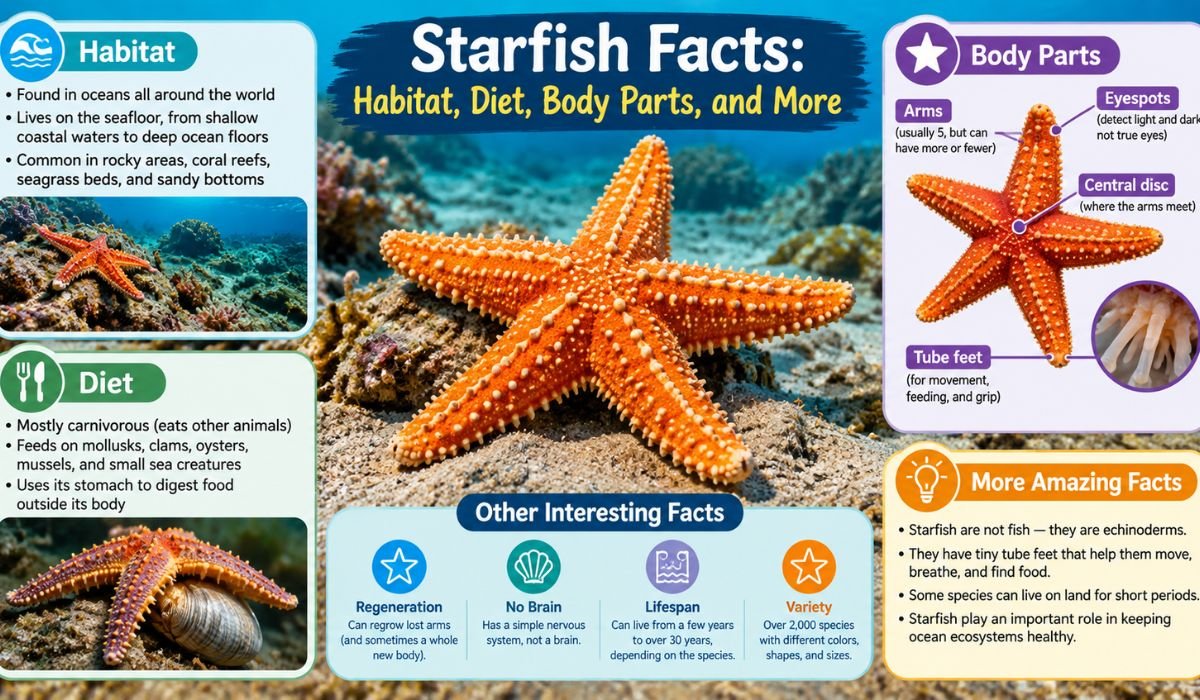
Starfish, also called sea stars, are fascinating marine animals found in oceans around the world. Their unusual shape, ability to regenerate certain body parts, and unique way of moving make them different from many other sea creatures. In this guide to starfish facts, you will learn about their habitat, diet, body parts, behavior, reproduction, and other interesting characteristics.
Despite their name, starfish are not actually fish. They are echinoderms, a group of marine animals that also includes sea urchins and sea cucumbers. Most starfish have five arms, although some species have many more. They live on the ocean floor and can be found in shallow coastal waters as well as deeper marine environments.
Starfish Facts About Their Classification
One of the most important starfish facts is that starfish belong to the phylum Echinodermata. Their scientific classification places them among animals with unique body structures and a water vascular system.
Starfish are invertebrates, meaning they do not have a backbone. Instead, many species have a hard internal structure made of calcium carbonate plates beneath their skin. This structure provides support and some protection.
Although they are commonly called starfish, the name “sea star” is also widely used because these animals are not fish. They do not have fins, gills, or the typical body structure of fish.
Where Do Starfish Live?
Starfish live in saltwater environments throughout the world’s oceans. They are especially common along rocky coastlines, coral reefs, sandy ocean floors, and areas with plenty of food.
Some starfish facts about their habitat include:
- They can live in tropical, temperate, and polar waters.
- Many species are found in shallow coastal areas.
- Some starfish live at considerable ocean depths.
- They commonly crawl across rocks, sand, mud, and coral.
- Different species are adapted to different marine environments.
Starfish are generally bottom-dwelling animals. They spend most of their lives moving across the seafloor in search of food or shelter.
What Do Starfish Eat?
Starfish are mostly carnivorous or opportunistic feeders, although their diets vary between species. They commonly eat mussels, clams, oysters, snails, small marine animals, and other organisms that they can capture.
One of the most remarkable starfish facts is that many species can feed on prey larger than their mouths. A starfish can partially push its stomach outside its body and use digestive enzymes to begin breaking down food before bringing the digested material back inside.
Some species also eat algae, organic matter, and decaying organisms. Their feeding habits depend greatly on their species and environment.
Read Related Post: Leopard Facts: Habitat, Diet, Behavior, and More
Starfish Body Parts and Anatomy
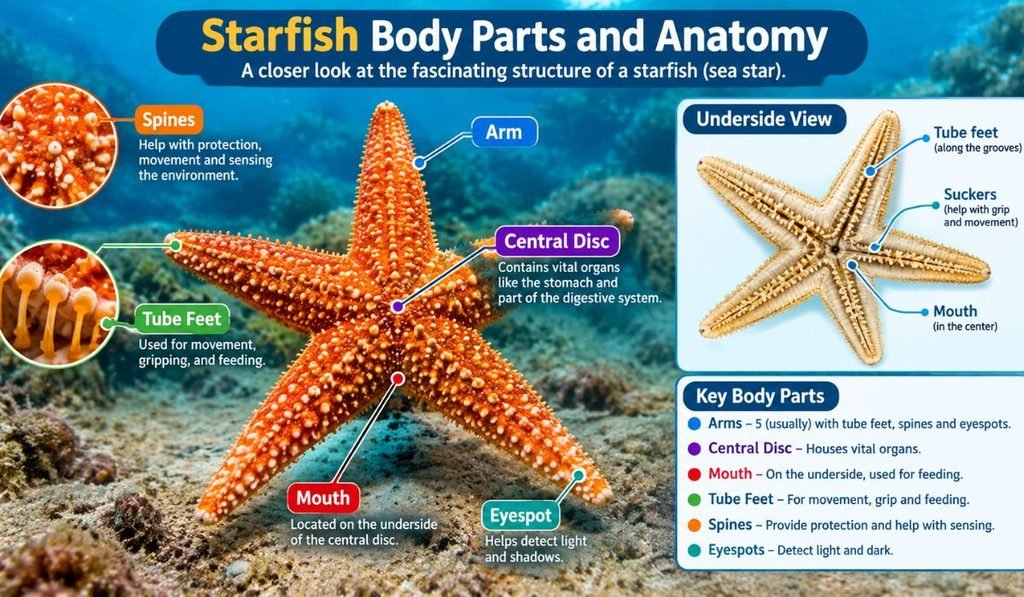
The body of a starfish is highly specialized for life on the ocean floor. Understanding its anatomy reveals why these animals are so unusual.
Arms
Most starfish have five arms extending from a central body region. However, the number can vary considerably among species. Some species have many arms, giving them a more rounded or flower-like appearance.
The arms help starfish move, capture food, and interact with their surroundings.
Tube Feet
Tube feet are tiny structures located along the underside of the arms. They are part of the starfish’s water vascular system and help the animal move across surfaces.
Tube feet can also assist with gripping rocks and handling food. Thousands of these tiny structures may work together to produce movement and control.
Central Disc
The central disc is the area where the arms meet. It contains many of the animal’s important internal organs.
The mouth is located on the underside of the central disc, facing the ocean floor.
Eyespots
Many starfish have simple eyespots at the tips of their arms. These structures cannot see detailed images like human eyes, but they can detect changes in light and help the animal understand its surroundings.
Water Vascular System
The water vascular system is one of the most interesting features highlighted by starfish facts. It is a network of fluid-filled canals that helps operate the tube feet.
Water enters through a structure called the madreporite and travels through the internal canal system. This unusual system helps with movement, feeding, and other important functions.
How Do Starfish Move?
Starfish move slowly across the ocean floor using their tube feet. Their movement is powered by the water vascular system and coordinated activity throughout their arms.
They can climb over rocks, move across sand, and grip different surfaces. Although starfish are generally slow-moving animals, their tube feet provide excellent control and attachment.
Some species can also use their arms and body muscles to help change direction or move around obstacles.
Can Starfish Regrow Their Arms?
One of the most famous starfish facts is their ability to regenerate lost arms. Many species can regrow an arm after it has been damaged or lost.
The regeneration process takes time and depends on the species, the size of the lost body part, and environmental conditions.
In some species, a separated arm may be capable of developing into a new individual if it contains enough of the central disc. However, this ability is not the same in every species, and not every detached arm can survive or regenerate into a complete animal.
How Do Starfish Reproduce?
Starfish can reproduce sexually, and some species can also reproduce through fragmentation.
During sexual reproduction, males and females generally release sperm and eggs into the water. Fertilization usually occurs externally, and the developing young pass through larval stages before eventually becoming juvenile starfish.
Some species have different reproductive strategies, including releasing fewer eggs and providing greater protection for their young.
The ability to reproduce through fragmentation in certain species is another reason these animals are particularly interesting.
Starfish Behavior
Starfish may appear simple, but they interact with their environment in sophisticated ways. They use chemical and sensory signals to locate food and respond to changes around them.
Their behavior is strongly influenced by food availability, predators, tides, temperature, and habitat conditions.
Many starfish are active predators of shellfish. By feeding on mussels and other organisms, they can influence the populations of animals living in coastal ecosystems.
Do Starfish Have Brains?
Starfish do not have a centralized brain like humans or many vertebrate animals. Instead, they have a decentralized nervous system consisting of a nerve ring and radial nerves extending into their arms.
This system allows them to coordinate movement and respond to their environment without having a conventional brain.
Their nervous system works together with their sensory structures, including eyespots and chemical receptors, to help them navigate their surroundings.
How Long Do Starfish Live?
The lifespan of a starfish varies greatly depending on its species and environment. Some species may live for several years, while certain larger species can survive for much longer under suitable conditions.
Food availability, water temperature, disease, predators, habitat quality, and other environmental factors can all affect how long a starfish survives.
Are Starfish Important to the Ecosystem?
Yes. Starfish can play an important role in marine ecosystems. As predators, they can regulate populations of shellfish and other marine organisms.
Some species are considered keystone predators because their feeding behavior can have a significant effect on the balance of an ecosystem. By controlling certain prey populations, starfish can influence which organisms become abundant in coastal habitats.
This makes them an important part of marine food webs.
Interesting Starfish Facts
Here are some additional starfish facts that show how unique these animals are:
- Starfish are echinoderms, not fish.
- They have no backbone.
- Most species have five arms, but some have many more.
- Starfish use tube feet for movement and gripping.
- Many species can regenerate lost arms.
- Their mouths are located on the underside of their bodies.
- Many starfish have simple eyespots at the tips of their arms.
- They do not have a centralized brain.
- Their water vascular system helps operate their tube feet.
- Starfish live in saltwater environments throughout the world’s oceans.
- Some species can feed on clams and mussels.
- Certain starfish can reproduce through fragmentation.
FAQ’s
What are the most interesting starfish facts?
Some of the most interesting starfish facts include their ability to regenerate certain body parts, their water vascular system, their tube feet, and their unusual feeding method. They are also echinoderms rather than fish.
How many arms does a starfish have?
Most starfish have five arms, but the number varies among species. Some species have many more than five arms.
Can starfish grow back lost arms?
Yes, many starfish species can regenerate lost or damaged arms. The process can take considerable time, and regeneration abilities differ between species.
What do starfish eat?
Starfish commonly eat mussels, clams, oysters, snails, and other marine organisms. Some species also consume algae, organic material, or dead animals.
Do starfish have a brain?
No, starfish do not have a centralized brain. Instead, they have a nerve ring and nerves extending into their arms that help coordinate their activities.
Where do starfish live?
Starfish live in oceans around the world. They can be found in rocky coastal areas, coral reefs, sandy seabeds, and deep ocean habitats.
How do starfish move?
Starfish move using hundreds or even thousands of tiny tube feet located on the underside of their arms. Their water vascular system helps control these tube feet.
Conclusion
Starfish are remarkable marine animals with unique anatomy, feeding methods, and survival abilities. From their tube feet and water vascular system to their ability to regenerate certain body parts, there are many reasons these creatures are so interesting.
These starfish facts also show how important sea stars can be to marine ecosystems. They help regulate prey populations and contribute to the balance of ocean communities. Although they move slowly and lack a centralized brain, their specialized bodies allow them to survive successfully in many different marine environments.

Hi, I’m Amelia, an SEO and content specialist with several years of experience researching and creating informative content for online audiences. At Animal Attack Facts, I focus on animal behavior, animal attacks on humans, and interesting facts about land animals, marine animals, birds, reptiles, and insects. My goal is to provide clear, useful, and engaging information that helps readers better understand wildlife and stay informed about animal encounters.
1 thought on “Starfish Facts: Habitat, Diet, Body Parts, and More”