
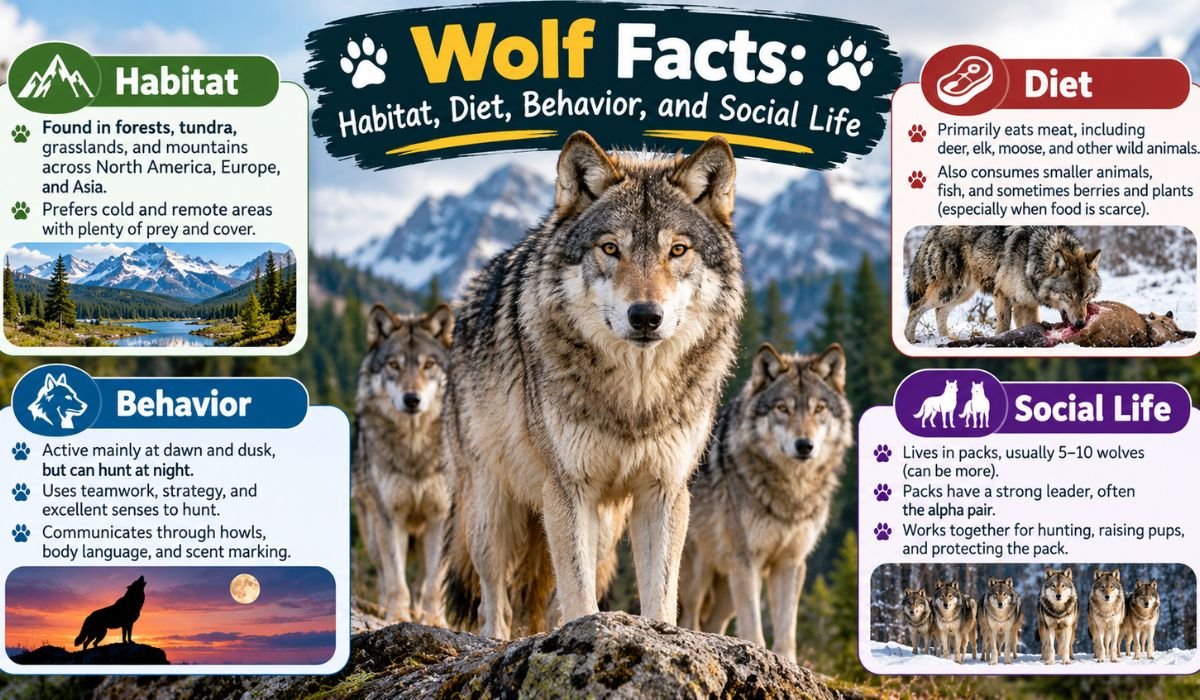
Wolves are among the most fascinating wild animals on Earth. Known for their intelligence, teamwork, and strong family bonds, they have adapted to a wide range of environments across the Northern Hemisphere. From frozen Arctic landscapes to forests, mountains, grasslands, and deserts, these predators play an important role in many ecosystems. Learning interesting wolf facts can help us better understand how wolves live, hunt, communicate, and care for their pack members.
Wolves belong to the dog family, Canidae, and the gray wolf (Canis lupus) is the best-known species. Their sharp senses, powerful bodies, and cooperative behavior make them highly successful predators. However, wolves are more than hunters. They are social animals that depend heavily on communication and close relationships within their family groups.
Wolf Facts: What Is a Wolf?
One of the most important wolf facts is that wolves are wild members of the dog family. They are closely related to domestic dogs, coyotes, and jackals. The gray wolf is the largest living wild member of the Canidae family and has a broad natural range.
Wolves have muscular bodies, long legs, large paws, pointed ears, and thick fur. Their appearance can vary depending on where they live. Some wolves have gray coats, while others may appear white, black, brown, reddish, or a mixture of several colors.
A wolf’s body is built for traveling long distances. Their strong legs allow them to move across difficult terrain, while their large paws help them walk on snow and uneven ground. Their thick fur also provides protection in cold environments.
Main Physical Features of Wolves
Common physical characteristics include:
- Strong and muscular bodies
- Thick fur for protection from weather
- Long legs designed for traveling
- Large paws that provide support on different surfaces
- Powerful jaws and sharp teeth
- Excellent hearing and sense of smell
- Eyes adapted for detecting movement
These adaptations help explain why wolf facts often focus on the animal’s ability to survive in challenging habitats.
Wolf Habitat and Where Wolves Live
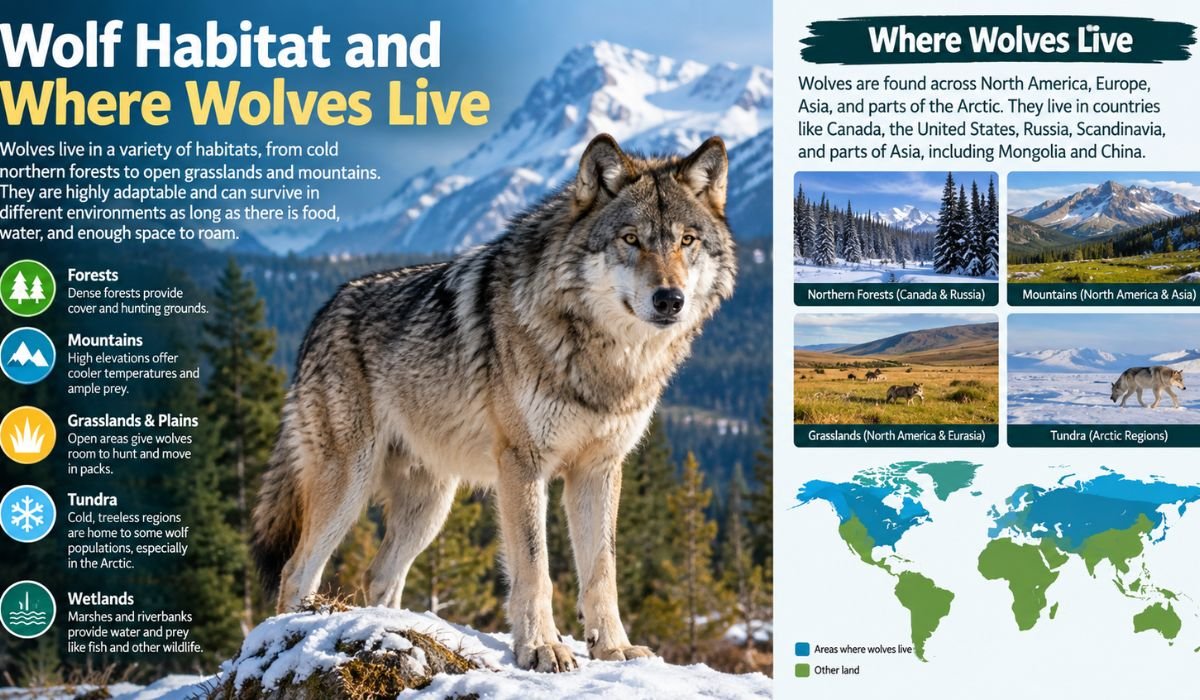
Wolves can live in many different environments. Their habitat depends on the species or population and the availability of food, water, shelter, and space.
Gray wolves are found in parts of North America, Europe, and Asia. They may live in forests, tundra, mountains, grasslands, wetlands, and other regions. Arctic wolves are adapted to extremely cold northern environments, while other wolf populations can survive in warmer and drier areas.
A wolf pack usually needs a large territory because wolves travel over wide areas while searching for food. The size of a territory can vary greatly depending on prey availability and local conditions. Areas with abundant food may support wolves within smaller ranges, while packs in regions with less prey may need to travel farther.
One of the most interesting wolf facts about habitat is that wolves are highly adaptable. Although many people imagine wolves living only in deep forests, they can survive in a surprising variety of landscapes.
Read Related Post: Bee Facts: Types, Habitat, Diet, and Life Cycle
Wolf Dens and Shelter
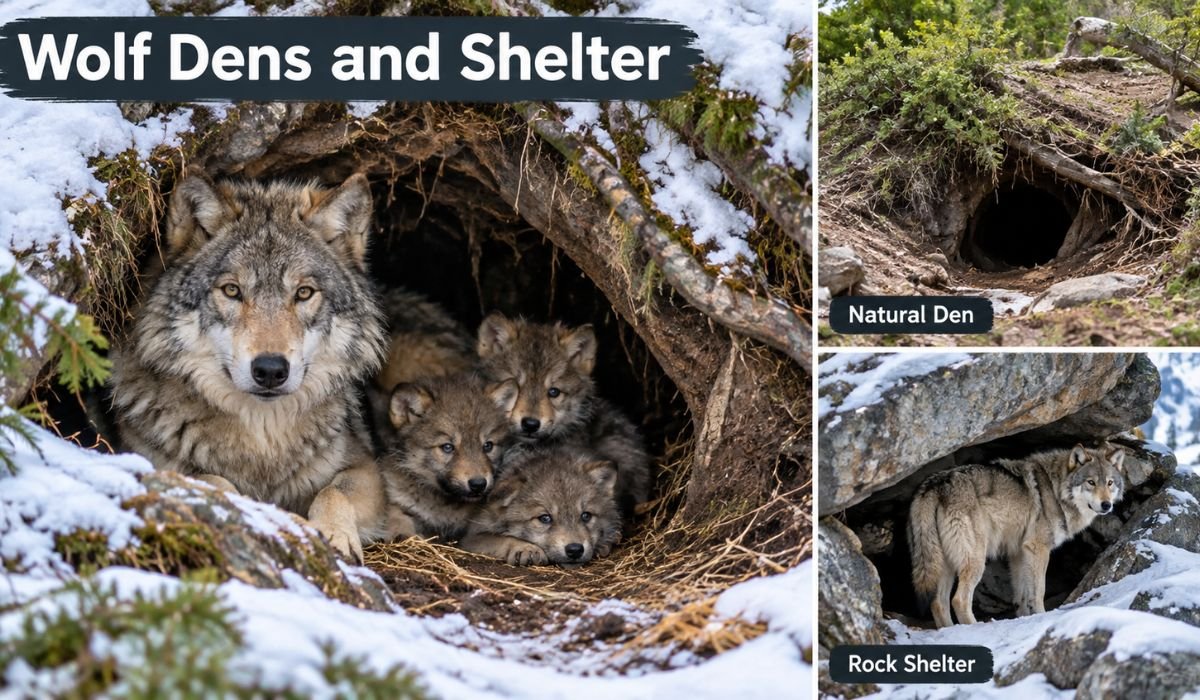
Wolves may use dens when raising young pups. A den can be located in a sheltered area, such as a natural opening in the ground or another protected location. The den provides a safer place for young pups during their earliest stage of life.
Adult wolves do not necessarily live inside dens throughout the year. Instead, they often rest in different sheltered locations within their territory.
Wolf Diet: What Do Wolves Eat?
Wolves are carnivores, meaning they primarily eat meat. Their diet varies according to their location and the animals available in their habitat.
Depending on the region, wolves may hunt animals such as deer, elk, moose, caribou, and other hoofed mammals. They can also eat smaller animals, including rabbits, rodents, and other available prey.
One of the most important wolf facts about feeding is that wolves are opportunistic. This means they may eat different foods depending on what is available. They may also scavenge carcasses rather than hunting every meal themselves.
How Wolves Hunt
Wolves are well known for cooperative hunting. Pack members can work together to follow, pursue, and catch prey. Their teamwork can be especially useful when hunting large animals.
However, wolves do not always hunt as one large group. Hunting behavior can vary depending on the pack, prey, habitat, and situation. Wolves use their strong sense of smell, hearing, endurance, and knowledge of their territory while searching for food.
Hunting can require a great deal of energy, and not every attempt is successful. Wolves must therefore be efficient and adaptable.
Wolf Facts About Behavior and Communication
Wolves have complex social behavior. Communication helps pack members stay together, defend their territory, care for young, and coordinate their activities.
Wolves communicate through sounds, body language, scent marking, and facial expressions. Their famous howls are only one part of a much larger communication system.
A wolf may howl to help maintain contact with other pack members or communicate across long distances. Howling can also help wolves locate one another. In addition, wolves may use growls, barks, whines, and other sounds in different situations.
These wolf facts show that wolf communication is not limited to howling. Body posture is also important. The position of the ears, tail, and body can provide information to other wolves.
Why Do Wolves Howl?
Wolves may howl for several reasons. A howl can help members of a pack communicate when they are separated. It may also help wolves announce their presence within an area.
Howling does not always mean the same thing. The meaning can depend on the situation and the other wolves involved. Because wolf packs can travel across large territories, long-distance vocal communication can be useful.
Wolf Social Life and Pack Structure
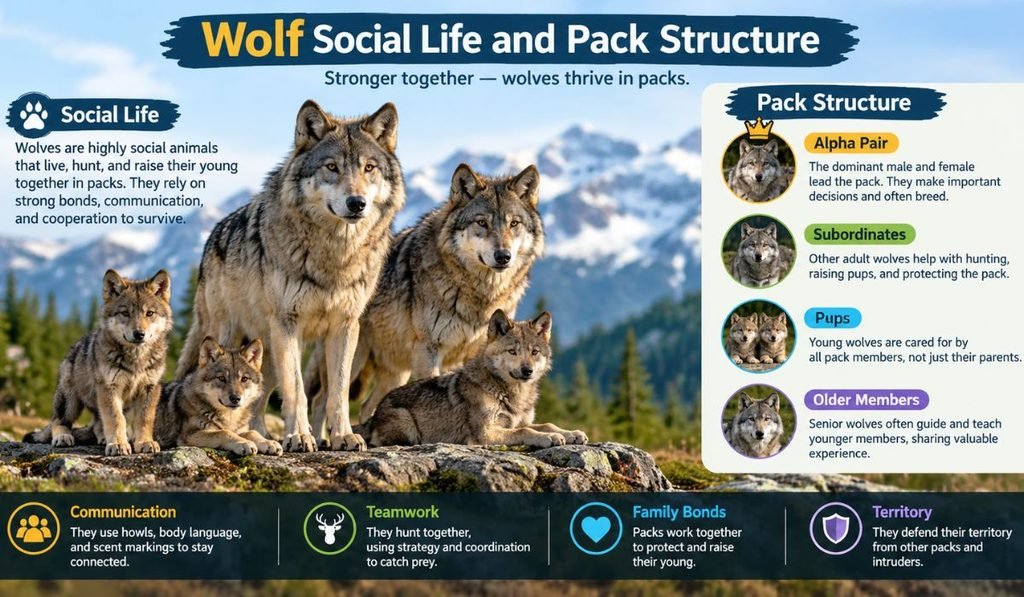
One of the most fascinating wolf facts is that wolves are strongly social animals. A wolf pack is often a family group rather than a random collection of unrelated wolves.
A typical pack may include parents and their offspring from one or more years. The exact size and structure of a pack can vary according to habitat, food supply, and other conditions.
Family cooperation is important in wolf life. Pack members may travel together, defend their territory, hunt, and help care for young pups. Older offspring can sometimes assist with younger members of the family.
Wolves form strong social relationships, and their behavior involves cooperation as well as competition. Social interactions help maintain order and relationships within the group.
Wolf Pups and Family Care
Wolf pups are born dependent on adult care. During their early weeks, they remain in or near a protected den while adults provide food and protection.
As the pups grow, they become more active and begin learning important skills. They observe and interact with other members of the pack, gradually developing behaviors that will help them survive.
Family life is therefore an important part of many wolf facts, especially when discussing how young wolves learn and develop.
Wolf Senses and Adaptations
Wolves have several adaptations that help them survive. Their sense of smell is extremely important for finding food, recognizing other wolves, and gathering information about their surroundings.
Their hearing is also highly developed. Wolves can detect sounds that may help them locate prey or communicate with pack members.
Their strong legs allow them to travel long distances, while their thick fur provides insulation in cold regions. Wolves also have powerful jaws that help them capture and eat prey.
Different wolf populations may have adaptations suited to their environments. For example, wolves living in cold northern regions generally have thick coats that provide protection from low temperatures.
The Role of Wolves in Ecosystems
Wolves are important predators in many ecosystems. By hunting prey, they can influence animal populations and relationships between species.
Predators may affect where prey animals feed and move, which can have wider effects on vegetation and other wildlife. However, ecosystems are complex, and the exact effects of wolves can vary between locations.
Understanding these wolf facts can help people see why predators are important parts of natural food webs. Wolves do not live separately from their environment; they interact with prey, other predators, plants, and changing environmental conditions.
Different Types of Wolves
The term “wolf” can refer to several species and populations. The gray wolf is the most widely recognized, but other members of the genus Canis are also commonly called wolves.
The gray wolf has different populations adapted to various regions. Arctic wolves, for example, are associated with northern Arctic environments and have characteristics suited to cold conditions.
Another well-known species is the red wolf, which is native to the United States and has a much more limited range than the gray wolf.
When exploring wolf facts, it is important to remember that not every wolf lives in the same environment or behaves in exactly the same way. Location and species can influence size, coat color, diet, and lifestyle.
Interesting Wolf Facts
Here are some quick and interesting wolf facts:
- Wolves belong to the Canidae family, which also includes domestic dogs and foxes.
- Gray wolves are the largest living wild members of the dog family.
- Wolves can live in forests, mountains, tundra, grasslands, and other habitats.
- Wolves use howls, body language, scents, and other signals to communicate.
- A wolf pack is commonly made up of related family members.
- Wolves can travel long distances while searching for food.
- Their diet depends on the prey available in their region.
- Wolves have powerful senses of smell and hearing.
- Young wolves depend on adult family members during their early development.
- Wolf fur can come in several colors, including gray, white, black, brown, and mixed shades.
Threats and Wolf Conservation
Wolf populations have faced different challenges throughout history. Habitat loss, conflicts with humans, reduced prey, and hunting have affected wolves in some regions.
Conservation efforts vary from place to place. Some populations have received legal protection and recovery programs, while others continue to face significant pressures.
Effective conservation often requires balancing wildlife protection, habitat management, scientific research, and the concerns of local communities. Because wolf populations differ across regions, conservation strategies must consider local environmental conditions.
Learning reliable wolf facts is useful when discussing conservation because wolves are often surrounded by myths and misunderstandings. Scientific information can provide a clearer picture of how these animals live and interact with their ecosystems.
FAQ’s
What are the most interesting wolf facts?
Some of the most interesting wolf facts include their strong family bonds, cooperative behavior, excellent senses, long-distance travel, and ability to communicate through howls, body language, and scent.
Where do wolves live?
Wolves live in a variety of habitats, including forests, mountains, grasslands, tundra, and Arctic regions. Their distribution depends on the species, available prey, and suitable habitat.
What do wolves eat?
Wolves mainly eat meat. Their diet can include large hoofed mammals and smaller animals, depending on what prey is available in their habitat.
Do wolves live in packs?
Yes, wolves are social animals and commonly live in family groups known as packs. Pack members may cooperate when traveling, raising young, and hunting.
Why do wolves howl?
Wolves howl as part of their communication system. Howling can help pack members maintain contact and communicate across long distances.
Are wolves related to dogs?
Yes. Wolves and domestic dogs belong to the Canidae family and are closely related. Domestic dogs are generally considered descendants of ancient wolf populations.
Conclusion
Wolves are intelligent, adaptable, and highly social animals with an important place in nature. Their powerful senses, cooperative behavior, and strong family relationships have helped them survive in a wide variety of environments. From their habitats and diets to their communication and pack life, there is always something new to discover about these remarkable predators.
The most valuable wolf facts reveal that wolves are far more complex than the myths often associated with them. Understanding their behavior, social life, and role in ecosystems can help people appreciate why these animals remain among the most studied and fascinating predators in the world.

Hi, I’m Amelia, an SEO and content specialist with several years of experience researching and creating informative content for online audiences. At Animal Attack Facts, I focus on animal behavior, animal attacks on humans, and interesting facts about land animals, marine animals, birds, reptiles, and insects. My goal is to provide clear, useful, and engaging information that helps readers better understand wildlife and stay informed about animal encounters.
1 thought on “Wolf Facts: Habitat, Diet, Behavior, and Social Life”