
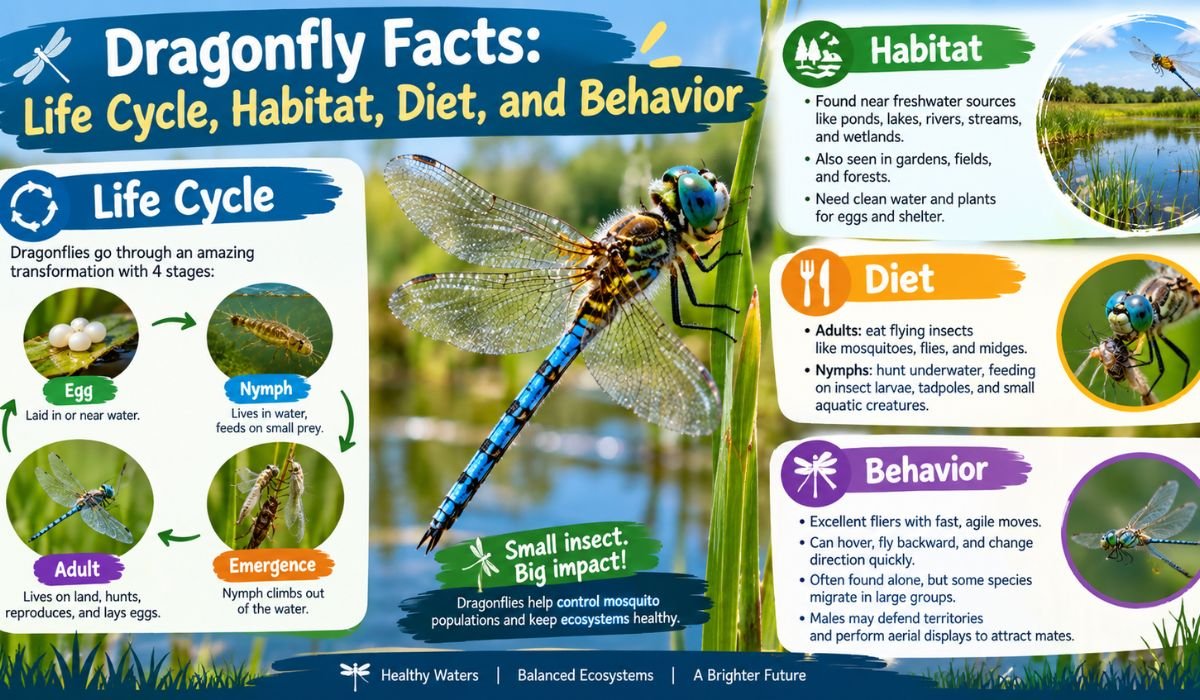
Dragonflies are fascinating flying insects known for their large eyes, four transparent wings, and impressive aerial skills. They can be found around ponds, lakes, rivers, wetlands, and other freshwater habitats across much of the world. Their lives begin underwater, where young dragonflies develop as aquatic predators before transforming into winged adults.
In this guide, you’ll discover interesting dragonfly facts about their life cycle, habitat, diet, physical features, hunting abilities, and behavior. These insects may look delicate, but they are highly effective predators with remarkable adaptations for life both underwater and in the air.
What Is a Dragonfly?
A dragonfly is an insect belonging to the order Odonata. Dragonflies are closely related to damselflies, although they have several noticeable differences. When resting, most dragonflies hold their wings spread outward, while damselflies generally hold their wings closer to their bodies.
Adult dragonflies have six legs, two pairs of wings, a long abdomen, and very large compound eyes. Their bodies can display a wide range of colors, including blue, green, yellow, red, brown, and black.
One of the most interesting dragonfly facts is that much of a dragonfly’s life is spent as an aquatic nymph rather than as a flying adult.
Dragonfly Life Cycle
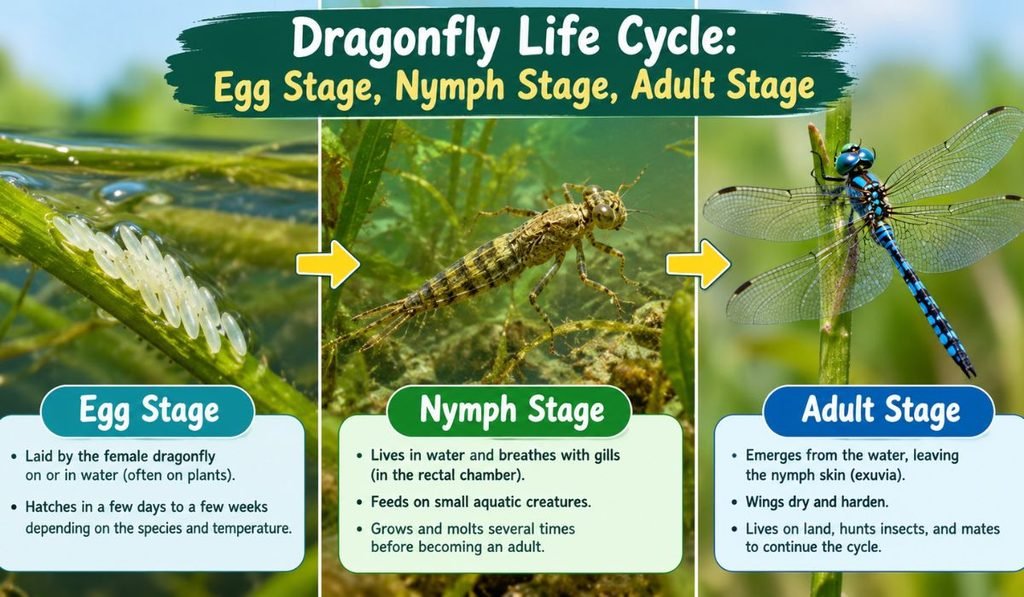
The dragonfly life cycle has three main stages: egg, nymph, and adult. Unlike butterflies and moths, dragonflies do not have a pupal stage.
1. Egg Stage
Female dragonflies lay eggs in or near water. Depending on the species, eggs may be deposited directly into water, attached to aquatic plants, or placed in moist areas.
The eggs eventually hatch into aquatic nymphs, beginning the longest stage of the dragonfly’s development.
2. Nymph Stage
Dragonfly nymphs live underwater and are very different in appearance from adults. They have no wings and use their specialized lower jaw to capture prey.
Nymphs eat aquatic organisms such as mosquito larvae, small insects, tadpoles, and other small animals. They grow by shedding their exoskeleton several times.
This aquatic stage can last from several months to several years, depending on the species and environmental conditions.
3. Adult Stage
When the nymph is fully developed, it climbs out of the water and sheds its old skin. The adult dragonfly emerges with soft wings and a flexible body.
After its wings harden, the dragonfly begins flying and hunting. The adult stage is focused mainly on feeding, finding mates, and reproducing.
Read Related Post: Pelican Facts: Habitat, Diet, Beak, and Behavior
Where Do Dragonflies Live?
Dragonflies are strongly associated with freshwater environments. They commonly live around ponds, lakes, streams, rivers, marshes, and wetlands.
Different species prefer different habitats. Some are adapted to slow-moving water, while others are associated with flowing streams or temporary pools.
Adult dragonflies often travel away from water while hunting. However, water remains important because reproduction and early development generally depend on aquatic habitats.
A useful dragonfly facts detail is that protecting freshwater environments can help support dragonfly populations and the many other organisms that depend on these ecosystems.
What Do Dragonflies Eat?
Dragonflies are predators throughout most of their lives.
Adult Dragonfly Diet
Adult dragonflies catch prey while flying. Their diet can include:
- Mosquitoes
- Flies
- Moths
- Midges
- Gnats
- Small beetles
- Other flying insects
Dragonflies use their legs to form a basket-like structure that helps them catch prey in midair. Their strong jaws then allow them to consume their food.
Nymph Diet
Dragonfly nymphs are also predators. Underwater, they may eat mosquito larvae, aquatic insects, small crustaceans, tadpoles, and other small aquatic animals.
Some larger nymphs can even capture small fish or other relatively large aquatic prey.
How Do Dragonflies Hunt?
Dragonflies are exceptional aerial hunters. They have strong wings and sophisticated vision that allow them to detect and pursue moving prey.
Instead of simply following an insect, a dragonfly can adjust its flight path to intercept its target. Its ability to control its four wings independently gives it excellent maneuverability.
Some dragonflies can hover, fly backward, turn quickly, and change direction rapidly. These abilities make them highly effective hunters.
Dragonfly Eyes and Vision
One of the most recognizable dragonfly facts is their enormous compound eyes. Their eyes occupy much of the head and contain thousands of tiny visual units called ommatidia.
This gives dragonflies a broad field of vision. Their eyesight helps them detect movement while flying and track potential prey.
Their vision is also important during interactions with other dragonflies and while navigating their surroundings.
Dragonfly Wings and Flight
Dragonflies have two pairs of long, transparent wings. The front and rear wings can move independently, giving these insects impressive control in the air.
Their wings are supported by a network of veins that provides strength while keeping them lightweight.
Dragonflies can perform several types of aerial movement, including hovering, rapid turns, climbing, and descending. Their flight abilities are among their most distinctive adaptations.
Dragonfly Behavior
Dragonflies display a variety of interesting behaviors.
Territorial Behavior
Some male dragonflies defend areas around water from competing males. They may repeatedly patrol the same section of habitat.
Mating Behavior
Males and females meet around suitable breeding habitats. After mating, females usually place their eggs in or near water.
Sunbathing
Dragonflies often rest in sunny locations. Warmth can help them maintain the body temperature needed for activity and flight.
Migration
Some dragonfly species undertake seasonal movements. In certain species, large numbers can travel considerable distances between regions.
How Long Do Dragonflies Live?
Dragonfly lifespan varies significantly between species and environmental conditions.
Most of their lives are spent underwater as nymphs. The adult stage is considerably shorter, often lasting only weeks or a few months.
Because the nymph stage can last for years in some species, an adult dragonfly that appears briefly around a pond may actually be the final stage of a much longer life cycle.
Dragonfly Adaptations
Dragonflies have several adaptations that help them survive.
Their large compound eyes provide excellent visual awareness. Their powerful wings allow precise flight, while their legs help them capture airborne prey.
Aquatic nymphs have a completely different set of adaptations. They can move through freshwater environments and use their specialized mouthparts to capture prey.
These differences between the aquatic and adult stages are among the most remarkable dragonfly facts.
Are Dragonflies Dangerous?
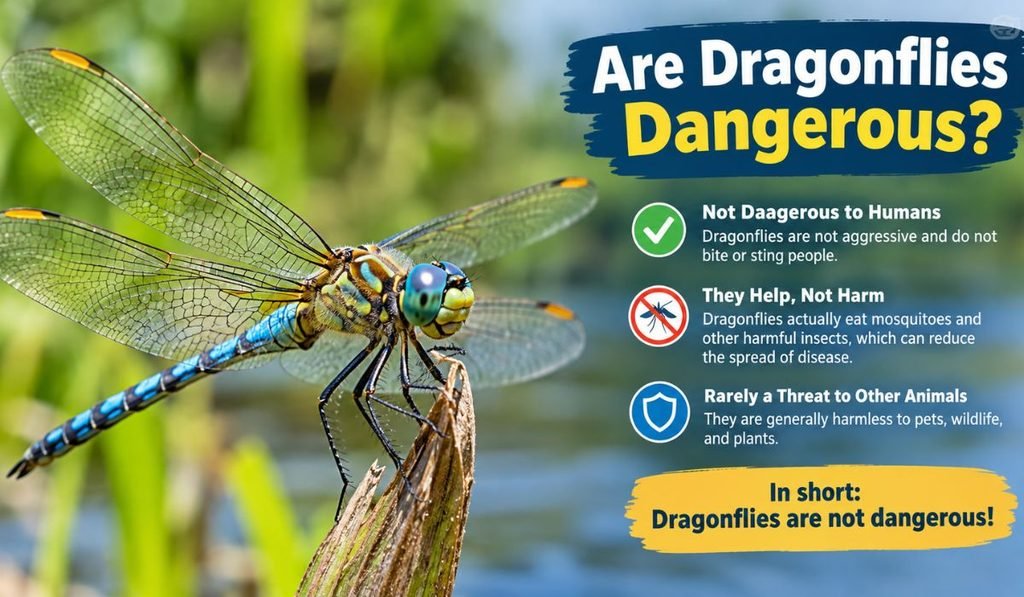
For humans, dragonflies are generally harmless. They do not normally attack people, and they are not known for aggressive behavior toward humans.
They are predators, but their prey consists primarily of smaller insects and other small animals.
Although dragonflies have strong jaws for their size, people have little reason to be concerned about them. Observing them from a reasonable distance is usually the best way to appreciate these fascinating insects.
Why Are Dragonflies Important?
Dragonflies play important roles in freshwater and terrestrial ecosystems. As predators, they help regulate populations of other insects.
They also serve as prey for birds, fish, frogs, and other animals.
Because their development depends on suitable aquatic environments, the presence and diversity of dragonflies can provide useful information about the condition of some freshwater habitats.
Interesting Dragonfly Facts
Here are some quick dragonfly facts to remember:
- Dragonflies are insects in the order Odonata.
- They have six legs and two pairs of wings.
- Most dragonfly species spend much of their lives as aquatic nymphs.
- Dragonfly nymphs are underwater predators.
- Adults commonly eat flying insects.
- Their large compound eyes provide a wide field of vision.
- Dragonflies can hover and make rapid turns.
- Some species migrate seasonally.
- Dragonflies do not have a pupal stage.
- Freshwater habitats are essential for their reproduction and development.
- Their adult stage is usually much shorter than their aquatic nymph stage.
- Dragonflies are closely related to damselflies.
FAQ’s
What are the most interesting dragonfly facts?
Some of the most interesting dragonfly facts include their aquatic nymph stage, exceptional flying ability, large compound eyes, and predatory lifestyle. They spend much of their lives underwater before emerging as flying adults.
How long do dragonflies live?
Dragonflies can spend months or several years as aquatic nymphs, depending on the species. Their adult flying stage is generally much shorter and may last weeks or a few months.
What do dragonflies eat?
Adult dragonflies mainly eat flying insects such as mosquitoes, flies, gnats, and other small insects. Their underwater nymphs eat aquatic insects and other small aquatic animals.
Where do dragonflies live?
Dragonflies are commonly found near freshwater habitats such as ponds, lakes, rivers, streams, marshes, and wetlands. Adults may travel farther from water while hunting.
Are dragonflies dangerous to humans?
Dragonflies are generally harmless to humans. They are predators of smaller animals and do not normally pose a threat to people.
Why do dragonflies live near water?
Water is essential for dragonfly reproduction and development. Females lay eggs in or near aquatic environments, and the young nymphs develop underwater.
Conclusion
Dragonflies are remarkable insects with a life cycle that connects freshwater environments with the skies above them. Their aquatic nymphs are skilled underwater predators, while adults become agile aerial hunters with excellent vision and flight control.
From their unusual life cycle to their powerful wings and specialized eyes, these insects provide plenty of fascinating dragonfly facts to explore. Protecting ponds, streams, wetlands, and other freshwater habitats is also important for maintaining the environments where dragonflies reproduce and develop.

Hi, I’m Amelia, an SEO and content specialist with several years of experience researching and creating informative content for online audiences. At Animal Attack Facts, I focus on animal behavior, animal attacks on humans, and interesting facts about land animals, marine animals, birds, reptiles, and insects. My goal is to provide clear, useful, and engaging information that helps readers better understand wildlife and stay informed about animal encounters.
1 thought on “Dragonfly Facts: Life Cycle, Habitat, Diet, and Behavior”