
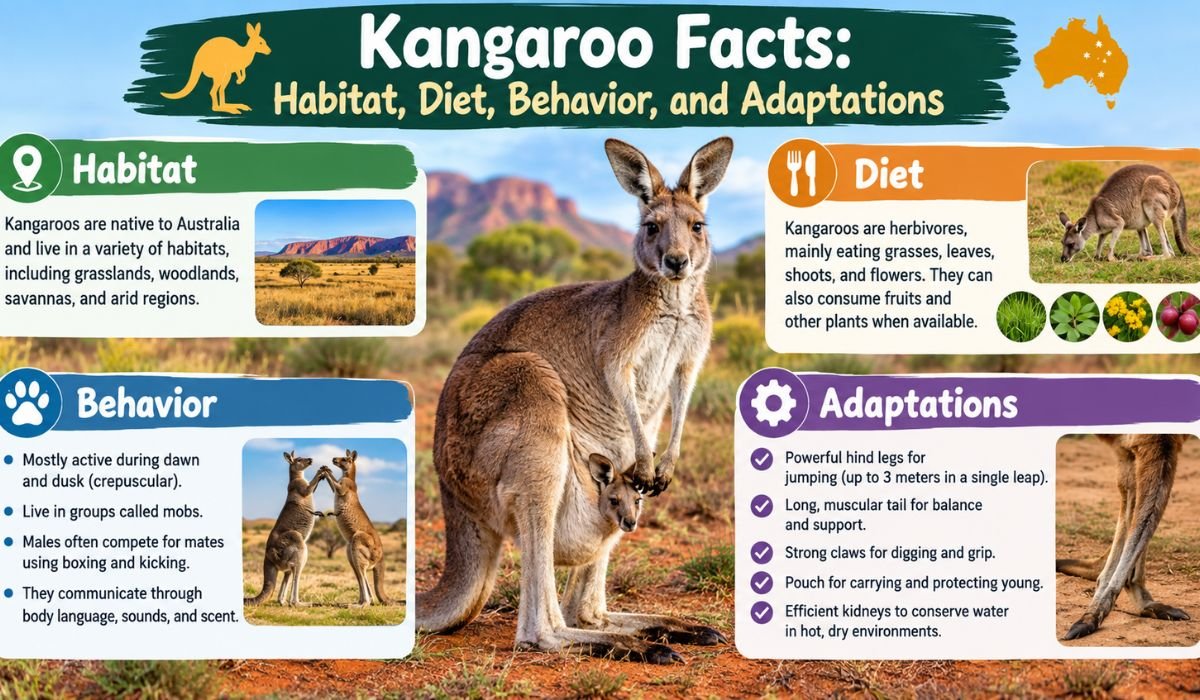
Kangaroos are among Australia’s most recognizable animals, famous for their powerful hind legs, long tails, hopping movement, and strong family bonds. These marsupials belong to the family Macropodidae, which also includes wallabies and wallaroos. Although several kangaroo species exist, the red kangaroo, eastern grey kangaroo, and western grey kangaroo are especially well known.
Learning kangaroo facts reveals how these animals are adapted to life in environments ranging from open grasslands to woodland areas. Their unusual movement, specialized digestive system, social behavior, and reproductive strategy help them survive in challenging Australian habitats. This guide explores where kangaroos live, what they eat, how they behave, and the adaptations that make them successful.
Kangaroo Facts About Habitat and Distribution
Kangaroos are native to Australia and nearby islands, with different species occupying different habitats. Red kangaroos are strongly associated with dry inland regions, while eastern grey kangaroos are common in eastern Australia and often live in forests, woodlands, and grasslands. Western grey kangaroos occur across parts of southern and western Australia.
Kangaroos generally need access to food, water, and places where they can rest. Open areas are useful because they allow these animals to move efficiently by hopping and make it easier to detect potential threats. Some species also use vegetation for shade and shelter during hot parts of the day.
Their range can change with rainfall and food availability. During favorable conditions, kangaroos may become more numerous in an area because grass and other plants provide abundant food.
Kangaroo Facts About Diet
Kangaroos are herbivores. Their diet mainly consists of grasses, leaves, herbs, and other plant material, although the exact foods vary according to species and habitat. They can feed on vegetation that is relatively low in nutritional value, which is useful in many Australian environments.
One of the interesting kangaroo facts is that their digestive system is specially adapted to a plant-based diet. Kangaroos have a complex stomach that supports microbial fermentation. Microorganisms help break down tough plant material and make nutrients more available.
Kangaroos often feed during cooler parts of the day, particularly around dawn and dusk. During hot weather, reducing activity during the middle of the day helps them conserve energy and avoid excessive heat.
Kangaroo Facts About Physical Features
Kangaroos have several physical features that support their distinctive way of life. Their large hind legs provide the power needed for hopping, while their long, muscular tails help with balance and stability. Their smaller front limbs are useful for handling food and other movements.
Another useful adaptation is their strong feet. The hind feet have elongated structures that help kangaroos generate powerful movements. Their body shape is well suited to efficient travel across open ground.
How Do Kangaroos Move?
Hopping is one of the most recognizable kangaroo facts. Unlike humans, kangaroos can move efficiently at moderate to high speeds by using both hind legs together. Their powerful tendons and leg muscles help store and release energy with each hop.
The tail also plays an important role in movement. It acts as a counterbalance while a kangaroo is hopping and can provide support when the animal moves slowly or stands. This combination of strong hind limbs and a large tail makes kangaroos highly specialized for their environment.
Kangaroo Facts About Behavior and Social Life
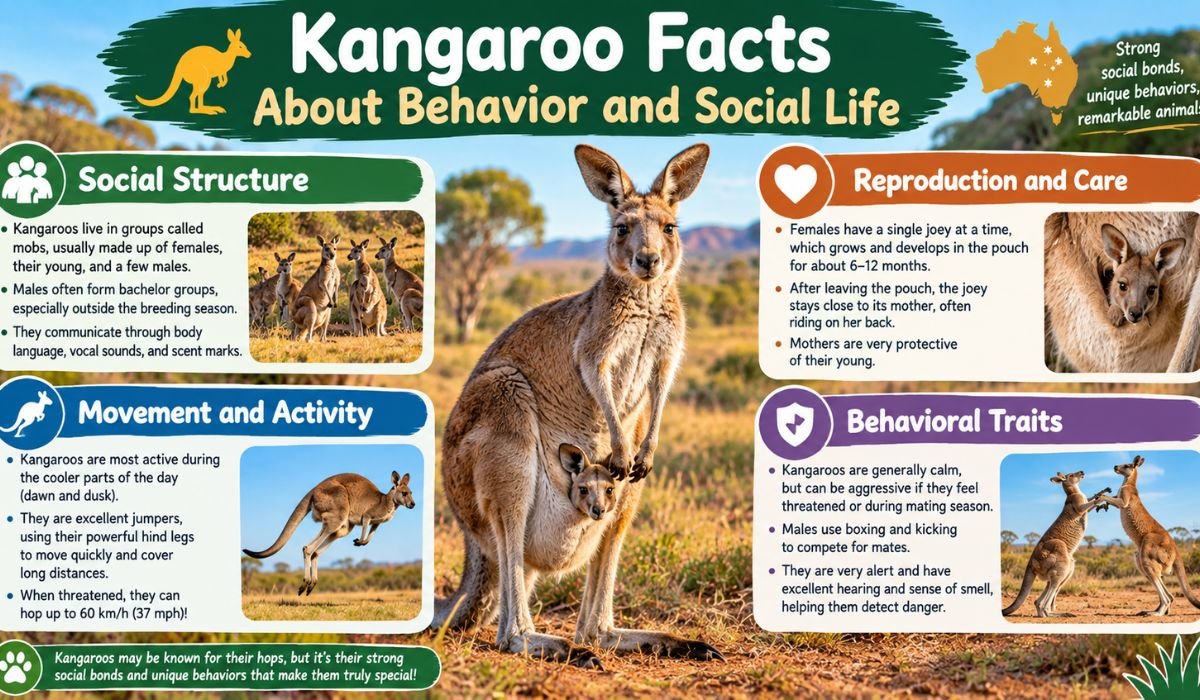
Kangaroos are social animals and may gather in groups commonly called mobs. Group size can vary depending on species, habitat, food availability, and environmental conditions. Living in groups can provide opportunities for social interaction and may help individuals detect danger.
Kangaroos communicate through body movements, vocalizations, and physical signals. Mothers and young have particularly close interactions. Adults may also use posture and movement to communicate with other members of their group.
Some kangaroos are more active during cooler periods of the day. When temperatures rise, they may rest in shaded areas and reduce unnecessary activity. This behavior helps them manage heat in Australia’s often warm climate.
Read Related Post: Dragonfly Facts: Life Cycle, Habitat, Diet, and Behavior
Kangaroo Facts About Reproduction
Kangaroos are marsupials, meaning females give birth to very underdeveloped young that continue developing outside the womb. After birth, the tiny newborn moves into its mother’s pouch, where it attaches to a teat and continues growing.
The pouch provides protection and a stable environment for the developing young. As the young kangaroo grows, it gradually spends more time outside the pouch before becoming increasingly independent.
One remarkable reproductive adaptation is embryonic diapause, which occurs in some kangaroo species. Under certain conditions, development of a fertilized embryo can pause. This allows the mother to delay the development of another young until environmental or reproductive conditions are more suitable.
Kangaroo Adaptations for Survival
Many kangaroo adaptations help these animals survive in Australia’s changing environments. Their hopping ability allows them to travel efficiently over long distances, while their strong hind limbs provide power for movement.
Their digestive system helps them obtain nutrients from fibrous vegetation. Their behavior also supports survival: resting during extreme heat reduces energy expenditure, while feeding during cooler periods can help manage body temperature.
Kangaroos also have adaptations related to water conservation. Some species can survive for periods when water is limited by obtaining moisture from food and reducing activity during hot conditions. However, their ability to cope with dry environments varies among species and circumstances.
Kangaroo Facts About Predators and Threats
Young kangaroos can be vulnerable to predators such as dingoes and large birds of prey. Adult kangaroos are much larger and have powerful legs, but they can still face threats from predators, habitat changes, vehicles, and human activities.
Habitat conversion can reduce access to natural feeding and resting areas. Roads can also create dangerous encounters between vehicles and wildlife, particularly in regions where kangaroos are abundant.
Are Kangaroos Dangerous?

Kangaroos are wild animals and should be observed from a safe distance. Most kangaroos prefer to avoid unnecessary conflict, but large males can be powerful and may become defensive in certain situations.
People should never attempt to approach, corner, feed, or handle a wild kangaroo. Giving animals space reduces the chance of stressful encounters and allows them to behave naturally.
Interesting Kangaroo Facts
Here are some quick kangaroo facts that highlight what makes these animals unusual:
- Kangaroos are marsupials native to Australia.
- They use powerful hind legs for hopping.
- Their long tails help with balance and movement.
- Kangaroos are herbivores that mainly eat plant material.
- Many kangaroos live in social groups called mobs.
- Female kangaroos carry developing young in a pouch.
- Some species can experience embryonic diapause.
- Kangaroos have digestive systems adapted to fibrous vegetation.
- Different kangaroo species occupy different Australian habitats.
- Kangaroo movement is highly efficient because of specialized legs and tendons.
FAQ’s
What are the most important kangaroo facts?
The most important kangaroo facts include their status as Australian marsupials, their powerful hopping ability, herbivorous diet, social behavior, pouch-based reproduction, and adaptations for surviving variable environments.
Where do kangaroos live?
Kangaroos live in many parts of Australia, including grasslands, woodlands, forests, and dry inland regions. Different species have different geographic ranges and habitat preferences.
What do kangaroos eat?
Kangaroos mainly eat grasses, leaves, herbs, and other vegetation. Their digestive systems help them process fibrous plant material.
Why do kangaroos hop?
Kangaroos hop because their powerful hind limbs, tendons, and body structure make this form of movement efficient for traveling across open landscapes.
How does a kangaroo carry its baby?
A female kangaroo carries her developing young in a pouch. The newborn enters the pouch soon after birth and continues developing there.
Are kangaroos social animals?
Yes. Many kangaroo species are social and may live in groups called mobs. Group behavior can vary depending on species and environmental conditions.
How do kangaroos survive hot weather?
Kangaroos can reduce activity during the hottest parts of the day, seek shade, and feed during cooler periods. These behaviors help them manage heat and conserve energy.
Conclusion
Kangaroos are highly specialized Australian marsupials with remarkable adaptations for movement, feeding, reproduction, and survival. Their powerful hind legs and balancing tails make hopping efficient, while their digestive systems allow them to use a plant-based diet. Social behavior and pouch-based reproduction add further complexity to their lives.
Understanding kangaroo facts also shows why habitat and responsible wildlife interactions matter. Although kangaroos are familiar symbols of Australia, they remain wild animals that depend on suitable environments and natural resources. Their combination of physical and behavioral adaptations makes them fascinating members of Australia’s wildlife.

Hi, I’m Amelia, an SEO and content specialist with several years of experience researching and creating informative content for online audiences. At Animal Attack Facts, I focus on animal behavior, animal attacks on humans, and interesting facts about land animals, marine animals, birds, reptiles, and insects. My goal is to provide clear, useful, and engaging information that helps readers better understand wildlife and stay informed about animal encounters.
1 thought on “Kangaroo Facts: Habitat, Diet, Behavior, and Adaptations”