
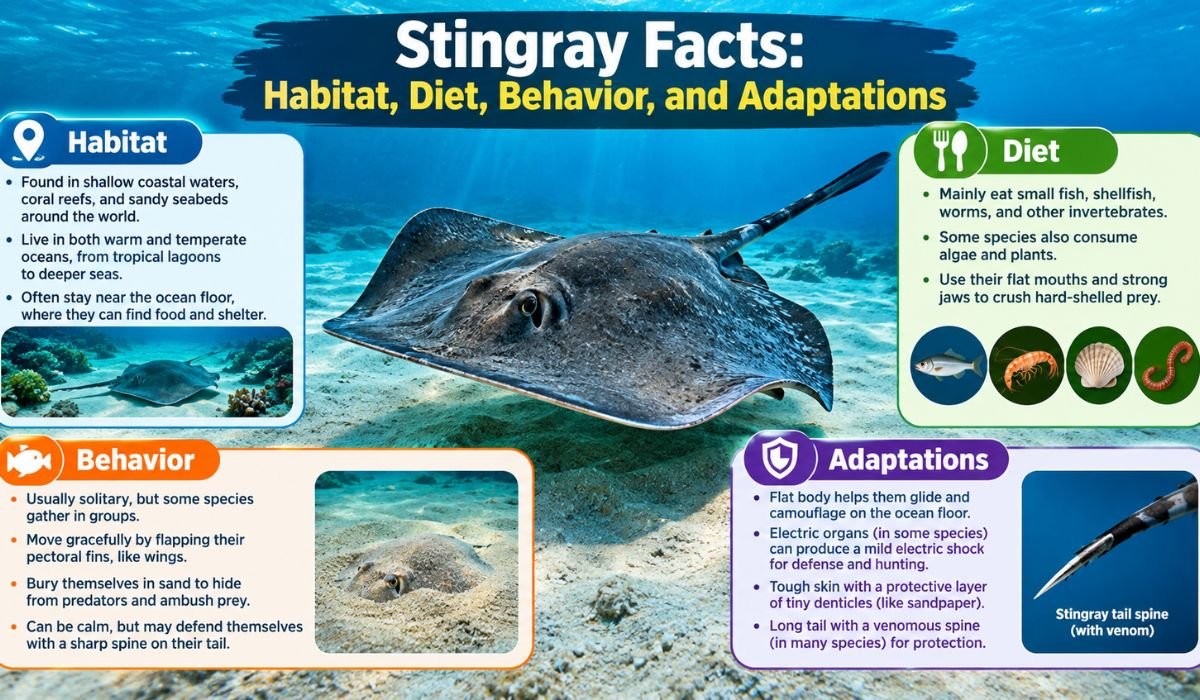
Stingrays are fascinating marine animals known for their flattened bodies, wide fins, and long tails. They belong to the ray group of cartilaginous fish, meaning their skeletons are made primarily of cartilage rather than hard bone. Many species live close to the ocean floor, where they search for food and spend much of their time buried in sand or resting on the seafloor.
These animals are closely related to sharks and share several important characteristics with them. Although stingrays have a reputation for being dangerous because some species possess venomous tail spines, they generally do not seek out humans. Understanding stingray facts can help explain their behavior, adaptations, feeding habits, and important role in marine ecosystems.
What Are Stingrays?
Stingrays are flattened fish belonging to a group of cartilaginous fishes. Their bodies are adapted for life near the seafloor, with large pectoral fins extending from the sides of their bodies. These fins create the distinctive disk-like shape associated with many rays.
One of the most interesting stingray facts is that not all rays are technically stingrays. Several types of rays have different body structures and adaptations, while true stingrays are particularly known for their tail spines.
Stingrays breathe using openings called spiracles located behind their eyes. Spiracles allow them to draw water into their bodies without constantly pulling water through their mouths. This is especially useful when a stingray is resting or buried beneath sand.
Stingray Habitat
Stingrays are found in many marine environments around the world. Most species live in relatively shallow coastal waters, although some can be found in deeper areas. Their habitats include sandy bottoms, coral reefs, seagrass beds, estuaries, and muddy coastal regions.
Different species have adapted to different environments. Some live in warm tropical waters, while others inhabit temperate regions. A few freshwater ray species are also known, particularly in tropical river systems.
An important stingray fact is that their flattened body helps them live close to the bottom. Their shape allows them to move efficiently over sand and other surfaces while searching for food.
Where Do Stingrays Live?
Stingrays can be found in oceans around the world, particularly in coastal areas. Many species prefer shallow water where prey such as small fish, crustaceans, worms, and mollusks are abundant.
Some stingrays spend much of the day partially buried in sand. Their camouflage can make them difficult to see because their body color often blends with the seafloor.
What Do Stingrays Eat?
Stingrays are generally carnivorous or feed heavily on animal-based foods. Their diets vary depending on their species, size, and habitat.
Common foods include:
- Small fish
- Shrimp
- Crabs
- Mollusks
- Worms
- Clams
- Other small marine animals
Many stingrays search for prey beneath the sand. They can use sensory organs to detect animals hidden below the surface. Once they locate prey, they may uncover it by moving their fins or disturbing the sediment.
One of the useful stingray facts to remember is that their mouths are positioned on the underside of the body. This location is well suited to feeding on animals living along the seafloor.
How Do Stingrays Hunt?
Stingrays rely on several senses to locate prey. Their eyes help them see their surroundings, but vision is not their only method of finding food.
Like sharks and other cartilaginous fish, stingrays possess sensory structures that can detect electrical signals produced by other animals. This ability can help them locate prey even when it is hidden beneath sand.
Some species also use smell and other sensory information to identify potential food. After finding prey, a stingray can use its mouth and specialized jaws to capture and crush certain hard-shelled animals.
Read Related Post: Kangaroo Facts: Habitat, Diet, Behavior, and Adaptations
Stingray Behavior
Stingrays are usually calm animals that spend much of their time swimming slowly near the bottom or resting on the seafloor. Their behavior can change depending on their environment, species, food availability, and potential threats.
Many species are solitary, although stingrays may gather in groups when food or suitable environmental conditions are available.
A notable stingray fact is that these animals are not naturally aggressive toward humans. Their tail spines are primarily defensive structures rather than hunting weapons.
When threatened, a stingray may attempt to swim away. If it feels trapped or is accidentally stepped on, it can use its tail as a defensive mechanism.
Stingray Adaptations
Stingrays have developed several adaptations that help them survive in marine environments.
Flattened Body
Their flattened bodies allow them to remain close to the seafloor. This shape also helps them hide beneath sand and avoid detection by predators.
Powerful Pectoral Fins
The large fins along the sides of their bodies provide most of their swimming power. Depending on the species, stingrays may move their fins in wave-like motions or use them to glide through the water.
Camouflage
Many stingrays have colors and patterns that resemble sand, rocks, or the seafloor. This camouflage can help them avoid predators and approach prey without being easily noticed.
Venomous Tail Spine
One of the most recognizable stingray facts is the presence of a serrated spine in many species. The spine is associated with venom-producing tissue and is mainly used for defense.
Not every ray has the same type of tail structure, and the number, shape, and position of spines can vary between species.
Electrical Sensing
Stingrays can detect weak electrical signals produced by other animals. This adaptation is particularly useful when prey is hidden beneath sediment.
How Do Stingrays Protect Themselves?
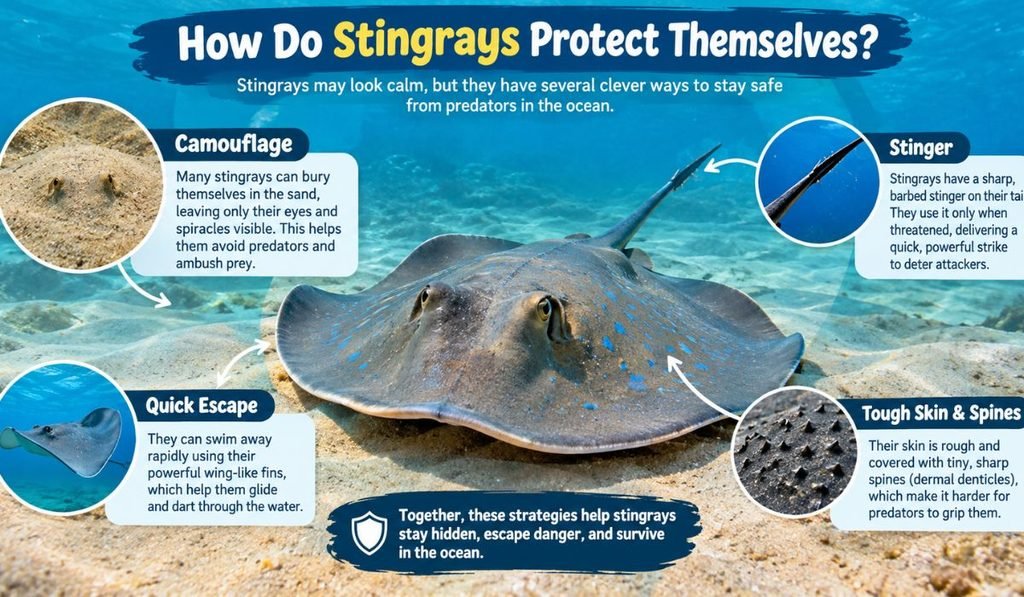
Stingrays have several ways to avoid predators. Their first defense is often camouflage. By blending into the seafloor, they can become difficult to detect.
They may also bury themselves in sand, leaving only parts of their bodies visible. If approached by a predator, a stingray may quickly swim away.
The tail spine provides another defensive option. When a stingray feels threatened, it can use the spine to protect itself. This is why people should never deliberately touch or handle a wild stingray.
Stingray Reproduction
Stingray reproduction varies among species, but many stingrays give birth to live young rather than laying external eggs. The developing embryos receive nourishment from the mother through specialized reproductive structures.
Young stingrays are generally born looking like smaller versions of adults. They must eventually become independent and learn to find food and avoid predators.
Some species produce only a small number of young, while others may produce more. Reproductive strategies differ considerably among ray species.
Stingray Predators
Despite their defensive adaptations, stingrays are eaten by several marine predators. Large sharks are among their important natural predators, and some other large fish and marine animals may also prey on them.
Young stingrays are generally more vulnerable because they are smaller and have fewer defenses.
Their ability to bury themselves and camouflage with the seafloor can significantly improve their chances of avoiding predators.
Are Stingrays Dangerous?
Stingrays are generally not aggressive toward people. Most encounters happen when humans enter shallow coastal waters where stingrays are resting or feeding.
The main risk comes when a person accidentally steps near or directly on a stingray. A frightened animal may react defensively with its tail spine.
One of the most important stingray facts is that giving wild stingrays space is one of the simplest ways to avoid an unwanted encounter. Observing them without touching or chasing them is safer for both the animal and people.
Stingrays and the Marine Ecosystem
Stingrays play an important role in marine ecosystems. As predators of animals such as crustaceans, mollusks, and small fish, they help influence populations of organisms living on or near the seafloor.
Their feeding behavior can also disturb sediment as they search for buried prey. This movement can affect small organisms and nutrients within bottom habitats.
Because they occupy different levels of marine food webs, stingrays are an important part of healthy coastal ecosystems.
Interesting Stingray Facts
Here are some quick stingray facts you may find interesting:
- Stingrays are cartilaginous fish, like sharks.
- Many stingrays have flattened bodies adapted to life near the seafloor.
- Their skeletons are made primarily of cartilage.
- Many species have defensive tail spines.
- Stingrays can detect weak electrical signals from nearby animals.
- Many species feed on crustaceans, mollusks, worms, and small fish.
- Stingrays often use camouflage to hide from predators.
- Some species can bury themselves beneath sand.
- Their eyes are positioned on the upper part of the body.
- Their mouths are located underneath the body.
- Stingrays can live in marine and, in some groups, freshwater environments.
- They are closely related to sharks.
- Some stingrays can grow much larger than people expect.
- Many species are active predators of seafloor animals.
- Stingrays generally use their tail spine for defense rather than hunting.
FAQ’s
Are stingrays aggressive?
Most stingrays are not naturally aggressive toward humans. They generally prefer to swim away when disturbed. Their defensive spine may be used if they feel threatened or are accidentally stepped on.
What do stingrays eat?
Stingrays commonly eat crustaceans, mollusks, worms, small fish, and other marine animals. Their exact diet depends on the species and its habitat.
Where do stingrays live?
Many stingrays live in shallow coastal waters, including sandy bottoms, coral reef areas, seagrass habitats, and estuaries. Some related rays live in deeper ocean environments or freshwater systems.
Can stingrays bury themselves?
Yes. Many stingray species can partially or almost completely bury themselves in sand or sediment. This behavior helps them hide from predators and can also allow them to approach prey.
Do stingrays have bones?
Stingrays do not have a typical bony skeleton. Like sharks, they are cartilaginous fish, meaning much of their internal skeleton is made of cartilage.
How do stingrays defend themselves?
One of the best-known stingray facts is that many species have a defensive tail spine. They can also rely on camouflage, burying themselves, and swimming away from threats.
Are stingrays related to sharks?
Yes. Stingrays and sharks are both cartilaginous fish. They belong to the broader group of animals whose skeletons are primarily made of cartilage.
How do stingrays find food?
Stingrays use several senses to locate prey. Their ability to detect weak electrical signals is particularly useful for finding animals hidden beneath sand or sediment.
Conclusion
Stingrays are highly adapted marine animals with unique body shapes, specialized senses, powerful fins, and effective defensive structures. They can live in a variety of habitats and feed on many animals found along the seafloor. Their ability to camouflage themselves and detect hidden prey makes them successful predators in many coastal ecosystems.
These stingray facts also show why these animals should be observed respectfully in the wild. Although some species have venomous tail spines, stingrays generally do not seek conflict with humans. Their role in marine food webs makes them an important part of healthy aquatic ecosystems.
Learning more about stingray facts helps us understand these unusual relatives of sharks and appreciate the adaptations that allow them to survive in diverse underwater environments.

Hi, I’m Amelia, an SEO and content specialist with several years of experience researching and creating informative content for online audiences. At Animal Attack Facts, I focus on animal behavior, animal attacks on humans, and interesting facts about land animals, marine animals, birds, reptiles, and insects. My goal is to provide clear, useful, and engaging information that helps readers better understand wildlife and stay informed about animal encounters.
1 thought on “Stingray Facts: Habitat, Diet, Behavior, and Adaptations”