
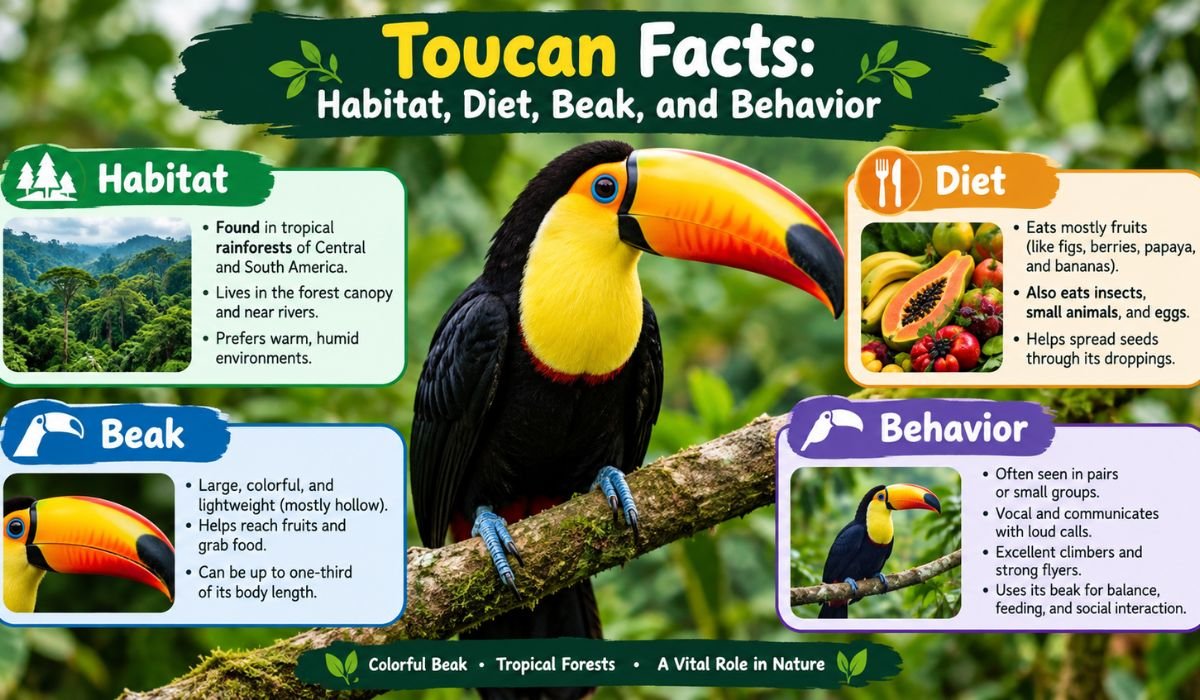
Toucans are among the most recognizable birds in tropical forests, famous for their oversized colorful beaks, bright plumage, and lively behavior. These birds belong to the family Ramphastidae and are found mainly in Central and South America. They live in warm forests filled with fruit trees and dense vegetation. Although their beaks look heavy, they are surprisingly lightweight and serve several useful purposes. In this guide to toucan facts, you will learn about their habitat, diet, unusual beaks, behavior, reproduction, and adaptations.
What Are Toucans?
Toucans are tropical birds known for their large bills, short bodies, and relatively long tails. There are more than 40 recognized toucan species and close relatives, ranging from small toucanets to larger species such as the toco toucan.
One of the most interesting toucan facts is that their huge bills are much lighter than they appear. The bill has a honeycomb-like internal structure that provides strength without making it excessively heavy. This allows a toucan to carry its large bill while moving through branches and searching for food.
Toucans are also related to woodpeckers and barbets. Their feet are adapted for gripping branches, helping them remain stable while climbing and feeding.
Where Do Toucans Live?
Toucans primarily inhabit tropical and subtropical regions of Central and South America. Different species occupy different parts of this range, with some living in lowland rainforests while others occur in mountain forests.
They are commonly associated with humid forests, but their habitats can also include woodland edges, savannas with trees, plantations, and other areas where food and nesting sites are available. Many species spend much of their lives high above the ground in the forest canopy.
An important part of toucan facts is their relationship with tropical forests. Because many toucans eat fruit and later pass seeds through their digestive systems, they can help move plant seeds from one location to another.
What Do Toucans Eat?
Fruit makes up a major part of a toucan’s diet. Depending on the species and season, they may eat berries, figs, palm fruits, and other soft fruits found in the forest. Their long bills allow them to reach fruit growing on thin branches or at the ends of twigs.
Toucans are not strictly fruit eaters. They may also consume insects, spiders, small reptiles, frogs, eggs, and nestlings when these foods are available. Animal foods can provide important nutrients, particularly when fruit is less abundant.
Toucans often swallow food whole or take manageable pieces with their bills. Their digestive systems process food relatively quickly, which can help them move through the forest while dispersing seeds.
Why Do Toucans Have Such Large Beaks?
The enormous bill is the feature most people immediately notice. Scientists believe it has several functions rather than serving only one purpose.
A toucan can use its bill to reach food that would otherwise be difficult to access. It can also help the bird handle fruit and may play a role in social interactions and displays. The bill’s size and bright colors can make it an important visual signal between birds.
Another fascinating toucan facts point is that the bill may help with temperature regulation. Blood vessels inside the bill allow heat to be transferred toward its surface, where it can be released. Toucans can adjust blood flow to the bill, helping control heat loss depending on environmental conditions.
Read Related Post: Stingray Facts: Habitat, Diet, Behavior, and Adaptations
How Do Toucans Behave?
Toucans are active, social birds. Some species travel in pairs or small groups, and they may communicate using calls, bill movements, body postures, and other visual signals.
Their calls vary among species. Some produce loud croaks, rattles, yelps, or repetitive sounds that can travel through dense vegetation. These vocalizations may help birds communicate with members of their group or establish contact.
Toucans can be energetic in the canopy but are not known for sustained long-distance flight. Their bodies and broad wings are better suited to moving between trees and branches than to extended soaring. They may make short flights followed by periods of climbing and hopping through vegetation.
How Big Are Toucans?
Toucan size varies considerably between species. The toco toucan is one of the largest and most familiar species, while several toucanets are much smaller.
The size of a toucan depends on its species, age, and sex. A large bill can make the bird appear bigger than its body actually is. Despite the impressive appearance of the bill, it is relatively lightweight because of its internal structure.
Their tails are often long and colorful, helping create the distinctive silhouette associated with these birds. Plumage patterns differ among species and can include combinations of black, white, red, yellow, orange, blue, and green.
How Do Toucans Reproduce?
Toucans usually nest in natural cavities in trees. Instead of building a large nest from branches, they may use abandoned woodpecker holes or existing openings and modify them as needed.
A female generally lays a small clutch of eggs, and both parents can take part in caring for the young. The eggs hatch after an incubation period that varies by species. Newly hatched chicks are relatively helpless and depend on their parents for food and protection.
Young toucans develop inside the safety of the tree cavity before eventually leaving the nest. Parents may continue feeding young birds for a period after they become capable of leaving the cavity.
Do Toucans Make Good Pets?
Toucans are wild tropical birds with specialized environmental, dietary, and social needs. Although their colorful appearance can make them seem appealing as pets, caring for a toucan is very different from caring for a domesticated bird.
They need suitable space, specialized nutrition, enrichment, and appropriate veterinary care. Their strong bills can also cause injuries if the bird becomes frightened or stressed. In many places, keeping native or exotic wildlife is regulated by law.
For these reasons, toucans are best appreciated in their natural habitats, accredited wildlife facilities, or reputable conservation programs rather than treated like ordinary household pets.
What Threats Do Toucans Face?
Toucans face several threats, especially where tropical forests are cleared or fragmented. Habitat loss can reduce access to food, nesting cavities, and safe areas for raising young.
Illegal wildlife capture and the destruction of nesting trees can also affect some populations. Changes in climate may alter forest conditions and food availability, although the effects differ among species and regions.
Protecting tropical forests is therefore an important part of conserving toucans. Maintaining mature trees, preserving connected forest habitats, and supporting responsible conservation efforts can help protect the ecosystems these birds depend on.
Interesting Toucan Facts
Here are some quick toucan facts to remember:
- Toucans are native mainly to Central and South America.
- Their bills are large but relatively lightweight.
- Many toucans eat fruit as a major part of their diet.
- Some species also eat insects, eggs, frogs, and small reptiles.
- Toucans often live in forest canopies.
- Their bills contain a lightweight internal structure.
- Some toucans use their bills to help regulate body heat.
- They nest in tree cavities rather than building large open nests.
- Toucans can help disperse seeds through their droppings.
- Different species have different colors, sizes, calls, and habitats.
- Toucans belong to the bird order Piciformes, which also includes woodpeckers.
- The toco toucan is one of the largest and best-known toucan species.
FAQ’s
What are the most interesting toucan facts?
One of the most fascinating toucan facts is that their enormous bills are surprisingly lightweight. Their internal structure provides strength without adding as much mass as the bill’s size might suggest.
Where are toucans found?
Toucans are mainly found in tropical and subtropical parts of Central and South America. Different species occupy different forest environments, from lowland rainforests to higher-elevation forests.
What do toucans eat?
Toucans primarily eat fruit, but they can also consume insects, spiders, eggs, frogs, small reptiles, and other small animals. Their exact diet depends on species, habitat, and food availability.
Why is a toucan’s beak so big?
A toucan’s large bill helps it reach and handle food and can also be involved in displays and temperature regulation. Its lightweight internal structure allows the bird to carry the large bill more easily.
Can toucans fly?
Yes, toucans can fly. They generally make short flights between trees and through the forest canopy rather than spending long periods soaring over open areas.
Conclusion
Toucans are remarkable tropical birds whose colorful appearance is matched by a range of useful adaptations. Their lightweight oversized bills help them reach food, communicate, and manage heat, while their fruit-based diets connect them closely with forest ecosystems. They also eat a variety of animal foods, nest in tree cavities, and use calls and visual signals to communicate.
Learning toucan facts shows why these birds are more than simply colorful rainforest animals. They are active parts of tropical ecosystems and can contribute to seed dispersal and forest regeneration. Protecting the forests where toucans live is essential for maintaining healthy populations and the diverse ecosystems they share with countless other species.

Hi, I’m Amelia, an SEO and content specialist with several years of experience researching and creating informative content for online audiences. At Animal Attack Facts, I focus on animal behavior, animal attacks on humans, and interesting facts about land animals, marine animals, birds, reptiles, and insects. My goal is to provide clear, useful, and engaging information that helps readers better understand wildlife and stay informed about animal encounters.
1 thought on “Toucan Facts: Habitat, Diet, Beak, and Behavior”