
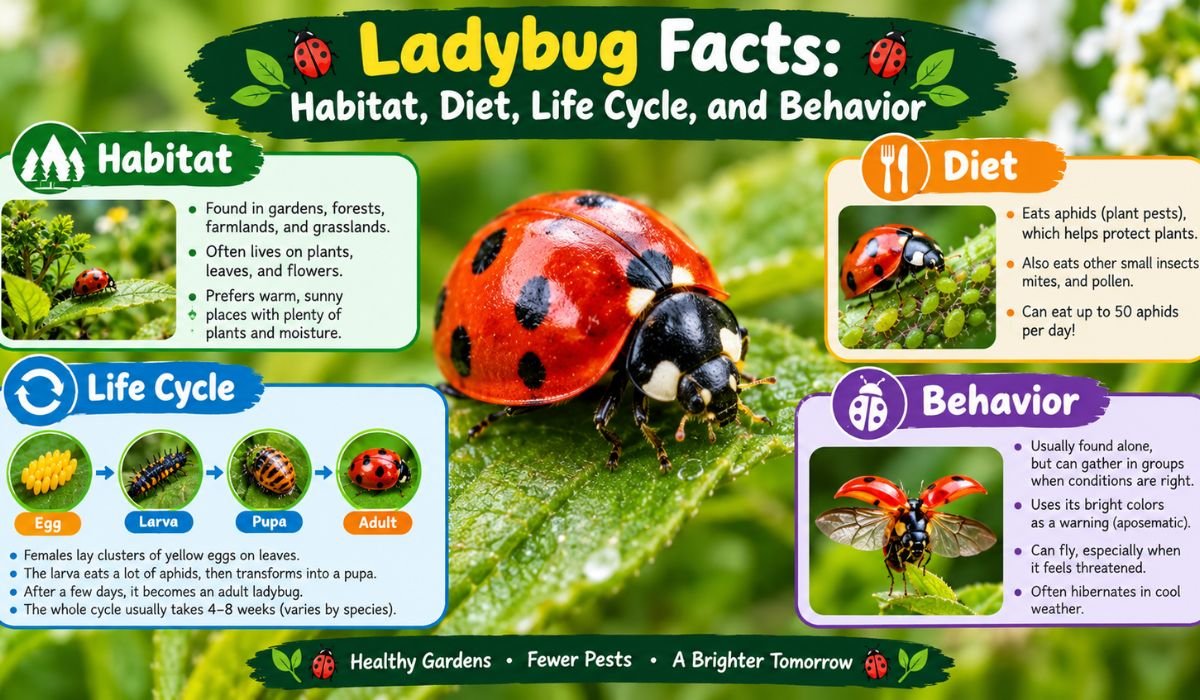
Ladybugs are small, colorful beetles found in many parts of the world. Known for their rounded bodies and spotted wings, these insects are especially valued because many species feed on plant pests such as aphids. Although they look delicate, ladybugs have interesting adaptations that help them survive in different environments. In this guide, you will discover important ladybug facts about their habitat, diet, life cycle, behavior, defense mechanisms, and more.
What Are Ladybugs?
Ladybugs are beetles belonging to the family Coccinellidae. In many countries, they are also called ladybirds or lady beetles. There are thousands of species, and they can vary greatly in color, pattern, and size.
One of the most recognizable ladybug facts is that their bright colors can serve as a warning to predators. Depending on the species, adults may be red, orange, yellow, black, or even brown.
Despite their name, ladybugs are not true bugs in the scientific sense. They are beetles because they have hardened front wings called elytra that protect their delicate flying wings underneath.
Ladybug Habitat
Ladybugs live in a wide variety of habitats. They can be found in gardens, forests, grasslands, agricultural fields, meadows, parks, and even urban areas.
Their habitat is often closely connected to the availability of food. Areas with plenty of aphids and other small insects can attract large numbers of ladybugs.
Where Do Ladybugs Live?
Common habitats include:
- Gardens and backyards
- Grasslands and meadows
- Forest edges
- Agricultural fields
- Shrublands
- Parks and urban green spaces
- Areas with flowering plants
During colder periods, some species gather together in sheltered locations. They may hide beneath leaves, bark, rocks, or other protected places.
What Do Ladybugs Eat?
One of the most useful ladybug facts is that many species are natural predators of plant pests. Aphids are an important food source for numerous ladybugs, especially during their larval and adult stages.
Depending on the species, ladybugs may also eat scale insects, mites, whiteflies, insect eggs, and other small organisms.
Not every ladybug has the same diet. Some species feed mainly on fungi or plant material, while others specialize in particular insects.
Do Ladybugs Eat Plants?
Some ladybug species do consume plant material, but many familiar ladybugs are predators rather than plant-eaters. This makes them beneficial in many gardens and agricultural environments because they can help reduce populations of certain plant pests.
Read Related Post: Toucan Facts: Habitat, Diet, Beak, and Behavior
Ladybug Life Cycle
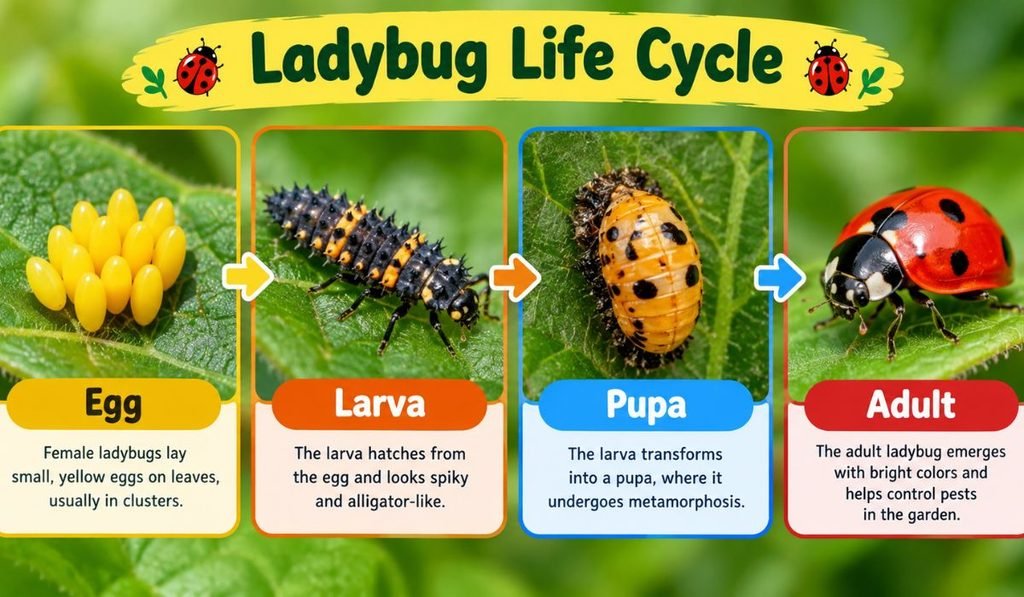
The ladybug life cycle has four major stages:
- Egg
- Larva
- Pupa
- Adult
This process is called complete metamorphosis because the young larva looks very different from the adult beetle.
1. Egg Stage
Female ladybugs usually lay small clusters of eggs on plants. They often choose locations where food will be available for the larvae after hatching.
The eggs are generally tiny and may be yellow, orange, or another color depending on the species.
2. Larval Stage
After hatching, the young ladybug becomes a larva. Ladybug larvae can look quite different from adults. They often have elongated bodies with small projections and contrasting markings.
The larvae are active feeders. In predatory species, they may consume large numbers of aphids and other small insects as they grow.
3. Pupal Stage
When the larva has completed its growth, it attaches itself to a suitable surface and enters the pupal stage. Inside the pupa, its body undergoes major changes.
Eventually, the adult beetle emerges.
4. Adult Stage
The newly emerged adult has soft wings and a lighter appearance at first. Its body gradually hardens, and its characteristic coloration and markings become more visible.
Adult ladybugs can fly and search for food, mates, and suitable places to lay eggs.
Ladybug Appearance and Colors
Ladybugs are famous for their bright colors and spots, but not every species has the classic red-and-black appearance.
Some have:
- Red wings with black spots
- Orange wings
- Yellow markings
- Black bodies with red markings
- Brown or patterned bodies
Their size also varies among species, but many are only a few millimeters long.
A useful ladybug fact is that their spots and colors are not simply decorative. Bright coloration can act as a warning to predators that the insect may taste unpleasant or be difficult to eat.
Ladybug Behavior
Ladybugs are generally active insects that spend much of their time searching for food or suitable places to reproduce.
Their behavior can change depending on temperature, food availability, season, and species.
Feeding Behavior
Predatory ladybugs use their mouthparts to capture and consume small insects. They may move across leaves and stems searching for prey.
When food is abundant, ladybugs can remain in an area for extended periods.
Flying Behavior
Adult ladybugs can fly using their delicate hind wings. Their hardened front wings open to allow the flying wings to move.
They may travel between plants in search of food or better environmental conditions.
Seasonal Behavior
In cooler climates, some ladybugs enter a period of reduced activity and seek protected locations. Large groups may sometimes gather together during seasonal sheltering.
How Do Ladybugs Protect Themselves?
Ladybugs have several defense mechanisms. Their bright colors can warn predators, while some species can release unpleasant-smelling or distasteful chemicals.
When threatened, a ladybug may also remain still or tuck its legs close to its body.
Some species can release a yellowish defensive fluid from their legs. This chemical defense can discourage predators from eating them.
These protective adaptations are among the most interesting ladybug facts because such a small insect has several ways to avoid becoming prey.
Are Ladybugs Helpful to Gardens?
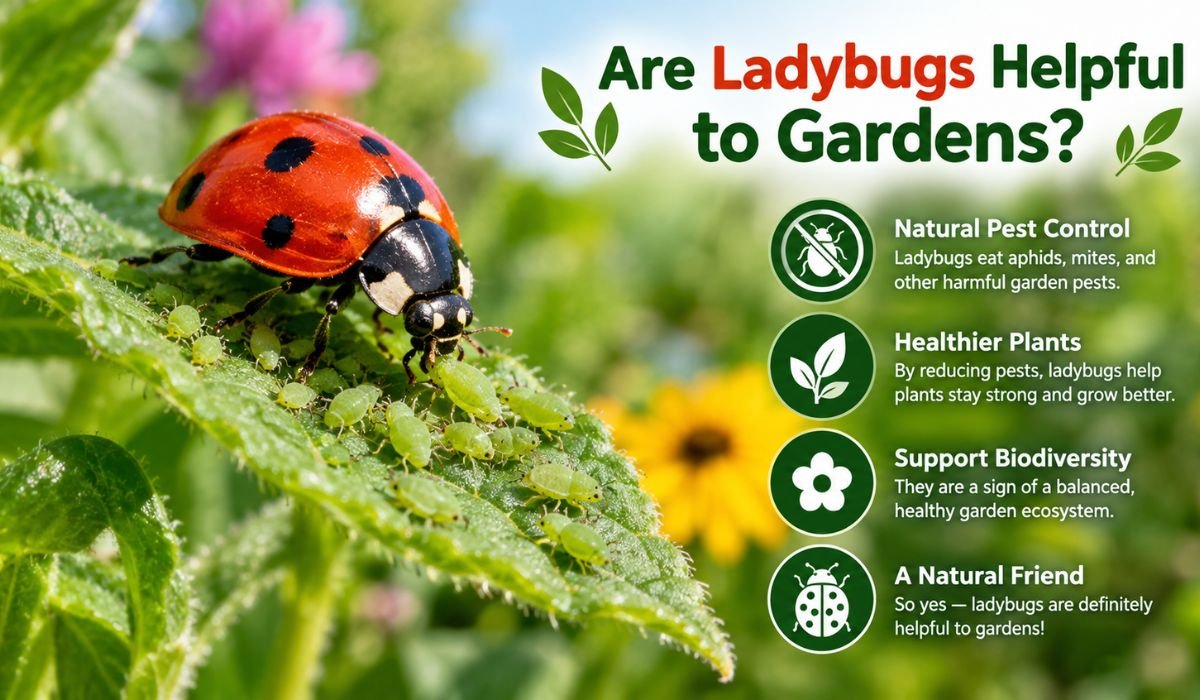
Many ladybug species are considered beneficial because they prey on aphids and other plant pests. Their presence can therefore be useful in gardens and natural ecosystems.
However, not every species has the same feeding habits. Some ladybugs eat plants or fungi rather than insects, so their ecological role depends on the species.
Ladybugs also form part of food webs. Birds, spiders, amphibians, and other predators may feed on them.
Interesting Ladybug Facts
Here are some quick ladybug facts:
- Ladybugs are beetles, not true bugs.
- They belong to the family Coccinellidae.
- Many species eat aphids.
- Ladybugs undergo complete metamorphosis.
- Their life cycle includes egg, larva, pupa, and adult stages.
- Ladybug larvae look very different from adults.
- Their bright colors can help warn predators.
- Some species release defensive chemicals when threatened.
- Adult ladybugs can fly using delicate hind wings.
- Ladybugs occur in many habitats around the world.
- Not all ladybugs are red with black spots.
- Some species feed on fungi or plant material.
- Ladybugs are important members of many food webs.
FAQ’s
What do ladybugs eat?
Many ladybugs eat aphids and other small insects. Depending on the species, they may also eat mites, scale insects, insect eggs, fungi, or plant material.
Where do ladybugs live?
Ladybugs can live in gardens, forests, grasslands, farms, meadows, parks, and other habitats where suitable food and shelter are available.
What is the life cycle of a ladybug?
The ladybug life cycle has four stages: egg, larva, pupa, and adult. This is a form of complete metamorphosis.
Are ladybugs beneficial?
Many species are beneficial because they eat aphids and other plant pests. However, different species have different diets and ecological roles.
Why are ladybugs brightly colored?
Bright colors can act as warning signals to predators. Some ladybugs also produce unpleasant defensive chemicals.
Can ladybugs fly?
Yes. Adult ladybugs have functional flying wings beneath their hardened front wings.
Are all ladybugs red?
No. Ladybugs can have many different colors and patterns, including orange, yellow, black, and brown.
Conclusion
These ladybug facts show that these tiny beetles are much more interesting than their familiar appearance suggests. Ladybugs have a fascinating four-stage life cycle, diverse diets, useful defensive adaptations, and behaviors that help them survive in many environments. Many species also play an important role in controlling populations of plant pests such as aphids. From their colorful bodies to their transformation from larvae into adults, ladybugs are an important and fascinating part of ecosystems around the world.

Hi, I’m Amelia, an SEO and content specialist with several years of experience researching and creating informative content for online audiences. At Animal Attack Facts, I focus on animal behavior, animal attacks on humans, and interesting facts about land animals, marine animals, birds, reptiles, and insects. My goal is to provide clear, useful, and engaging information that helps readers better understand wildlife and stay informed about animal encounters.
1 thought on “Ladybug Facts: Habitat, Diet, Life Cycle, and Behavior”