
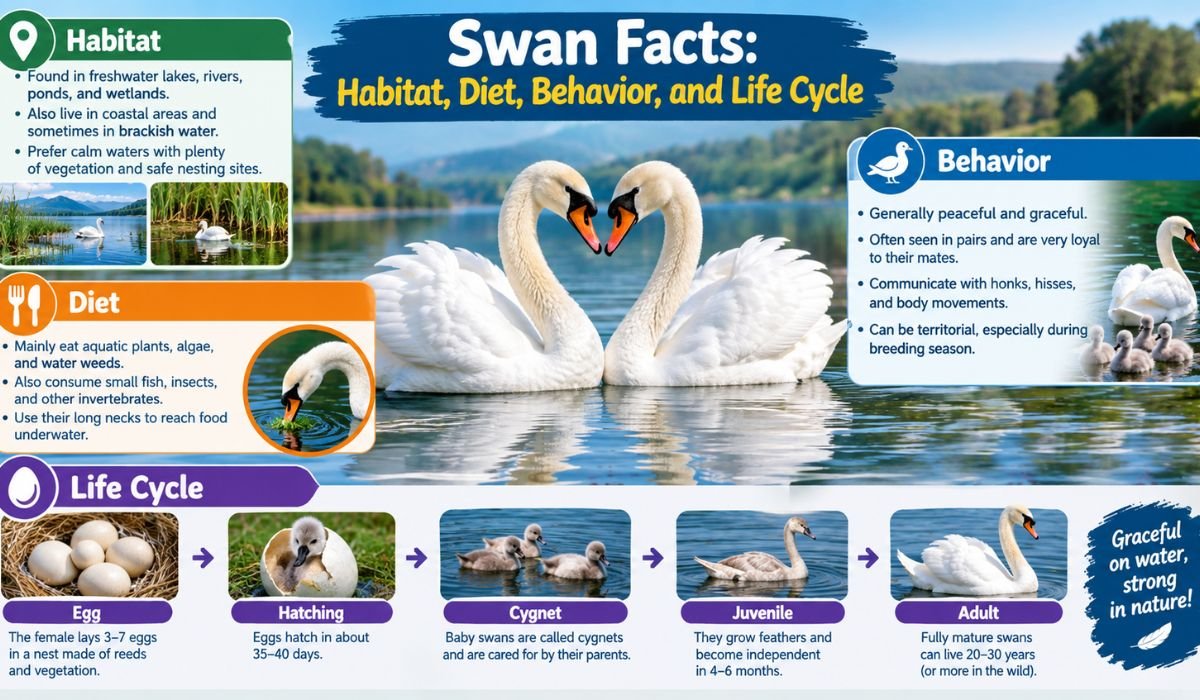
Swans are among the most recognizable water birds in the world, known for their long necks, graceful movements, and striking appearance. These large members of the waterfowl family can be found in lakes, rivers, wetlands, and coastal areas across several parts of the world. Understanding swan facts reveals that these birds are not only beautiful but also highly adapted to aquatic environments.
Swans belong to the family Anatidae, which also includes ducks and geese. Depending on the species, they may live in temperate or colder regions and can migrate long distances when seasonal conditions change. Their strong bodies, specialized bills, webbed feet, and insulating feathers help them survive in different habitats.
What Are Swans?
Swans are large waterfowl recognized by their long necks, broad bodies, and webbed feet. There are several living swan species, including the mute swan, whooper swan, trumpeter swan, tundra swan, black swan, and black-necked swan.
One of the most interesting swan facts is that not all swans are white. The black swan, native to Australia, has predominantly black feathers, while the black-necked swan of South America has a white body and a black neck.
Swans are generally larger than ducks and many species of geese. Their powerful wings allow them to fly efficiently despite their considerable body size.
Swan Habitat
Swans are closely associated with freshwater environments, although some species also use coastal waters and brackish wetlands. Their habitats commonly include:
- Lakes and ponds
- Slow-moving rivers
- Marshes and wetlands
- Floodplains
- Coastal lagoons
- Estuaries
- Sheltered bays
Different species prefer different environments. For example, some northern swans spend their breeding season in Arctic and sub-Arctic areas before migrating to milder regions for winter.
Another important part of swan facts is their ability to adapt to human-modified environments. Swans may live on artificial lakes, reservoirs, canals, and city ponds when suitable food and nesting areas are available.
What Do Swans Eat?
Swans are primarily herbivorous, although their diet can vary depending on species and habitat. They commonly feed on aquatic vegetation and other plant material.
Their diet may include:
- Aquatic grasses
- Pondweed
- Algae
- Leaves
- Roots
- Seeds
- Agricultural crops
- Small aquatic organisms occasionally
Swans often feed by dipping their long necks underwater. Their extended necks allow them to reach vegetation beneath the surface without diving their entire bodies.
Young swans may consume more animal-based food than adults in some circumstances, particularly when growing and developing. However, plant material makes up a major part of the diet for many species.
Swan Behavior
Swans are social and intelligent birds with a wide range of behaviors. They communicate through calls, body movements, wing displays, and other signals.
Some species form strong pair bonds, and established pairs may remain together for many breeding seasons. Swans can also become territorial, especially during the nesting season.
When threatened, a swan may stretch its neck, raise its wings, hiss, or make other warning displays. These behaviors are intended to discourage potential threats.
Despite their elegant appearance, swans are powerful birds. Their large wings and strong bills can make defensive displays appear quite impressive.
Read Related Post: Sea Otter Facts: Habitat, Diet, Behavior, and Adaptations
Do Swans Migrate?
Migration is an important part of many swan facts. Several species travel between breeding and wintering areas as temperatures and food availability change.
For example, species that breed in northern regions may migrate south during winter. They often travel in family groups or larger flocks and may return to the same general breeding areas year after year.
Migration routes can cover hundreds or even thousands of miles. Swans use environmental cues, landscape features, and inherited behaviors to navigate between seasonal habitats.
Not every swan species is strongly migratory. Some populations remain in relatively mild regions throughout the year when food and open water are available.
Swan Life Cycle
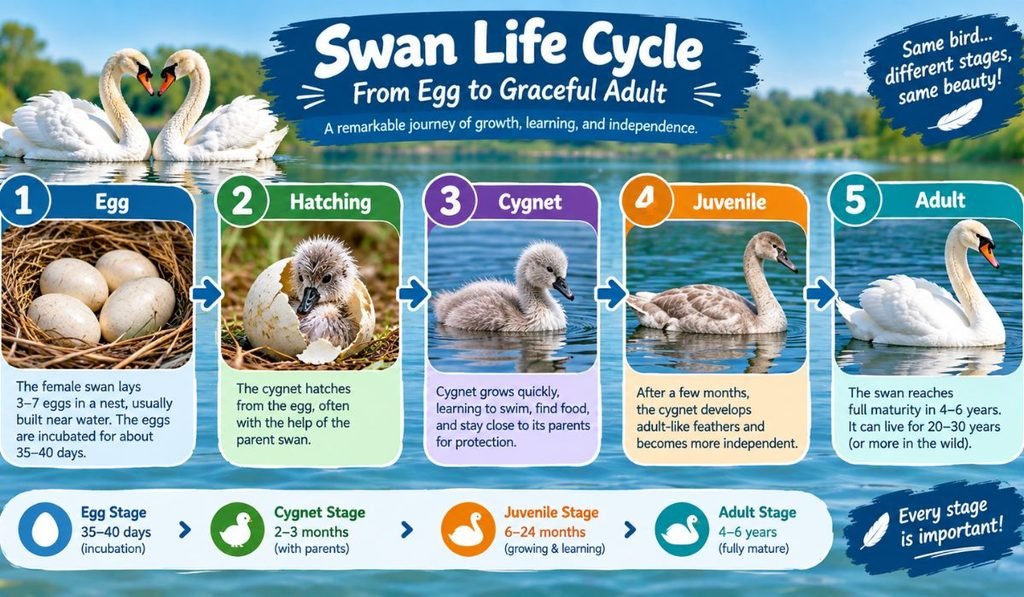
The swan life cycle begins when adults establish a breeding territory and build a nest. Nesting usually occurs near water, where vegetation and other materials can provide protection and support.
The female lays a clutch of eggs and incubates them for several weeks. The male generally remains nearby and may help defend the nesting area.
After hatching, young swans are covered with soft down and are usually able to move around relatively soon. They may enter the water shortly after hatching and begin learning how to feed.
Young swans are often called cygnets. They grow rapidly and gradually develop their adult feathers.
Cygnets and Development
Cygnets depend on their parents for protection and guidance during their early life. Parents may lead them to feeding areas and help protect them from predators.
As the young birds mature, their bodies become larger and their feathers gradually change. Depending on the species, juveniles may have noticeably different coloring from adults.
They eventually become capable of independent feeding and flight. Reaching full maturity can take several years.
Swan Reproduction
Breeding behavior is another fascinating area of swan facts. Many swan species form monogamous pair bonds, although mating systems can vary among species and populations.
The pair usually selects a nesting site close to water. The nest may be constructed from reeds, grasses, leaves, and other vegetation.
The female lays several eggs, and incubation lasts for roughly a month in many species. The exact timing and clutch size vary according to the species.
Both parents may participate in protecting their young after hatching. This parental care helps cygnets survive during their vulnerable early stages.
How Long Do Swans Live?
Swans can live for many years, especially when they have access to suitable habitat and face limited threats. Lifespan varies among species and individuals.
In the wild, survival can be affected by:
- Food availability
- Predators
- Severe weather
- Disease
- Habitat loss
- Human activity
- Accidents
Some swans can live well over a decade, and individuals may survive considerably longer under favorable conditions.
Swan Adaptations
Many physical characteristics help swans survive in aquatic environments. Their long necks are particularly useful because they allow them to reach submerged plants while keeping most of their body above water.
Their webbed feet provide efficient propulsion through water. Their broad wings provide powerful flight, while dense feathers help insulate their bodies.
An additional example among swan facts is their specialized bill. The shape and structure of the bill help different species obtain vegetation and other food from their preferred habitats.
Swans also have strong legs and feet that help them move through shallow water and onto land.
Different Types of Swans
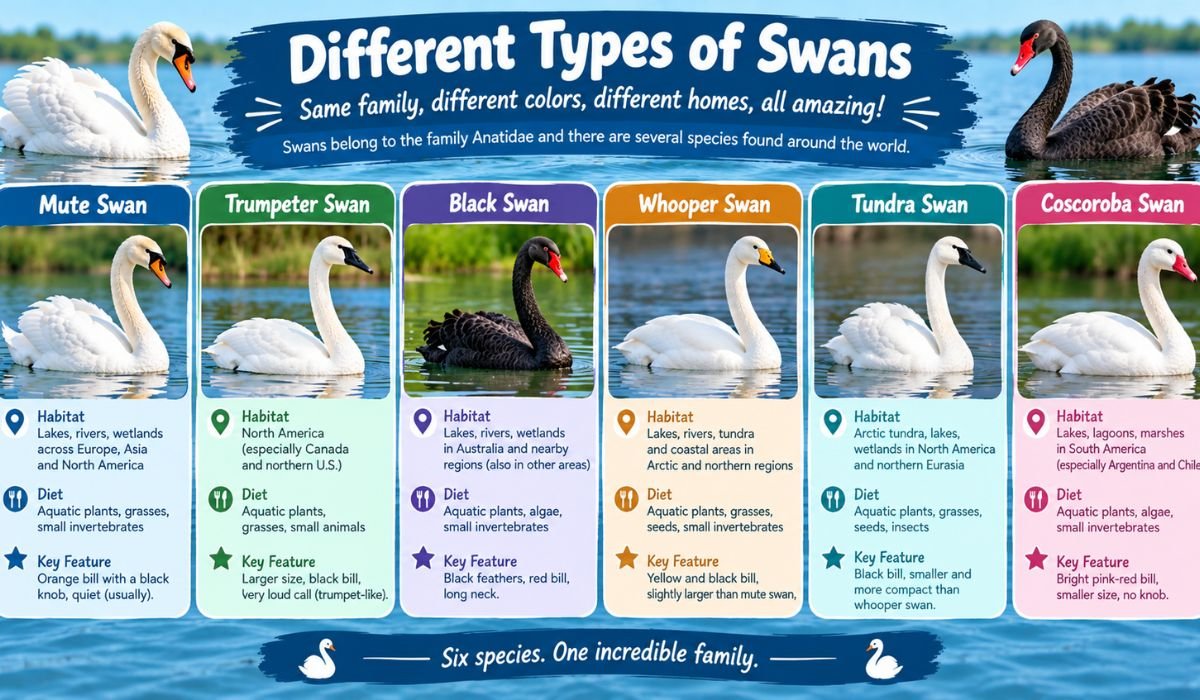
Several swan species live in different regions of the world.
Mute Swan
The mute swan is widely recognized by its white plumage and orange bill with a dark knob near the base. It is native to parts of Europe and Asia and has also been introduced elsewhere.
Whooper Swan
The whooper swan breeds in northern Europe and Asia. It is a large migratory species with a distinctive yellow-and-black bill.
Trumpeter Swan
The trumpeter swan is native to North America and is one of the world’s largest flying waterfowl. It has entirely white plumage and a mostly black bill.
Black Swan
The black swan is native to Australia. Its dark body and contrasting red-and-white bill make it easy to distinguish from many other swan species.
Black-Necked Swan
The black-necked swan lives in parts of South America. It has a white body, black neck, and distinctive red bill.
Are Swans Aggressive?
Swans are generally not aggressive without a reason, but they can become highly defensive around nests, mates, and young. During breeding season, adults may use warning displays when they perceive a threat.
These behaviors are an important part of swan facts because their graceful appearance can sometimes lead people to underestimate their strength. Giving wild swans adequate space is the safest way to observe them.
FAQ’s
What do swans eat?
Most swans primarily eat aquatic vegetation, grasses, algae, roots, leaves, and other plant material. Some may also consume small aquatic animals or invertebrates when available.
Where do swans live?
Swans live around lakes, rivers, ponds, wetlands, marshes, coastal lagoons, and other suitable aquatic habitats. Their exact range depends on the species.
What is a baby swan called?
A baby swan is called a cygnet. Cygnets stay with their parents while they develop their swimming, feeding, and flying abilities.
Are swans migratory?
Some swan species are strongly migratory, while others are partly migratory or mostly resident. Migration commonly occurs between northern breeding grounds and milder wintering areas.
How long do swans live?
Swans can live for many years in the wild. Lifespan varies by species, environmental conditions, disease, predators, and other factors.
Do swans mate for life?
Many swan species form long-term pair bonds, and some pairs remain together for multiple breeding seasons. However, pair relationships can change if circumstances change.
Can swans fly?
Yes. Swans are powerful fliers despite their large bodies. They require considerable space for takeoff in many situations and can travel long distances during migration.
Conclusion
These swan facts show why swans are remarkable waterfowl. Their long necks, powerful wings, webbed feet, specialized bills, and insulating feathers help them survive in aquatic environments around the world. From their plant-based diets and seasonal migrations to their strong parental care and distinctive life cycle, swans have many fascinating adaptations.
Learning about swan facts also highlights the importance of healthy wetlands, lakes, rivers, and coastal habitats. Protecting these environments provides swans with the food, shelter, and nesting areas they need throughout their lives.

Hi, I’m Amelia, an SEO and content specialist with several years of experience researching and creating informative content for online audiences. At Animal Attack Facts, I focus on animal behavior, animal attacks on humans, and interesting facts about land animals, marine animals, birds, reptiles, and insects. My goal is to provide clear, useful, and engaging information that helps readers better understand wildlife and stay informed about animal encounters.
1 thought on “Swan Facts: Habitat, Diet, Behavior, and Life Cycle”