
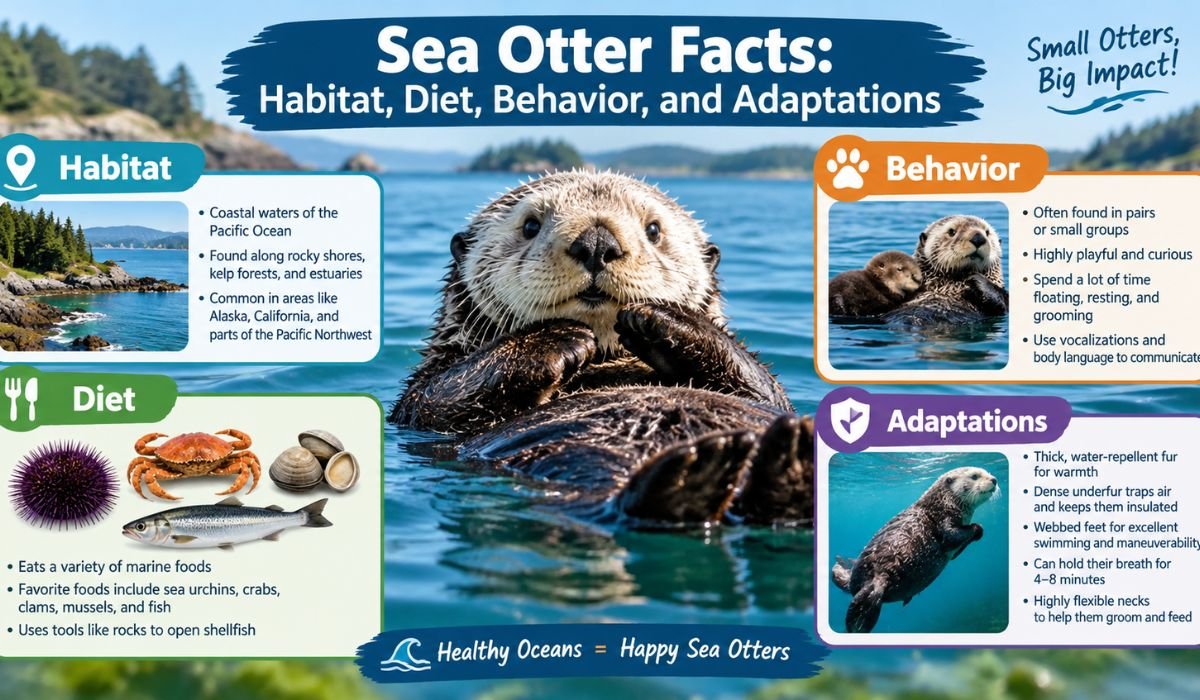
Sea otters are small marine mammals known for their playful behavior, dense fur, and ability to use tools. They spend most of their lives in coastal ocean habitats, where they feed on animals such as sea urchins, crabs, clams, and other invertebrates. These fascinating animals have several adaptations that help them survive in cold water.
In this guide to sea otter facts, you will learn about their habitat, diet, behavior, physical adaptations, reproduction, and role in marine ecosystems.
What Are Sea Otters?
Sea otters are marine mammals belonging to the weasel family, Mustelidae. Their scientific name is Enhydra lutris. Unlike many marine mammals, sea otters do not have a thick layer of blubber. Instead, they depend heavily on their exceptionally dense fur for insulation.
Adult sea otters typically have a streamlined body, short legs, webbed hind feet, and a long, muscular tail. Their front paws are highly dexterous and help them handle food and other objects.
One of the most interesting sea otter facts is that they are among the few animals known to regularly use tools. They may use rocks to break open hard-shelled prey.
Where Do Sea Otters Live?
Sea otters live along coastal waters of the northern and eastern Pacific Ocean. Their range includes parts of Russia, Alaska, British Columbia, Washington, California, and other areas where populations have been re-established.
They are commonly associated with shallow coastal waters, rocky shorelines, kelp forests, bays, and estuaries. Kelp forests are particularly important because they provide food and shelter.
Unlike many land mammals, sea otters spend most of their time in the water. They may rest while floating on their backs and can even sleep while drifting on the ocean surface.
Sea Otter Habitat
A sea otter’s habitat provides both food and protection. Kelp forests can create complex underwater environments where many marine organisms live.
Sea otters may also wrap themselves in kelp while resting. This can help keep them from drifting away with currents.
Their coastal habitat can vary considerably. Some populations live near rocky shores, while others occupy sheltered bays and areas with extensive kelp beds.
Healthy coastal ecosystems are therefore important for maintaining sea otter populations.
What Do Sea Otters Eat?
Sea otters are carnivores with a varied diet. Their prey can include:
- Sea urchins
- Crabs
- Clams
- Mussels
- Snails
- Abalone
- Other marine invertebrates
- Occasionally fish
Sea otters often search for prey underwater. They can use their sensitive front paws to locate and handle food.
One of the most famous sea otter facts is their tool use. An otter may place a rock on its chest and repeatedly strike a shell against it until the shell opens.
Read Related Post: Camel Facts: Habitat, Diet, and Desert Adaptations
How Do Sea Otters Find Food?
Sea otters can dive underwater to search for prey along the seafloor. Their whiskers and sensitive paws help them detect objects even when visibility is poor.
After finding prey, an otter may bring it to the surface. It can then hold the food between its front paws while floating on its back.
Sea otters have strong teeth and jaws that allow them to crush or chew many types of hard-shelled prey.
Sea Otter Adaptations
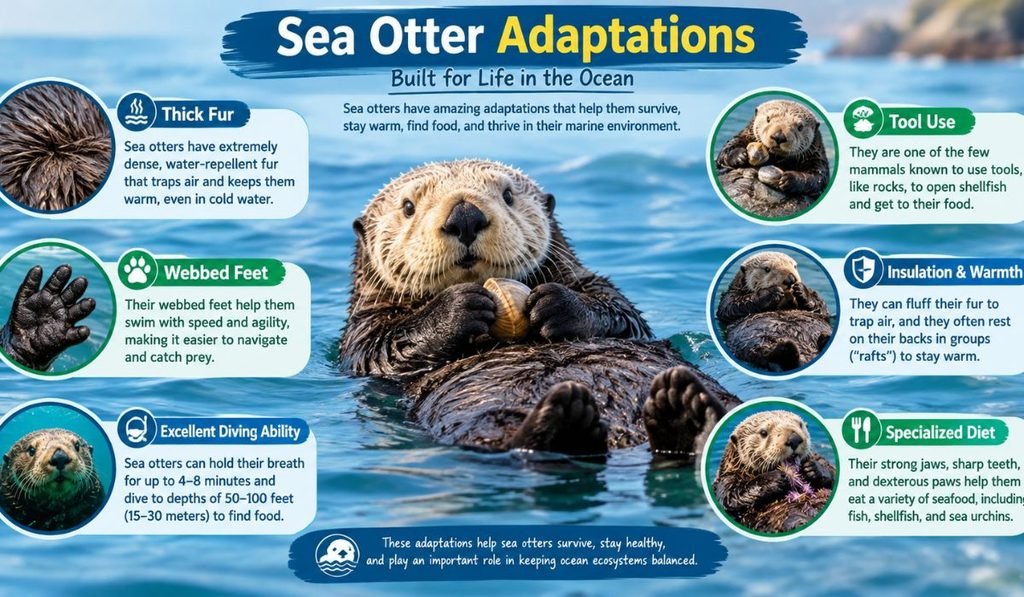
Sea otters have several remarkable adaptations that allow them to survive in cold marine environments.
Extremely Dense Fur
Sea otters have exceptionally dense fur. Rather than relying on blubber, they maintain body temperature with their thick coat.
They spend considerable time grooming their fur. Keeping the coat clean and properly arranged helps maintain its insulating properties.
Webbed Feet
Their hind feet are broad and webbed, making them effective for swimming. The tail also helps with steering and movement through the water.
Sensitive Paws
Their front paws are flexible and sensitive. These paws are useful for finding prey, handling food, and manipulating objects.
Strong Teeth
Sea otters have powerful teeth adapted for eating hard-shelled prey. Their molars can crush shells and other tough food items.
Large Lungs
Sea otters are capable swimmers and can remain underwater for several minutes during dives. Their bodies are well adapted to repeated diving and surfacing.
Sea Otter Behavior
Sea otters are intelligent and active animals. They spend much of their day searching for food, eating, grooming, resting, and interacting with other otters.
They often float on their backs while resting or feeding. Groups of resting otters can sometimes hold onto one another or become entangled with kelp.
Although sea otters can live alone, females and their pups commonly stay together. Other groups may contain several individuals resting or feeding in the same general area.
Do Sea Otters Use Tools?
Yes. Tool use is one of the most remarkable sea otter facts.
Sea otters can use rocks or other hard objects to open prey with tough shells. An otter may hold the tool against its body and strike a clam, mussel, or other shellfish against it.
This behavior allows sea otters to access food that would otherwise be difficult to open.
How Do Sea Otters Reproduce?
Sea otters generally reproduce throughout the year, although timing can vary between populations.
Female sea otters usually give birth to a single pup. Newborn pups are dependent on their mothers for warmth, protection, and food.
A young pup has buoyant baby fur that helps keep it at the water’s surface. The mother carries and cares for the pup until it becomes increasingly independent.
Mother and pup relationships are an important part of sea otter behavior.
How Long Do Sea Otters Live?
Sea otters can live for many years in the wild, although lifespan varies depending on environmental conditions, food availability, disease, predators, and other factors.
Survival can be especially challenging for young otters because they depend on their mothers during their early development.
Why Are Sea Otters Important?
Sea otters play an important role in coastal ecosystems. One particularly important relationship involves sea otters and sea urchins.
Sea urchins feed on kelp. When sea otters consume large numbers of sea urchins, they can help reduce grazing pressure on kelp forests.
This relationship is an example of how a predator can influence an entire ecosystem.
Kelp forests provide habitat for numerous marine species, so changes in sea otter populations can have effects beyond the otters themselves.
What Threatens Sea Otters?
Sea otters face several threats, depending on their location. These can include:
- Oil pollution
- Disease
- Parasites
- Food shortages
- Entanglement in fishing equipment
- Habitat changes
- Predation
- Human-related disturbances
Oil spills are especially dangerous because sea otters depend on their fur for insulation. Contamination can interfere with the protective properties of their coat.
Conservation programs focus on protecting habitat, reducing human-caused threats, monitoring populations, and improving understanding of sea otter health.
Interesting Sea Otter Facts
Here are some additional sea otter facts worth knowing:
- Sea otters are members of the weasel family.
- They spend much of their lives in the ocean.
- Their fur is extremely dense and provides insulation.
- They do not depend on a thick layer of blubber for warmth.
- Sea otters often eat sea urchins, crabs, clams, and mussels.
- They can use rocks as tools to open hard-shelled prey.
- They frequently float on their backs while resting and feeding.
- Their front paws are highly sensitive and flexible.
- Mothers carry and care for their pups in the water.
- Sea otters can influence the health of kelp forest ecosystems.
FAQ’s
What are the most interesting sea otter facts?
Some of the most interesting sea otter facts include their extremely dense fur, tool use, floating lifestyle, sensitive paws, and important role in kelp forest ecosystems.
What do sea otters eat?
Sea otters mainly eat marine invertebrates such as sea urchins, crabs, clams, mussels, snails, and other hard-shelled animals. Some also eat fish.
Where do sea otters live?
Sea otters live primarily in coastal waters of the North Pacific. They are commonly found around rocky shorelines, bays, estuaries, and kelp forests.
Do sea otters use tools?
Yes. Sea otters are well known for using rocks and other objects to break open hard-shelled prey.
Why are sea otters important?
Sea otters can help regulate sea urchin populations. This can reduce grazing pressure on kelp and contribute to healthier coastal ecosystems.
How do sea otters stay warm?
Sea otters rely heavily on their extremely dense fur for insulation. Regular grooming helps keep the fur effective at trapping insulating air.
Conclusion
Sea otters are remarkable marine mammals with specialized adaptations for life in cold coastal waters. Their dense fur, webbed feet, sensitive paws, strong teeth, and tool-using abilities help them find food and survive in their environment.
These sea otter facts also show why the species is important beyond its own survival. By influencing sea urchin populations and kelp forests, sea otters can play a significant role in coastal ecosystems. Protecting their habitats and reducing threats such as pollution and human disturbance is important for maintaining healthy marine environments.

Hi, I’m Amelia, an SEO and content specialist with several years of experience researching and creating informative content for online audiences. At Animal Attack Facts, I focus on animal behavior, animal attacks on humans, and interesting facts about land animals, marine animals, birds, reptiles, and insects. My goal is to provide clear, useful, and engaging information that helps readers better understand wildlife and stay informed about animal encounters.
1 thought on “Sea Otter Facts: Habitat, Diet, Behavior, and Adaptations”