
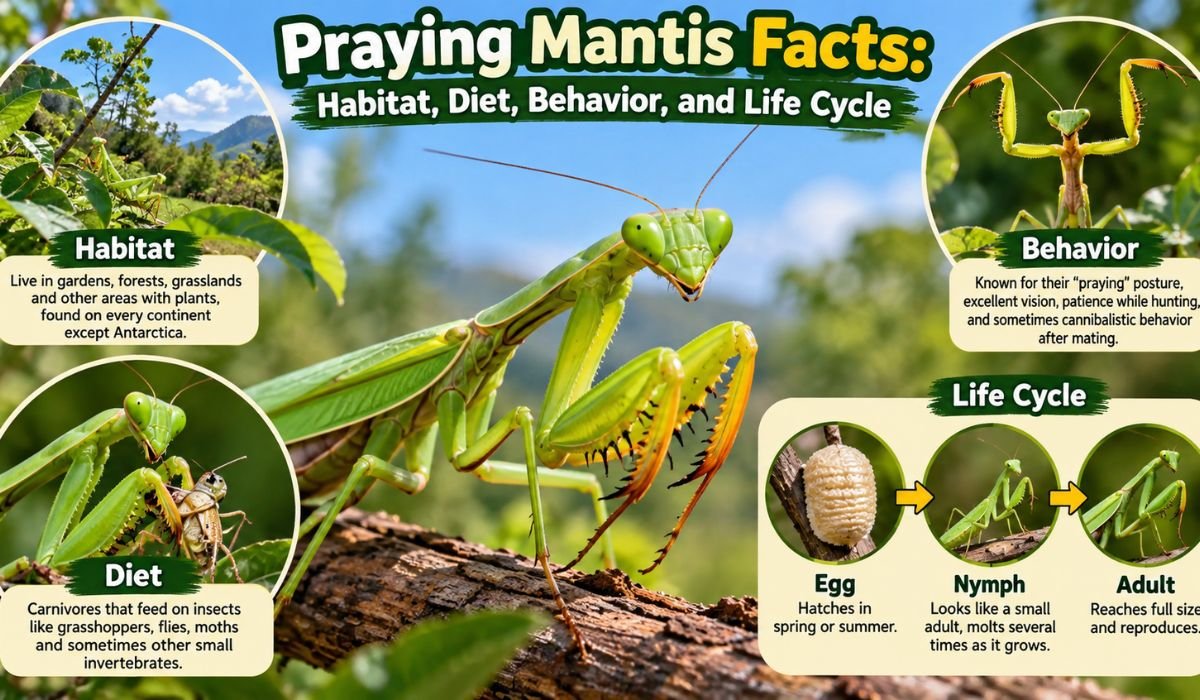
Praying mantises are fascinating insects known for their unusual appearance, powerful front legs, and remarkable hunting abilities. There are thousands of mantis species found in different parts of the world, living in forests, grasslands, gardens, and other environments. These insects are generally recognized by their triangular heads, long bodies, and folded front legs that look as if they are held in prayer. Learning praying mantis facts reveals how these insects survive, hunt, reproduce, and adapt to their surroundings.
What Is a Praying Mantis?
A praying mantis is a predatory insect belonging to the order Mantodea. Mantises are closely associated with warm environments, although different species have adapted to a wide range of habitats. They vary considerably in size, color, and appearance.
One of the most recognizable praying mantis facts is that mantises can turn their heads much farther than most insects. Their flexible neck allows them to observe potential prey while keeping their bodies relatively still.
Mantises have large compound eyes that help them detect movement. They also have three simple eyes, called ocelli, located between their larger eyes. Their excellent vision is especially useful when they are waiting for prey.
Where Do Praying Mantises Live?
Praying mantises can be found on several continents, although their distribution depends on the species. They commonly inhabit warm and temperate regions.
Typical mantis habitats include:
- Grasslands and meadows
- Forest edges
- Shrublands
- Agricultural areas
- Gardens
- Bushes and low vegetation
- Tropical forests
Some species are highly adapted to particular environments. For example, certain mantises have colors and body shapes that help them blend into leaves, branches, flowers, or dry vegetation.
Another interesting aspect of praying mantis facts is their ability to remain hidden in plain sight. Their camouflage can make them difficult for both predators and humans to notice.
What Do Praying Mantises Eat?
Praying mantises are carnivorous predators. They mainly eat other insects and small animals that they can capture with their specialized front legs.
Their diet may include:
- Flies
- Moths
- Crickets
- Grasshoppers
- Beetles
- Butterflies
- Other insects
Larger mantises may sometimes capture small vertebrates, such as small lizards or frogs, when an opportunity arises. However, insects and other arthropods make up much of their normal diet.
Young mantises, known as nymphs, generally begin feeding on small prey after leaving their egg case. As they grow, they can take on larger prey.
Read Related Post: Swan Facts: Habitat, Diet, Behavior, and Life Cycle
How Do Praying Mantises Hunt?
Praying mantises are ambush predators. Instead of constantly chasing prey, they often remain still and wait for an animal to come close enough to capture.
Their folded front legs are specially adapted for grabbing prey. These legs are called raptorial legs and have sharp spines that help hold captured animals securely.
When prey comes within range, the mantis can extend its front legs extremely quickly. It then uses its mouthparts to consume the captured food.
One of the most remarkable praying mantis facts is how strongly these insects depend on patience and camouflage. A mantis may remain motionless for a long period before making a sudden movement to catch prey.
Praying Mantis Appearance and Body Structure
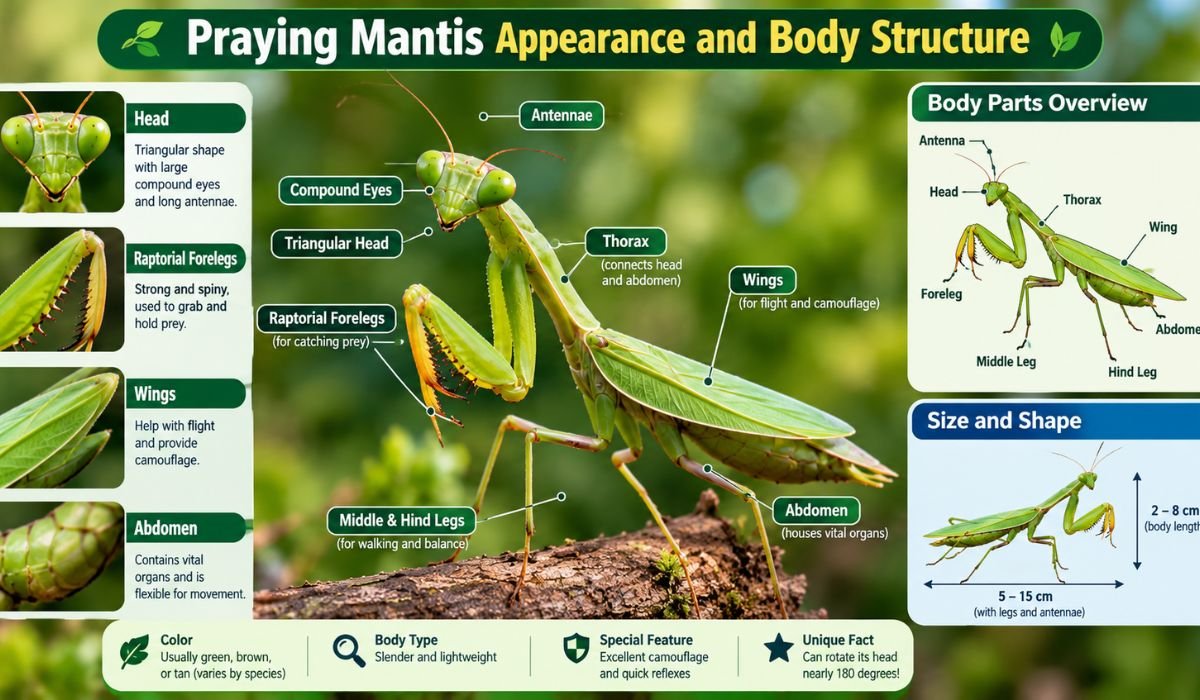
A praying mantis usually has a long body, a triangular head, large eyes, and six legs. The front pair of legs is much more specialized than the other four legs.
The body is divided into three main sections:
- Head
- Thorax
- Abdomen
Mantises have wings in many species, although not every mantis is capable of strong flight. In some species, females have reduced wings or wings that are less useful for flying.
Colors can range from green and brown to gray and other shades. These colors often provide camouflage in the environments where the mantis lives.
Praying Mantis Behavior
Mantises display several interesting behaviors that help them survive. They often move slowly and deliberately when approaching prey or changing locations.
Some species also use body movements as part of defensive behavior. If threatened, a mantis may spread its wings and raise its front legs to appear larger.
Their behavior can also be influenced by temperature, light, food availability, and reproductive activity.
Many praying mantis facts demonstrate that these insects are highly specialized predators rather than simply passive insects waiting for food.
How Do Praying Mantises Reproduce?
Praying mantises reproduce sexually. After mating, the female produces an egg case called an ootheca. The ootheca protects the developing eggs and may be attached to vegetation, branches, rocks, or other surfaces.
The number of eggs inside an ootheca varies depending on the species. When conditions are suitable, young mantises eventually emerge.
A newly hatched mantis is called a nymph. It resembles a miniature adult but does not yet have the complete body structure or reproductive maturity of an adult.
An important part of praying mantis facts is that mantises undergo incomplete metamorphosis. Their development does not include a pupal stage.
Praying Mantis Life Cycle
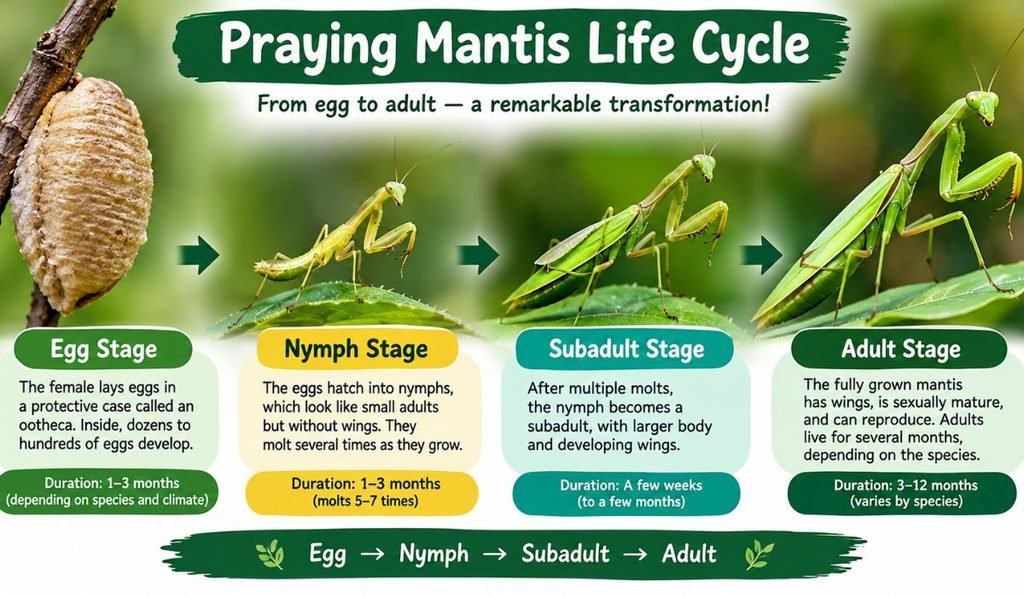
The praying mantis life cycle consists of several stages:
1. Egg
The life cycle begins when eggs are deposited inside a protective ootheca. The egg case helps protect the developing young from environmental conditions and predators.
2. Nymph
Young mantises emerge from the ootheca as nymphs. They look similar to adults but are smaller and immature.
Nymphs must feed and grow as they develop. Because their external skeleton cannot expand continuously, they shed their exoskeleton several times.
3. Molting
During growth, a mantis goes through several molts. Each molt allows the insect to become larger and develop toward its adult form.
This stage is particularly important because the insect is temporarily vulnerable while its new outer covering hardens.
4. Adult
After completing its final molt, the mantis becomes an adult. Adult mantises are capable of reproduction, and many species develop fully formed wings at this stage.
The length of the entire life cycle varies among species and is strongly influenced by environmental conditions.
Do Praying Mantises Fly?
Some adult praying mantises can fly, but flying ability differs between species and sexes. Male mantises are often more capable of flight because they tend to have lighter bodies and well-developed wings.
Females in some species have heavier bodies and may fly less frequently. In other species, wings can be reduced or absent.
Flight can help mantises search for mates, move between habitats, or escape threats.
Do Praying Mantises Bite?
Praying mantises are capable of biting, but they generally do not pose a significant threat to humans. They are primarily interested in catching prey rather than interacting with people.
Their strong mouthparts are designed for eating insects and other small animals. Like many wild animals, a mantis may defend itself if handled or seriously threatened.
It is usually best to observe a mantis without disturbing it.
Do Praying Mantises Have Predators?
Despite being skilled predators themselves, mantises can become prey for other animals. Birds, reptiles, amphibians, spiders, and larger insects may prey on mantises.
Egg cases and young nymphs can also be vulnerable to predators. Camouflage is therefore an important survival strategy.
Some mantises resemble leaves, sticks, flowers, or other parts of vegetation. This allows them to remain difficult to detect while hunting and avoiding predators.
Why Are Praying Mantises Important?
Praying mantises are part of food webs and contribute to the balance of insect populations. Because they eat many different insects, they are predators within their ecosystems.
They can also become prey for birds and other animals, making them an important link between different levels of the food chain.
However, mantises do not distinguish between insects that humans consider helpful and those considered pests. They may eat beneficial insects as well as insects that damage plants.
Interesting Praying Mantis Facts
Here are some additional praying mantis facts worth knowing:
- Mantises have triangular heads and large compound eyes.
- Their specialized front legs are used to capture prey.
- Many species rely heavily on camouflage.
- Mantises can turn their heads to observe their surroundings.
- They are primarily carnivorous insects.
- Young mantises are called nymphs.
- Mantises grow by molting their exoskeletons.
- Their eggs are protected inside an ootheca.
- Some adult mantises can fly.
- Different species can have very different colors and body shapes.
- Mantises can live in gardens, forests, grasslands, and other habitats.
- They are predators as well as prey within ecosystems.
How Long Do Praying Mantises Live?
The lifespan of a praying mantis depends on its species, environment, temperature, food availability, and other conditions. Many mantises have relatively short lifespans compared with larger animals.
In many species, the life cycle from egg to adult takes place within a single year. Adults eventually reproduce, and the next generation begins when new eggs develop inside oothecae.
Because their lives can be relatively short, mantises spend much of their development growing and preparing for adulthood and reproduction.
FAQ’s
What are the most interesting praying mantis facts?
Some of the most interesting praying mantis facts include their ability to turn their heads, their specialized hunting legs, excellent vision, camouflage, and unusual reproductive behavior. Their life cycle also includes several molts but no pupal stage.
Where do praying mantises live?
Praying mantises live in many habitats, including grasslands, forests, gardens, shrublands, agricultural areas, and tropical environments. Their preferred habitat depends on the species.
What do praying mantises eat?
Praying mantises mainly eat insects such as flies, moths, crickets, grasshoppers, and beetles. Larger species may occasionally capture small vertebrates.
How do praying mantises catch their food?
Mantises usually use an ambush strategy. They remain still until prey approaches and then rapidly extend their specialized front legs to grab it.
What is a baby praying mantis called?
A young praying mantis is called a nymph. It resembles a small adult and grows through several molts before reaching maturity.
How do praying mantises reproduce?
Female mantises produce a protective egg case called an ootheca. Eggs develop inside the case, and young nymphs eventually emerge.
Can praying mantises fly?
Some praying mantis species can fly as adults. Flight ability varies between species and can also differ between males and females.
Conclusion
Praying mantises are remarkable insects with specialized bodies and behaviors that help them survive as predators. From their powerful raptorial legs and excellent vision to their camouflage and unusual life cycle, these insects have many fascinating adaptations. Understanding praying mantis facts also shows how they fit into ecosystems as both predators and prey. Whether found in a garden, grassland, or forest, a praying mantis is a fascinating example of insect adaptation and survival.

Hi, I’m Amelia, an SEO and content specialist with several years of experience researching and creating informative content for online audiences. At Animal Attack Facts, I focus on animal behavior, animal attacks on humans, and interesting facts about land animals, marine animals, birds, reptiles, and insects. My goal is to provide clear, useful, and engaging information that helps readers better understand wildlife and stay informed about animal encounters.
1 thought on “Praying Mantis Facts: Habitat, Diet, Behavior, and Life Cycle”