
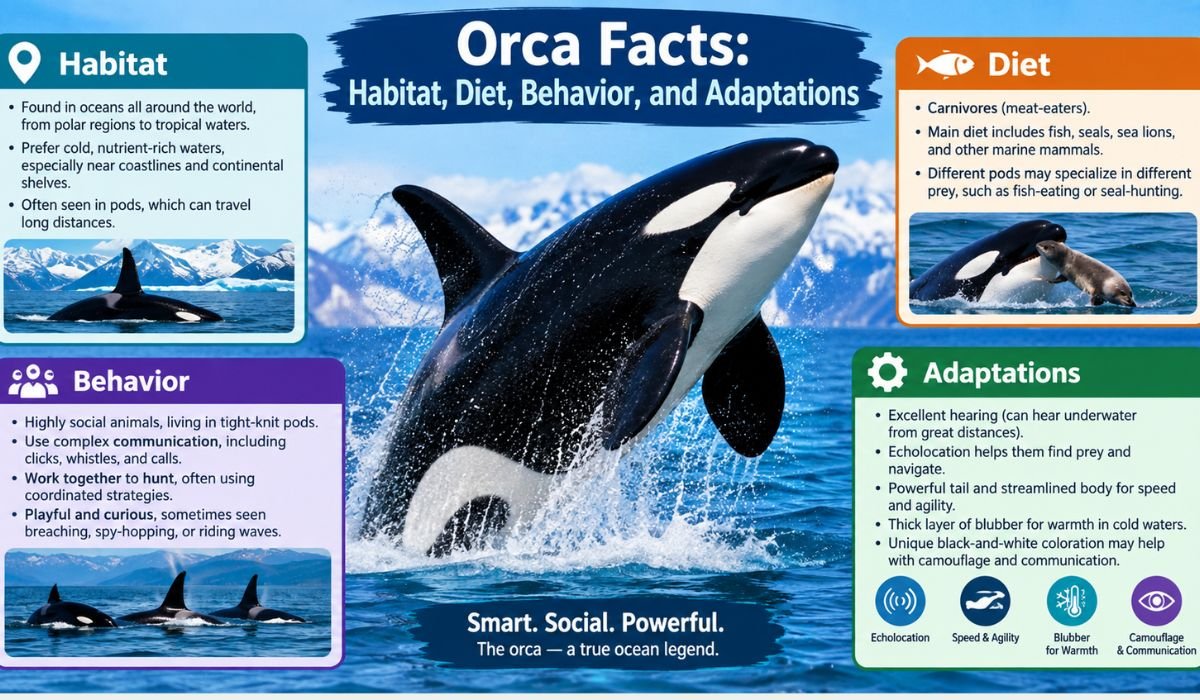
Orcas, also called killer whales, are highly intelligent marine mammals found throughout the world’s oceans. They are known for their striking black-and-white appearance, powerful bodies, complex communication and cooperative hunting strategies. Although they are called killer whales, orcas are actually the largest members of the dolphin family.
These fascinating animals live in a wide variety of marine environments, from cold polar waters to warmer tropical seas. Different populations can have distinct diets, behaviors, social structures, and hunting techniques. Understanding orca facts helps explain how these remarkable predators survive in such diverse environments.
What Is an Orca?
An orca (Orcinus orca) is a toothed whale belonging to the dolphin family, Delphinidae. Orcas are apex predators, meaning adult orcas generally have no natural predators in their marine ecosystems.
One of the most interesting orca facts is that they are dolphins rather than members of the true whale families. Their streamlined bodies, tall dorsal fins, and powerful tails allow them to travel efficiently through the water.
Orcas are highly social animals and usually live in groups called pods. These groups can contain related individuals that cooperate when traveling, communicating, and finding food.
Orca Size and Physical Characteristics
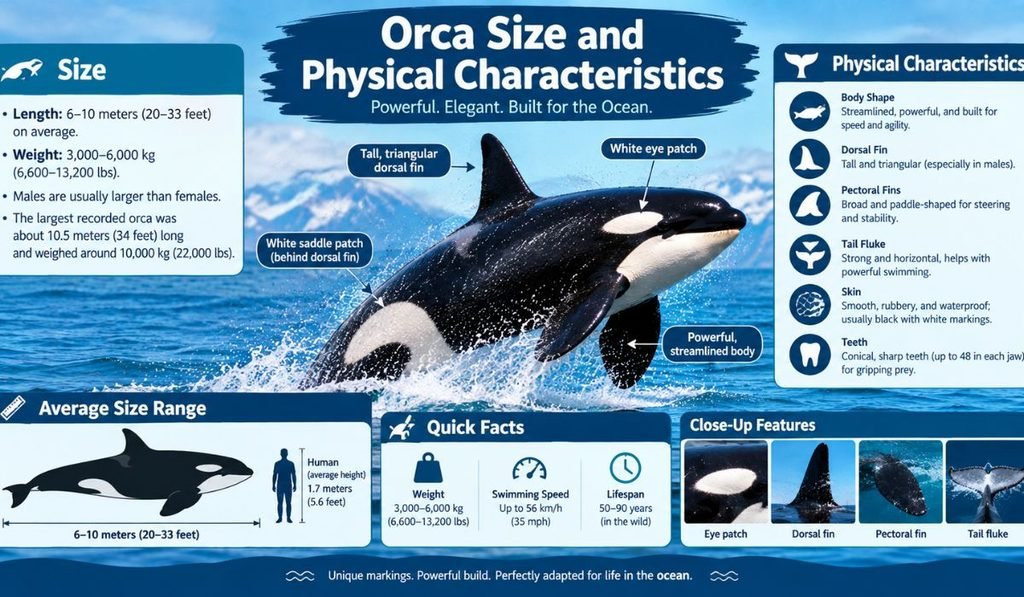
Orcas have a distinctive appearance that makes them easy to recognize. Their bodies are mostly black on the back and white underneath, with a white patch behind each eye and a lighter area on the underside.
Adult males are generally larger than females. Males can reach around 9 meters (30 feet) in length, while females are usually smaller. Males also develop much taller dorsal fins, which can reach approximately 1.8 meters (6 feet) in height.
Orcas have powerful jaws containing numerous conical teeth. Their teeth are adapted for gripping prey rather than chewing it. Their strong muscles and streamlined bodies make them effective hunters.
Where Do Orcas Live?
Orcas have one of the widest distributions of any marine mammal. They can be found in oceans around the world, including the Arctic, Antarctic, Atlantic, Pacific, and Indian Oceans.
They are particularly common in productive coastal and polar waters, where large quantities of prey are available. However, some populations travel across open ocean environments.
Another important point among orca facts is that not all populations use the same habitat. Some remain within relatively limited areas, while others travel considerable distances in search of food.
What Do Orcas Eat?
Orcas are carnivores with diets that vary considerably between populations. Depending on where they live, they may eat fish, squid, seabirds, sea turtles, and marine mammals.
Some populations specialize heavily in fish, particularly salmon and other schooling fish. Other populations primarily hunt marine mammals such as seals, sea lions, and smaller cetaceans.
This dietary specialization is one of the most important orca facts because it demonstrates how different groups can develop unique hunting traditions. Orcas may pass successful hunting techniques from older individuals to younger members of their pod.
How Do Orcas Hunt?
Orcas use intelligence, cooperation, communication, and physical strength when hunting. Their hunting methods can vary depending on the prey and environment.
Some groups work together to herd fish into concentrated groups before feeding. Others use coordinated movements to separate marine mammals from larger groups.
In certain environments, orcas can create waves to wash animals from floating ice. These specialized techniques require coordination and timing.
Orcas also use echolocation to detect objects and prey underwater. They produce sounds and interpret returning echoes to understand their surroundings.
Read Related Post: Horse Facts: Habitat, Diet, Behavior, and More
Orca Social Behavior
Social relationships are a major part of orca life. Pods can consist of mothers, offspring, and other related individuals that cooperate closely.
Young orcas learn many important behaviors from older members of their groups. These may include where to find food, how to hunt particular prey, and how to communicate effectively.
Some orca populations have stable social structures that can persist for many years. Family relationships can therefore play an important role in survival.
Orca Communication
Orcas communicate using clicks, whistles, and pulsed calls. Different groups can have distinctive vocal patterns.
These sounds help orcas maintain contact, coordinate activities, and communicate while traveling through the ocean. Their communication systems are particularly interesting because some vocal behaviors are learned socially.
Orca calves gradually learn the sounds and behaviors used by their social group. This is another example of how knowledge can be passed between generations.
Orca Intelligence
Among the most remarkable orca facts is their sophisticated behavior. Orcas can solve problems, cooperate during hunts, learn from other individuals, and adapt their strategies to different situations.
Their intelligence is closely connected with their social lives. Living in groups gives young orcas opportunities to observe experienced members and learn important survival behaviors.
Different populations can also develop specialized hunting traditions. These traditions are sometimes described as cultural behaviors because they are learned and passed through generations.
Orca Adaptations
Orcas have several adaptations that help them survive in marine environments.
Streamlined Body
Their streamlined bodies reduce resistance as they move through water. This allows them to travel efficiently while searching for prey or moving between areas.
Powerful Tail
The muscular tail provides the main source of propulsion. Orcas can use it to accelerate quickly and maneuver while pursuing prey.
Echolocation
Echolocation helps orcas locate objects and prey underwater, especially when visibility is limited.
Thick Blubber
A layer of fat beneath the skin helps insulate orcas from cold water. This adaptation is especially important for populations living in polar and subpolar environments.
Specialized Teeth
Their strong teeth allow them to grasp and tear prey. Different populations may target different prey depending on their environment and learned hunting traditions.
Orca Reproduction and Life Cycle
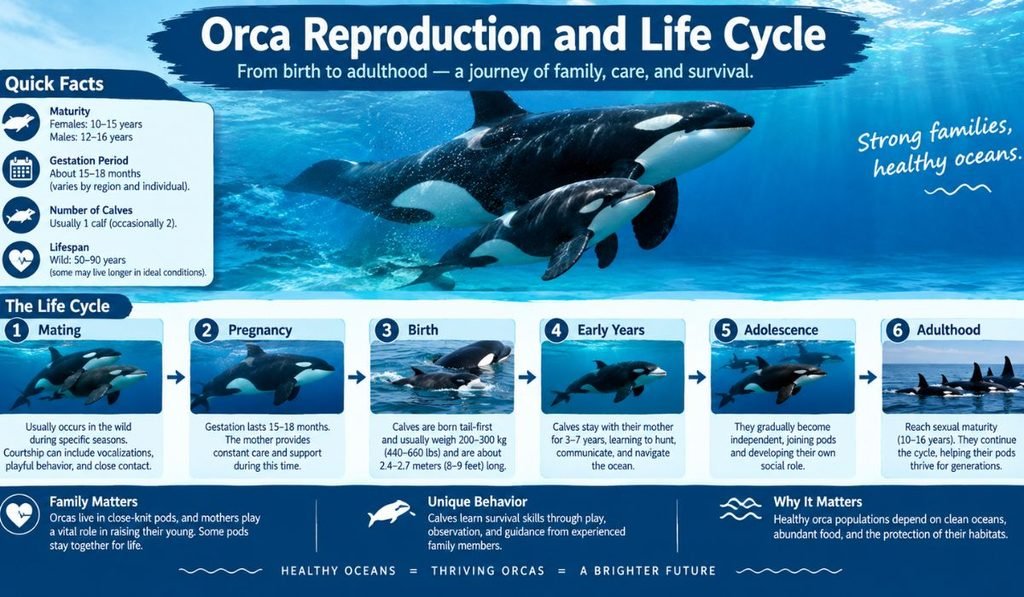
Female orcas give birth to a single calf after a long pregnancy. Calves depend heavily on their mothers during their early development.
Young orcas learn important survival skills by observing members of their social group. Mothers and other pod members can play important roles in protecting and teaching calves.
Females may have several calves during their lifetime, although reproduction does not occur continuously.
How Long Do Orcas Live?
Orca lifespan varies between individuals and populations. Females can live for several decades, and some females have been documented at much older ages. Males generally have shorter lifespans than females.
One interesting aspect of orca biology is that females can live for many years after they stop reproducing. Their continued presence within a social group may provide important knowledge and experience.
Are Orcas Dangerous?
Orcas are powerful predators, but their behavior toward humans in the wild is very different from their behavior toward natural prey. There are no well-documented cases of a wild orca killing a human.
However, orcas are large, strong wild animals and should always be observed responsibly. Their size, speed, and hunting abilities make maintaining a safe distance important when encountering them in the ocean.
Orcas and Their Role in the Ocean
As apex predators, orcas can influence marine ecosystems by affecting the populations and behavior of their prey. Their ecological role varies between different populations because their diets are not identical.
Fish-eating orcas, for example, can have different ecological effects from populations that specialize in marine mammals.
Studying these differences gives scientists a better understanding of marine food webs and the relationships between predators and prey.
Conservation Challenges Facing Orcas
Orcas face several environmental challenges. Depending on the population, these may include reduced prey availability, chemical pollution, underwater noise, habitat changes, and interactions with human activities.
The impact of these threats differs among populations. Some groups have experienced declines linked to changes in food availability and environmental conditions.
Protecting healthy marine ecosystems, maintaining adequate prey populations, reducing harmful pollution, and limiting unnecessary disturbance can help support vulnerable orca populations.
Frequently Asked Questions About Orca Facts
What are the most interesting orca facts?
Some of the most interesting orca facts include their membership in the dolphin family, sophisticated communication, cooperative hunting, strong family relationships, and ability to learn specialized behaviors from older members of their pods.
Where do orcas live?
Orcas live in oceans around the world, from polar waters to tropical regions. Their distribution is particularly associated with areas where suitable prey is abundant.
What do orcas eat?
Orcas eat a wide range of prey depending on their population. Their diets can include fish, squid, seabirds, seals, sea lions, and other marine mammals.
Are orcas dolphins?
Yes. Orcas belong to the dolphin family and are the largest members of that family.
How do orcas communicate?
Orcas communicate using several types of sounds, including clicks, whistles, and pulsed calls. They also use echolocation to gather information about their underwater surroundings.
How do orcas hunt?
Orcas use different hunting techniques depending on their prey and habitat. They can cooperate to herd fish, separate prey, or create waves and other coordinated movements.
What adaptations help orcas survive?
Important adaptations include a streamlined body, powerful tail, thick blubber, echolocation, strong teeth, and highly developed social and learning abilities.
Do orcas live in groups?
Yes. Orcas commonly live in social groups called pods. These groups can include related individuals that cooperate during travel, hunting, and other activities.
Conclusion
Orcas are among the most fascinating predators in the world’s oceans. Their intelligence, social relationships, communication abilities, and specialized hunting techniques make them exceptionally interesting marine mammals. Their powerful bodies and physical adaptations also allow them to survive in environments ranging from tropical waters to polar seas.
The most important orca facts show that these animals are not simply powerful hunters. They are highly social creatures capable of learning behaviors from other members of their groups. Understanding their biology and the challenges facing different populations can help people appreciate the important role orcas play in marine ecosystems.

Hi, I’m Amelia, an SEO and content specialist with several years of experience researching and creating informative content for online audiences. At Animal Attack Facts, I focus on animal behavior, animal attacks on humans, and interesting facts about land animals, marine animals, birds, reptiles, and insects. My goal is to provide clear, useful, and engaging information that helps readers better understand wildlife and stay informed about animal encounters.
1 thought on “Orca Facts: Habitat, Diet, Behavior, and Adaptations”