
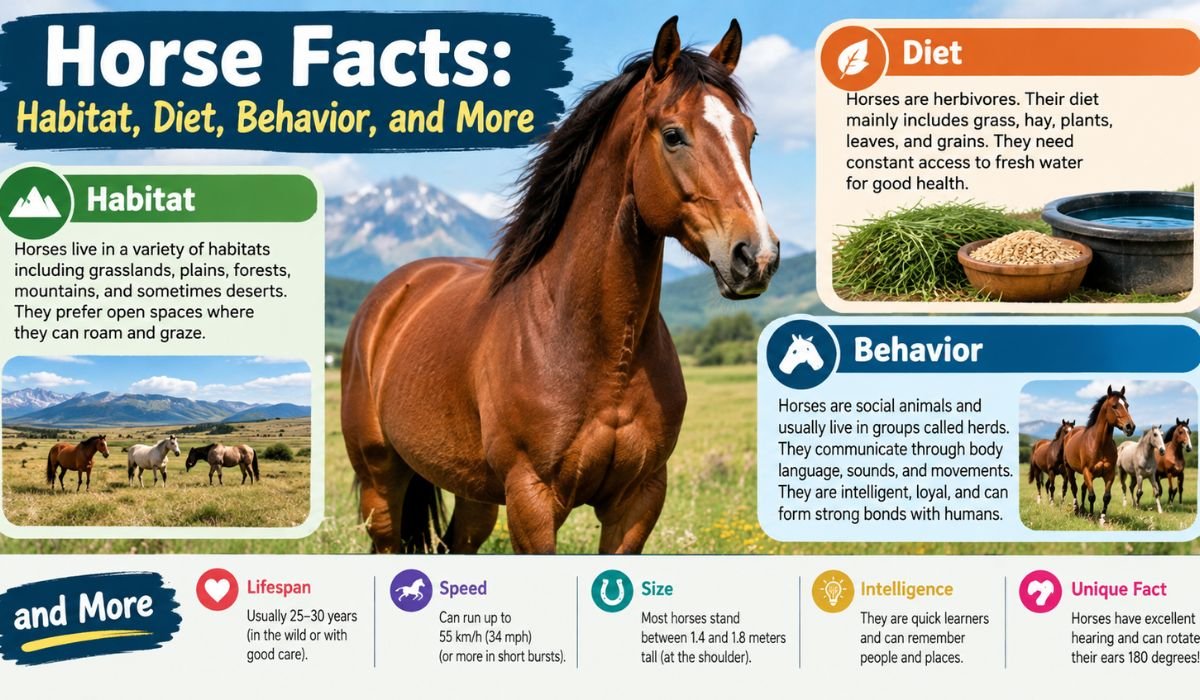
Horses are among the most familiar and fascinating mammals in the world. They have lived alongside humans for thousands of years and have played important roles in transportation, agriculture, sport, and culture.
From their powerful legs and remarkable speed to their social behavior and excellent senses, horses have many interesting characteristics. In this guide to horse facts, you will learn about their habitat, diet, behavior, physical features, communication, lifespan, and other important facts about these remarkable animals.
What Is a Horse?
A horse is a large domesticated mammal belonging to the family Equidae. Its scientific name is Equus caballus. Horses are closely related to donkeys and zebras.
Horses are herbivores, meaning they mainly eat plant material. They have strong bodies, long legs, hooves, and teeth adapted for grazing. Although domestic horses are common around the world, wild populations and closely related wild equids also live in different natural environments.
One of the most interesting horse facts is that horses have evolved as grazing animals. Their digestive system allows them to spend many hours each day eating relatively small amounts of plant material.
Horse Habitat
Domestic horses can live in many different environments because humans have introduced them to almost every part of the world. They may be found on farms, grasslands, ranches, stables, and open countryside.
In natural or semi-wild conditions, horses generally prefer areas where food and water are available. Grasslands, plains, open woodlands, and other areas with vegetation can provide suitable habitat.
Horses need access to fresh water, nutritious vegetation, shelter, and enough space to move around. Their environment can have a major effect on their health and behavior.
Where Do Wild Horses Live?
Some free-roaming horse populations live in open grasslands, deserts, scrublands, and mountainous regions. The term “wild horse” is sometimes used for horses that live freely, although some populations are technically descended from domesticated horses rather than being truly wild in origin.
These horses often travel in groups while searching for food and water. Their ability to adapt to different environments is one reason horses have become widespread.
What Do Horses Eat?
Horses are herbivores and naturally spend much of their time feeding. Their diet commonly includes grasses, leaves, and other plant material.
Domestic horses may also receive hay, grains, vegetables, and specially formulated feeds depending on their nutritional needs and level of activity. Their diet should be balanced because too much concentrated food can cause health problems.
How Do Horses Eat?
Horses use their front teeth to bite or clip vegetation and their back teeth to grind food. Their lips are also highly sensitive and help them select and manipulate food.
Another interesting point among horse facts is that horses are often described as “trickle feeders.” They naturally eat small amounts over many hours rather than consuming one or two very large meals.
Read Related Post: Grasshopper Facts: Habitat, Diet, Life Cycle, and Behavior
Horse Physical Features
Horses have several physical adaptations that help them survive and move efficiently. Their long legs and strong muscles allow them to walk, trot, canter, and gallop.
Their hooves are especially important. Each horse has one main weight-bearing toe on each foot, protected by a hard hoof. Strong hooves allow horses to travel across different types of terrain.
Horses also have large eyes positioned toward the sides of their heads. This gives them a wide field of vision and helps them detect potential dangers around them.
Their ears can move independently, allowing horses to focus on sounds coming from different directions.
Horse Behavior
Horses are social animals that naturally form groups. Living in groups can provide protection because several animals can watch for potential threats.
Horses communicate through body movements, sounds, facial expressions, and physical contact. Ear position, tail movement, posture, and facial expressions can all provide information about a horse’s mood or intentions.
A horse may become alert when it notices something unusual. It may raise its head, move its ears toward a sound, or change its posture.
Understanding these behaviors is an important part of caring for domestic horses. Horse facts about communication show how much horses rely on subtle physical signals when interacting with other horses and humans.
Do Horses Have Social Relationships?

Yes. Horses can form strong social bonds with other horses. They may spend time near preferred companions, groom each other, and coordinate their movements.
In groups, horses may develop social structures in which individual animals have different relationships with one another. Stable companionship and regular interaction can therefore be important for their well-being.
How Fast Can a Horse Run?
Horses are capable of impressive speeds, particularly when galloping. The exact speed depends on the horse’s breed, body condition, training, and individual ability.
Some racehorses can reach speeds of roughly 40 miles per hour (64 kilometers per hour) over short distances.
Horses have powerful hindquarters that help generate speed. Their long legs and flexible movement also allow them to cover significant distances efficiently.
Among interesting horse facts, their running ability is one of the characteristics that has made horses valuable to humans throughout history.
How Do Horses Communicate?
Horses communicate in several ways. They use sounds such as neighs, whinnies, nickers, snorts, and squeals. Different sounds can occur in different social situations.
Body language is equally important. A horse’s ears, eyes, nostrils, tail, head, and overall posture can communicate information.
For example, ears directed toward a particular sound may indicate attention, while changes in posture can signal excitement, relaxation, or concern.
Horse Senses
Horses have well-developed senses that help them understand their surroundings.
Vision
Horses have large eyes and a wide field of vision. Their eye placement allows them to see much of the area around their bodies without turning their heads.
Hearing
Their mobile ears help them detect and locate sounds. Horses can move each ear in different directions, helping them monitor their surroundings.
Smell
Horses also have a strong sense of smell. They may use scent to investigate unfamiliar objects, food, other animals, and their surroundings.
Taste and Touch
Sensitive lips help horses investigate and select food. Their skin is also sensitive to touch, which contributes to communication and social interactions.
How Long Do Horses Live?
Domestic horses commonly live around 25 to 30 years, although individual lifespans vary. Some horses can live longer when they receive appropriate nutrition, veterinary care, dental care, exercise, and suitable living conditions.
Age can affect a horse’s nutritional requirements and physical abilities. Regular care becomes increasingly important as a horse gets older.
Horse Breeds
There are hundreds of horse breeds and types around the world. They vary greatly in size, body shape, coat color, temperament, and abilities.
Some horses have been bred for racing, while others have traditionally been used for farm work, riding, transportation, jumping, or endurance activities.
Examples include Arabian horses, Thoroughbreds, Quarter Horses, Clydesdales, and Shetland Ponies. Each breed has its own history and characteristics.
One of the most diverse horse facts is the enormous variety found among domestic horse breeds.
Interesting Horse Facts
Here are some additional horse facts worth knowing:
- Horses belong to the family Equidae.
- Horses are herbivorous mammals.
- A horse’s hoof protects its single main toe.
- Horses can sleep both standing up and lying down.
- Foals can usually stand and walk relatively soon after birth.
- Horses have highly developed hearing and vision.
- Their ears can move independently.
- Horses use many different sounds to communicate.
- Domestic horses occur in many breeds and sizes.
- Horses have been associated with humans for thousands of years.
- A male horse is commonly called a stallion.
- A female horse is called a mare.
- A young horse is called a foal.
- An adult male that has been castrated is called a gelding.
Frequently Asked Questions About Horse Facts
What are 5 interesting horse facts?
Five interesting horse facts are that horses can sleep standing up, their ears can move independently, they have a very wide field of vision, they communicate extensively through body language, and their hooves support their weight on a single main toe.
What do horses eat?
Horses mainly eat grasses and other plant material. Domestic horses commonly receive hay and may also be given carefully balanced feeds depending on their nutritional requirements.
Where do horses live?
Domestic horses live in places such as farms, ranches, stables, and pastures. Free-roaming populations can live in grasslands, deserts, scrublands, and mountainous areas where food and water are available.
How long do horses live?
Many domestic horses live approximately 25 to 30 years, although lifespan varies between individuals. Proper nutrition, veterinary care, dental care, exercise, and living conditions can all influence longevity.
Are horses social animals?
Yes. Horses naturally form social groups and can develop strong relationships with other horses. They communicate using sounds, body language, facial expressions, and physical contact.
Conclusion
Horses are intelligent, social, adaptable mammals with a long history of interaction with humans. Their powerful bodies, specialized hooves, excellent senses, grazing behavior, and complex communication make them fascinating animals to study. From their natural grazing habits to their ability to move at high speeds, horse facts reveal how well these animals are adapted to their environment.
Learning about horse facts also helps explain why horses have remained important animals across many cultures. Whether living on a farm, in a pasture, or in a free-roaming population, horses continue to be admired for their strength, movement, social behavior, and remarkable connection with people.

Hi, I’m Amelia, an SEO and content specialist with several years of experience researching and creating informative content for online audiences. At Animal Attack Facts, I focus on animal behavior, animal attacks on humans, and interesting facts about land animals, marine animals, birds, reptiles, and insects. My goal is to provide clear, useful, and engaging information that helps readers better understand wildlife and stay informed about animal encounters.
1 thought on “Horse Facts: Habitat, Diet, Behavior, and More”