
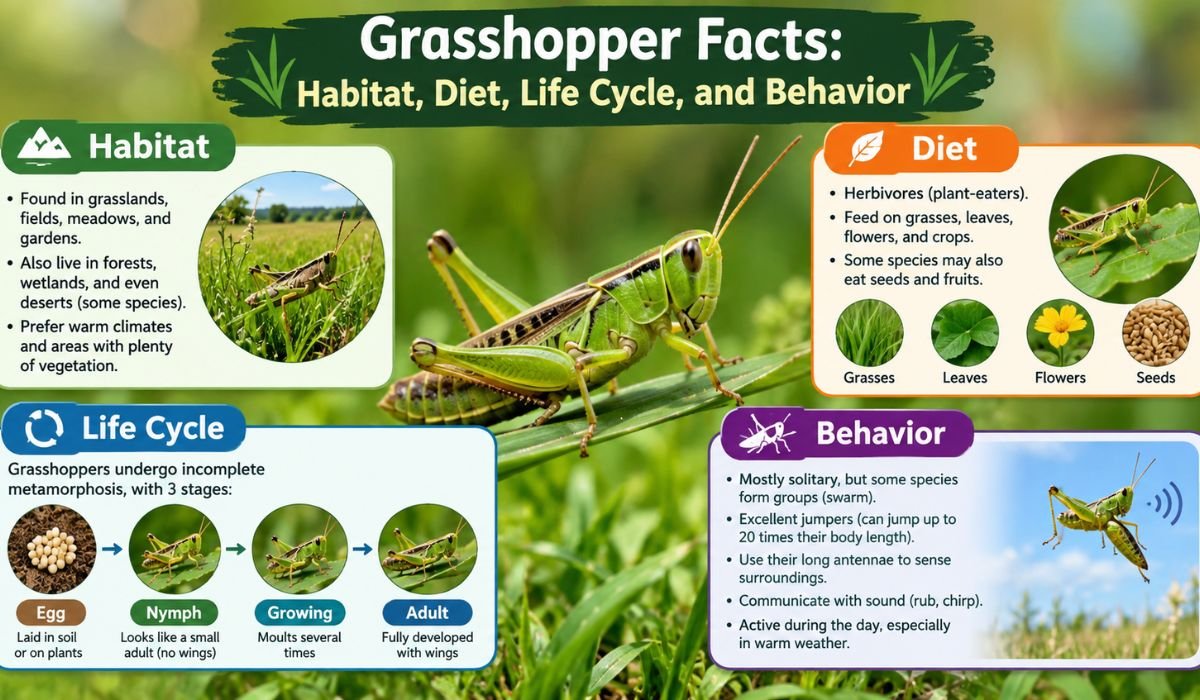
Grasshoppers are fascinating insects found in many parts of the world. They are especially well known for their powerful hind legs, jumping ability, long antennae, and plant-based diet. Although grasshoppers are small compared with many animals, they play an important role in food webs and ecosystems. These insects can live in grasslands, meadows, forests, agricultural areas, and other habitats where vegetation is available.
Learning about grasshopper facts reveals how these insects grow, find food, communicate, escape predators, and adapt to their surroundings. Some species are solitary, while others can gather in enormous groups under suitable environmental conditions. This article explores their habitat, diet, life cycle, physical characteristics, behavior, predators, and other interesting facts.
What Are Grasshoppers?
Grasshoppers are insects belonging to the order Orthoptera, which also includes crickets and katydids. There are thousands of grasshopper species, and they vary considerably in size, color, habitat, and behavior.
Most grasshoppers have three main body sections: the head, thorax, and abdomen. They have six legs, with the enlarged hind legs specially adapted for jumping. Their front and middle legs are used mainly for walking and handling food.
One of the most interesting grasshopper facts is that these insects have ears located on the sides of their abdomen. They use these organs to detect sounds and communicate with other grasshoppers.
Where Do Grasshoppers Live?
Grasshoppers can live in a wide range of environments as long as suitable vegetation and appropriate conditions are available. They are commonly found in grasslands, meadows, open woodlands, agricultural fields, gardens, and areas with low vegetation.
Many species prefer warm, sunny environments because their body temperature is strongly influenced by the surrounding environment. Grasshoppers often become more active when temperatures rise.
Their habitat can influence their color and behavior. Some species blend into green vegetation, while others have brown, gray, or other earthy colors that help them remain less noticeable against soil, dry grass, or vegetation.
What Do Grasshoppers Eat?
Grasshoppers are primarily herbivores. Their diet commonly includes grasses, leaves, stems, flowers, and other plant material. Different species may prefer different types of plants depending on what is available in their environment.
They use strong mouthparts to bite and chew vegetation. Grasshoppers generally consume relatively small amounts individually, but large populations can consume significant quantities of plant material.
Here are some common foods grasshoppers may eat:
- Grass and other grasses
- Leaves
- Plant stems
- Flowers
- Seeds
- Agricultural crops
- Wild vegetation
One of the important grasshopper facts is that not every species has exactly the same diet. Some are more selective than others, while certain species may eat a broader variety of plants.
Grasshopper Physical Characteristics
Grasshoppers have several physical adaptations that help them survive. Their body is divided into three sections, and their external skeleton provides protection and structural support.
Their most noticeable feature is their powerful hind legs. Large muscles in these legs allow grasshoppers to make impressive jumps relative to their body size.
Grasshoppers also have:
- Two antennae
- Six legs
- Two compound eyes
- Smaller simple eyes called ocelli
- Two pairs of wings in many species
- Strong chewing mouthparts
- A segmented abdomen
Their wings can be used for flight, although some species fly more effectively than others. Coloration varies among species and can provide camouflage against vegetation or soil.
Read Related Post: Penguin Facts: Habitat, Diet, Behavior, and Adaptations
Grasshopper Life Cycle
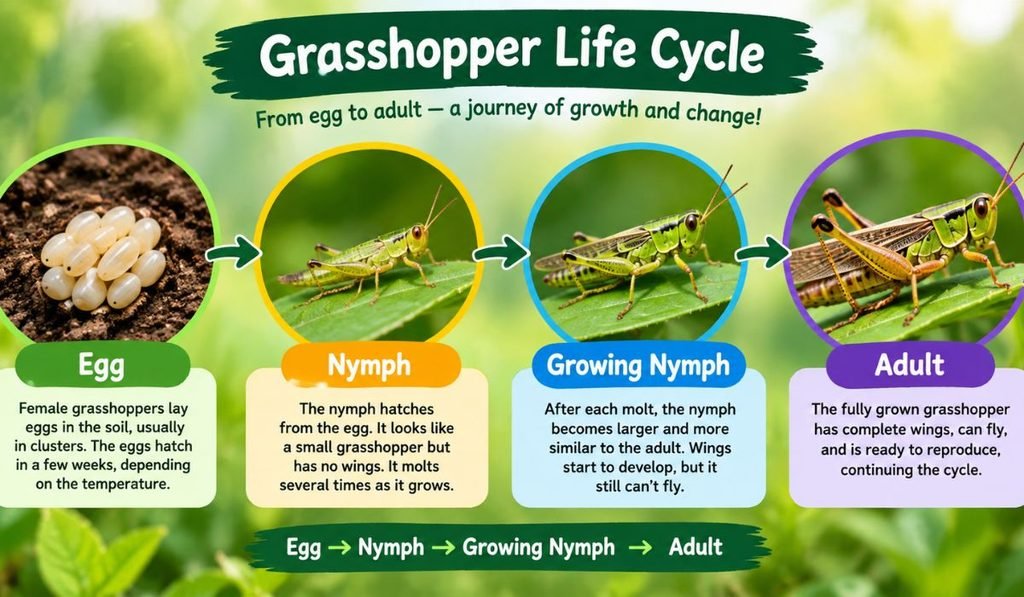
Grasshoppers have an incomplete metamorphosis, meaning they do not pass through a pupal stage. Their development generally consists of three main stages: egg, nymph, and adult.
1. Egg Stage
Female grasshoppers lay eggs in soil or other suitable locations. Depending on the species and environmental conditions, eggs may remain dormant for a period before hatching.
The eggs provide protection for the developing young until they are ready to emerge.
2. Nymph Stage
Young grasshoppers are called nymphs. They resemble small versions of adults but do not have fully developed wings or reproductive organs.
Nymphs grow through several stages called instars. During each stage, they shed their external skeleton in a process called molting.
3. Adult Stage
After completing their final molt, grasshoppers become adults. Their wings and reproductive structures are fully developed, and they can reproduce.
This relatively simple life cycle is one of the useful grasshopper facts for understanding how these insects differ from butterflies and moths, which undergo complete metamorphosis.
How Do Grasshoppers Jump?
Jumping is one of the most recognizable abilities of a grasshopper. Their enlarged hind legs contain powerful muscles that help them launch their bodies into the air.
A grasshopper can use jumping as an escape response when a predator approaches. Instead of slowly moving away, it can suddenly leap in a different direction, making it harder for a predator to catch.
Some species combine jumping with flight. They may jump first and then use their wings to travel farther from danger.
Grasshopper Behavior
Grasshopper behavior varies among species. Many grasshoppers spend much of their time feeding, resting, moving through vegetation, and avoiding predators.
They are often most active during warm parts of the day. Some species use sunlight to warm their bodies before becoming fully active.
Communication is another important part of their behavior. Many grasshoppers produce sounds by rubbing body parts together. This behavior, known as stridulation, can help individuals attract mates or communicate with others.
Other grasshopper facts show that these insects rely heavily on their senses. Their eyes help detect movement, while their antennae provide information about their surroundings.
How Do Grasshoppers Protect Themselves?
Grasshoppers have several defenses against predators. Their ability to jump quickly is one of their primary escape mechanisms.
Camouflage is another important defense. A grasshopper may blend into grass, leaves, soil, or dry vegetation, making it difficult for predators to detect.
Some species also have bright colors or patterns that can surprise predators when the insect suddenly moves or flies. In addition, their speed and unpredictable movements can make them difficult to capture.
What Animals Eat Grasshoppers?
Grasshoppers are an important food source for many animals. Because they are common in many habitats, they form an important link between plants and predators.
Animals that may eat grasshoppers include:
- Birds
- Frogs
- Lizards
- Snakes
- Small mammals
- Spiders
- Praying mantises
- Other predatory insects
These relationships demonstrate why grasshoppers are important components of ecosystems. They consume vegetation and, in turn, provide energy to animals higher in the food chain.
Grasshoppers and Ecosystems
Grasshoppers play several roles in natural ecosystems. By feeding on plants, they influence vegetation and transfer energy from plants to predators.
Their bodies also become part of the nutrient cycle after they die. In this way, grasshoppers contribute to the movement of nutrients through their environment.
However, some species can become agricultural pests when their populations increase significantly. Large numbers may consume crops and other valuable vegetation.
This is particularly important when discussing grasshopper facts because the same insects that have an ecological role can sometimes cause serious agricultural damage when populations become unusually large.
Grasshoppers vs. Locusts
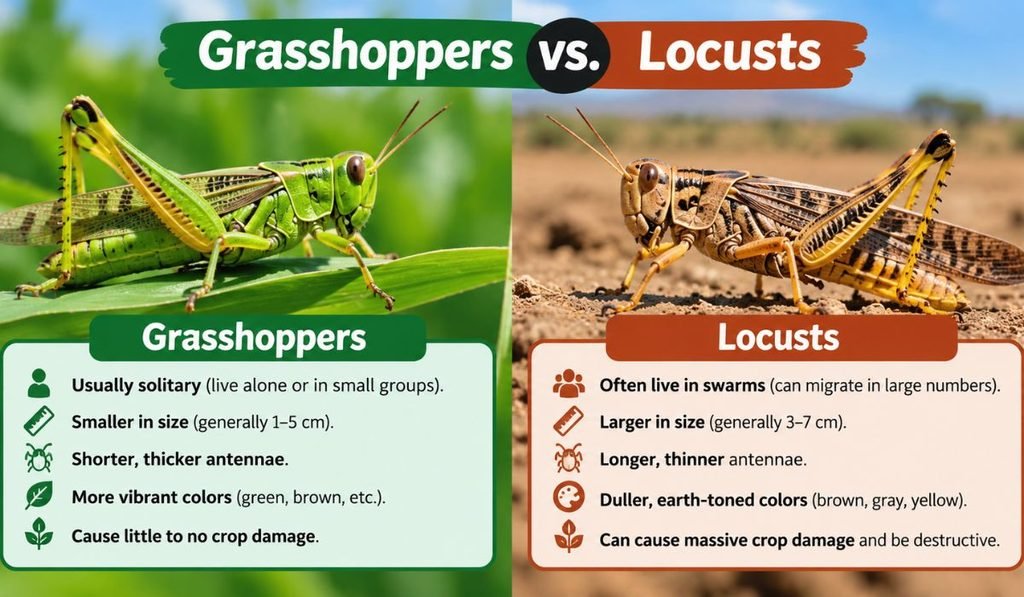
Grasshoppers and locusts are closely related, but they are not exactly the same in behavior. Locusts are certain species of grasshoppers that can change their behavior and physical characteristics under particular environmental conditions.
During favorable conditions, some locust species can form large groups and travel considerable distances. Most grasshopper species, however, remain relatively solitary.
This distinction is among the most commonly misunderstood grasshopper facts. Not every grasshopper becomes a locust, and the terms should not be treated as completely interchangeable.
How Long Do Grasshoppers Live?
The lifespan of a grasshopper varies by species and environmental conditions. Many species complete their life cycle within a single year, although the exact timing differs.
Temperature, food availability, predators, disease, and habitat conditions can all influence survival.
In regions with seasonal climates, adults may reproduce before the onset of unfavorable conditions, leaving eggs to survive until the next suitable season.
Interesting Grasshopper Facts
Here are some additional grasshopper facts that make these insects especially interesting:
- Grasshoppers have six legs, like other insects.
- Their large hind legs are specialized for jumping.
- Grasshoppers have ears on the sides of their abdomen.
- They have compound eyes that help detect movement.
- Most grasshoppers are herbivores.
- Grasshoppers develop through egg, nymph, and adult stages.
- Nymphs resemble miniature adults but lack fully developed wings.
- Grasshoppers shed their external skeleton as they grow.
- Many species can fly as well as jump.
- Grasshoppers are an important food source for many predators.
- Some grasshoppers produce sounds by rubbing body parts together.
- Certain grasshopper species can become locusts under particular conditions.
- Their colors can help them camouflage themselves.
- Grasshoppers are found on every continent except Antarctica.
- Large populations can sometimes damage agricultural crops.
FAQ’s
What do grasshoppers eat?
Grasshoppers mainly eat grasses, leaves, stems, flowers, and other plant material. Their exact diet depends on the species and the plants available in their habitat.
Where do grasshoppers live?
Grasshoppers live in many habitats, including grasslands, meadows, forests, gardens, agricultural fields, and open areas with suitable vegetation.
How do grasshoppers grow?
Grasshoppers grow through incomplete metamorphosis. They hatch from eggs as nymphs, pass through several growth stages, and eventually become adults after molting.
Can grasshoppers fly?
Yes, many adult grasshoppers can fly. However, flying ability varies among species. Grasshoppers commonly use both jumping and flying to move around or escape predators.
Are grasshoppers dangerous?
Grasshoppers are generally not dangerous to people. They are primarily plant-eating insects, although large populations of certain species can damage crops and other vegetation.
What is the difference between grasshoppers and locusts?
Locusts are certain types of grasshoppers that can change their behavior and physical characteristics when environmental conditions encourage population increases. Most grasshoppers remain solitary.
Conclusion
Grasshoppers are highly adaptable insects with specialized bodies and behaviors that help them survive in diverse environments. Their powerful hind legs allow them to jump away from predators, while their camouflage, senses, wings, and feeding adaptations provide additional survival advantages.
Understanding grasshopper facts also shows why these insects are important to ecosystems. They consume plants, provide food for numerous predators, and contribute to natural food webs. Although some species can become agricultural pests when populations grow dramatically, grasshoppers remain an important and fascinating part of the natural world.

Hi, I’m Amelia, an SEO and content specialist with several years of experience researching and creating informative content for online audiences. At Animal Attack Facts, I focus on animal behavior, animal attacks on humans, and interesting facts about land animals, marine animals, birds, reptiles, and insects. My goal is to provide clear, useful, and engaging information that helps readers better understand wildlife and stay informed about animal encounters.
1 thought on “Grasshopper Facts: Habitat, Diet, Life Cycle, and Behavior”