
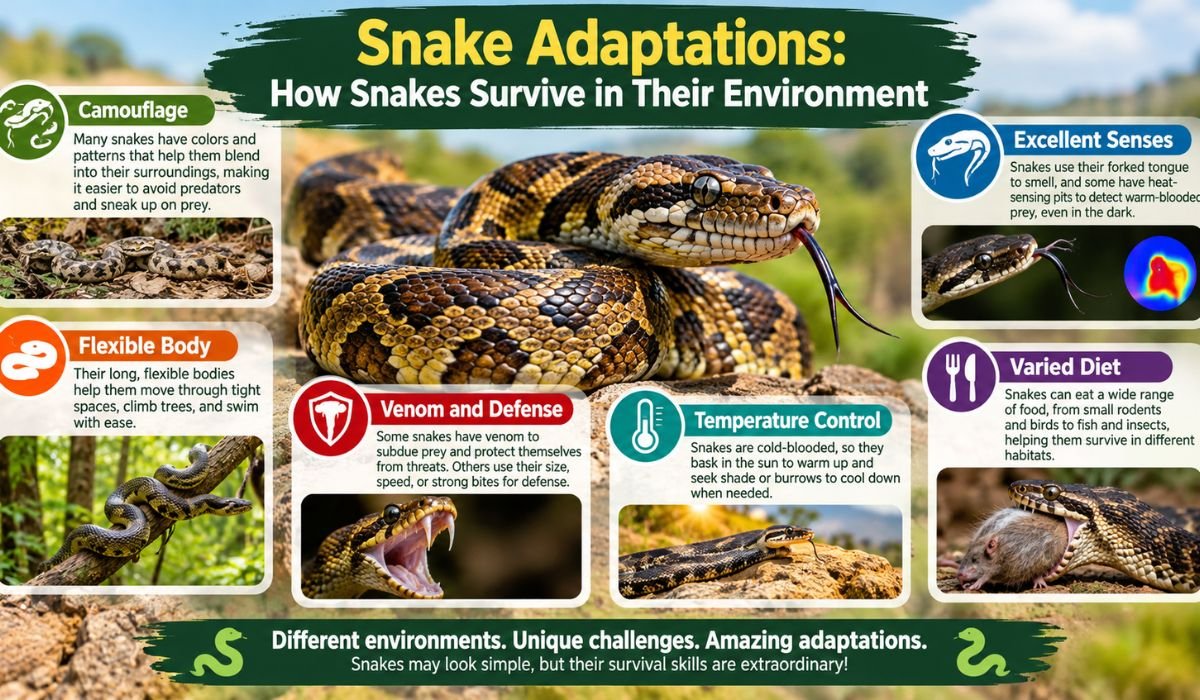
Snakes are highly adaptable reptiles found in deserts, forests, grasslands, wetlands, mountains, and even oceans. Their long bodies, specialized senses, flexible jaws, scales, and diverse hunting strategies help them live in environments that range from extremely hot and dry to cool and wet.
Understanding snake adaptations reveals how these reptiles find food, avoid predators, move efficiently, regulate their body temperature, and survive changing conditions. Although different snake species have evolved different traits, many adaptations are shared across groups.
What Are Snake Adaptations?
Snake adaptations are physical, behavioral, and physiological features that help snakes survive and reproduce in their environments. These traits developed over many generations through natural selection.
Some adaptations are easy to notice, such as a snake’s scales or body shape. Others are less obvious, including heat-sensitive organs, specialized senses, and behaviors that help snakes conserve energy.
The most important snake adaptations include:
- Long, flexible bodies
- Specialized scales
- Powerful muscles for movement
- Highly developed chemical senses
- Flexible jaws
- Camouflage
- Venom in some species
- Heat detection in certain snakes
- Ability to survive long periods without food
- Behavioral thermoregulation
How Does a Snake’s Body Help It Survive?
A snake’s unusual body shape is one of its most important adaptations. Unlike animals with legs, snakes have elongated bodies supported by numerous vertebrae and ribs.
This structure allows them to move through narrow spaces, climb, swim, and travel across different surfaces.
Their bodies also contain powerful muscles that work with their ribs and scales to produce movement. Different species use different forms of locomotion depending on their habitat.
For example, snakes living in trees may have adaptations that improve climbing, while aquatic snakes often have body shapes that make swimming easier.
Snake Scales and Their Protective Role
Scales provide important protection for snakes. They cover the body and help reduce physical damage while a snake moves across rough surfaces.
Scales also help reduce water loss. This is especially important for snakes living in dry environments where water may be scarce.
A snake’s scales can also contribute to movement. Certain scales provide traction against the ground, allowing muscles to push the body forward.
Some snakes have specialized scales that help them move across sand, climb surfaces, or swim efficiently.
Camouflage Helps Snakes Avoid Danger
Camouflage is another important example of snake adaptations. Many snakes have colors and patterns that blend with their surroundings.
A forest-dwelling snake might have brown, green, or mottled markings that resemble leaves, bark, or shadows. Desert species may have colors that blend with sand and rocks.
Camouflage can serve two purposes. It can make a snake harder for predators to detect, while also allowing a predator to approach prey without being noticed.
Some snakes also use patterns that create visual confusion, making it difficult for predators or prey to recognize their body shape.
How Do Snakes Sense Their Environment?
Snakes rely on several specialized senses to understand their surroundings.
Their vision varies considerably between species, but many snakes can detect movement effectively. Their sense of smell is particularly important for locating prey and identifying other animals.
Snakes use their forked tongues to collect chemical particles from the environment. When the tongue returns to the mouth, it transfers these particles to a specialized sensory organ called the Jacobson’s organ, or vomeronasal organ.
This system helps snakes determine the direction and presence of chemical signals.
Read Related Post: Penguin Habitat: Where Penguins Live and How They Survive
Heat Detection in Some Snakes
Certain snakes, including pit vipers, boas, and pythons, have specialized heat-sensitive organs.
These organs can detect infrared radiation from warm objects. This gives some snakes additional information about warm-bodied prey, especially in low-light conditions.
Heat detection is one of the most specialized snake adaptations and is particularly useful for species that hunt mammals and other warm-blooded animals.
How Do Snakes Move Without Legs?
One of the most remarkable snake adaptations is locomotion without limbs.
Snakes use their muscles, ribs, vertebrae, and scales together to move across different surfaces. Several types of movement are possible.
Lateral undulation is the familiar side-to-side movement used by many snakes. The snake pushes against objects or irregularities in the ground to move forward.
Concertina movement allows snakes to move through narrow spaces, particularly when climbing or moving through confined areas.
Rectilinear movement involves the snake moving relatively straight ahead using muscular contractions and movements of the belly scales. Large snakes can use this movement when traveling slowly.
Some desert snakes also use specialized movement patterns that help them travel across loose sand.
How Do Snakes Adapt to Different Climates?
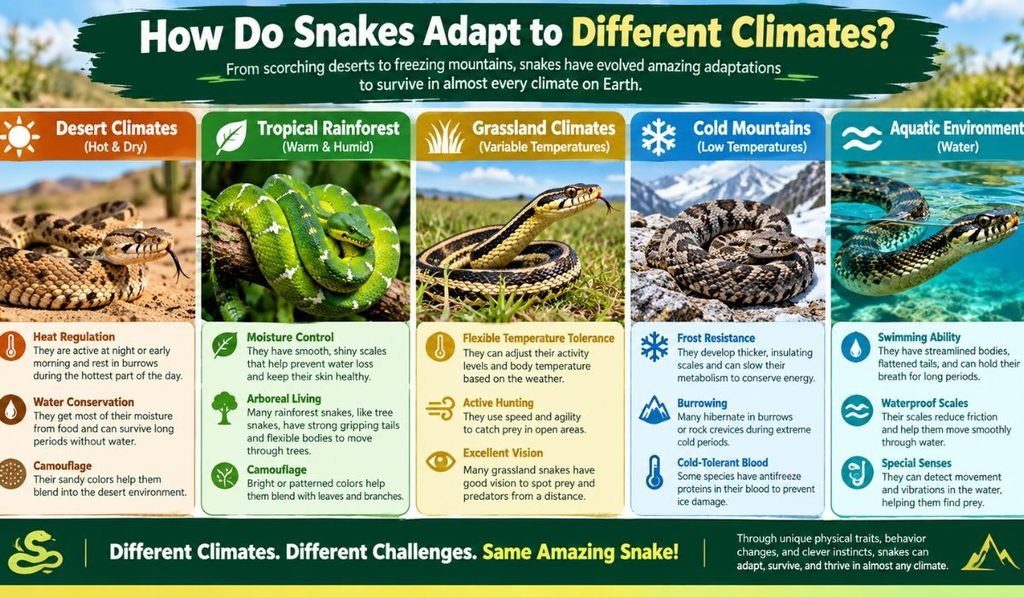
Snakes are ectothermic animals, meaning they depend heavily on external sources of heat to regulate body temperature.
Instead of producing enough internal heat to maintain a constant body temperature, snakes adjust their behavior.
They may bask in sunlight to warm themselves and move into shade, vegetation, water, or burrows when they become too warm.
This behavioral temperature regulation allows snakes to function in many climates without the enormous energy requirements of maintaining a constant internal temperature.
Desert Snake Adaptations
Desert snakes face intense heat, limited water, and large temperature changes.
Their adaptations may include:
- Camouflage that matches sand and rocks
- Activity during cooler periods
- Burrowing or sheltering underground
- Efficient water conservation
- Specialized movement across loose sand
Some desert snakes are primarily active at night, helping them avoid the hottest part of the day.
Cold-Climate Adaptations
Snakes living in cooler regions face different challenges. During cold periods, their activity decreases because their body temperature falls.
Some species spend winter in sheltered locations such as underground burrows, rock crevices, or communal wintering sites.
When temperatures rise again, they emerge and become active.
How Do Venomous Snakes Use Their Adaptations?
Venom is an important adaptation found in some snake species. Venom can help a snake subdue prey and begin the process of digestion.
Venomous snakes have specialized venom-delivery systems. Depending on the species, venom may be delivered through specialized teeth called fangs.
Not all venomous snakes use venom in exactly the same way. Their venom composition and hunting strategies vary considerably between species.
Venom therefore represents one specialized branch of snake adaptations rather than a feature shared by all snakes.
Flexible Jaws Help Snakes Eat Large Prey
Snakes are famous for swallowing prey that appears larger than their heads. However, snakes do not simply “unhinge” their jaws.
Their skulls and jaw structures are highly flexible. The lower jaw is divided into two sides connected by flexible tissue, allowing the sides to move somewhat independently.
This flexibility helps snakes consume relatively large prey.
Their backward-curving teeth can also help hold prey while the snake gradually moves its jaws forward over the food.
How Do Snakes Survive Without Eating Often?
Snakes have adaptations that allow them to survive periods when food is unavailable.
Their metabolism can be relatively low compared with many warm-blooded animals. After eating a large meal, some snakes can greatly increase their digestive activity.
When food is scarce, snakes can reduce their activity and energy use.
This is particularly useful for species living in environments where prey availability changes seasonally.
Behavioral Adaptations Help Snakes Survive
Not all snake adaptations involve body structures. Behavior is equally important.
Snakes may use behaviors such as:
- Hiding under rocks or vegetation
- Burrowing underground
- Basking to warm the body
- Moving into shade to cool down
- Hunting at night
- Changing activity according to seasons
- Using camouflage instead of fleeing
- Seeking shelter from extreme weather
Some snakes also use defensive behaviors when threatened. Depending on the species, they may retreat, remain still, display warning patterns, or adopt defensive postures.
How Do Snakes Adapt to Different Habitats?
Different habitats favor different adaptations.
Forest snakes may benefit from camouflage and climbing abilities. Aquatic snakes may have streamlined bodies and swimming behaviors. Desert snakes often have adaptations for conserving water and dealing with extreme temperatures.
Grassland species may rely heavily on camouflage and rapid movement, while mountain snakes must tolerate cooler temperatures and limited seasonal activity.
This diversity demonstrates why there is no single set of snake adaptations that applies equally to every species.
FAQ’s
What are the main snake adaptations?
The main snake adaptations include elongated bodies, scales, specialized movement, camouflage, advanced chemical sensing, flexible jaws, behavioral temperature regulation, and specialized hunting features in some species.
How do snake adaptations help them survive?
Snake adaptations help these reptiles find food, avoid predators, move through their habitats, regulate body temperature, conserve water, and reproduce successfully.
How do snakes survive in hot environments?
Snakes can avoid extreme heat by becoming active during cooler periods, using shade or underground shelters, and regulating their body temperature behaviorally.
Do all snakes have the same adaptations?
No. Snake adaptations vary between species because different snakes live in different environments and face different survival challenges.
How do snakes move without legs?
Snakes use coordinated movements of their muscles, ribs, vertebrae, and scales. Different species use several forms of locomotion, including lateral undulation, concertina movement, and rectilinear movement.
Why do some snakes have venom?
Venom can help certain snakes capture and subdue prey. It may also assist with digestion and, in some species, defense.
How do snakes find prey?
Snakes can use vision, smell, their forked tongues, the vomeronasal organ, and—in certain species—heat-sensitive organs to detect and locate prey.
Conclusion
Snake adaptations allow these remarkable reptiles to survive across an enormous range of habitats. Their scales protect the body, specialized senses help them locate prey, flexible jaws allow them to consume large meals, and muscular bodies enable efficient movement without legs.
Behavioral adaptations are equally important. Snakes can change their activity patterns, seek shelter, bask or cool themselves, and conserve energy when food is scarce.
Together, these physical and behavioral traits help explain why snakes have successfully adapted to deserts, forests, wetlands, grasslands, mountains, and aquatic environments around the world.

Hi, I’m Amelia, an SEO and content specialist with several years of experience researching and creating informative content for online audiences. At Animal Attack Facts, I focus on animal behavior, animal attacks on humans, and interesting facts about land animals, marine animals, birds, reptiles, and insects. My goal is to provide clear, useful, and engaging information that helps readers better understand wildlife and stay informed about animal encounters.
1 thought on “Snake Adaptations: How Snakes Survive in Their Environment”