
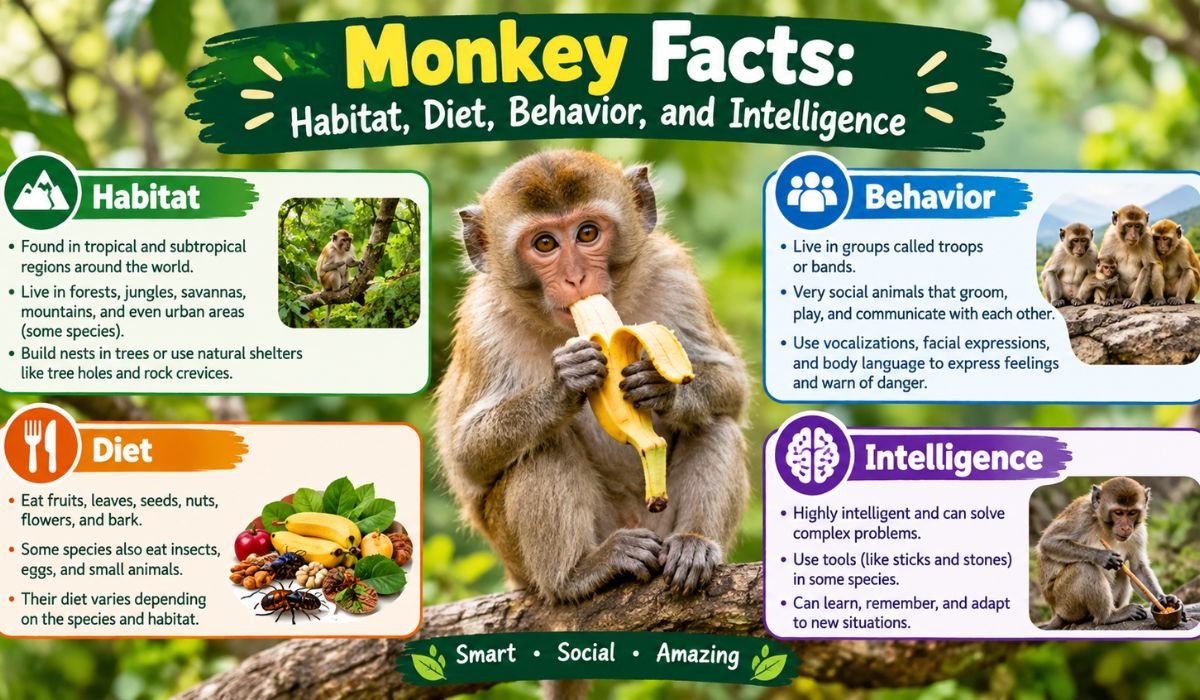
Monkeys are among the most adaptable and intelligent mammals on Earth. They live in forests, grasslands, mountains, and other environments across Africa, Asia, and the Americas. From tiny marmosets to large baboons, different species have developed remarkable ways to find food, avoid danger, communicate, and live together.
Learning monkey facts reveals how diverse these primates are. Some spend most of their lives in trees, while others are comfortable on the ground. Their diets can include fruit, leaves, seeds, insects, and small animals, depending on the species and habitat.
What Is a Monkey?
Monkeys are primates that belong to two major groups: Old World monkeys and New World monkeys. Old World monkeys are native mainly to Africa and Asia, while New World monkeys live naturally in Central and South America.
Although monkeys are often confused with apes, they are different. Most monkeys have tails, while apes do not have tails. There are also important differences in body structure, movement, and evolutionary history.
There are more than 200 living monkey species, ranging widely in size, appearance, behavior, and lifestyle. This diversity is one reason monkey facts can vary considerably from one species to another.
Monkey Facts About Habitat
Monkeys occupy a wide range of habitats. Tropical rainforests are especially important because they provide abundant food, shelter, and places to raise young. Many species live high in the forest canopy, where they can move between branches and search for fruit.
Other monkeys live in woodland, savanna, wetlands, mountains, or areas with seasonal climates. Some baboons, for example, spend substantial time on the ground and can live in open environments.
Where Do Monkeys Live?
Monkeys naturally occur in Africa, Asia, Central America, and South America. They are not native to Australia, Europe, or North America, although some populations may live in these regions after being introduced by humans.
New World monkeys generally have prehensile or highly flexible tails in some species, which can help them move through trees. Old World monkeys have different adaptations, and their tails vary greatly among species.
Understanding these habitat differences is one of the most useful monkey facts because habitat strongly influences how each species feeds and moves.
Monkey Facts About Diet
Most monkeys are omnivores, meaning they can eat both plant and animal foods. However, the exact diet depends heavily on the species and the habitat where it lives.
Fruit is an important food for many forest monkeys. Leaves, flowers, seeds, nuts, and other plant material may also form a major part of the diet. Some species eat insects, eggs, small vertebrates, or other animal foods when available.
Read Related Post: Snake Adaptations: How Snakes Survive in Their Environment
How Do Monkeys Find Food?
Monkeys use their vision, memory, smell, and learned behavior to locate food. In social groups, younger animals can learn feeding habits by watching older members.
Some species have specialized teeth or digestive systems that help them process particular foods. For example, leaf-eating monkeys may have complex digestive systems or specialized adaptations that allow them to obtain nutrients from tough plant material.
These feeding strategies are among the monkey facts that demonstrate how closely animals can adapt to the resources available in their environment.
Monkey Facts About Behavior
Monkey behavior is strongly influenced by social life, habitat, and species. Many monkeys live in groups that may contain several individuals or, in some species, dozens or more.
Groups can provide protection from predators and help individuals find food. Social relationships are also important for grooming, communication, cooperation, and raising young.
Grooming is a common social behavior. Monkeys may groom one another to remove parasites and strengthen social bonds. Group members also use body postures, facial expressions, calls, and other signals to communicate.
Monkey Communication
Communication is one of the most interesting areas of monkey facts. Monkeys can produce different calls for alarms, social interactions, food, and other situations.
Some species use loud calls to warn group members about potential predators. Others rely heavily on facial expressions, gestures, body movements, and physical contact.
Research has shown that several monkey species can recognize individuals, remember social relationships, and respond differently depending on who is nearby. Their communication systems are complex, although they are not equivalent to human language.
Monkey Intelligence
Intelligence is another important part of monkey facts. Many monkeys demonstrate impressive learning and problem-solving abilities. They can remember locations, recognize individuals, learn from other members of their group, and adapt their behavior to changing conditions.
Some species can use simple tools. Capuchin monkeys, for example, are known for using stones and other objects to help process food. Other primates have demonstrated the ability to learn tasks through observation and repeated practice.
Monkey intelligence is not identical across all species. Different monkeys have evolved different abilities depending on their environments, diets, and social systems.
How Intelligent Are Monkeys?
The intelligence of monkeys can be seen in their ability to learn, remember, solve problems, and interact socially. Young monkeys often learn important behaviors by observing adults and other members of their group.
These abilities make monkey intelligence an especially fascinating subject among monkey facts.
How Do Monkeys Protect Themselves?
Monkeys use several strategies to reduce danger. Living in groups is one of the most important because multiple individuals can watch for predators. When a threat is detected, an individual may give an alarm call, causing others to become alert or move away.
Tree-dwelling species may escape by climbing quickly through branches, while ground-dwelling species may rely on speed, group defense, or vigilance.
Some monkeys also have strong teeth and can defend themselves if threatened. However, their best defense is often avoiding danger before a confrontation occurs.
Monkey Reproduction and Young
Female monkeys usually give birth to one infant at a time, although reproductive patterns differ between species. Young monkeys depend heavily on their mothers during early life.
Infants learn important survival skills through observation and interaction. They gradually develop the ability to move independently, identify food, communicate, and participate in social activities.
In many species, other group members may interact with or help care for young monkeys. This social environment gives juveniles opportunities to learn behaviors they will need as adults.
Different Types of Monkeys
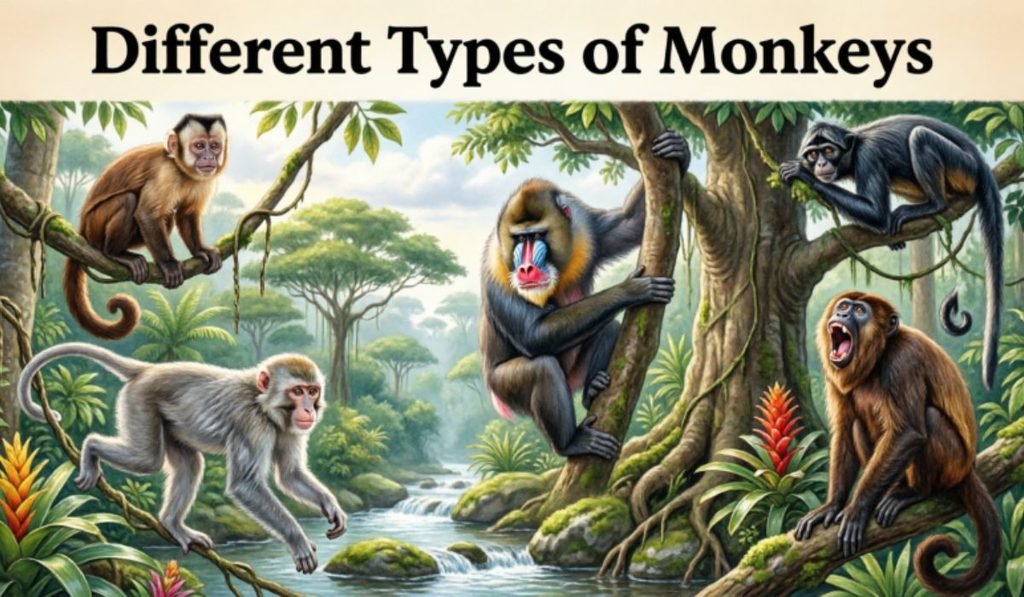
There is enormous variety among monkeys. Commonly recognized groups include macaques, baboons, vervet monkeys, capuchins, squirrel monkeys, tamarins, marmosets, howler monkeys, spider monkeys and colobus monkeys.
Marmosets and tamarins are among the smallest monkeys. Baboons are much larger and are adapted to spending considerable time on the ground. Spider monkeys have long limbs and highly flexible tails that help them move through forest canopies.
These differences show why there is no single lifestyle that describes every monkey species and why monkey facts can be so varied.
Are Monkeys Endangered?
The conservation status of monkeys varies greatly. Some species have healthy populations, while others face serious threats.
Habitat loss is one of the biggest problems for many monkeys. Deforestation, agricultural expansion, hunting, illegal wildlife trade, and human-wildlife conflict can reduce populations.
Protecting forests and other natural habitats is essential for monkey conservation. Conservation programs can also involve protected areas, habitat restoration, scientific research, and efforts to reduce illegal hunting and wildlife trafficking.
Frequently Asked Questions About Monkey Facts
Are Monkeys Intelligent?
Yes. Many monkeys have strong learning, memory, communication, and problem-solving abilities. Some species also use simple tools and learn behaviors by observing others.
What Do Monkeys Eat?
Monkeys can eat fruit, leaves, flowers, seeds, nuts, insects, eggs, and small animals. Their diet varies according to species, season, and habitat.
Where Do Monkeys Live?
Monkeys naturally live in parts of Africa, Asia, Central America, and South America. Their habitats include tropical forests, woodlands, savannas, mountains, and other environments.
Do All Monkeys Have Tails?
No. Most monkeys have tails, but tail length and function vary greatly. Some New World monkeys have prehensile tails, while several Old World monkeys have short tails or no external tail.
What Is the Difference Between Monkeys and Apes?
Most monkeys have tails, while apes do not. Apes also generally have different body structures and shoulder anatomy. Humans are classified as apes, not monkeys.
How Do Monkeys Communicate?
Monkeys communicate using vocal calls, facial expressions, body movements, gestures, and physical contact. Different signals can convey information about danger, social relationships, food, or other situations.
Why Do Monkeys Live in Groups?
Groups can help monkeys find food, protect one another from predators, care for young, and maintain social relationships. The size and structure of groups differ among species.
Conclusion
Monkeys are diverse primates with remarkable adaptations for life in forests, mountains, grasslands, and other habitats. Their varied diets, social behavior, communication systems, and learning abilities make them fascinating animals to study.
The most interesting monkey facts also show how strongly species differ from one another. Some are highly adapted to life in trees, while others spend much of their time on the ground. Understanding these differences can help us appreciate the importance of protecting the habitats that monkeys depend on.

Hi, I’m Amelia, an SEO and content specialist with several years of experience researching and creating informative content for online audiences. At Animal Attack Facts, I focus on animal behavior, animal attacks on humans, and interesting facts about land animals, marine animals, birds, reptiles, and insects. My goal is to provide clear, useful, and engaging information that helps readers better understand wildlife and stay informed about animal encounters.
1 thought on “Monkey Facts: Habitat, Diet, Behavior, and Intelligence”