
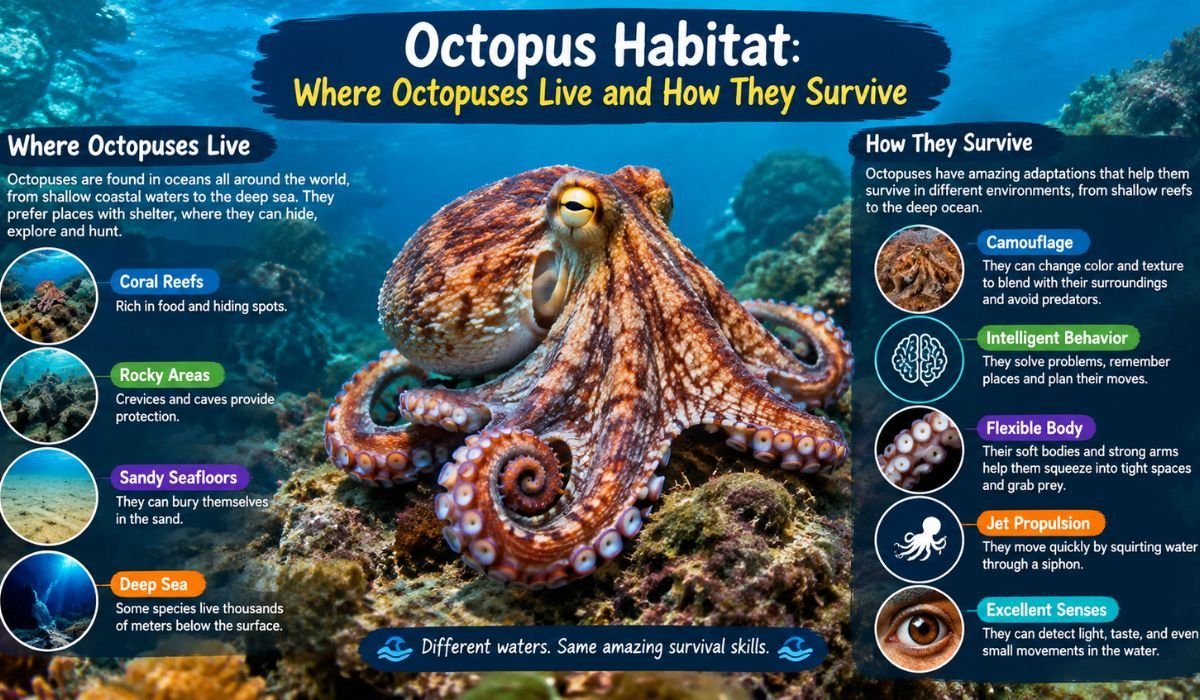
Octopuses are highly adaptable marine animals found in oceans around the world. From shallow coastal waters and coral reefs to deep ocean floors, different species occupy a wide range of environments. Understanding octopus habitat helps explain how these intelligent animals find food, avoid predators, and survive changing conditions.
What Is an Octopus Habitat?
An octopus habitat is the natural marine environment where an octopus lives, feeds, hides, and reproduces. Most octopuses are bottom-dwelling animals, meaning they spend much of their time near the seafloor.
Their habitats can include rocky reefs, sandy or muddy seabeds, seagrass beds, tide pools, caves, and deep-sea environments. The exact habitat depends on the species, depth, temperature, available food, and presence of suitable shelter.
Where Do Octopuses Live?
Octopuses live in oceans throughout the world. They can be found in tropical, temperate, and polar waters.
Common locations include:
- Rocky coastal areas
- Coral reefs
- Seagrass beds
- Sandy ocean floors
- Muddy seabeds
- Underwater caves
- Tide pools
- Deep-sea environments
Some species prefer relatively shallow water, while others spend their lives hundreds or thousands of meters below the surface.
Shallow-Water Habitats
Many octopuses live close to shore. Shallow coastal habitats provide plenty of hiding places and access to prey such as crabs, shrimp, mollusks, and fish.
Rocky areas are especially useful because octopuses can squeeze into cracks and crevices. They may also use empty shells, discarded objects, or other structures as temporary shelters.
Coral Reef Habitats
Coral reefs can provide an excellent octopus habitat because they contain many holes, cracks, and other places to hide. Reefs also support diverse communities of marine animals, giving octopuses access to a variety of prey.
Octopuses living around reefs can move between rocks and coral structures while searching for food. Their ability to change color and texture can also help them blend into their surroundings.
Octopus Habitat in the Deep Ocean
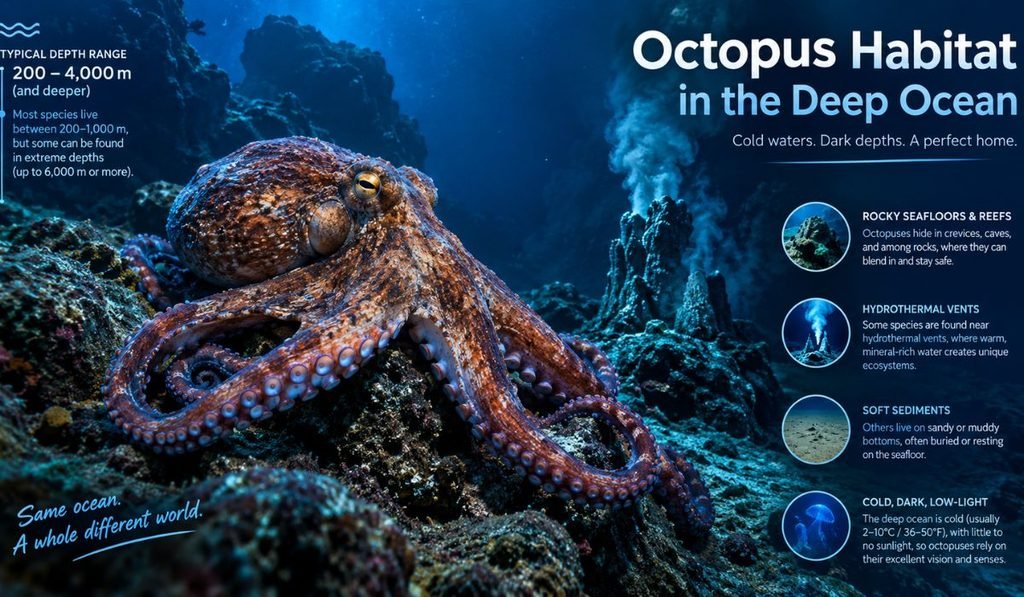
Not all octopuses live near the coast. Some species are adapted to life in the deep ocean, where sunlight is limited or completely absent.
Deep-sea habitats can have extremely high pressure, low temperatures, and limited food compared with shallow environments. Deep-sea octopuses have adaptations that allow them to function under these challenging conditions.
Some species are found on the deep seafloor, while others live around underwater geological features. The famous giant Pacific octopus, for example, generally occupies coastal waters rather than the deepest parts of the ocean.
Read Related Post: Monkey Facts: Habitat, Diet, Behavior, and Intelligence
How Octopuses Choose Their Shelter
Shelter is an important part of an octopus habitat. Because octopuses have soft bodies without a protective shell, they need places where they can hide from predators.
Depending on the species and environment, an octopus may use:
- Rock crevices
- Caves
- Holes in the seafloor
- Empty shells
- Coral structures
- Seagrass
- Natural debris
An octopus may modify its shelter by moving rocks, shells, or other objects around the entrance. These materials can provide additional protection.
How Octopuses Survive in Their Habitat
Octopuses have several remarkable adaptations that help them survive in different marine environments.
Camouflage
Camouflage is one of the most important survival abilities of an octopus. Specialized skin cells allow many octopuses to rapidly change their color and patterns.
Some can also alter the appearance and texture of their skin, helping them resemble rocks, sand, coral, or other surfaces.
This camouflage can help an octopus remain hidden while resting or hunting.
Flexible Bodies
An octopus has no rigid internal skeleton. Its soft body allows it to squeeze through surprisingly small openings.
This flexibility is particularly useful in a rocky octopus habitat, where narrow cracks and holes can become safe hiding places.
Powerful Arms and Suckers
Octopuses use their eight arms to explore their surroundings, capture prey, and interact with objects. Their suckers provide grip and help them manipulate food and objects.
This combination of flexibility and control allows an octopus to navigate complex underwater environments.
Jet Propulsion
When an octopus needs to move quickly, it can force water through a structure called the siphon. This creates jet propulsion that can move the animal through the water.
Octopuses normally crawl or swim at slower speeds, but jet propulsion can help them escape danger.
What Do Octopuses Eat in Their Habitat?
Food availability is another major factor in an octopus habitat. Most octopuses are carnivorous and feed on other marine animals.
Their diets can include:
- Crabs
- Shrimp
- Lobsters
- Clams
- Snails
- Fish
- Other small marine animals
An octopus often uses camouflage to approach prey without being noticed. Once close enough, it can use its arms and suckers to capture the animal.
Different species have different diets depending on what prey is available in their particular environment.
Do Octopuses Live Alone?
Most octopus species are largely solitary. They generally spend much of their time alone rather than living in permanent social groups.
A suitable octopus habitat provides enough food and shelter for individual animals to survive. During certain periods, octopuses may encounter one another for mating, but this does not usually mean they form long-term social groups.
Their solitary lifestyle may also reduce competition for food and shelter.
How Habitat Conditions Affect Octopuses
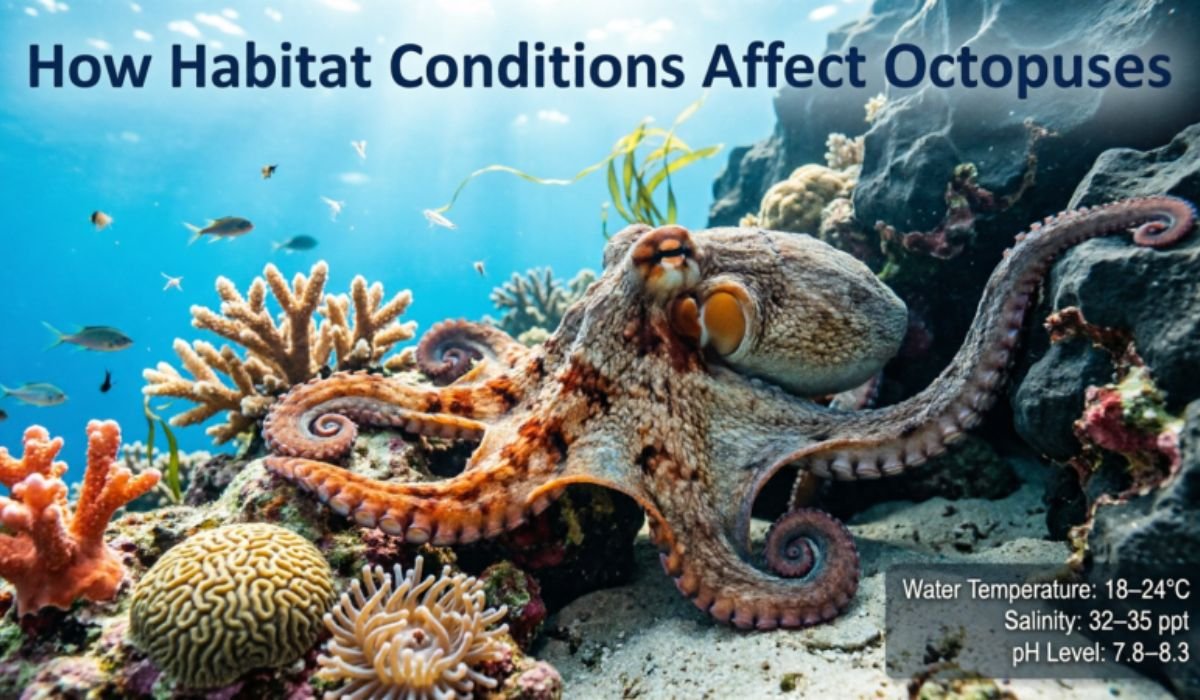
Water temperature, depth, oxygen levels, food availability, and shelter all influence where octopuses can live.
Temperature
Different species are adapted to different temperature ranges. Some prefer warm tropical waters, while others are suited to cooler temperate or polar environments.
Depth
Depth affects temperature, pressure, light, and food availability. Shallow-water octopuses experience very different conditions from species living in the deep sea.
Food
An area with abundant prey can support more octopuses than an environment with limited food. Availability of crabs, shellfish, fish, and other prey can strongly influence habitat suitability.
Shelter
Because octopuses have soft bodies, access to protective hiding places is especially important. Rocky crevices, caves, and other structures can provide protection from predators.
How Octopuses Avoid Predators
An octopus habitat can contain many predators, including fish, marine mammals, seabirds, and other large ocean animals.
Octopuses rely on several defenses. Their camouflage can make them difficult to detect, while their flexible bodies allow them to disappear into narrow spaces.
When threatened, many octopuses can release ink into the surrounding water. The ink can create confusion and give the octopus an opportunity to escape.
Some species also use rapid movement to get away from danger.
How Humans Affect Octopus Habitats
Human activities can alter marine environments where octopuses live. Coastal development, pollution, destructive fishing practices, and changes to marine ecosystems can affect available food and shelter.
Climate-related changes can also influence ocean temperature and other environmental conditions.
Protecting healthy marine ecosystems is therefore important for maintaining suitable habitats for octopuses and many other ocean species.
Frequently Asked Questions About Octopus Habitat
Where is the most common octopus habitat?
Many octopus species live near the ocean floor in coastal waters. Rocky reefs, caves, crevices, sandy seabeds, and other areas offering shelter are common habitats.
Do octopuses live in deep water?
Yes. Some species live in deep-sea environments, where they experience cold temperatures, high pressure, and little or no sunlight.
Do octopuses live in coral reefs?
Yes, some octopus species live around coral reefs. Reefs provide shelter and access to a variety of prey.
Can octopuses live in shallow water?
Yes. Many species occupy shallow coastal environments, including rocky shores, tide pools, reefs, and seagrass areas.
What does an octopus need in its habitat?
An octopus needs suitable water conditions, food, oxygen, and places to hide. The exact requirements vary between species.
How does an octopus survive in its habitat?
An octopus survives through adaptations such as camouflage, flexible bodies, powerful arms, ink defense, and the ability to move through difficult underwater environments.
Conclusion
The octopus habitat can range from shallow coastal waters and coral reefs to cold, deep ocean environments. Although different species occupy different parts of the ocean, most need access to food, suitable water conditions, and protective shelter.
Their camouflage, flexible bodies, powerful arms, and other adaptations allow them to survive in complex marine environments. By protecting healthy oceans and coastal ecosystems, we can help preserve the diverse habitats that octopuses depend on.

Hi, I’m Amelia, an SEO and content specialist with several years of experience researching and creating informative content for online audiences. At Animal Attack Facts, I focus on animal behavior, animal attacks on humans, and interesting facts about land animals, marine animals, birds, reptiles, and insects. My goal is to provide clear, useful, and engaging information that helps readers better understand wildlife and stay informed about animal encounters.
1 thought on “Octopus Habitat: Where Octopuses Live and How They Survive”