
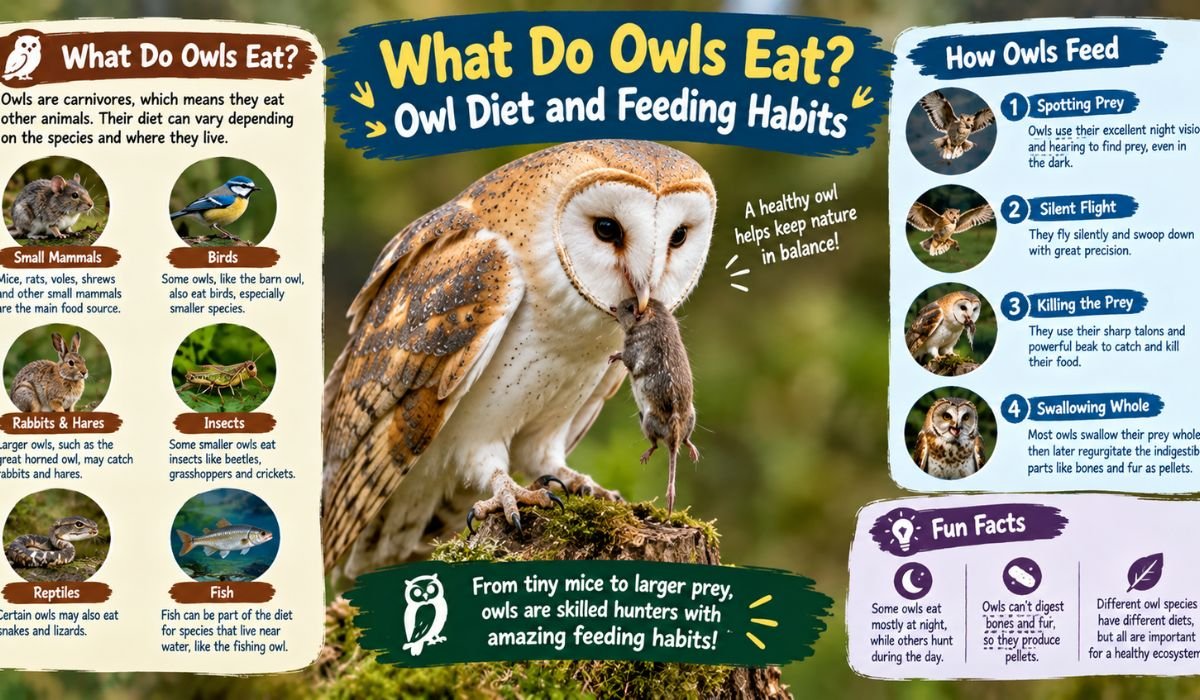
Owls are fascinating birds of prey known for their excellent night vision, sharp talons, and silent flight. Their diet mainly consists of small mammals, insects, birds, and other animals they can catch with their powerful feet and hooked beaks. However, the exact owl diet varies depending on the owl species, its habitat, its size and the availability of prey.
Some owls primarily hunt mice and voles, while larger species can capture rabbits, fish, and other birds. Understanding what owls eat helps explain how these birds survive in forests, grasslands, deserts, wetlands, and even urban environments.
In this guide, we will explore the typical owl diet, the animals owls hunt, their feeding habits, how they catch prey, and how their food preferences change throughout the year.
What Is an Owl’s Diet?
The owl diet is mainly carnivorous, meaning owls eat other animals to obtain the nutrients and energy they need. Most owl species are skilled hunters that rely on their eyesight, hearing, sharp claws, and strong beaks to capture prey.
Small owls often feed on insects and tiny mammals, whereas larger owls can hunt bigger animals. Some species also specialize in particular food sources, such as fish or other birds.
Common foods in an owl’s diet include:
- Mice and rats
- Voles and shrews
- Rabbits and hares
- Small birds
- Insects and other invertebrates
- Frogs and other amphibians
- Lizards and snakes
- Fish, for certain species
Owls usually swallow small prey whole or tear larger prey into manageable pieces. They also swallow bones, fur, feathers, and other indigestible materials, which they later expel as compact pellets.
What Do Owls Eat in the Wild?
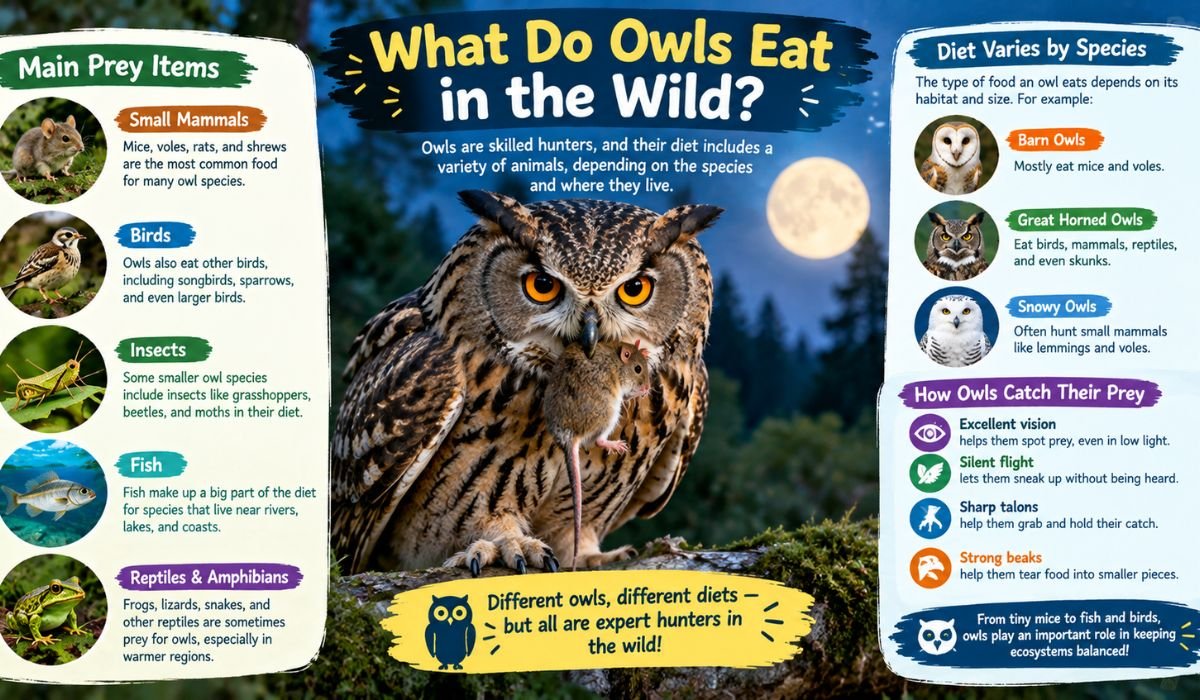
The natural owl diet depends on the species and the environment where the bird lives. Owls are adaptable predators, and they often select prey that is easy to find and catch.
1. Mice and Other Small Mammals
Small mammals are among the most important food sources for many owl species. Mice, voles, shrews, and rats provide protein and fat that help owls maintain their energy.
Barn owls, for example, frequently hunt rodents in agricultural fields, grasslands, and open countryside. They use their sensitive hearing to detect prey moving through vegetation, even when visibility is poor.
The availability of rodents can strongly influence the owl diet. When mice and voles are abundant, many owls have access to plenty of food. When rodent populations decline, owls may need to hunt other prey or travel farther to find food.
2. Insects and Other Invertebrates
Insects are an important part of the diet of several small owl species. Depending on their size and hunting abilities, owls may eat beetles, grasshoppers, crickets, moths, and other invertebrates.
Eastern screech owls and elf owls can include insects in their diets, although their food choices vary with location and availability.
Insects are especially useful when they are abundant during warmer months. They provide an accessible food source for smaller owls that may struggle to capture larger prey.
3. Small Birds
Some owls hunt songbirds, sparrows, finches, and other small birds. Larger owl species may also capture medium-sized birds when the opportunity arises.
Owls often hunt birds at night or during low-light periods, although some species are active during daylight. Their flight feathers help reduce noise, allowing them to approach prey without being easily detected.
The role of birds in the owl diet varies considerably. Some species eat birds regularly, while others rely more heavily on mammals or insects.
4. Rabbits and Hares
Larger owls can capture rabbits and young hares. These animals provide a substantial meal and are particularly valuable to powerful species with strong feet and talons.
The Eurasian eagle-owl and great horned owl are examples of large owls capable of hunting relatively large mammals.
However, not every owl can catch rabbits. Smaller species generally focus on insects, rodents, and other prey that matches their size and hunting abilities.
5. Frogs, Lizards, and Snakes
Some owls eat reptiles and amphibians, particularly in warmer regions where these animals are readily available.
Their prey may include frogs, toads, lizards, and small snakes. Owls living near wetlands or tropical habitats may encounter these animals more frequently than species living in colder environments.
These food sources add variety to the owl diet, helping owls survive when their preferred prey is less abundant.
6. Fish and Aquatic Animals
Although most owls are known for hunting land animals, some species regularly catch fish.
Blakiston’s fish owl and the African fishing owl are examples of fish-eating owls. Depending on the species, they may hunt along rivers, lakes, streams, and other waterways.
These owls use their strong feet and claws to grasp slippery prey. Fish can be a major food source for species adapted to aquatic hunting.
Read Related Post: Dolphin Habitat: Where Dolphins Live and How They Survive
How Does an Owl’s Diet Change by Species?
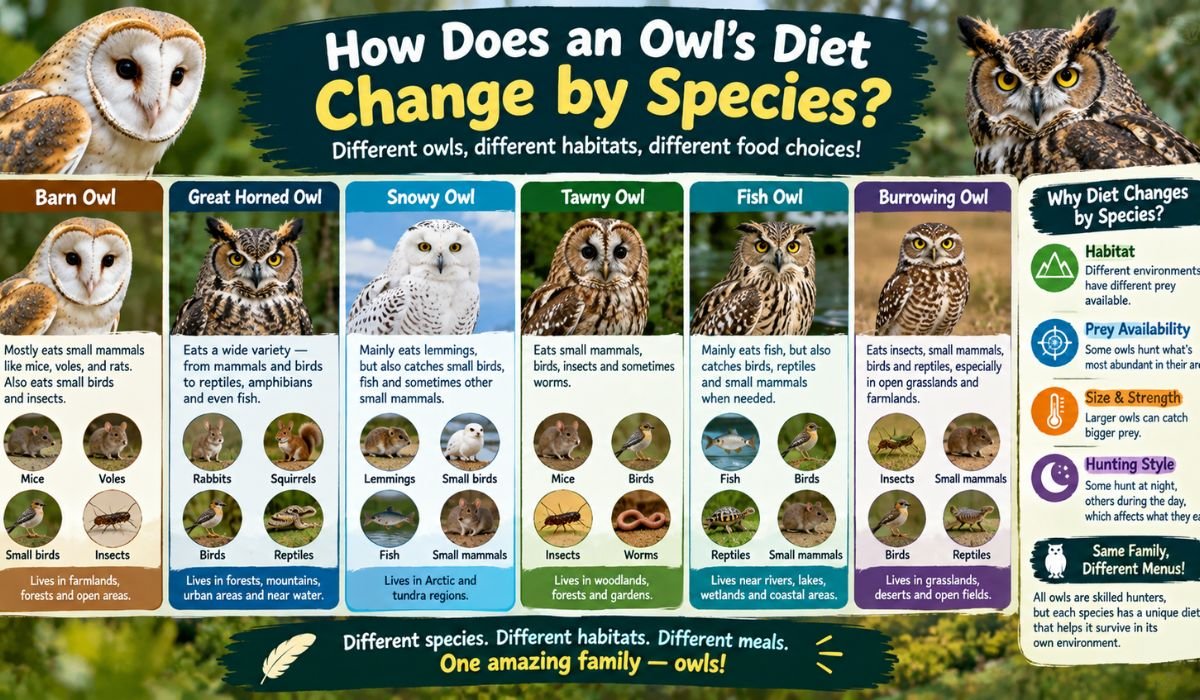
Different owl species have different dietary needs. Their size, habitat, hunting skills, and available prey determine what they eat most often.
| Owl species | Common food sources |
| Barn owl | Mice, voles, shrews, and other small mammals |
| Great horned owl | Rabbits, rodents, birds, and reptiles |
| Snowy owl | Lemmings, other rodents, and birds |
| Burrowing owl | Insects, small mammals, and reptiles |
| Eastern screech owl | Insects, rodents, small birds, and other small animals |
| Elf owl | Insects and other small invertebrates |
| Blakiston’s fish owl | Fish and other aquatic prey |
This comparison shows why there is no single owl diet that applies to every species. A snowy owl living in Arctic regions has different food opportunities from a fish owl living near a river.
How Do Owls Hunt for Food?
Owls have several adaptations that help them locate and capture prey. Their hunting methods vary, but many species rely on a combination of stealth, sharp senses, and quick movements.
Excellent Hearing
Many owls have highly sensitive hearing that helps them locate prey hidden beneath grass, leaves, or snow.
Some species have asymmetrically positioned ear openings, which help them determine the direction and distance of sounds. This ability is particularly useful when hunting in darkness.
Powerful Vision
Owls have large, forward-facing eyes that help them judge distances and detect movement in low light.
Although owls are often associated with nighttime hunting, not all species are strictly nocturnal. Some hunt during the day or around dawn and dusk.
Silent Flight
Specialized feather structures help many owls fly quietly. This reduces the sound of their approach and makes it harder for prey to detect them.
Silent flight is an important hunting advantage, especially when owls pursue small mammals or birds.
Sharp Talons and Hooked Beaks
Owls use their strong feet and curved talons to seize and hold prey. Their hooked beaks help them tear food into smaller pieces when necessary.
Together, these adaptations make owls effective predators and allow them to exploit a wide range of food sources.
How Much Do Owls Eat?
The amount an owl eats depends on its species, body size, activity level, age, and the availability of prey.
A small owl may consume several insects or small prey animals in a day, while a larger owl may eat a more substantial meal less frequently.
For example, a barn owl may consume multiple small rodents over a night, depending on the size of its meals and its energy needs. Larger owls can eat larger prey, which may provide enough energy for a longer period.
Young owls that are growing rapidly often need frequent feeding. Adult owls may adjust their food intake according to hunting success and environmental conditions.
Therefore, the owl diet is not determined by body size alone. Prey availability and seasonal changes also influence how much food an owl consumes.
Do Owls Eat Every Part of Their Prey?
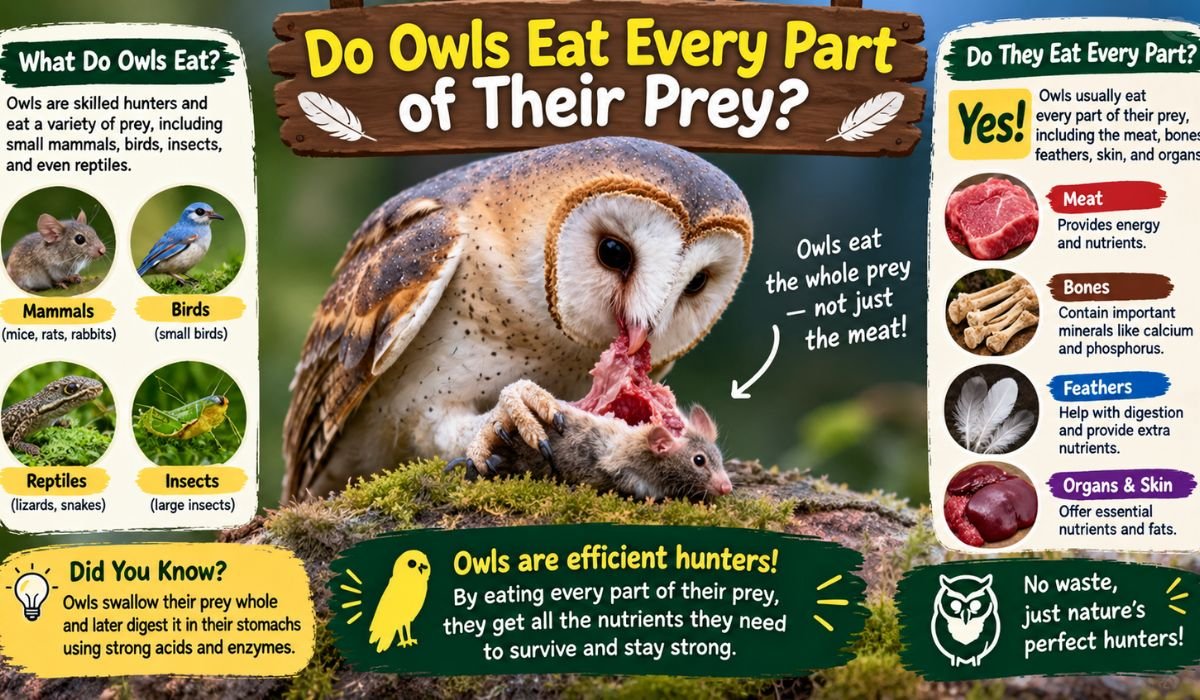
Owls often swallow small prey whole, including bones, fur, feathers and other parts they cannot digest properly.
Their digestive systems separate usable nutrients from indigestible material. The remaining material is compressed into a pellet that the owl later regurgitates through its mouth.
Owl pellets commonly contain:
- Small bones
- Fur
- Feathers
- Insect exoskeletons
Researchers and students can examine these pellets to learn what owls have eaten. The bones and other remains often help identify the prey species.
This process is a natural part of owl digestion and provides useful evidence about the owl diet in a particular habitat.
Does an Owl’s Diet Change With the Seasons?
Yes, the owl diet can change throughout the year as prey availability shifts.
During warmer months, insects, amphibians, and some small mammals may be more abundant. In colder months, certain prey species become less active or harder to find, requiring owls to adjust their hunting strategies.
Snow can make rodents difficult for some predators to locate, although owls with excellent hearing may still detect prey beneath the snow.
In regions where rodent populations rise and fall dramatically, owls may reproduce more successfully when food is plentiful. When prey becomes scarce, they may hunt over larger areas or rely on alternative food sources.
These seasonal changes demonstrate how closely owl survival is connected to the local environment.
What Do Owls Eat in Different Habitats?
An owl’s surroundings have a major influence on the food it can find.
Forests
Forest-dwelling owls often hunt mice, voles, small birds, insects, and other woodland animals. Trees provide perches and nesting sites, while fallen leaves and vegetation support many prey species.
Grasslands and Farmland
Open areas often support large populations of rodents, making them excellent hunting grounds for barn owls and other species that hunt small mammals.
Deserts
Desert owls may feed on insects, rodents, lizards, and other animals adapted to dry environments. Their food choices depend on local prey populations and seasonal conditions.
Wetlands and Rivers
Owls living near water may catch fish, frogs, and other aquatic animals. Some species are especially adapted to hunting along riverbanks and streams.
The variety of available habitats explains why the owl diet differs so much across the world.
Frequently Asked Questions About Owl Diet
1. What is the main food in an owl diet?
The main food in an owl diet is usually small mammals, especially mice and voles. However, some species depend more heavily on insects, fish, birds, reptiles, or amphibians.
2. Do owls eat mice every day?
Many owls hunt mice frequently, but they do not necessarily catch them every day. Their feeding schedules depend on hunting success, prey availability, species, and individual energy requirements.
3. Do owls eat fruit or plants?
Owls are primarily carnivorous and normally eat other animals rather than fruit or plants. Animal prey provides the nutrients they need to survive.
4. Do all owls hunt at night?
No. Many owls are nocturnal, but some are active during the day or at dawn and dusk. Their activity patterns depend on the species and its environment.
5. What do baby owls eat?
Baby owls are fed animal prey by their parents. Depending on the species, their food may include small rodents, insects, birds, or other suitable animals. Parents generally provide prey in pieces that the young can swallow.
6. How does the owl diet change in winter?
In winter, owls may rely on available rodents, birds, or other prey depending on their habitat. Some adjust their hunting areas or prey choices when food becomes scarce.
7. Why do owls regurgitate pellets?
Owls regurgitate pellets because their digestive systems cannot fully break down materials such as bones, fur, and feathers. These materials are compacted and expelled after digestion.
Conclusion
The owl diet consists mainly of animal prey, including mice, voles, insects, birds, rabbits, reptiles, amphibians, and fish. The foods an owl eats depend on its species, size, habitat, and the availability of prey throughout the year.
From barn owls hunting rodents in open fields to fish owls catching prey near rivers, these birds have developed specialized adaptations that help them find and capture food. Their excellent hearing, low-light vision, silent flight and powerful talons make them efficient hunters.
Understanding the owl diet also reveals the important role owls play in natural ecosystems. By feeding on rodents and other animals, they help regulate prey populations and maintain ecological balance.

Hi, I’m Amelia, an SEO and content specialist with several years of experience researching and creating informative content for online audiences. At Animal Attack Facts, I focus on animal behavior, animal attacks on humans, and interesting facts about land animals, marine animals, birds, reptiles, and insects. My goal is to provide clear, useful, and engaging information that helps readers better understand wildlife and stay informed about animal encounters.
1 thought on “What Do Owls Eat? Owl Diet and Feeding Habits”