
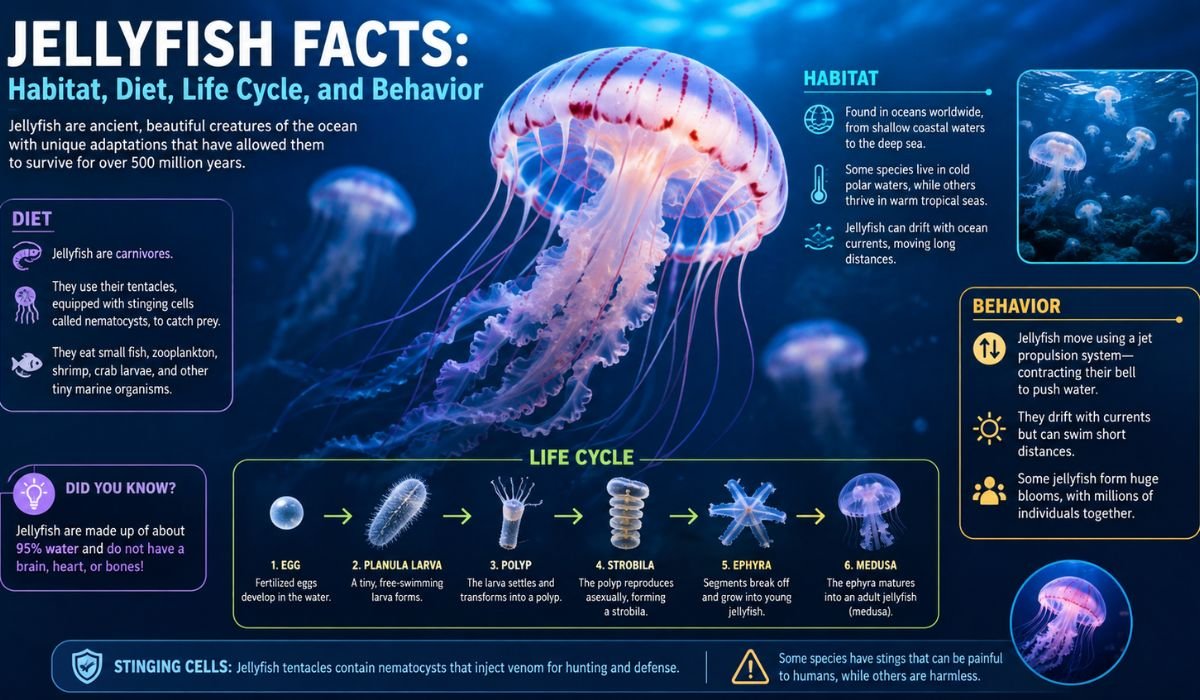
Jellyfish are some of the most fascinating creatures found in the world’s oceans. Their soft, transparent bodies, flowing tentacles, and unusual movements make them easy to recognize. Despite their simple appearance, jellyfish have survived for hundreds of millions of years and have developed remarkable ways to find food, defend themselves, and reproduce.
These animals can be found in oceans around the world, from shallow coastal waters to the deep sea. In this guide to jellyfish facts, we will explore their habitat, diet, life cycle, behavior, physical features, and other interesting characteristics.
What Are Jellyfish?
Jellyfish are marine animals belonging to the group called cnidarians. They are related to corals, sea anemones, and hydras. Unlike fish, jellyfish do not have backbones, fins, or scales. Their bodies are mostly made of water and a jelly-like substance called mesoglea.
One of the most interesting jellyfish facts is that jellyfish have been living in Earth’s oceans for an extremely long time. Fossil evidence suggests that ancient jellyfish-like animals existed hundreds of millions of years ago.
The typical jellyfish body consists of a bell-shaped structure and tentacles hanging underneath it. Some species have only a few tentacles, while others can have many. Their tentacles contain specialized cells called nematocysts, which can release tiny structures that help capture prey and provide protection from predators.
Jellyfish Habitat
Jellyfish live in oceans throughout the world. They can be found in tropical, temperate, and polar waters. Some species prefer warm coastal areas, while others are adapted to colder environments.
Another important jellyfish facts point is that these animals are not limited to shallow water. Different species can live at various depths, including areas far below the ocean surface.
Many jellyfish are commonly seen near beaches, bays, harbors, and coastal waters. Ocean currents can carry them over long distances, which is why large groups of jellyfish sometimes appear in particular coastal areas.
Some jellyfish species spend much of their lives drifting with currents, while others have more control over their movement. Their ability to survive in different marine environments has helped them become widely distributed.
What Do Jellyfish Eat?
Jellyfish are generally carnivorous and eat small marine organisms. Their diet can include plankton, fish eggs, larvae, tiny crustaceans, and sometimes small fish.
Their tentacles help them capture food. When a suitable organism comes into contact with a jellyfish’s tentacles, specialized stinging cells can immobilize the prey. The jellyfish then moves the food toward its mouth using structures around the underside of its bell.
One of the useful jellyfish facts about feeding is that jellyfish do not have a complex digestive system like mammals. Food enters through the mouth and is processed in a simple internal cavity. Waste is also expelled through the same opening.
Jellyfish feeding habits vary between species. Larger jellyfish can sometimes capture relatively large prey, while smaller species mainly consume microscopic organisms.
Read Related Post: Turtle Facts: Types, Habitat, Diet, and Life Cycle
Jellyfish Life Cycle
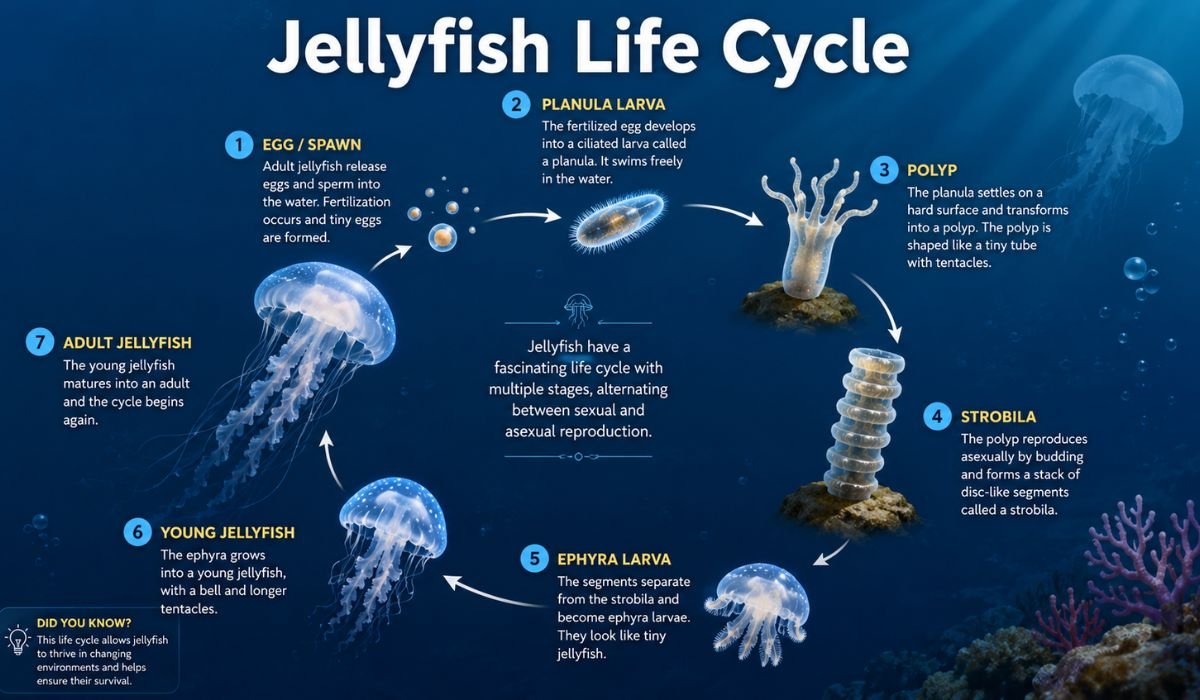
The life cycle of a jellyfish is one of the most unusual aspects of its biology. Many jellyfish species go through several different stages before becoming adults.
The cycle often begins when adult jellyfish reproduce and release eggs and sperm into the water. Fertilized eggs develop into tiny larvae called planulae. These larvae swim for a short period before attaching themselves to a suitable surface.
After attachment, the planula develops into a polyp. The polyp looks very different from an adult jellyfish and can remain attached for a period of time.
Eventually, the polyp produces young jellyfish through a process called strobilation. The young organisms, known as ephyrae, gradually develop into mature jellyfish.
These different stages are among the most fascinating jellyfish facts because the animal changes dramatically in appearance and lifestyle during its development.
Jellyfish Behavior
Jellyfish do not have a brain or a centralized nervous system. Instead, they have a network of nerves that helps them respond to changes in their surroundings.
Their nervous system allows them to detect light, water movement, and other environmental signals. Jellyfish can contract their bells to move through the water, although currents often play a major role in determining where they travel.
Some jellyfish species show behaviors that help them remain in favorable areas. They may adjust their swimming patterns according to light or water conditions.
Although jellyfish may appear to move randomly, their bodies are capable of responding to environmental information. This simple nervous system is surprisingly effective for an animal without a brain.
How Do Jellyfish Protect Themselves?
Jellyfish rely heavily on their tentacles for defense. Their tentacles contain nematocysts, specialized structures capable of delivering a sting.
The strength of a jellyfish sting varies greatly among species. Some cause only mild irritation in humans, while others can cause much more serious reactions.
The stinging cells are primarily used for capturing prey, but they also discourage potential predators from getting too close.
Not every animal avoids jellyfish, however. Certain marine creatures have developed ways to eat jellyfish despite their stinging cells. Some sea turtles, for example, include jellyfish in their diets.
Jellyfish Size and Appearance
Jellyfish come in a wide range of sizes and shapes. Some are very small, while others can have bells measuring several feet across.
Their bodies are usually soft and flexible. Many species appear transparent or translucent, allowing light to pass through their tissues.
Jellyfish can also display different colors, including white, blue, pink, orange, yellow, and purple. Their appearance can change depending on the species, age, environment, and available food.
An interesting group of jellyfish facts concerns their lack of bones. Because their bodies contain so much water, jellyfish are extremely different from animals with rigid skeletons.
Do Jellyfish Have Brains?
No, jellyfish do not have brains. Instead, they have a decentralized nerve network that helps coordinate their movements and responses.
Their nervous system is relatively simple compared with that of vertebrates. Nevertheless, it allows them to detect environmental conditions and react appropriately.
This is one reason jellyfish are scientifically interesting. They demonstrate that an animal can survive and behave effectively without having a brain or complex organs.
Are Jellyfish Fish?
Despite their common name, jellyfish are not actually fish. Fish are vertebrates with internal skeletons, while jellyfish are invertebrates belonging to the cnidarian group.
The word “fish” in their name comes from their aquatic lifestyle rather than their biological classification.
This is an important distinction when learning jellyfish facts, because jellyfish are much more closely related to animals such as corals and sea anemones than they are to fish.
Interesting Jellyfish Facts
Here are several interesting jellyfish facts that show how unusual these animals are:
- Jellyfish are invertebrates and do not have backbones.
- They do not have brains or hearts.
- Their bodies are mostly water.
- Many jellyfish use stinging cells to capture prey.
- Jellyfish have existed in Earth’s oceans for hundreds of millions of years.
- Some species live in shallow coastal waters, while others inhabit the deep ocean.
- Jellyfish can reproduce through several life stages.
- Ocean currents can transport jellyfish over long distances.
- Some jellyfish are bioluminescent and can produce their own light.
- Jellyfish are eaten by several marine animals, including some sea turtles.
FAQ’s
1. What do jellyfish eat?
Jellyfish commonly eat plankton, tiny crustaceans, fish eggs, larvae, and small fish. Their tentacles help capture prey before food is transported to the mouth.
2. Where do jellyfish live?
Jellyfish live in oceans around the world. Different species can survive in tropical, temperate, polar, coastal, and deep-sea environments.
3. Do jellyfish have brains?
No. Jellyfish do not have brains. They have a network of nerves that allows them to respond to light, movement, and other environmental signals.
4. How do jellyfish reproduce?
Many jellyfish species have a life cycle involving eggs, planula larvae, polyps, young ephyrae, and adult jellyfish. The exact process varies among species.
5. Why do jellyfish sting?
Jellyfish sting mainly to capture prey and protect themselves. Their tentacles contain specialized cells that can release stinging structures when triggered.
6. Are all jellyfish dangerous?
No. Jellyfish stings vary considerably between species. Some species have very mild stings, while a small number can be dangerous to humans.
Conclusion
Jellyfish are remarkable marine animals with simple bodies but surprisingly effective survival strategies. From their unusual life cycle and nerve networks to their ability to capture prey with specialized tentacles, they have adapted successfully to many ocean environments.
Understanding these jellyfish facts helps explain why these ancient creatures continue to thrive in seas around the world. Their unique biology also makes them an important subject for scientists studying marine ecosystems and animal evolution.

Hi, I’m Amelia, an SEO and content specialist with several years of experience researching and creating informative content for online audiences. At Animal Attack Facts, I focus on animal behavior, animal attacks on humans, and interesting facts about land animals, marine animals, birds, reptiles, and insects. My goal is to provide clear, useful, and engaging information that helps readers better understand wildlife and stay informed about animal encounters.
1 thought on “Jellyfish Facts: Habitat, Diet, Life Cycle, and Behavior”