
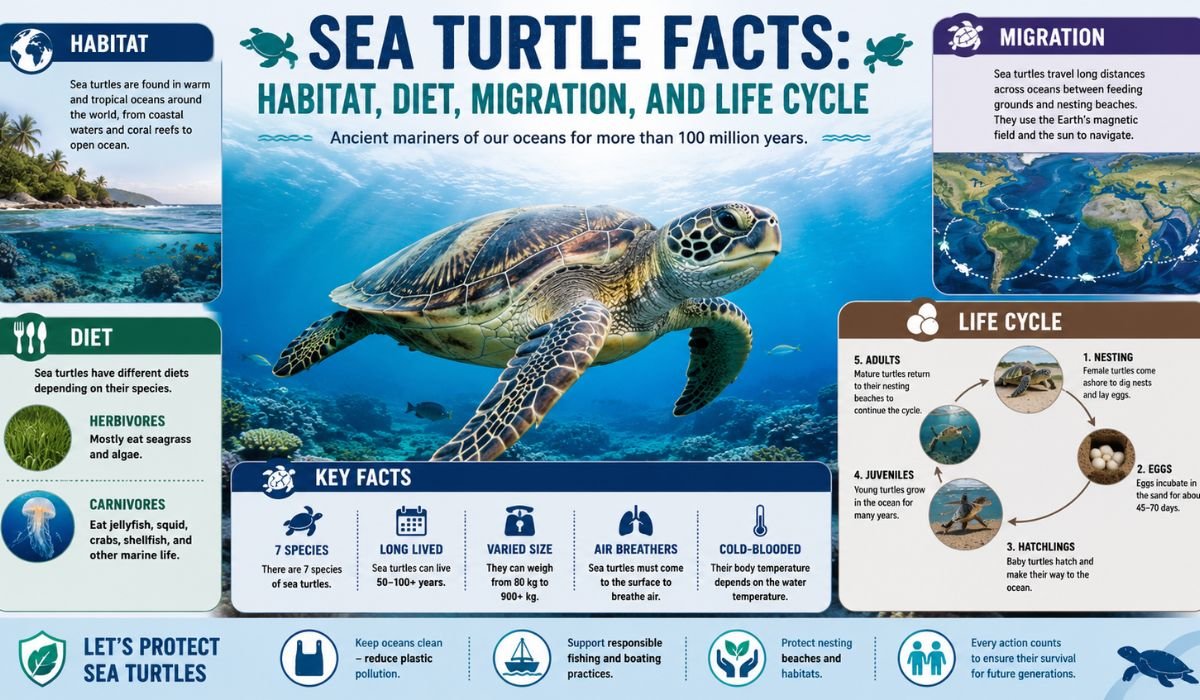
Sea turtles are fascinating marine reptiles that have lived in the world’s oceans for millions of years. They are well adapted to life in the sea, with streamlined bodies, powerful flippers, and shells that protect their organs. From long-distance migrations to remarkable nesting journeys, sea turtle facts reveal how these animals survive in challenging marine environments.
There are seven living species of sea turtles, including green sea turtles, loggerheads, leatherbacks, hawksbills, and olive ridleys. Although each species has unique characteristics, they share many important behaviors, such as returning to beaches to lay eggs. Learning sea turtle facts can help us understand their habitat, diet, migration patterns, reproduction, and role in marine ecosystems.
Sea Turtle Facts and Basic Characteristics
Sea turtles belong to the reptile group and spend most of their lives in oceans and coastal waters. Unlike land turtles, their bodies are specially shaped for swimming. Their front flippers provide powerful strokes, while their rear flippers help with steering.
Most sea turtles cannot pull their heads and limbs completely inside their shells. Their shells are also generally flatter and more streamlined than those of land turtles.
One of the most interesting sea turtle facts is that these animals must come to the surface to breathe air. They can remain underwater for extended periods while resting or searching for food, but they eventually need to surface.
Sea turtles are found in tropical and temperate oceans around the world. Depending on the species, adults can range from relatively small olive ridleys to enormous leatherbacks.
How Long Do Sea Turtles Live?
The exact lifespan of many sea turtle species is difficult to determine because they spend much of their lives underwater. Scientists believe several species can live for many decades, with some potentially reaching 50 years or more.
Sea turtles grow slowly and often take many years to reach sexual maturity. This long development period makes the survival of young and adult turtles especially important for maintaining populations.
Sea Turtle Habitat
Sea turtles live in a variety of marine environments. Their habitats can include open oceans, coral reefs, seagrass meadows, coastal waters, bays, and sandy beaches.
Different species prefer different environments. Green sea turtles, for example, often feed in shallow coastal areas with seagrass and algae. Hawksbill turtles are closely associated with coral reef ecosystems, where their diet can include sponges.
Leatherback turtles are particularly adapted to traveling through the open ocean. They can also tolerate colder waters better than most other sea turtle species.
Where Do Sea Turtles Nest?
Female sea turtles return to beaches to lay their eggs. In many cases, they return to the same general region where they were born, although the exact mechanisms behind this navigation are complex.
Nesting beaches are usually sandy and located along tropical or subtropical coastlines. A female typically comes ashore at night, digs a nest in the sand, lays her eggs, covers them, and returns to the ocean.
Protecting these beaches is an important part of sea turtle conservation.
Read Related Post: Rhinoceros Facts: Habitat, Diet, and Behavior
What Do Sea Turtles Eat?
Sea turtle diets vary considerably between species and life stages. Some are mainly herbivorous, while others eat animals such as jellyfish, crabs, mollusks, and other marine organisms.
Green sea turtles often become largely herbivorous as adults and feed on seagrasses and algae. Hawksbill turtles commonly eat sponges and other organisms found around coral reefs.
Loggerhead turtles have strong jaws that help them consume hard-shelled prey such as crabs and mollusks. Leatherbacks have a diet that includes soft-bodied animals such as jellyfish.
These dietary differences reduce competition between species and allow different sea turtles to occupy different ecological niches.
Do Sea Turtles Drink Water?
Yes. Sea turtles live in saltwater but have special adaptations that help them deal with excess salt. Glands near their eyes remove extra salt from their bodies.
This adaptation allows them to survive in marine environments where drinking seawater would otherwise create a serious problem with salt balance.
Sea Turtle Migration
Migration is one of the most remarkable aspects of sea turtle behavior. Some sea turtles travel thousands of miles between feeding areas and nesting beaches.
Adult turtles may spend months or years feeding in productive marine habitats before migrating toward nesting areas. Female turtles can make repeated journeys between feeding grounds and nesting beaches during a nesting season.
Young turtles may also travel long distances after entering the ocean. Their movements can take them through large portions of the open sea before they settle into areas where food is available.
How Do Sea Turtles Navigate?
Scientists believe sea turtles use several environmental clues to navigate. One important ability is sensitivity to Earth’s magnetic field. This may help turtles determine their approximate position and direction during long ocean journeys.
They may also use ocean currents, visual cues, chemical information, and other environmental signals.
The navigational abilities of sea turtles are still being studied, making migration one of the most interesting areas of marine biology.
Sea Turtle Life Cycle
The sea turtle life cycle begins when a female lays eggs on a sandy beach. Depending on the species, a nest may contain dozens of eggs.
After incubation, hatchlings emerge from the nest and move toward the sea. Their early lives are particularly challenging because many young turtles face natural predators and difficult environmental conditions.
Once they enter the ocean, juvenile turtles spend years growing and developing. Some species move between different habitats as they mature.
Eventually, they become adults and reach reproductive maturity. Adult females return to nesting beaches and begin the cycle again.
What Determines a Hatchling’s Sex?
Temperature plays an important role in determining the sex of sea turtle hatchlings. Warmer nest temperatures generally produce more females, while cooler temperatures tend to produce more males.
This temperature-dependent sex determination makes nesting beaches particularly sensitive to environmental changes. Changes in sand temperature can influence the balance of males and females produced by turtle populations.
Sea Turtle Reproduction and Nesting
Sea turtles usually reproduce in marine environments, but females must come onto land to lay their eggs. Nesting commonly occurs during warmer months, although timing varies by species and location.
A female may lay multiple nests during a nesting season. After depositing the eggs, she carefully covers the nest with sand before returning to the ocean.
The eggs are left to develop without parental care. When the hatchlings emerge, they must make their way toward the water on their own.
One of the important sea turtle facts is that females do not normally raise or feed their young after laying eggs. The hatchlings are independent from the beginning of their lives.
Threats Facing Sea Turtles
Sea turtles face threats both in the ocean and on nesting beaches. Habitat loss, pollution, accidental capture in fishing equipment, and climate-related changes can all affect populations.
Plastic pollution is particularly concerning because turtles may mistake floating plastic for food. Artificial lighting near nesting beaches can also confuse hatchlings and interfere with their movement toward the ocean.
Fishing activities can accidentally capture sea turtles. Specialized fishing practices and equipment can help reduce these accidental interactions.
How Can Sea Turtles Be Protected?
Protecting sea turtles requires conservation efforts across both land and ocean environments. Important measures include protecting nesting beaches, reducing marine pollution, improving fishing practices, and conserving feeding habitats.
People can also help by keeping beaches clean, avoiding disturbance of nesting turtles, and reducing unnecessary plastic waste.
Interesting Sea Turtle Facts
Here are some fascinating sea turtle facts to remember:
- There are seven living species of sea turtles.
- Sea turtles are reptiles, not amphibians.
- They breathe air through their lungs.
- Leatherback turtles are the largest living sea turtle species.
- Some sea turtles migrate thousands of miles.
- Females return to land to lay their eggs.
- Nest temperature influences hatchling sex.
- Sea turtles have specialized glands that remove excess salt.
- Different species have different diets.
- Sea turtles have existed in some form for millions of years.
- Young turtles can spend years developing before reaching adulthood.
- Sea turtles play important roles in marine ecosystems.
These sea turtle facts show how specialized these reptiles are for life in the ocean.
FAQ’s
How many species of sea turtles are there?
There are seven living species of sea turtles: green, loggerhead, leatherback, hawksbill, Kemp’s ridley, olive ridley, and flatback turtles.
How long can sea turtles stay underwater?
The length of time varies depending on species, activity, and conditions. Sea turtles can remain underwater for extended periods, especially when resting, but they must eventually surface to breathe.
What is the largest sea turtle?
The leatherback turtle is the largest living sea turtle species. It has a flexible, leathery shell rather than the hard shell found in most other sea turtles.
Do sea turtles lay eggs in the ocean?
No. Female sea turtles must come onto sandy beaches to lay their eggs. They dig nests in the sand and return to the ocean afterward.
Do sea turtles migrate?
Yes. Many sea turtles undertake long migrations between feeding areas and nesting beaches. Some journeys can cover thousands of miles.
What do baby sea turtles eat?
The diet of young turtles varies by species. Juveniles may consume small marine organisms, plants, or other available food depending on their species and habitat.
Conclusion
Sea turtles are among the most remarkable animals in the world’s oceans. Their streamlined bodies, specialized diets, long migrations, and unique nesting behavior allow them to survive across diverse marine environments.
The life cycle of a sea turtle begins on a sandy beach and continues through years of growth in the ocean before adults return to reproduce. Understanding sea turtle facts helps explain why protecting nesting beaches, feeding habitats, and marine ecosystems is so important.
From their impressive migrations to their temperature-sensitive eggs, sea turtle facts demonstrate how closely these ancient reptiles are connected to their environment. Protecting them requires cooperation between scientists, conservation organizations, communities, and individuals who share the oceans and coastlines with these extraordinary animals.

Hi, I’m Amelia, an SEO and content specialist with several years of experience researching and creating informative content for online audiences. At Animal Attack Facts, I focus on animal behavior, animal attacks on humans, and interesting facts about land animals, marine animals, birds, reptiles, and insects. My goal is to provide clear, useful, and engaging information that helps readers better understand wildlife and stay informed about animal encounters.
1 thought on “Sea Turtle Facts: Habitat, Diet, Migration, and Life Cycle”