
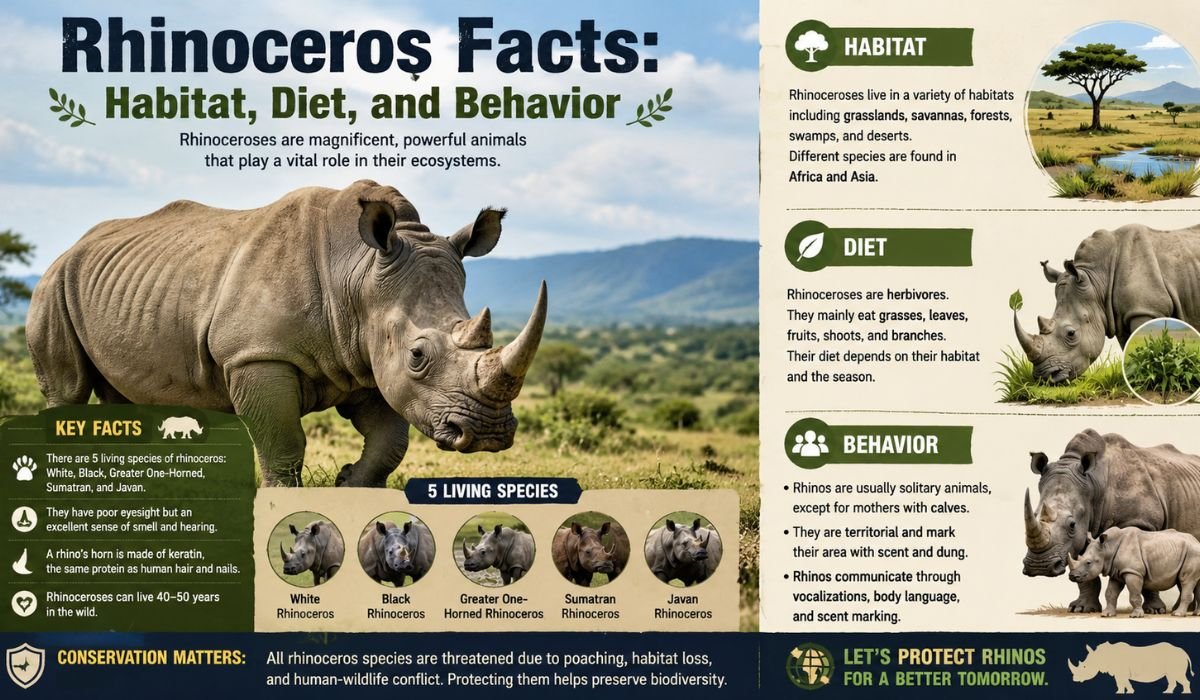
Rhinoceroses are among the largest land mammals on Earth and are easily recognized by their powerful bodies, thick skin, and distinctive horns. Although they may look slow and heavy, rhinos can move surprisingly quickly when threatened. There are five living species of rhinoceros, each with unique characteristics, habitats, and behaviors. Learning rhinoceros facts helps us understand these remarkable animals and the challenges they face in the wild.
Rhinos have existed for millions of years, and their ancestors were once much more widespread than modern species. Today, rhinoceroses are found mainly in parts of Africa and Asia. They play an important role in their ecosystems by shaping vegetation, creating pathways, and helping maintain grassland and woodland habitats.
Rhinoceros Facts and Basic Information
There are five living rhinoceros species: the white rhinoceros, black rhinoceros, Indian rhinoceros, Javan rhinoceros, and Sumatran rhinoceros. Two species live mainly in Africa, while three are native to Asia.
Despite their enormous size, rhinos are herbivores. Their diets consist mainly of grasses, leaves, shoots, fruits, and other vegetation, depending on the species and habitat.
Most rhinos have relatively poor eyesight, but they have strong senses of smell and hearing. These senses help them detect predators, other rhinos, and potential threats.
Where Do Rhinoceroses Live?
One of the most interesting rhinoceros facts is that different species live in very different environments.
African white and black rhinos are found in countries across eastern and southern Africa. White rhinos commonly prefer open grasslands and savannas where they can find plenty of grass. Black rhinos are more likely to inhabit areas with shrubs, bushes, and thicker vegetation.
The Indian rhinoceros lives mainly in grasslands, wetlands, and forested areas around the foothills of the Himalayas. Javan rhinos are extremely rare and survive in a small protected area in Indonesia. Sumatran rhinos live in tropical forests and mountainous environments.
Although their habitats differ, all rhinoceroses need access to food and water. Availability of vegetation, seasonal rainfall, and protection from human activity can strongly influence where rhinos can survive.
African Rhinoceros Habitat
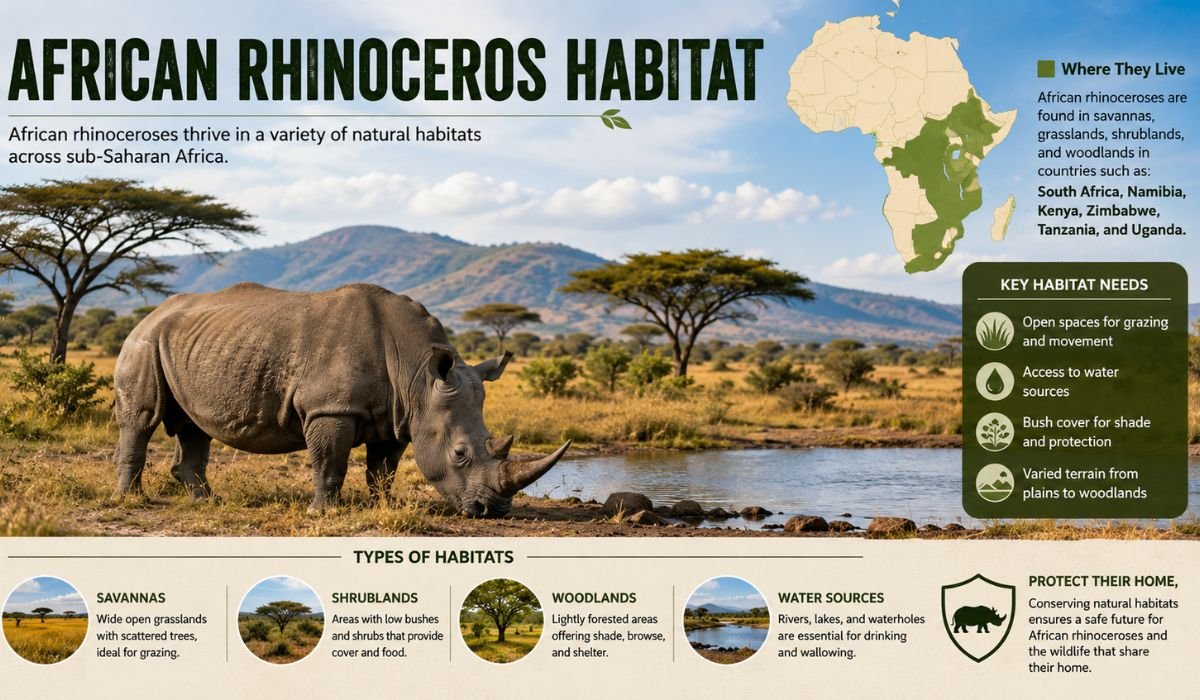
African rhinos are particularly associated with savannas and grasslands. White rhinos generally spend considerable time grazing in open areas. Black rhinos often prefer areas with bushes and woody vegetation.
These habitats provide food, water, shade, and places where rhinos can rest. Conservation areas and national parks have become important refuges for remaining wild populations.
Asian Rhinoceros Habitat
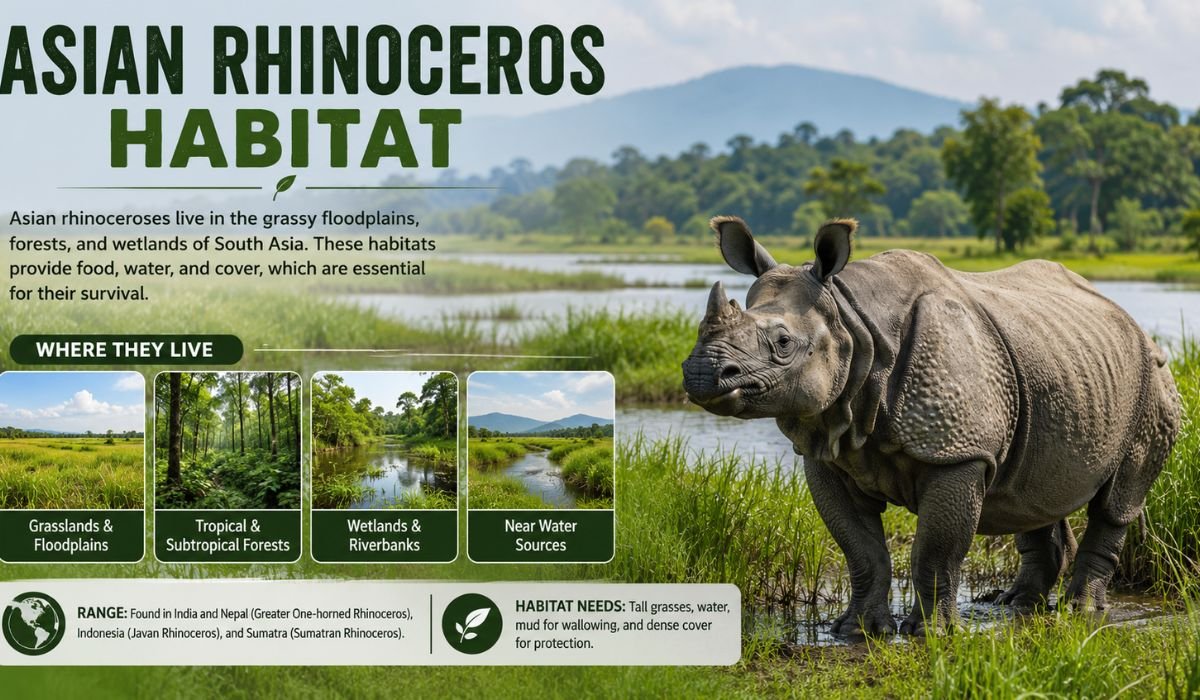
Asian rhino species generally live in forests, wetlands, and tall-grass habitats. The Indian rhinoceros, for example, is well adapted to wet grasslands and can spend time in water.
The Javan and Sumatran rhinos are strongly associated with forest environments. Habitat loss has been one of the major threats to these species.
What Do Rhinoceroses Eat?
Diet is another important part of rhinoceros facts. All living rhinoceros species are herbivores, but their preferred foods vary.
White rhinos are primarily grazers. Their wide, flat mouths are well suited for eating grasses close to the ground. Black rhinos have pointed, flexible lips that allow them to browse on leaves, twigs, and branches.
Indian rhinos eat grasses, leaves, fruits, aquatic plants, and other vegetation. Sumatran rhinos consume a variety of leaves, fruits, twigs, and other forest plants.
Rhinos can spend many hours searching for and eating vegetation. Their large bodies require substantial amounts of food, particularly when plant growth is abundant.
Read Related Post: Tortoise Facts: Habitat, Diet, Lifespan, and Behavior
Rhinoceros Size and Physical Features
Some of the most impressive rhinoceros facts involve their size. White rhinos are among the largest rhino species, with large individuals weighing more than 2,000 kilograms. Indian rhinos can also reach enormous weights.
Rhinos have thick, tough skin that provides protection, although it is not an impenetrable shield. Their skin can also contain folds that give the animals a distinctive armored appearance.
Most rhinoceros species have one or two horns. African species and the Sumatran rhino generally have two horns, while the Indian and Javan rhinos have one prominent horn.
A rhino’s horn is made primarily of keratin, the same type of protein found in human hair and fingernails. Unlike antlers, the horn does not have a bony core.
How Do Rhinoceroses Behave?
Understanding rhinoceros facts also means looking at their behavior. Rhinos can be solitary animals, although their social behavior varies between species.
White rhinos are often more social than black rhinos and may be seen in small groups, particularly in areas with plentiful food. Adult black rhinos are more commonly solitary.
Rhinos communicate using sounds, body movements, scent marking, and other behaviors. They may use dung piles and urine to leave chemical signals that provide information to other rhinos.
Although they are often portrayed as aggressive animals, rhinos do not normally attack without a reason. They may become defensive when they feel threatened, surprised, or when a mother is protecting a calf.
Are Rhinoceroses Fast?
Despite their heavy bodies, rhinos can run surprisingly fast. Some species can reach speeds of roughly 40 kilometers per hour or more over short distances.
Rhinos may charge when they feel threatened. Their speed and size make such a charge dangerous, which is why wild rhinos should always be observed from a safe distance.
Rhinoceros Reproduction and Babies
Female rhinoceroses usually give birth to a single calf after a long pregnancy. The exact gestation period varies by species, but it can last well over a year.
Newborn calves stay close to their mothers for protection and nourishment. Young rhinos gradually learn how to find food, recognize danger, and navigate their environment.
A mother rhino can become particularly defensive if she believes her calf is in danger. Calves remain dependent on their mothers for an extended period before becoming fully independent.
Do Rhinoceroses Have Good Eyesight?
Another interesting rhinoceros facts detail is their relatively weak eyesight. Rhinos generally cannot see distant objects as clearly as humans can.
However, poor eyesight does not mean rhinos are unaware of their surroundings. They have strong hearing and an excellent sense of smell. These abilities help them detect movement, identify other animals, and locate potential threats.
Because they may have difficulty identifying something visually from a distance, sudden movements or unexpected encounters can sometimes cause a defensive reaction.
Rhinoceros Conservation and Threats
Many rhinoceros facts are closely connected to conservation because several rhino species face serious threats.
Historically, rhinoceroses have been hunted for their horns. Illegal wildlife trafficking has caused major population declines, especially among some Asian and African rhino populations.
Habitat loss is another significant problem. Agriculture, human development, roads, and other activities can reduce or fragment the areas where rhinos live.
Conservation programs include protected areas, anti-poaching efforts, habitat management, wildlife monitoring, and breeding programs. International cooperation is also important because illegal wildlife trade can cross national borders.
The Javan and Sumatran rhinoceroses are particularly vulnerable because their remaining populations are very small. Protecting their habitats and preventing illegal hunting are essential for their survival.
Interesting Rhinoceros Facts
Here are some fascinating rhinoceros facts to remember:
- There are five living species of rhinoceros.
- Rhinoceroses are herbivores.
- White rhinos are primarily grass eaters.
- Black rhinos commonly browse on leaves, shoots, and branches.
- Rhinos have thick skin but are not covered in true armor.
- Rhino horns are made primarily of keratin.
- Most rhino species have two horns, while some Asian species have one.
- Rhinoceroses can run much faster than their appearance suggests.
- Many rhinos have relatively poor eyesight.
- Their hearing and sense of smell are important for detecting danger.
- Some rhino species are largely solitary.
- White rhinos can be more social than several other species.
- Rhinos use scent and dung to communicate information.
- Female rhinos usually give birth to one calf at a time.
- Several rhino species are threatened by habitat loss and illegal hunting.
FAQ’s
How many rhinoceros species are there?
There are five living rhinoceros species: white, black, Indian, Javan, and Sumatran rhinoceroses. Each species has different physical characteristics, diets, and habitat preferences.
What do rhinoceroses eat?
Rhinoceroses are herbivores. Depending on the species, they eat grasses, leaves, shoots, twigs, fruits, and aquatic vegetation.
How fast can a rhinoceros run?
Some rhino species can reach speeds of around 40 kilometers per hour or more over short distances. Their speed is one reason they should never be approached in the wild.
Why are rhinoceroses endangered?
One of the most important rhinoceros facts is that several species face severe conservation threats. Illegal hunting for their horns, habitat loss, and small population sizes are major concerns.
What is a rhinoceros horn made of?
A rhinoceros horn is primarily made of keratin. Keratin is a structural protein also found in human hair and fingernails.
Are rhinoceroses aggressive?
Rhinos can be defensive and dangerous when they feel threatened, but they do not simply attack everything they encounter. Their behavior depends on the species, situation, and individual animal.
Where do rhinoceroses live?
African rhinos mainly live in grasslands, savannas, and areas with shrubs. Asian rhinos can be found in grasslands, wetlands, forests, and other tropical environments.
Conclusion
These rhinoceros facts show that rhinos are much more than enormous animals with horns. They are specialized herbivores with complex behaviors, strong senses of smell and hearing, and important ecological roles. Their different species have adapted to grasslands, wetlands, forests, and other environments across Africa and Asia.
Unfortunately, several rhinoceros species remain under serious pressure from habitat loss and illegal hunting. Conservation efforts are helping protect populations and preserve their habitats, but continued protection is essential. Learning about these remarkable animals can help people better understand why rhinoceroses deserve protection for future generations.

Hi, I’m Amelia, an SEO and content specialist with several years of experience researching and creating informative content for online audiences. At Animal Attack Facts, I focus on animal behavior, animal attacks on humans, and interesting facts about land animals, marine animals, birds, reptiles, and insects. My goal is to provide clear, useful, and engaging information that helps readers better understand wildlife and stay informed about animal encounters.
1 thought on “Rhinoceros Facts: Habitat, Diet, and Behavior”