
Ostriches are among the most remarkable birds on Earth. They are famous for their enormous size, powerful legs, impressive running ability, and unique appearance. Although they cannot fly, ostriches have adapted extremely well to life on land and can survive in some of the hottest and driest environments in Africa. These birds are also known for their large eyes, long necks, and strong feet.
In this guide, we explore fascinating ostrich facts about their size, speed, habitat, diet, behavior, reproduction, and survival adaptations. Whether you are researching these giant birds for school, wildlife knowledge, or simple curiosity, these facts will help you understand what makes ostriches so unusual.
Ostrich Facts About Size and Appearance
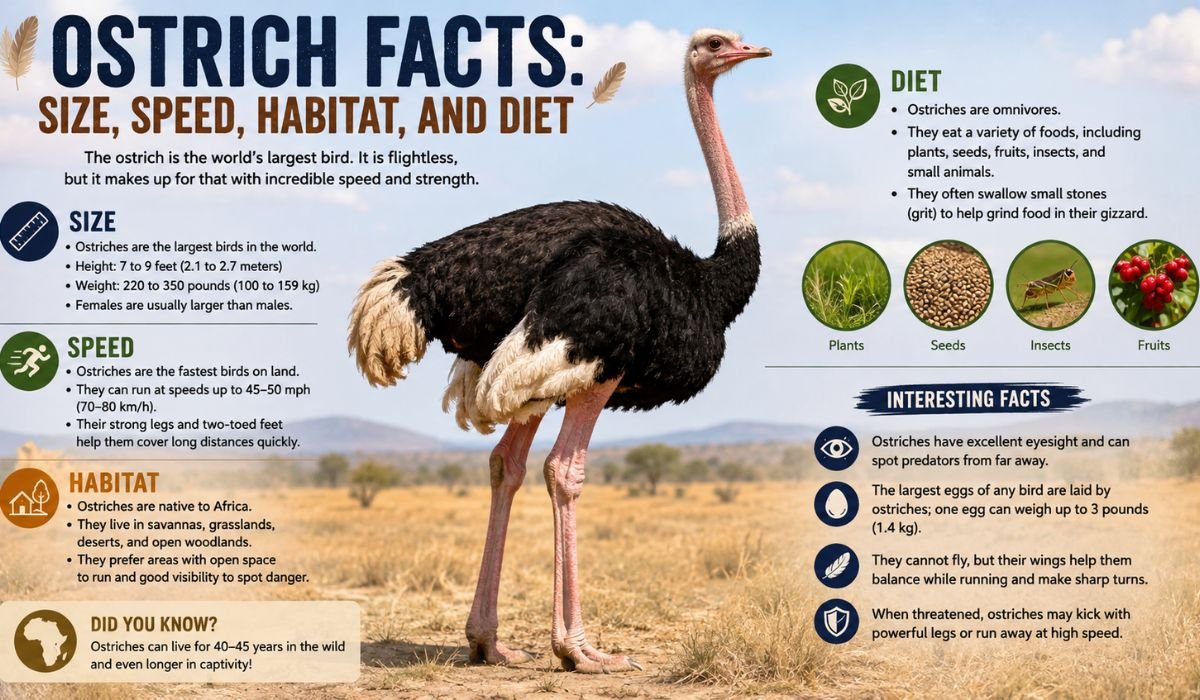
One of the most interesting ostrich facts is that the ostrich is the world’s largest living bird. Adult males can reach around 2.4–2.8 meters in height, while females are generally somewhat smaller. Their large bodies can weigh more than 100 kilograms, with some individuals becoming considerably heavier.
Ostriches have long, bare-looking necks, small heads, and very large eyes. Their eyes are among the largest of any land animal and provide excellent vision, helping them detect predators from a distance.
Male ostriches usually have mostly black feathers with white feathers on their wings and tail. Females and young birds generally have brownish-gray plumage. This difference in appearance between males and females is called sexual dimorphism.
Why Can’t Ostriches Fly?
Despite having wings, ostriches cannot fly because their bodies are too large and heavy for powered flight. Their wings have a different purpose. They can help with balance while running, changing direction, courtship displays, and protecting their young.
Their flightless lifestyle is an excellent example of how birds can evolve different physical features for life on the ground.
How Fast Can an Ostrich Run?
Among the most impressive ostrich facts is their incredible running ability. Ostriches can reach speeds of roughly 60–70 km/h for short periods, making them the fastest birds on land.
Their long, powerful legs allow them to take very large strides. Instead of using several small steps, an ostrich can cover significant distances with each stride.
Ostriches also have excellent endurance and can maintain high speeds when escaping danger. Their running ability is one of their most important defenses against predators.
How Do Ostriches Run So Fast?
An ostrich has two toes on each foot, which is unusual among birds. One of the toes has a large claw that can provide additional protection when necessary.
Their long legs act almost like powerful springs. Strong muscles combined with long limbs allow ostriches to move efficiently across open landscapes.
Their wings also help them steer. When running quickly, an ostrich can use its wings to assist with balance and sudden changes in direction.
Ostrich Habitat
Another important group of ostrich facts concerns where these birds live. Wild ostriches are native to Africa and are commonly associated with open habitats such as savannas, grasslands, scrublands, and semi-arid regions.
They prefer areas where they can see across large distances. Open landscapes allow ostriches to spot approaching predators while also providing plenty of space to run away.
Ostriches can tolerate hot and dry conditions because they have several adaptations that help them manage challenging environments.
Read Related Post: Sea Turtle Facts: Habitat, Diet, Migration, and Life Cycle
How Do Ostriches Survive Hot Weather?
Ostriches have adaptations that help them cope with high temperatures. Their bodies can regulate heat effectively, and they can survive without drinking water constantly when suitable food provides moisture.
Their feathers also play a role in insulation. Although feathers may seem unsuitable for hot environments, they can help protect the body from direct sunlight and temperature changes.
Ostriches often adjust their activity according to environmental conditions, spending more time feeding during cooler periods.
What Do Ostriches Eat?
Their diet is another fascinating part of ostrich facts. Ostriches are omnivorous birds, although plant material makes up a major part of their diet.
They commonly eat grasses, leaves, seeds, flowers, fruits, and other plant matter. They may also consume insects and small animals when opportunities arise.
Because ostriches do not have teeth, they cannot chew their food. Instead, they swallow food and use their digestive system to process it.
Why Do Ostriches Swallow Stones?
One of the more unusual ostrich facts is that these birds swallow small stones and other hard objects called gastroliths. The stones remain in the muscular part of the stomach and help grind food.
This is particularly useful for breaking down tough plant material. Similar behavior occurs in several other bird species.
Ostrich Behavior
Ostriches are social birds and may live in groups that vary in size depending on environmental conditions. Groups can provide benefits such as increased opportunities to detect predators.
Several ostriches can feed together while some individuals remain alert. Their excellent eyesight allows them to notice potential threats from far away.
Despite their reputation for being aggressive, ostriches usually prefer to avoid danger by running. However, when threatened or cornered, they can defend themselves using their powerful legs.
Do Ostriches Bury Their Heads?
A popular myth claims that ostriches bury their heads in the sand when frightened. This is not true.
This idea may have developed because ostriches sometimes lower their heads toward the ground while feeding, checking their nests, or responding to danger. From a distance, the bird’s body can make its head difficult to see, creating the illusion that it has disappeared into the ground.
Ostrich Reproduction and Eggs
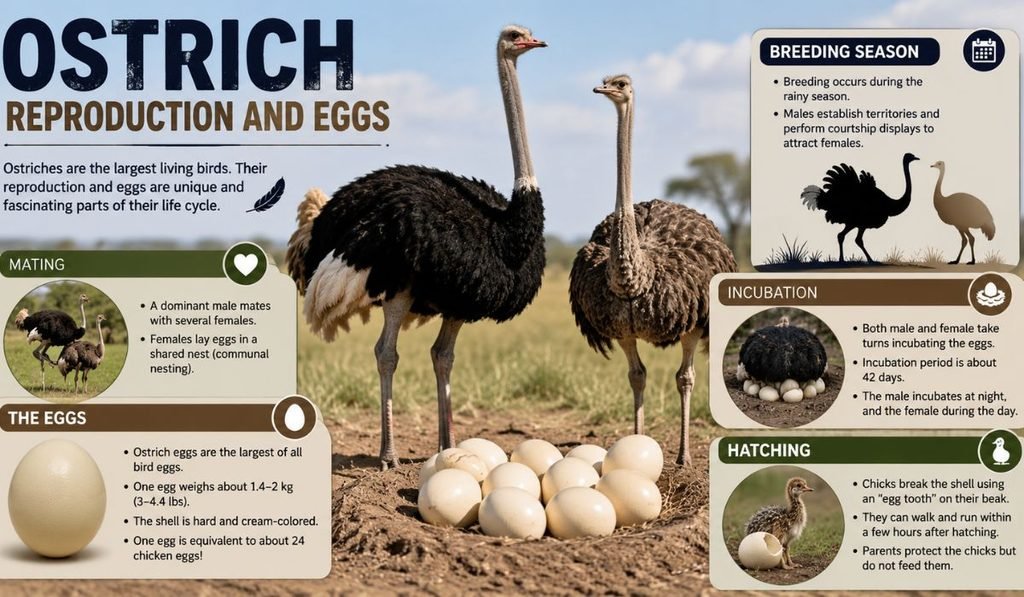
Reproduction provides some of the most fascinating ostrich facts. Ostrich eggs are enormous compared with the eggs of most other living birds. They can weigh around 1.5 kilograms, although size varies.
Female ostriches lay their eggs in a communal nest, which is generally a simple scrape in the ground. Several females may lay eggs in the same nest.
The dominant female and male have important roles in the nesting process. Both males and females may participate in incubation, with males often taking a larger role during nighttime incubation.
How Big Are Ostrich Eggs?
An ostrich egg can be roughly 15 centimeters long and has a thick, strong shell. Despite being the largest bird egg, it is relatively small compared with the size of the adult bird when compared proportionally.
The strong shell helps protect the developing chick from environmental conditions and potential threats.
Ostrich Chicks
Young ostriches grow quickly after hatching. Chicks are covered with soft, downy feathers and are capable of walking soon after birth.
This is important because ostrich chicks need to move with adults rather than remaining helpless in a nest for an extended period.
Parents help protect chicks from predators, while the young birds gradually become more independent as they grow.
Ostrich Defense Mechanisms
A major reason ostriches have survived in challenging African environments is their combination of speed, vision, and physical strength.
Their height gives them a broad view of the surrounding landscape. Their strong legs allow them to escape many threats, while their powerful feet can be used for defense.
An adult ostrich is capable of delivering a dangerous kick, particularly when defending itself or its young. However, running away is generally the preferred strategy when escape is possible.
Interesting Ostrich Facts You Should Know
Here are several quick ostrich facts that highlight just how unusual these birds are:
- Ostriches are the largest living birds.
- They are flightless birds.
- They are among the fastest birds on land.
- Ostriches have two toes on each foot.
- Their eyes are exceptionally large.
- Their eggs are the largest of any living bird.
- They are native to Africa.
- Ostriches mainly eat plants but can also consume insects and small animals.
- They can use their wings for balance while running.
- Male and female ostriches have different feather coloration.
- Ostriches can live for many years in suitable conditions.
- Their powerful legs are useful for both running and defense.
Are Ostriches Dangerous?
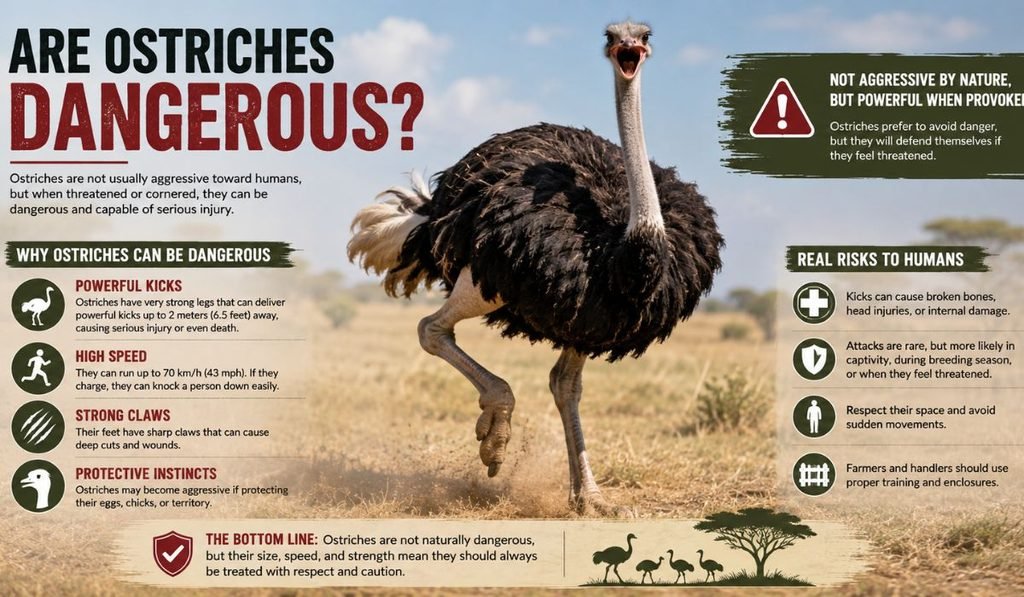
Although ostriches are generally not looking for conflict with humans, they are large and powerful wild animals. Their size, speed, and strong legs mean they should be observed from a safe distance.
The idea that ostriches are harmless because they are birds is misleading. Their physical strength is an important part of their survival strategy.
FAQ’s
How tall is an ostrich?
One of the most well-known ostrich facts is that adult ostriches can grow to around 2.4–2.8 meters tall, making them the tallest living birds.
How fast can an ostrich run?
Ostriches can reach speeds of approximately 60–70 km/h for short periods. Their long legs, strong muscles, and two-toed feet make them highly efficient runners.
Where do ostriches live?
Ostriches naturally occur in Africa, especially in open grasslands, savannas, scrublands, and semi-arid environments where they have plenty of space to move and spot predators.
What do ostriches eat?
Ostriches mainly eat grasses, leaves, seeds, flowers, and fruits. They may also eat insects and other small animals, making them omnivorous.
Can ostriches fly?
No. Their large bodies and specialized anatomy prevent them from flying. Instead, their wings are mainly used for balance, steering, communication, and courtship.
How big are ostrich eggs?
Ostrich eggs can weigh around 1.5 kilograms and are the largest eggs produced by any living bird species.
Do ostriches really bury their heads in sand?
No. This is a common myth. Ostriches may lower their heads toward the ground while feeding, nesting, or responding to threats, but they do not bury their heads in sand to hide.
Conclusion
These ostrich facts show why ostriches are among the most remarkable birds in the world. Their enormous size, powerful legs, remarkable running speed, excellent eyesight, and ability to survive in hot African environments make them highly specialized land birds.
Although ostriches cannot fly, they have developed other impressive abilities that help them survive. From their enormous eggs and unusual two-toed feet to their social behavior and plant-based diet, almost every part of an ostrich’s biology is fascinating.
Understanding these ostrich facts also helps separate real wildlife science from popular myths, such as the idea that ostriches bury their heads in sand. These extraordinary birds are much more interesting than the myths suggest.

Hi, I’m Amelia, an SEO and content specialist with several years of experience researching and creating informative content for online audiences. At Animal Attack Facts, I focus on animal behavior, animal attacks on humans, and interesting facts about land animals, marine animals, birds, reptiles, and insects. My goal is to provide clear, useful, and engaging information that helps readers better understand wildlife and stay informed about animal encounters.
1 thought on “Ostrich Facts: Size, Speed, Habitat, and Diet”