
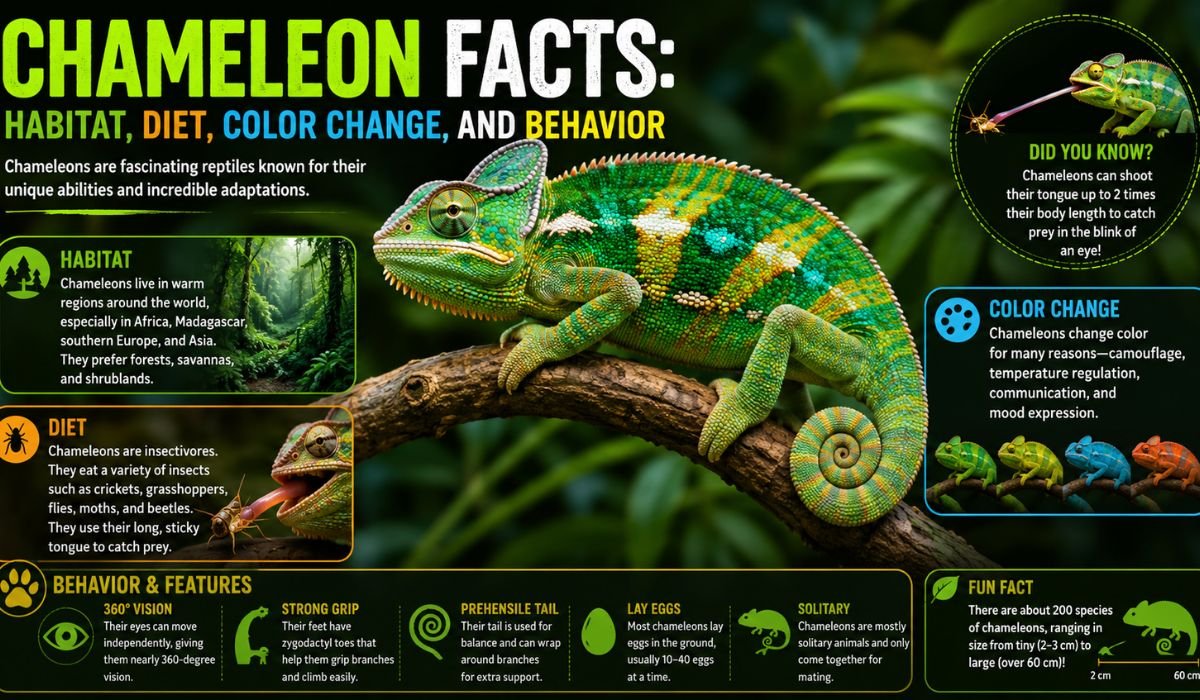
Chameleons are among the most fascinating reptiles on Earth. Famous for their unusual eyes, gripping feet, long tongues, and remarkable ability to change color, these reptiles have developed special adaptations that help them survive in different environments.
From tropical forests to dry regions, chameleons use their unique bodies and behaviors to find food, avoid danger, and communicate with other chameleons. In this guide to chameleon facts, you will learn about their habitat, diet, color-changing abilities, physical features, behavior, reproduction, and other interesting characteristics.
What Are Chameleons?
Chameleons are reptiles belonging mainly to the family Chamaeleonidae. There are many different chameleon species, and they vary considerably in size, appearance, and habitat. Most are found in Africa and Madagascar, although some species also live in parts of southern Europe, the Middle East, and Asia.
One of the most interesting chameleon facts is that these reptiles are specially adapted for life in trees. Many species have prehensile tails and feet that can tightly grip branches. Their bodies are often shaped to help them move carefully through vegetation while remaining difficult for predators to notice.
Chameleons are generally slow-moving animals. Instead of relying on speed, they use camouflage, specialized eyesight, and other adaptations to survive.
Chameleon Habitat
Chameleons live in a variety of environments, although many species prefer areas with vegetation where they can climb and hunt insects.
Forests and Woodlands
Many chameleons live in tropical and subtropical forests. Trees, shrubs, and dense vegetation provide places to climb, hunt, hide, and rest. Madagascar is particularly famous for its diverse chameleon population.
Dry and Semi-Dry Areas
Some species have adapted to drier environments. These chameleons may live in scrublands, savannas, and other areas where vegetation is less dense. Their ability to tolerate different environmental conditions contributes to their wide range of habitats.
Where Do Chameleons Sleep?
Most tree-dwelling chameleons spend the night resting on branches or among vegetation. During the day, they become active and search for food. Their sleeping positions can sometimes make them easier to locate because their colors and patterns may change while they are resting.
Chameleon Diet
Most chameleons are primarily insectivores, meaning insects make up a large part of their diet. They use their specialized tongues to capture prey from a distance.
Common foods can include:
- Crickets
- Grasshoppers
- Flies
- Moths
- Beetles
- Other small insects
Larger chameleon species may also eat small vertebrates, depending on their size and environment. Some species consume plant material, especially fruits or leaves, although this varies among species.
An important point among chameleon facts is that their hunting strategy does not usually involve chasing prey. Instead, a chameleon often remains still and waits for an insect to come within range.
Read Related Post: Ostrich Facts: Size, Speed, Habitat, and Diet
How Does a Chameleon Catch Food?
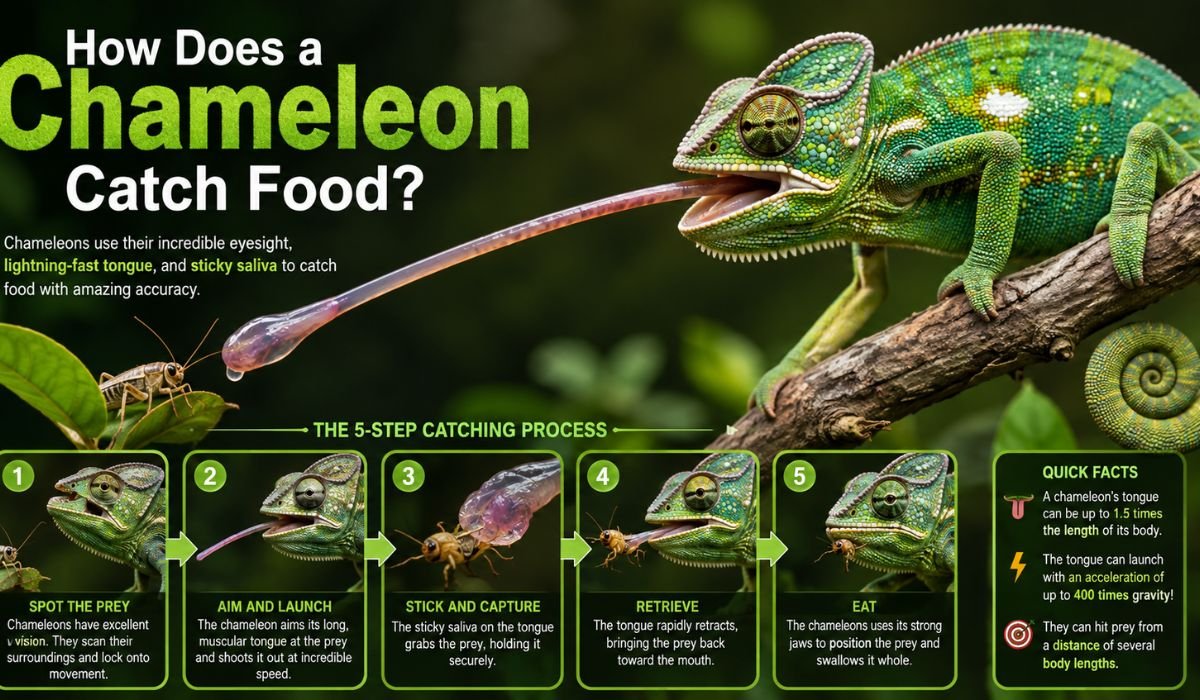
A chameleon’s tongue is one of its most impressive adaptations. It can rapidly extend toward prey and use its sticky tip to help capture the target. The chameleon then pulls the tongue back into its mouth and eats the prey.
This hunting method allows chameleons to conserve energy while still catching fast-moving insects.
Why Do Chameleons Change Color?
Color change is probably the best-known feature of chameleons. However, one of the most important chameleon facts is that they do not simply change color to match every background like a living camouflage machine.
Chameleons can change their colors for several reasons, including communication, temperature regulation, and emotional state.
Specialized cells in their skin help produce these changes. These include pigment-containing cells and reflective structures that interact with light. By changing the arrangement or appearance of these structures, some chameleons can display different colors and patterns.
Color Change and Communication
Color can communicate information to other chameleons. For example, certain displays may be associated with courtship, territorial behavior, aggression, or stress.
The exact colors and meanings vary between species. A brighter or more contrasting display can sometimes signal that a chameleon is attempting to communicate with another individual.
Color Change and Temperature
Chameleons may also change color in response to temperature. Darker colors can help some individuals absorb more sunlight when they are cold, while lighter colors may help reflect some sunlight when they are warm.
Therefore, color change is a useful physiological and communication tool rather than simply a camouflage trick.
Chameleon Eyes
Chameleon eyes are another extraordinary adaptation. Each eye can move independently of the other, allowing a chameleon to observe different directions at the same time.
This provides a wide field of vision and helps the reptile detect potential predators and prey.
When a chameleon identifies prey, its eyes can coordinate to focus on the target. This combination of independently moving eyes and precise depth perception makes hunting more effective.
Among the most surprising chameleon facts is that their visual system is highly specialized for an animal that often moves slowly.
Chameleon Feet and Tail
Chameleons have specially adapted feet that help them grip branches. Their toes are arranged into groups that allow them to hold onto narrow surfaces securely.
Their tails provide additional support. Many species have prehensile tails, meaning they can use the tail to wrap around branches and help stabilize their bodies.
These adaptations are especially useful for arboreal species that spend much of their lives above the ground.
Chameleon Behavior
Chameleons are generally solitary animals. Many species prefer to live alone and may become territorial when another chameleon enters their space.
Their behavior can include slow climbing, basking, hunting, hiding, and communicating through body posture and color changes.
How Do Chameleons Defend Themselves?
When threatened, a chameleon may attempt to make itself appear larger. It can change its body posture, inflate its body, open its mouth, or display stronger colors.
Some species may also hiss or attempt to bite if they feel seriously threatened. However, avoiding detection and staying hidden are important parts of their natural defense strategy.
Chameleon Size
Chameleon size varies greatly between species. Some are only a few centimeters long, while others can become considerably larger.
Size can influence diet, habitat preference, behavior, and vulnerability to predators. Males and females may also differ in size and appearance in some species.
This diversity in body size is one reason there is no single description that applies perfectly to every chameleon species.
Chameleon Reproduction
Many chameleon species reproduce by laying eggs, although reproductive strategies differ among species. Females may search for suitable locations where their eggs can develop safely.
After the eggs hatch, young chameleons are generally independent and must find food and avoid predators without extensive parental care.
Some species have reproductive cycles influenced by environmental conditions such as temperature, rainfall, and food availability.
How Long Do Chameleons Live?
Chameleon lifespan varies depending on the species, habitat, environmental conditions, and other factors. Some smaller species naturally have relatively short lifespans, while certain larger species can live longer.
Wild chameleons face threats from predators, habitat loss, disease, and environmental changes. Their survival therefore depends heavily on the quality and stability of their natural habitat.
Chameleon Predators
Chameleons are hunted by various predators depending on where they live. Birds, snakes, mammals, and larger reptiles may prey on them.
Their ability to remain still, blend into vegetation, and change colors can help reduce the risk of being detected. Their unusual eyesight also allows them to monitor their surroundings while remaining relatively motionless.
One of the useful chameleon facts to remember is that survival depends on a combination of camouflage, vision, body adaptations, and cautious behavior rather than a single defense mechanism.
Interesting Chameleon Facts
Here are some additional chameleon facts that make these reptiles especially interesting:
- Chameleons are reptiles, not amphibians.
- Many chameleons are excellent climbers.
- Their eyes can move independently.
- Many species have prehensile tails.
- Their feet are specialized for gripping branches.
- Their tongues can rapidly extend to capture prey.
- Color changes can be used for communication.
- Color can also be influenced by temperature and emotional state.
- Most chameleons primarily eat insects.
- Madagascar contains an exceptional diversity of chameleon species.
- Chameleons generally move slowly rather than relying on speed.
- Different species can vary dramatically in size and appearance.
FAQ’s
Are chameleons able to change color?
Yes. Chameleons can change their skin colors and patterns using specialized structures within their skin. The changes can be related to communication, temperature, and emotional state.
What do chameleons eat?
Most chameleons primarily eat insects such as crickets, grasshoppers, flies, and other small invertebrates. Larger species may sometimes consume other small animals or plant material.
Why do chameleons have unusual eyes?
Their independently moving eyes provide a broad field of vision. This helps them watch for predators and locate prey while remaining relatively still.
Can all chameleons change color?
Chameleons generally have some ability to change their coloration, but the extent and range of color changes differ between species. Not every species can produce the same dramatic color displays.
Where do chameleons live?
Chameleons are especially common in Africa and Madagascar. Different species can live in forests, woodlands, savannas, scrublands, and other environments.
How does a chameleon catch insects?
A chameleon usually waits for prey rather than chasing it. When an insect comes within range, the chameleon rapidly extends its specialized tongue to capture it.
Are chameleons dangerous?
Chameleons are generally not dangerous to people. They are small reptiles that usually prefer to avoid threats. Like many animals, they may defend themselves if they feel threatened.
Conclusion
Chameleons are remarkable reptiles with a collection of adaptations that make them highly successful in their natural environments. Their independently moving eyes help them observe their surroundings, specialized feet and tails allow them to climb, and their powerful tongues help them capture prey. Their ability to change color also plays important roles in communication and temperature regulation.
These chameleon facts show that color change is only one part of what makes these reptiles special. Their behavior, hunting techniques, vision, physical adaptations, and diversity all contribute to their fascinating biology. Whether living in tropical forests or drier landscapes, chameleons demonstrate how specialized adaptations can help animals survive and thrive in challenging environments.

Hi, I’m Amelia, an SEO and content specialist with several years of experience researching and creating informative content for online audiences. At Animal Attack Facts, I focus on animal behavior, animal attacks on humans, and interesting facts about land animals, marine animals, birds, reptiles, and insects. My goal is to provide clear, useful, and engaging information that helps readers better understand wildlife and stay informed about animal encounters.
1 thought on “Chameleon Facts: Habitat, Diet, Color Change, and Behavior”