
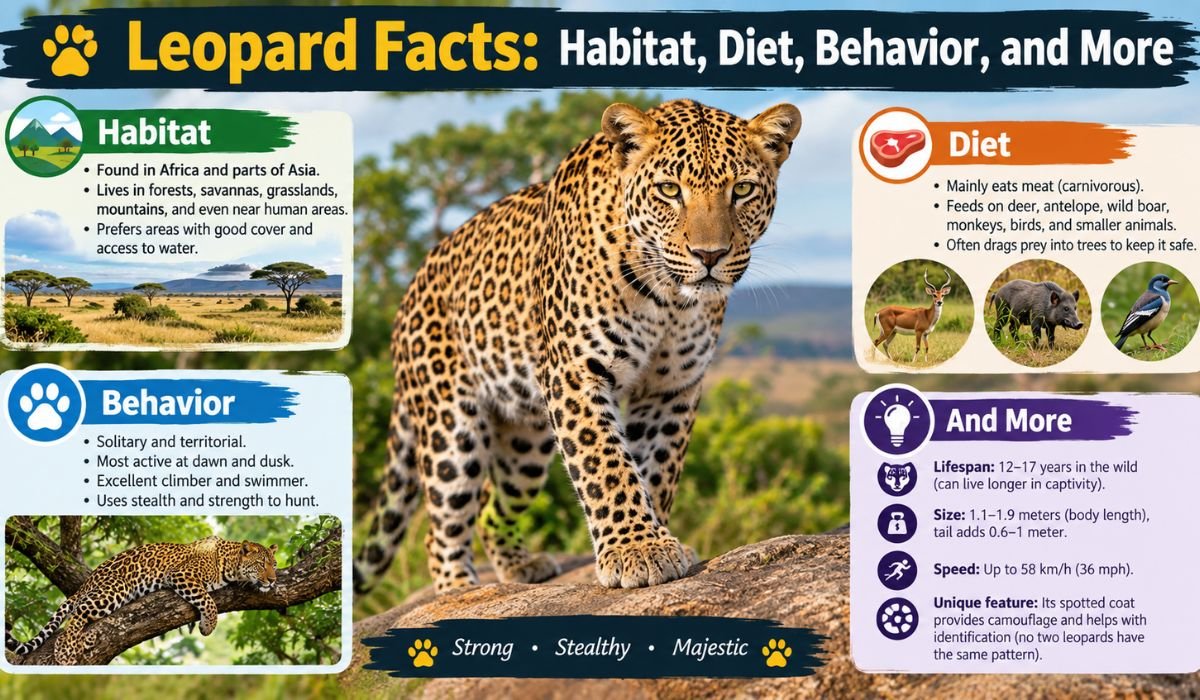
Leopards are among the most adaptable and fascinating big cats in the world. Known for their spotted coats, powerful bodies, and remarkable climbing abilities, these predators can survive in forests, grasslands, mountains, and even dry regions. Learning interesting leopard facts reveals how these solitary cats hunt, communicate, raise their young, and adapt to changing environments.
Unlike some big cats that depend on a particular habitat, leopards are highly versatile. They can live close to rivers and wetlands, in dense forests, and across open savannas. Their strength, stealth, and intelligence make them successful hunters in many different ecosystems.
Leopard Facts About Their Appearance
One of the most recognizable leopard facts is their distinctive coat. Leopards usually have golden-yellow or pale brown fur covered with dark spots called rosettes. These patterns help break up the outline of their bodies, making them harder for prey to notice.
Leopards have relatively short legs, powerful shoulders, and long tails. Their tails help them maintain balance when climbing, running, or moving across uneven terrain. Their muscular bodies allow them to carry surprisingly heavy prey into trees.
Male leopards are generally larger and heavier than females. Their size can vary considerably depending on their geographic location and the available food in their habitat.
Where Do Leopards Live?
One of the most important leopard facts is that these cats have an exceptionally wide geographic range. Leopards naturally occur across parts of Africa and Asia, although their populations are fragmented in many areas.
They may inhabit:
- Tropical forests
- Savannas and grasslands
- Woodlands
- Mountain regions
- Semi-arid landscapes
- River valleys
- Scrublands
Leopards are especially successful because they can adapt to different environmental conditions. Some populations live in areas where temperatures are extremely hot, while others inhabit colder mountainous environments.
Their ability to use different habitats gives them an advantage over predators with more specialized habitat requirements.
Leopard Diet and Hunting
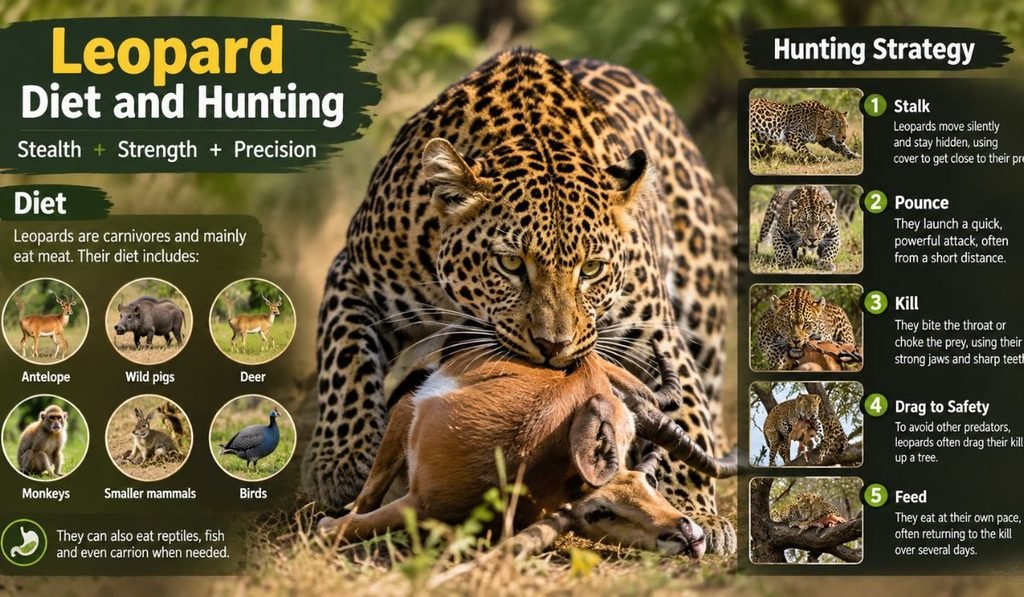
Another fascinating part of leopard facts is their broad diet. Leopards are carnivores and can hunt many different types of animals depending on what is available.
Their prey may include:
- Antelope
- Gazelles
- Monkeys
- Rodents
- Hares
- Birds
- Reptiles
- Warthogs and other small mammals
Leopards are primarily ambush predators. Rather than chasing prey over long distances, they often use vegetation, rocks, or darkness to approach quietly. Once close enough, they make a short and powerful attack.
Leopards are also known for their ability to drag prey into trees. This behavior can protect their food from competing predators and scavengers. Their powerful jaws, shoulders, and forelimbs make this possible.
How Do Leopards Behave?
Their behavior provides some of the most interesting leopard facts. Leopards are generally solitary animals. Adults usually spend much of their time alone, except when mothers are caring for their cubs or during mating periods.
They communicate using sounds, scent markings, body language, and visual signals. Leopards may mark their territories with scent and other signs to communicate their presence to other individuals.
Although they are often associated with nighttime activity, leopards can also be active during the day. Their activity patterns depend on their environment, prey availability, competition, and human activity.
Read Related Post: Butterfly Facts: Life Cycle, Diet, Habitat, and Behavior
Are Leopards Good Climbers?
Yes. Their climbing ability is one of the best-known leopard facts. Leopards are excellent climbers and can use trees for resting, hiding, storing food, and escaping potential threats.
Their strong limbs and sharp claws allow them to climb tree trunks effectively. Young leopards also spend time learning climbing skills as they develop.
Trees can provide a safe location where a leopard can eat or rest without immediately facing competition from animals on the ground.
Leopard Cubs and Family Life
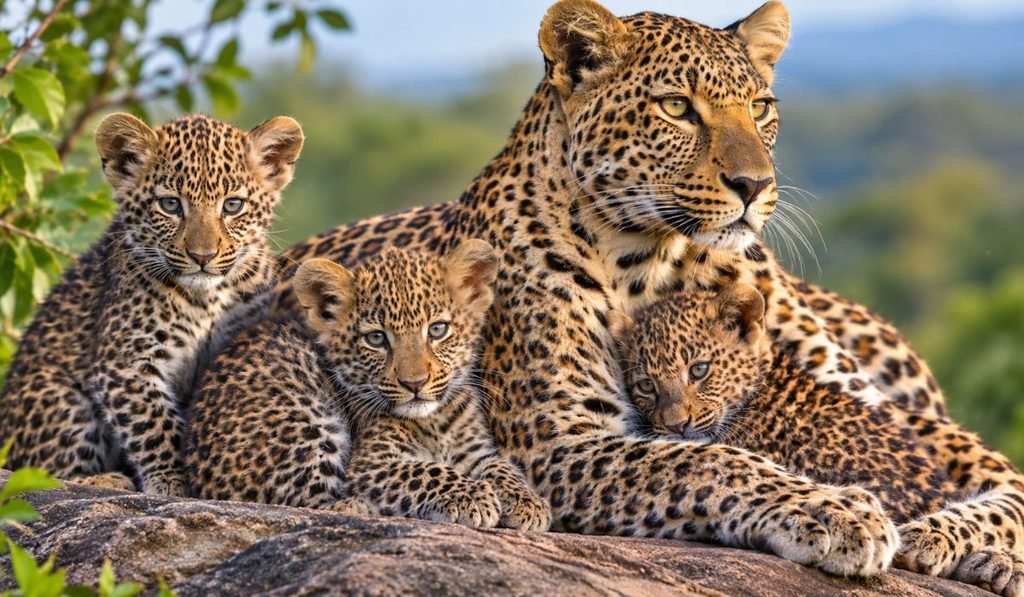
Female leopards usually raise their cubs alone. After a gestation period of roughly three months, a female gives birth to a small litter, although litter size can vary.
Newborn cubs are vulnerable and depend heavily on their mother. They are born with their eyes closed and remain hidden in a secure den during their earliest weeks.
As they grow, cubs begin exploring their surroundings and practicing important survival skills. Their mother teaches them through experience, including how to move, hunt, and recognize potential dangers.
These young animals remain dependent on their mother for an extended period before becoming independent.
Leopard Adaptations
Several physical and behavioral adaptations help explain why leopards are such successful predators. Their spotted coats provide camouflage, while their muscular bodies support powerful attacks.
Their long tails improve balance, particularly when climbing. Strong jaws and sharp teeth help them handle prey, while retractable claws provide traction and help them capture animals.
Their flexible hunting strategy is another important adaptation. Instead of relying on only one type of prey, leopards can adjust their diet according to what is available.
This adaptability is one reason they can occupy such a wide variety of habitats.
Leopard Facts About Speed and Strength
Although leopards are not built for long-distance pursuit, they can move quickly over short distances. Their real advantage comes from combining speed with stealth and explosive strength.
A leopard can quietly approach prey before making a sudden attack. Its powerful forelimbs and jaws allow it to subdue animals that may be surprisingly large compared with the cat itself.
Leopards are also exceptionally strong for their size. Their ability to climb while carrying food demonstrates the strength of their muscles and limbs.
Do Leopards Have Different Species?
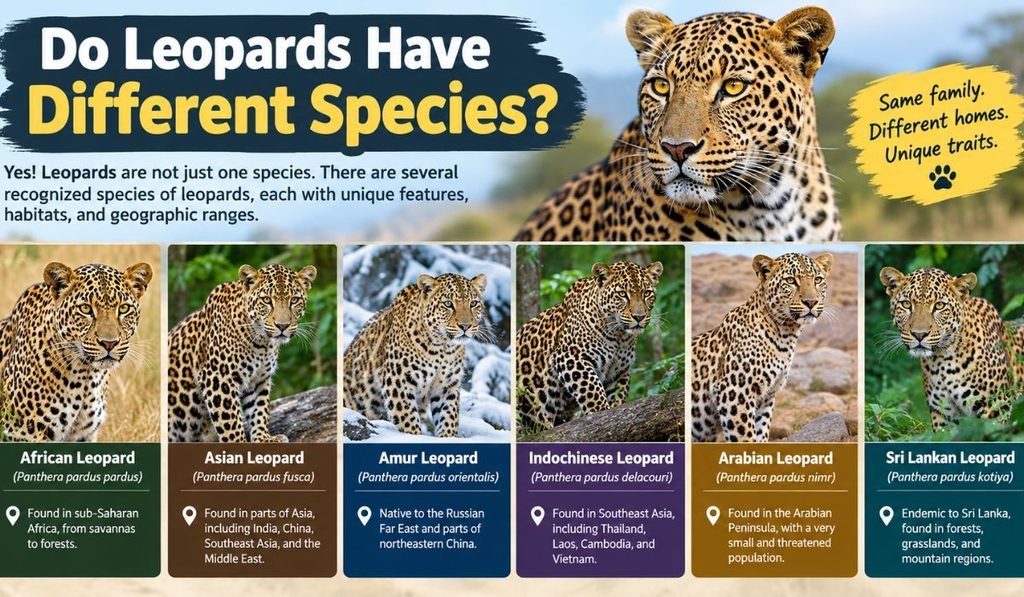
The leopard belongs to the species Panthera pardus. Scientists recognize several subspecies or regional populations, although their classification has changed as genetic and scientific research has developed.
Leopards are related to other members of the Panthera genus, including lions, tigers, jaguars, and snow leopards.
A leopard should not be confused with a jaguar. Both have spotted coats and rosette patterns, but they are different species and naturally occur in different parts of the world.
Leopard Habitat and Conservation
Understanding leopard facts also means recognizing the challenges these animals face. Leopards have lost habitat in many parts of their historical range because of agriculture, development, roads, and other human activities.
They can also experience conflict with people when they hunt livestock or live close to human communities. Illegal hunting and the loss of natural prey can create additional pressure on some populations.
Conservation efforts focus on protecting habitats, maintaining wildlife corridors, reducing human-wildlife conflict, and preventing illegal hunting.
Because leopards occupy such diverse environments, protecting large connected habitats is particularly important for their long-term survival.
Interesting Leopard Facts You Should Know
Here are some quick leopard facts that highlight just how remarkable these big cats are:
- Leopards are excellent climbers and may carry prey into trees.
- Their spotted coats provide effective camouflage.
- Leopards are generally solitary animals.
- They can live in a wide variety of habitats.
- Their diet includes many different types of animals.
- Leopards rely heavily on stealth when hunting.
- Females usually raise cubs without the assistance of males.
- Their long tails help them balance while climbing and moving.
- Leopards can be active during both daylight and nighttime.
- Their adaptability helps them survive in changing environments.
FAQ’s
What are the most interesting leopard facts?
Some of the most interesting leopard facts include their ability to climb trees, carry prey into branches, survive in diverse habitats, and hunt using stealth rather than long-distance pursuit.
Where do leopards live?
Leopards live across parts of Africa and Asia. They can be found in forests, grasslands, savannas, mountains, woodlands, and other environments where suitable food and cover are available.
What do leopards eat?
Leopards eat a wide variety of animals, including antelope, monkeys, rodents, birds, reptiles, and other mammals. Their diet depends on the prey available in their particular habitat.
Are leopards dangerous?
Leopards are powerful wild predators and should always be treated with caution. They generally avoid people when possible, but wild animals can behave unpredictably, especially when threatened, cornered, or protecting young.
Can leopards climb trees?
Yes. Their strong limbs, sharp claws, and muscular bodies make them excellent climbers. They may climb trees to rest, escape threats, or protect food from competing animals.
How long do leopards live?
Wild leopards can live for more than a decade, although lifespan varies depending on habitat, food availability, disease, competition, and other environmental conditions. Captive leopards may live considerably longer.
Conclusion
These leopard facts show why leopards are among the most adaptable big cats on Earth. Their camouflage, climbing ability, powerful bodies, flexible diets, and stealthy hunting strategies allow them to survive in many different environments.
From dense forests to open grasslands and mountainous regions, leopards have developed remarkable ways to find food and avoid competition. However, habitat loss, declining prey, human-wildlife conflict, and illegal hunting remain important conservation concerns.
Protecting natural habitats and maintaining healthy ecosystems can help ensure that these extraordinary predators continue to survive in the wild for future generations.

Hi, I’m Amelia, an SEO and content specialist with several years of experience researching and creating informative content for online audiences. At Animal Attack Facts, I focus on animal behavior, animal attacks on humans, and interesting facts about land animals, marine animals, birds, reptiles, and insects. My goal is to provide clear, useful, and engaging information that helps readers better understand wildlife and stay informed about animal encounters.
1 thought on “Leopard Facts: Habitat, Diet, Behavior, and More”