
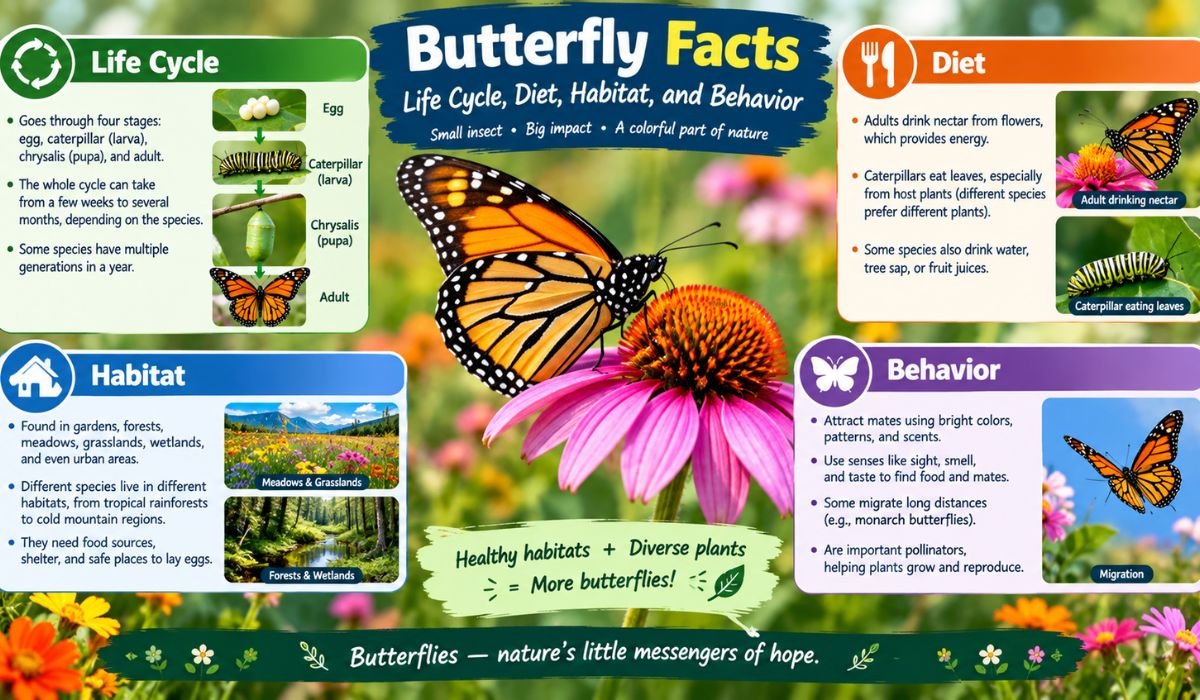
Butterflies are among the most fascinating insects on Earth, known for their colorful wings, delicate appearance, and remarkable transformation. These insects belong to the order Lepidoptera, which they share with moths. Learning butterfly facts reveals much more than their beautiful colors. Butterflies have complex life cycles, specialized feeding habits, unique behaviors, and important roles in ecosystems.
There are thousands of butterfly species found across the world, from tropical rainforests to grasslands, forests, mountains, and even urban gardens. Although butterflies are small and fragile compared with many other animals, they have developed impressive adaptations that help them survive.
In this guide, we will explore important butterfly facts, including their life cycle, diet, habitat, physical characteristics, behavior, defense mechanisms, and ecological importance.
What Are Butterflies?
Butterflies are insects characterized by four wings covered with tiny scales. Their wings come in many colors and patterns, depending on the species. These patterns can help butterflies attract mates, communicate, camouflage themselves, or discourage predators.
Like other insects, butterflies have six legs, a head, thorax, and abdomen. They also have two antennae that help them detect smells and navigate their surroundings.
One of the most interesting butterfly facts is that butterflies taste with their feet. Special sensory receptors on their legs allow them to detect chemicals when they land on plants.
Butterflies are generally active during the daytime, while many moths are more active at night. However, there are exceptions to this general pattern.
Butterfly Life Cycle
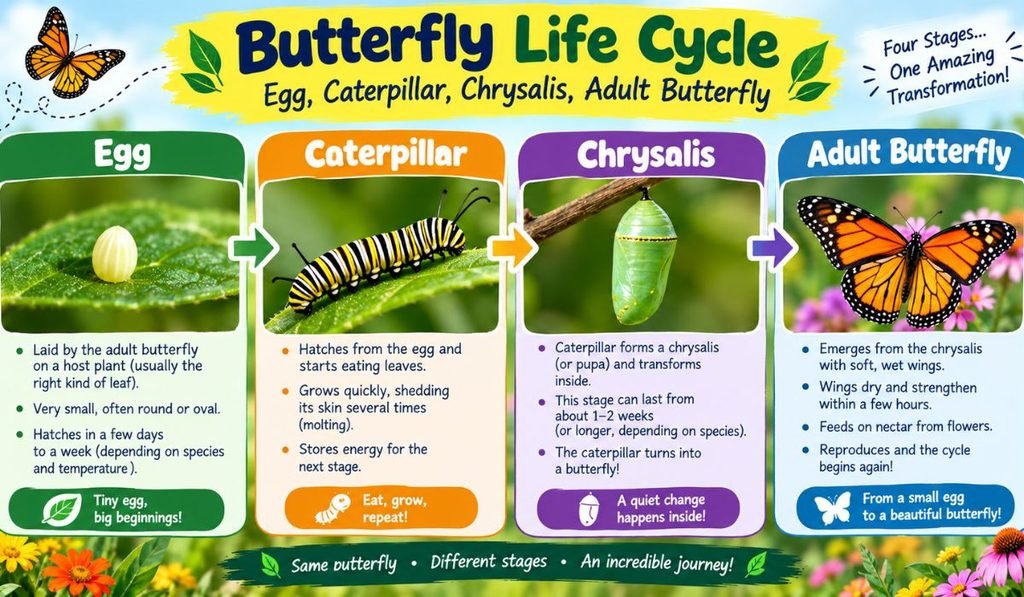
The butterfly life cycle is one of the most remarkable processes in nature. Butterflies undergo complete metamorphosis, meaning they pass through four distinct stages.
1. Egg
The life of a butterfly begins as an egg. Female butterflies usually lay their eggs on or near plants that will provide food for their future caterpillars.
The size, shape, and color of butterfly eggs vary between species. Some eggs are laid individually, while others may be deposited in groups.
2. Caterpillar
After hatching, the young butterfly is called a caterpillar or larva. This stage is primarily focused on eating and growing.
Caterpillars can consume large amounts of plant material as they develop. Because their bodies grow quickly, they must shed their outer skin several times.
3. Chrysalis
Once the caterpillar has finished growing, it enters the pupal stage. It forms a protective structure called a chrysalis.
Inside the chrysalis, the insect undergoes major physical changes. Its body gradually develops into the adult butterfly form.
4. Adult Butterfly
Eventually, the adult butterfly emerges from the chrysalis. Its wings are initially soft and folded, so it needs time for them to expand and become ready for flight.
Once its wings are fully developed, the adult butterfly can fly, feed, find a mate, and reproduce.
This four-stage process is one of the most well-known butterfly facts and is a classic example of metamorphosis.
Read Related Post: Crow Facts: Intelligence, Diet, Habitat, and Behavior
What Do Butterflies Eat?
Adult butterflies primarily consume liquid foods. Their main source of nutrition is often nectar from flowers.
They use a long, tube-like mouthpart called a proboscis to drink liquids. When not feeding, the proboscis is usually coiled beneath the butterfly’s head.
Some butterflies also obtain nutrients from other sources. Depending on the species and environment, they may feed on tree sap, fruit juices, minerals from damp soil, or other nutrient-rich liquids.
Caterpillars have very different diets from adults. Most caterpillars eat leaves and other plant material, and many species are closely associated with particular host plants.
An important butterfly fact is that the plants available during the caterpillar stage can determine whether a species is able to reproduce successfully in an area.
Where Do Butterflies Live?
Butterflies live on every continent except Antarctica. They are especially diverse in warm regions where suitable plants and favorable temperatures are available.
Common butterfly habitats include:
- Tropical forests
- Temperate forests
- Grasslands
- Meadows
- Wetlands
- Mountains
- Deserts
- Gardens
- Agricultural landscapes
- Urban parks
Different species have different habitat requirements. Some need particular plants for their caterpillars, while others depend on specific flowers for adult feeding.
Because butterflies are sensitive to environmental changes, their presence can provide useful information about the condition of an ecosystem.
Butterfly Appearance and Wings
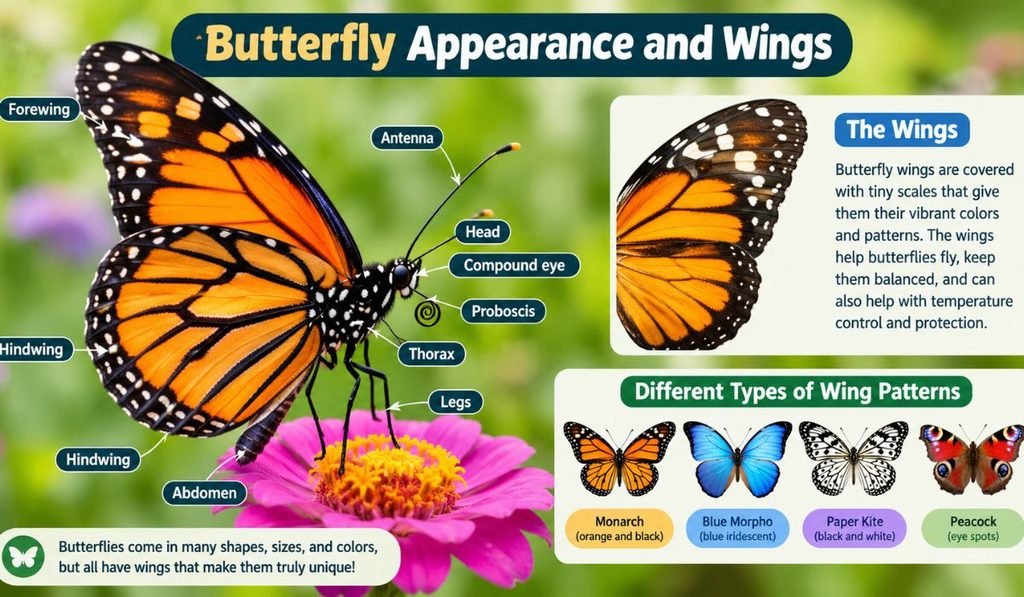
Butterfly wings are covered with thousands of microscopic scales. These scales create many of the colors and patterns visible on butterfly wings.
Colors can serve several purposes. Bright patterns may help butterflies attract mates or warn predators. Other species use colors and patterns for camouflage.
Some butterflies have wing patterns that resemble eyes. These markings can make a predator hesitate or may redirect an attack away from more vulnerable parts of the body.
One fascinating butterfly fact is that butterfly wings are not simply colorful sheets. Their patterns and structures are produced through an intricate combination of tiny scales, pigments, and sometimes microscopic structures that interact with light.
How Do Butterflies Fly?
Butterflies have four wings that work together to produce flight. Their flying ability varies greatly between species.
Some butterflies fly slowly and close to the ground, while others can travel long distances. Flight allows butterflies to search for food, locate mates, escape predators, and migrate.
Butterflies use their antennae and other sensory systems to gather information about their surroundings. Sunlight and temperature can also influence their activity.
Most butterflies are ectothermic, meaning their body temperature is strongly influenced by their environment. They may bask in sunlight to warm their bodies before becoming active.
Butterfly Behavior
Butterflies display a variety of interesting behaviors.
They may spend time basking in sunlight, feeding on flowers, searching for mates, defending territories, or looking for suitable plants on which to lay eggs.
Some male butterflies defend small territories from other males. Others travel considerable distances while searching for mates or food.
Certain species migrate seasonally. The best-known example is the monarch butterfly, famous for its remarkable long-distance migration in North America.
Social behavior varies between species. While butterflies are generally not highly social insects like ants or bees, several individuals may gather where food, minerals, or suitable resting conditions are available.
How Do Butterflies Protect Themselves?
Despite their delicate appearance, butterflies have several defenses against predators.
Camouflage allows some species to blend into leaves, bark, or other parts of their environment. Others have bright colors that can warn predators that they are unpleasant or potentially harmful to eat.
Some harmless butterflies have evolved appearances that resemble more dangerous or unpalatable species. This strategy is called mimicry.
Butterflies can also use their flight abilities to escape predators quickly. Their unpredictable movements can make them difficult for some predators to catch.
These adaptations demonstrate that butterfly facts are closely connected to survival and evolution.
Butterflies and Pollination
Butterflies play an important role in many ecosystems. As they visit flowers to feed on nectar, pollen can sometimes stick to their bodies and be transferred between flowers.
Although butterflies are not generally considered as efficient pollinators as bees for many crops, they still contribute to pollination and plant reproduction.
Butterflies are also an important source of food for birds, spiders, reptiles, amphibians, and other animals.
Their dependence on plants means they are connected to several levels of the food web.
Interesting Butterfly Facts
Here are some additional butterfly facts worth knowing:
- Butterflies have six legs because they are insects.
- Their wings are covered in tiny scales.
- Butterflies taste with sensory receptors on their feet.
- Most adult butterflies feed on liquids rather than solid food.
- Caterpillars and adult butterflies often have very different diets.
- Butterflies undergo complete metamorphosis.
- Butterflies can be found on every continent except Antarctica.
- Some butterfly species migrate over long distances.
- Butterfly colors can provide camouflage or warnings.
- Many butterflies depend on specific plants during their caterpillar stage.
- Butterflies are important parts of many food webs.
- Temperature can strongly affect butterfly activity.
FAQ’s
What are the most interesting butterfly facts?
Some of the most interesting butterfly facts include their four-stage life cycle, their ability to taste with their feet, and the fact that their wings are covered with tiny scales. Some species can also migrate long distances.
How long does a butterfly live?
Butterfly lifespan varies considerably by species. Some adult butterflies live for only a short period, while others can survive for several weeks or longer. The complete life cycle also depends on species, temperature, food availability, and environmental conditions.
What do butterflies eat?
Adult butterflies mainly drink nectar from flowers. Some species also obtain nutrients from fruit juices, tree sap, damp soil, or other liquid sources. Caterpillars generally eat leaves and other plant material.
Where do butterflies live?
Butterflies live in many environments, including forests, grasslands, meadows, wetlands, mountains, deserts, gardens, and urban parks. Different species require different combinations of plants, temperature, and shelter.
Do butterflies have bones?
No. Butterflies are invertebrates, meaning they do not have an internal skeleton made of bones. Instead, they have an external skeleton called an exoskeleton that supports and protects their bodies.
Why are butterflies important?
Butterflies contribute to ecosystems through pollination and by serving as food for other animals. They can also act as indicators of environmental changes because many species depend on specific plants and suitable habitat conditions.
Conclusion
Butterflies are much more than colorful insects flying between flowers. Their remarkable metamorphosis, specialized feeding structures, diverse habitats, defensive adaptations, and important ecological roles make them fascinating animals to study.
From the tiny egg to the caterpillar, chrysalis, and adult butterfly, their life cycle demonstrates one of nature’s most remarkable transformations. Understanding butterfly facts also helps us appreciate how closely these insects are connected to plants, predators, pollinators, and entire ecosystems.
Protecting natural habitats and maintaining diverse plant life can help provide butterflies with the food and shelter they need to survive. Whether found in a rainforest, meadow, mountain region, or backyard garden, butterflies remain an important and beautiful part of the natural world.

Hi, I’m Amelia, an SEO and content specialist with several years of experience researching and creating informative content for online audiences. At Animal Attack Facts, I focus on animal behavior, animal attacks on humans, and interesting facts about land animals, marine animals, birds, reptiles, and insects. My goal is to provide clear, useful, and engaging information that helps readers better understand wildlife and stay informed about animal encounters.
1 thought on “Butterfly Facts: Life Cycle, Diet, Habitat, and Behavior”