
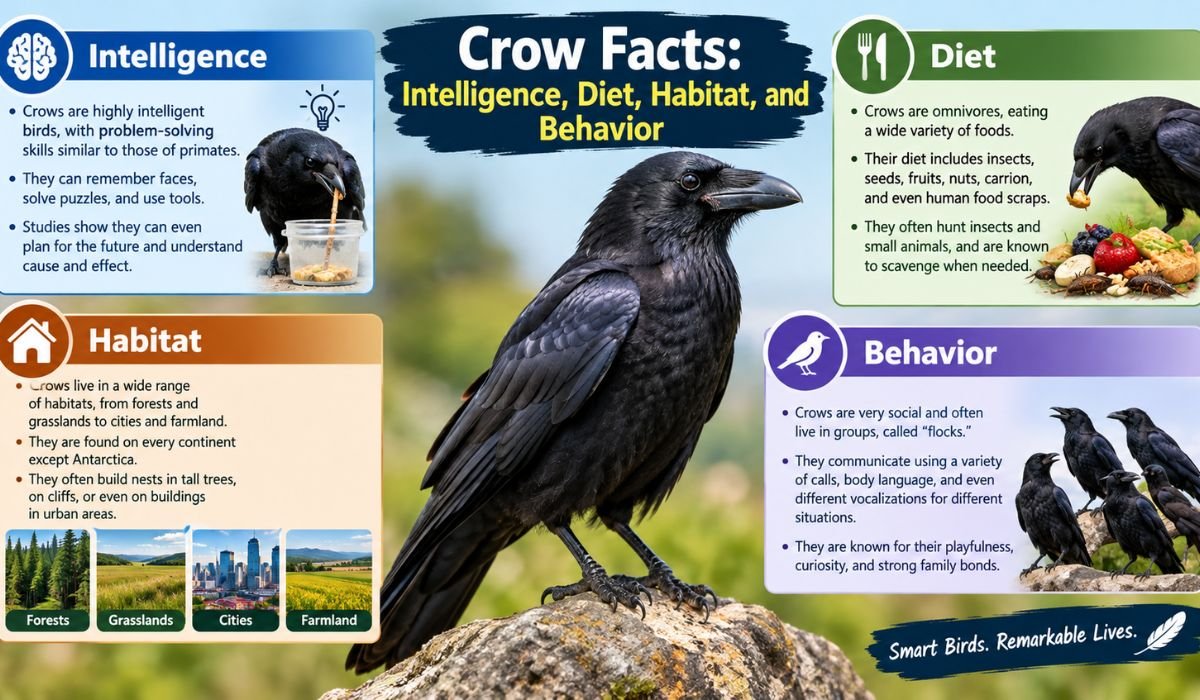
Crows are among the most intelligent and adaptable birds in the world. They belong to the corvid family, which also includes ravens, magpies, and jays. Found across many different environments, crows have learned to live successfully in forests, grasslands, farms, cities, and even busy urban neighborhoods. Their problem-solving skills, strong memories, communication abilities, and social behavior make them especially interesting birds to study.
These birds are often recognized by their dark feathers, strong bills, and distinctive calls. However, there is much more to them than their familiar appearance. In this guide to crow facts, you will learn about their intelligence, diet, habitat, behavior, communication, reproduction, and remarkable adaptations.
What Are Crows?
Crows are medium-sized to large birds belonging to the genus Corvus. There are many crow species around the world, and they vary in size, appearance, and habitat. The American crow, for example, is widespread across North America, while other crow species live in Europe, Asia, Africa, and Australia.
Crows generally have dark feathers, sturdy legs, and powerful bills. Depending on the species, their feathers may appear completely black or show subtle shades when exposed to sunlight.
One of the most interesting crow facts is that these birds are highly adaptable. They can adjust their behavior when environmental conditions change, which helps them survive in places where many other birds struggle.
Crow Intelligence and Problem-Solving Skills
Crows are famous for their intelligence. Scientists have observed them solving problems, remembering important locations, using objects as tools, and learning from experience.
Their intelligence is especially noticeable when they need to obtain food. A crow may manipulate an object to reach something that would otherwise be difficult to access. Some crows can also learn how to solve multi-step problems.
Another remarkable ability is their memory. Crows can remember locations where they have found food and can recognize familiar individuals. They may also learn to associate particular people with positive or negative experiences.
These abilities are among the most fascinating crow facts because they show that bird intelligence can be surprisingly complex.
Crow Diet: What Do Crows Eat?
Crows are omnivores, meaning they eat both plant and animal foods. Their flexible diet is one reason they can survive in so many different environments.
A crow’s diet may include:
- Insects and other small invertebrates
- Seeds and grains
- Fruits and berries
- Nuts
- Eggs
- Small animals
- Carrion
- Food scraps
Crows are opportunistic feeders. Instead of depending on only one food source, they take advantage of whatever safe and nutritious foods are available.
In agricultural areas, they may feed on grains, insects, and other naturally available foods. In cities, they often search for food in parks, gardens, streets, and other areas where edible material is accessible.
Their varied diet is an important part of crow facts because it explains how these birds manage to occupy such a wide range of habitats.
Where Do Crows Live?
Crows are found on several continents, although individual species have different geographic ranges. They can live in natural environments as well as areas heavily modified by humans.
Common crow habitats include:
- Forests
- Woodlands
- Grasslands
- Farmland
- Coastal areas
- Open countryside
- Parks
- Suburban neighborhoods
- Cities
Crows often prefer areas that provide a combination of food, water, and suitable places for nesting or resting. Their ability to use human-dominated landscapes has helped some populations become extremely successful.
Urban environments can provide plenty of food and nesting opportunities, while nearby trees and buildings offer places to rest.
Read Related Post: Walrus Facts: Habitat, Diet, Behavior, and Adaptations
Crow Behavior and Social Life
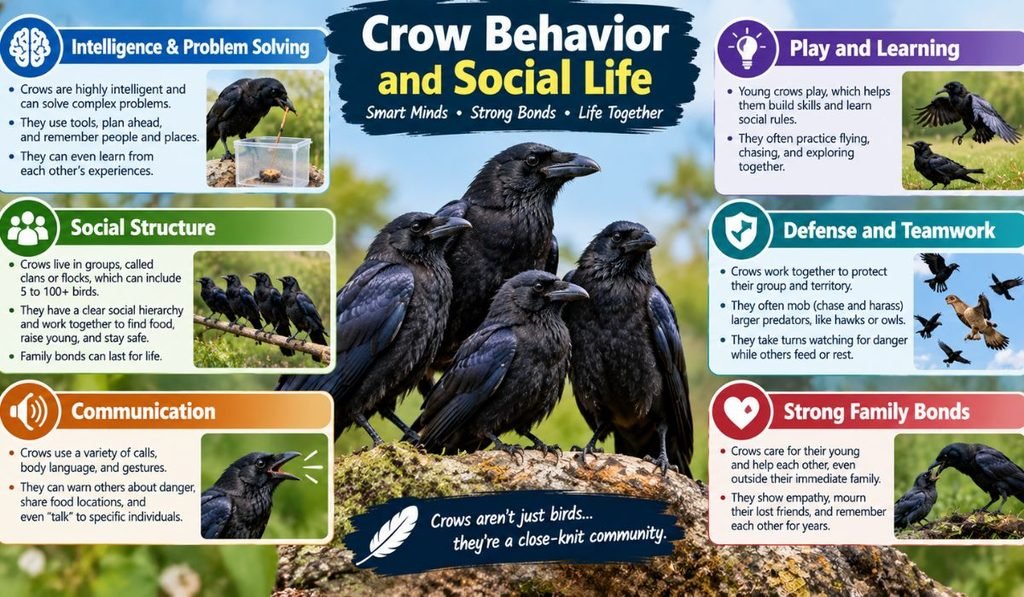
Crows are social birds and can often be seen in pairs, family groups, or larger gatherings. Their social behavior can become especially noticeable when they gather around food or suitable resting areas.
Young crows may remain associated with their parents for an extended period and can learn important survival skills from them. Family relationships can therefore play an important role in their development.
Crows also communicate frequently. They use different calls and body movements to interact with other members of their group. Their vocalizations can help warn others about potential dangers, attract attention, or maintain contact.
Observing these social interactions provides some of the most interesting crow facts for bird enthusiasts.
How Do Crows Communicate?
Crows have a complex communication system. Their familiar “caw” is only one part of their vocal behavior.
They can produce different sounds depending on the situation. Calls may be used to warn other crows about predators, communicate with family members, or respond to unfamiliar situations.
Body language can also contribute to communication. Movements of the head, wings, and feathers may provide additional signals.
Crows are also capable of learning through observation. A crow that notices another bird responding to a threat may change its own behavior based on what it has observed.
Crow Habitat Adaptations
One of the main reasons crows are so successful is their ability to adapt.
Their strong bills can handle a variety of foods, while their intelligence helps them find resources in changing environments. Their ability to learn also allows them to adjust to human activity.
Crows can recognize patterns in their surroundings and remember useful locations. They can also change their feeding habits when certain food sources become unavailable.
Their adaptability is a central theme among crow facts, especially when comparing crows with birds that depend on very specific habitats or foods.
Nesting and Reproduction
Crows usually build nests in trees, although nesting locations can vary depending on the species and environment. Nests are commonly constructed from sticks and other plant materials and may be lined with softer materials.
A female generally lays a clutch of eggs, and the parents work together to care for the young. The exact number of eggs and breeding behavior varies among species.
Young crows depend on their parents for food and protection after hatching. They gradually develop the skills needed to find food, recognize danger, and interact with other crows.
Parental care is another important example of the complex social behavior seen in crow facts.
How Long Do Crows Live?
Crow lifespan varies according to species and environmental conditions. Wild crows face threats such as predators, disease, accidents, food shortages, and human-related hazards.
Some individual crows can live for many years when conditions are favorable. Their intelligence and adaptability can improve their ability to respond to environmental challenges.
However, lifespan should not be generalized across every crow species because different species experience different conditions and risks.
Crows and Human Environments
Crows have a close relationship with human environments. Many species have learned to live around farms, towns, suburbs, and cities.
They can benefit from human environments because these areas may provide abundant food and shelter. At the same time, living near people can create risks, including traffic, habitat changes, and conflict over crops or waste.
Their ability to thrive around people demonstrates how flexible these birds can be.
One of the most useful crow facts to remember is that their success is not simply a result of having plenty of food. Their learning ability, social behavior, memory, and adaptability all contribute to their survival.
Are Crows Helpful to the Environment?
Yes, crows can play useful roles in ecosystems. As omnivores and scavengers, they consume a variety of foods and can help remove animal remains and organic material from the environment.
They also interact with plants by eating and sometimes dispersing seeds. By feeding on insects and other small organisms, they participate in local food webs.
Crows are also prey for some larger animals, particularly during vulnerable stages of their lives. This makes them part of broader ecological relationships.
Interesting Crow Facts
Here are some quick facts about these remarkable birds:
- Crows belong to the corvid family.
- They are highly adaptable and can live in cities and rural environments.
- Crows are omnivores with a very flexible diet.
- They have strong memories and can learn from experience.
- Many crow species are highly social.
- Crows use vocalizations and body language to communicate.
- They can recognize useful locations and environmental patterns.
- Family groups can play an important role in raising young birds.
- Their intelligence helps them cope with changing environments.
- Different crow species vary in size, range, behavior, and appearance.
These crow facts demonstrate why crows are considered some of the most fascinating birds in the world.
FAQ’s
What makes crows so intelligent?
Crows are known for their problem-solving abilities, memory, learning skills, and capacity to adapt their behavior. These abilities help them find food and respond to changing environments.
What do crows eat?
Crows eat a wide range of foods, including insects, seeds, fruits, nuts, eggs, small animals, carrion, and food scraps. Their omnivorous diet helps them survive in many habitats.
Where do crows live?
Crows can live in forests, grasslands, farmland, coastal areas, suburbs, parks, and cities. Their ability to adapt allows them to occupy both natural and human-modified environments.
Are crows social birds?
Yes. Many crow species are social and can live or travel in pairs, family groups, or larger gatherings. Young birds may also remain associated with their parents while learning survival skills.
How do crows communicate?
Crows communicate through vocal calls, body movements, and other behaviors. Different calls can be associated with situations such as warnings, contact, or social interaction.
Why are crows good at adapting?
Crows have flexible diets, strong learning abilities, good memories, and social behaviors. These characteristics allow them to adjust when food sources, habitats, or environmental conditions change.
Conclusion
Crows are intelligent, adaptable, social, and highly resourceful birds. Their ability to solve problems, remember important information, communicate with one another, and use a wide variety of food sources has helped them succeed in environments around the world.
From forests and farmland to crowded cities, crows have demonstrated an impressive ability to adjust to their surroundings. Their complex behavior and intelligence make them much more than ordinary black birds.
These crow facts show why crows continue to attract the attention of scientists, birdwatchers, and nature enthusiasts. Learning about their diet, habitat, intelligence, communication, and social behavior gives us a better understanding of the important role these birds play in nature.

Hi, I’m Amelia, an SEO and content specialist with several years of experience researching and creating informative content for online audiences. At Animal Attack Facts, I focus on animal behavior, animal attacks on humans, and interesting facts about land animals, marine animals, birds, reptiles, and insects. My goal is to provide clear, useful, and engaging information that helps readers better understand wildlife and stay informed about animal encounters.
1 thought on “Crow Facts: Intelligence, Diet, Habitat, and Behavior”