
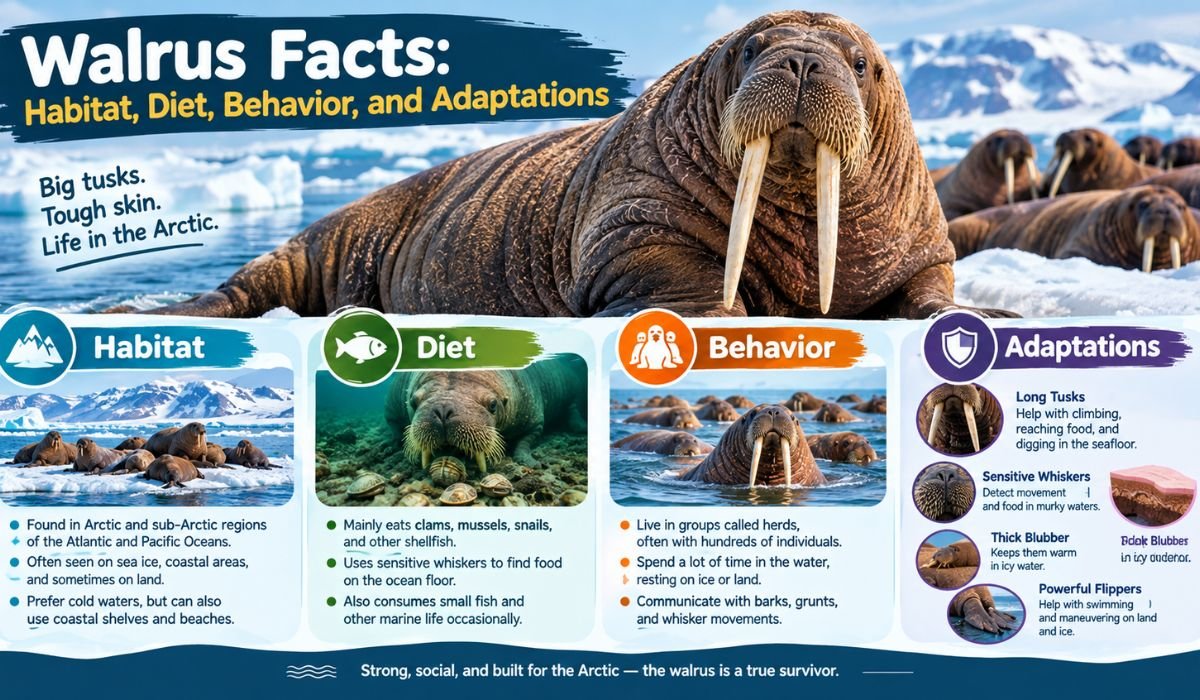
Walruses are large marine mammals famous for their long tusks, whiskered faces, and ability to survive in some of the coldest environments on Earth. These impressive animals spend much of their lives in Arctic and sub-Arctic waters, where thick blubber and specialized adaptations help them cope with freezing conditions. Learning walrus facts reveals how these animals find food, communicate, raise their young, and survive in challenging polar habitats.
Walruses belong to the pinniped group, which also includes seals and sea lions. Unlike many seals, walruses have prominent tusks and large, sensitive whiskers that help them locate food on the ocean floor. Their social behavior is another remarkable feature, as they often gather in large groups on sea ice or coastal beaches.
Walrus Facts About Habitat
One of the most important walrus facts is that walruses are strongly associated with Arctic and sub-Arctic environments. They are mainly found around the Arctic Ocean and nearby seas, including parts of the waters surrounding Alaska, Canada, Greenland, and Russia.
Walruses usually prefer shallow coastal waters because much of their food is found on the seafloor. They may rest on sea ice, rocky shorelines, sandy beaches, or other suitable areas known as haul-out sites.
Sea ice is particularly important for some walrus populations because it provides a place to rest between feeding trips. As Arctic conditions change, walruses may increasingly use land-based haul-out areas.
What Do Walruses Eat?
Another interesting part of walrus facts is their unusual feeding behavior. Walruses mainly eat animals that live on or in the ocean floor. Their diet can include clams, mussels, worms, snails, sea cucumbers, and other marine invertebrates.
They use their sensitive whiskers, called vibrissae, to detect prey hidden beneath sediment. Instead of relying mainly on sight, a walrus can sweep its whiskers across the seafloor to locate potential food.
Walruses can also use their mouths and strong suction abilities to remove soft-bodied prey from the sediment. Although they are primarily bottom-feeding animals, they may occasionally eat fish and other marine animals.
Walrus Tusks and Teeth
The long tusks are among the most recognizable features discussed in walrus facts. Both male and female walruses generally have tusks, although their size can vary.
Tusks are elongated canine teeth that continue growing throughout a walrus’s life. They can be used for several purposes, including establishing social status, competing with other walruses, and helping the animal climb onto ice.
Tusks may also play an important role in displays between individuals. Larger tusks can be particularly noticeable in males, which may use them during social interactions and competition.
Despite their impressive appearance, tusks are not primarily specialized for catching prey.
How Big Are Walruses?
Size is another fascinating subject when looking at walrus facts. Walruses are among the largest living pinnipeds. Adult males are generally larger and heavier than females.
Their bodies are thick and rounded, with large amounts of fat that help provide insulation in cold water. Adult walruses can weigh hundreds of kilograms, while particularly large individuals may weigh well over a thousand kilograms.
Their size can vary depending on sex, age, population, and environmental conditions. Their massive bodies also help them conserve heat while living in extremely cold regions.
Read Related Post: Komodo Dragon Facts: Habitat, Diet, Size, and Behavior
Walrus Adaptations for Cold Environments
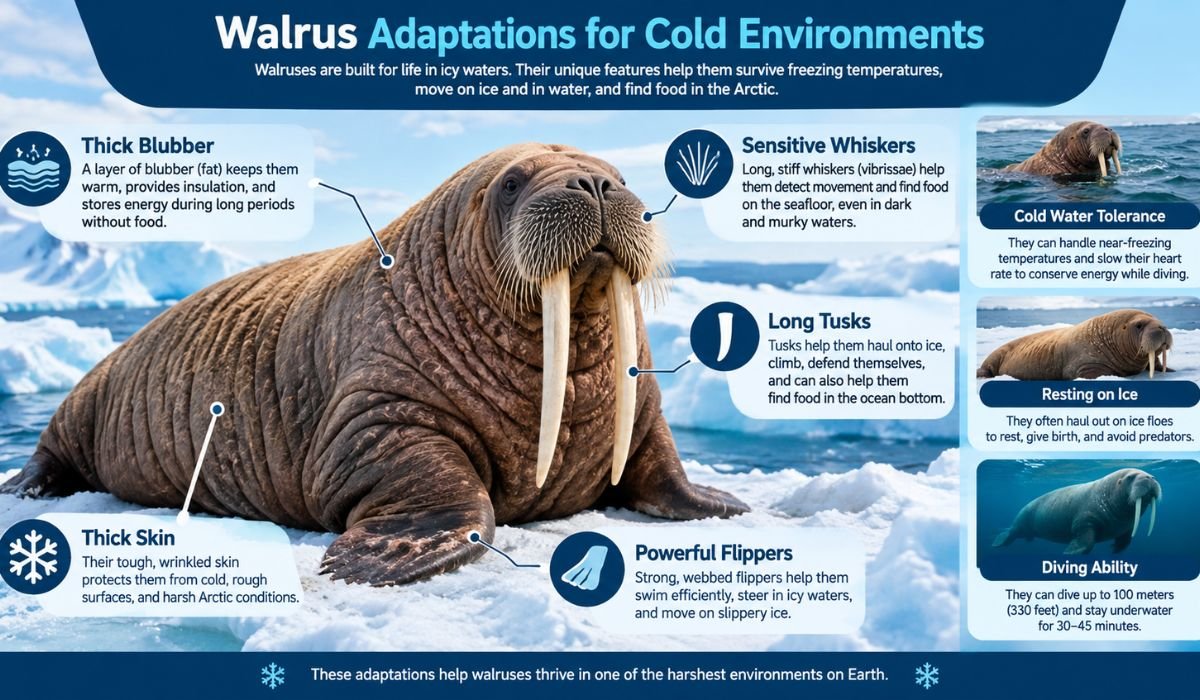
Several physical adaptations explain how walruses survive Arctic conditions. These adaptations are an important part of walrus facts because they demonstrate how closely the species is suited to its environment.
Thick Blubber
Walruses have a substantial layer of blubber beneath their skin. This fat provides insulation and helps reduce heat loss when they enter cold seawater.
Blubber also acts as an energy reserve. When food availability changes, stored energy can help support the animal’s demanding lifestyle.
Sensitive Whiskers
A walrus’s whiskers are extremely useful for finding food. They contain many sensory structures that help the animal detect movement and objects in the water and sediment.
Because much of their feeding occurs on the dark ocean floor, this sensory ability is especially valuable.
Strong Flippers
Walruses have powerful front and rear flippers that allow them to move through water and maneuver around haul-out areas. Their flippers also help them move across ice and land, although they are much more efficient swimmers than walkers.
Walrus Behavior and Social Life
Social behavior is one of the most interesting walrus facts. Walruses are highly social animals and often gather in groups. These groups can contain many individuals resting together on ice or land.
They may communicate using a variety of sounds, including bell-like calls, grunts, clicks, and other vocalizations. Communication can be especially important when animals are gathered closely together.
Walruses may also display different behaviors depending on age, sex, reproductive condition, and social position. Large groups can provide safety and opportunities for social interaction, although crowding can also create competition for suitable resting areas.
How Do Walruses Reproduce?
Reproduction is another important area covered by walrus facts. Walruses generally reproduce through seasonal breeding, with mating occurring during part of the year and births taking place months later.
Female walruses typically give birth to a single calf. Newborn calves are dependent on their mothers and spend considerable time nursing.
A mother walrus is highly protective of her young. Calves remain close to their mothers while learning important behaviors, including swimming and finding food.
Young walruses develop gradually, and mothers provide care and nourishment during their early life.
Where Do Walruses Sleep?
Walruses need regular periods of rest after spending time feeding in the water. One of the lesser-known walrus facts is that they can rest both on sea ice and on land.
They often gather at haul-out sites in groups. Depending on local conditions, hundreds or even thousands of walruses may gather in suitable locations.
Resting together is a normal part of walrus behavior. However, large gatherings can become crowded, especially when animals are forced to rely more heavily on land because suitable sea ice is unavailable.
How Long Do Walruses Live?
Walruses are relatively long-lived marine mammals. Individuals can live for several decades, although lifespan varies depending on environmental conditions, disease, injuries, food availability, and other factors.
Age can sometimes be estimated using biological characteristics, including changes in teeth and other tissues.
Their relatively long lifespan means walruses experience many seasonal changes throughout their lives and may travel between feeding and resting areas repeatedly.
Walrus Predators
Natural predators are another useful part of walrus facts. Adult walruses are large and powerful animals, so healthy adults have relatively few natural predators.
Polar bears may prey on walruses, particularly young, weak, or vulnerable individuals. Orcas can also attack walruses in some circumstances.
Calves are more vulnerable than adults because they are smaller and less capable of defending themselves.
Walruses can use their tusks and large bodies as defensive tools. Their tendency to gather in groups can also provide some protection against predators.
Why Are Walruses Important to the Arctic Ecosystem?
Walruses play an important role in Arctic marine ecosystems. Their feeding activities disturb sediment on the ocean floor, which can influence the movement of nutrients and other organisms.
By consuming large quantities of benthic animals, walruses are also part of the food web connecting seafloor communities with larger Arctic predators.
Their dependence on sea ice and shallow marine habitats also makes them useful indicators of environmental changes occurring in Arctic ecosystems.
Threats Facing Walruses
Modern walrus facts also include the challenges these animals face. Climate change is one of the major concerns because Arctic sea ice is changing rapidly.
Reduced or changing sea ice can affect access to feeding areas and suitable resting locations. When large numbers of walruses gather on land, disturbances can sometimes cause sudden movements through crowded groups.
Other potential threats include marine pollution, human disturbance, increased shipping activity, and changes in prey availability.
Protecting Arctic marine habitats and reducing unnecessary disturbance can help support healthy walrus populations.
Interesting Walrus Facts
Here are some quick walrus facts to remember:
- Walruses are marine mammals and members of the pinniped group.
- Both male and female walruses generally have tusks.
- Their tusks are elongated canine teeth.
- Walruses use sensitive whiskers to help locate prey.
- They mainly feed on animals living on the seafloor.
- Walruses are highly social and often rest in groups.
- Thick blubber helps insulate them in cold water.
- Walruses can rest on sea ice or land.
- Females usually give birth to one calf at a time.
- Walruses are strongly associated with Arctic and sub-Arctic environments.
- Polar bears and orcas can prey on walruses.
- Their feeding behavior can disturb seafloor sediments.
- Walruses are powerful swimmers despite their enormous size.
- Their tusks can help with social displays and climbing onto ice.
FAQ’s
What are the most interesting walrus facts?
Some of the most interesting walrus facts include their enormous size, long tusks, highly sensitive whiskers, thick blubber, social behavior, and ability to survive in extremely cold Arctic environments.
What do walruses eat?
Walruses primarily eat seafloor animals such as clams, mussels, worms, snails, and other marine invertebrates. Their whiskers help them locate prey beneath sediment.
Do all walruses have tusks?
Most male and female walruses have tusks. Tusks are elongated canine teeth and can serve several functions, including social displays, competition, and helping walruses climb onto ice.
Where do walruses live?
Walruses mainly live in Arctic and sub-Arctic regions. They are associated with shallow coastal waters, sea ice, beaches, and other suitable haul-out locations.
How do walruses stay warm?
Walruses stay warm partly because of their thick layer of blubber. This fat provides insulation and helps reduce heat loss in cold Arctic water.
Are walruses social animals?
Yes. Walruses are highly social and commonly gather in groups to rest, communicate, and interact with one another.
How long can walruses live?
Walruses can live for several decades. Their exact lifespan varies according to factors such as food availability, environmental conditions, injuries, and overall health.
Are walruses dangerous?
Walruses are powerful wild animals and can be dangerous when threatened or disturbed. Their large bodies and tusks make it important for people to observe them from a safe distance.
Conclusion
Walruses are remarkable Arctic mammals with a combination of physical and behavioral adaptations that allow them to survive in challenging environments. Their thick blubber provides insulation, their whiskers help them find prey, and their tusks support several important behaviors.
The most fascinating walrus facts show how closely these animals depend on Arctic marine ecosystems. From their social gatherings to their seafloor feeding habits, walruses play an important role in their environment. Protecting sea ice, coastal habitats, and Arctic waters is essential for helping these impressive animals continue to thrive.

Hi, I’m Amelia, an SEO and content specialist with several years of experience researching and creating informative content for online audiences. At Animal Attack Facts, I focus on animal behavior, animal attacks on humans, and interesting facts about land animals, marine animals, birds, reptiles, and insects. My goal is to provide clear, useful, and engaging information that helps readers better understand wildlife and stay informed about animal encounters.
1 thought on “Walrus Facts: Habitat, Diet, Behavior, and Adaptations”