
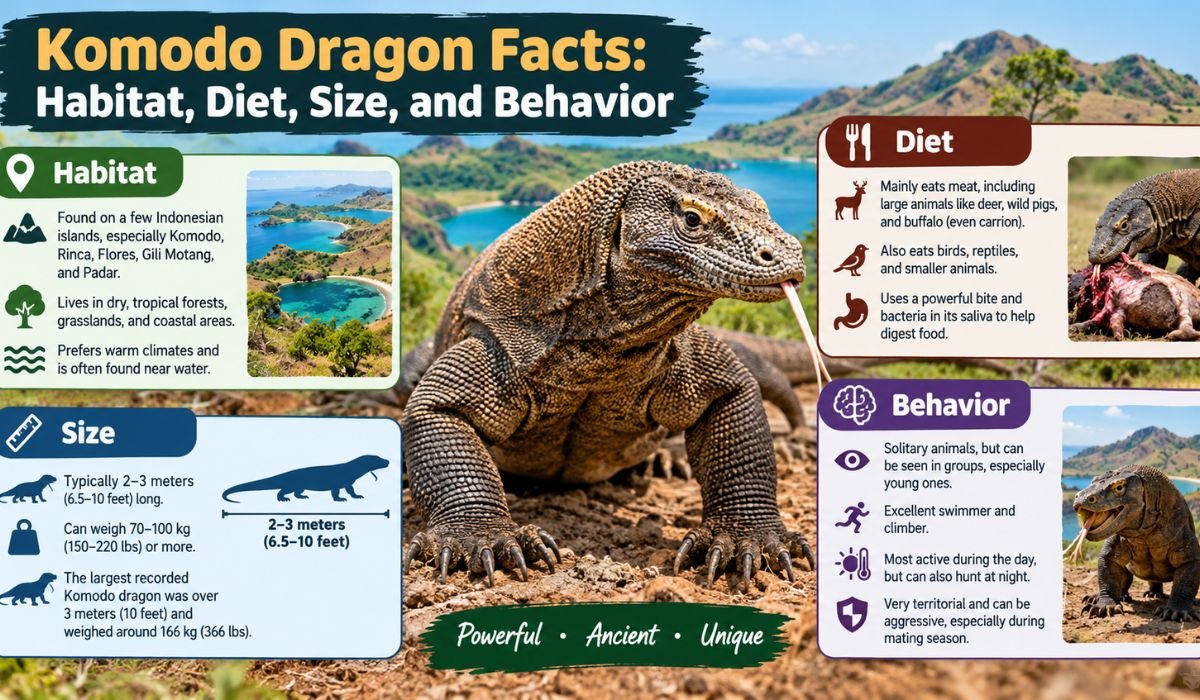
Komodo dragons are among the most fascinating reptiles on Earth. These giant monitor lizards are known for their impressive size, powerful bodies, strong tails, and unique hunting abilities. Found naturally on a few Indonesian islands, they have adapted to hot, dry environments where food can sometimes be scarce. Learning komodo dragon facts helps explain why this remarkable reptile is so different from most other lizards.
The Komodo dragon is scientifically known as Varanus komodoensis. It is the largest living lizard species and can reach several meters in length. Despite its slow-looking movements at times, it can move quickly when hunting or defending itself. Its excellent sense of smell, strong jaws, sharp claws, and muscular tail make it a highly effective predator.
Komodo Dragon Facts About Habitat
One of the most interesting komodo dragon facts is that these reptiles have a very limited natural range. Wild Komodo dragons are found on several Indonesian islands, including Komodo, Rinca, Gili Motang, and parts of Flores.
Their habitat consists mainly of tropical forests, savannas, open grasslands, and dry hills. These environments provide shelter, water sources, and opportunities to find prey. Komodo dragons are well adapted to warm climates and often spend time in areas where they can regulate their body temperature.
They may rest in shaded areas during the hottest part of the day and become more active when temperatures are suitable. Young Komodo dragons often spend more time in trees than adults because climbing helps them avoid larger predators, including adult Komodo dragons.
Komodo Dragon Size and Appearance
The size of a Komodo dragon is one of the features that makes it so famous. Adult males are generally larger and heavier than females. Large individuals can grow to around 3 meters (10 feet) in length and may weigh well over 60 kilograms, with some exceptionally large animals weighing considerably more.
Their bodies are covered with tough, protective scales. They have strong legs, curved claws, a long muscular tail, and a broad head. Their coloration is generally grayish, brown, or earthy, which helps them blend into their surroundings.
Another interesting feature is their long, forked tongue. Like other monitor lizards, Komodo dragons use their tongues to collect chemical particles from the air and environment. These particles are processed by a specialized sensory organ, helping the animal detect potential food from a distance.
What Do Komodo Dragons Eat?
Their diet is another important part of komodo dragon facts. Komodo dragons are carnivores and can eat a wide variety of animals. Their prey may include deer, wild pigs, smaller reptiles, birds, and other animals available in their habitat.
They are also known to eat carrion, meaning animals that have already died. This allows them to take advantage of food opportunities without always needing to catch live prey.
Young Komodo dragons generally eat smaller animals such as insects, small reptiles, and birds. As they grow larger and stronger, they can take on increasingly large prey.
Komodo dragons have flexible feeding habits. When they find a large food source, they may consume a substantial amount in one feeding. Their ability to use different food sources is especially useful in an environment where prey availability can change.
How Do Komodo Dragons Hunt?
Komodo dragons are ambush predators. Rather than constantly chasing prey over long distances, they can remain relatively still and wait for an opportunity to attack.
Their powerful legs allow them to move quickly over short distances. When they attack, they can use their jaws, teeth, claws, and tail to overpower prey.
A key part of komodo dragon facts is their remarkable sense of smell. Their forked tongues help them detect chemical signals in their surroundings, allowing them to locate food from considerable distances under suitable conditions.
Komodo dragons have serrated teeth designed for tearing flesh. Their saliva and oral bacteria were once widely described as the primary reason their bites were dangerous, but modern research has shown that their venom glands also play an important role. Venom can contribute to blood loss, lower blood pressure, and reduced ability of prey to respond effectively after a bite.
Read Related Post: Cheetah Facts: Speed, Habitat, Diet, and Behavior
Komodo Dragon Behavior
Komodo dragons are generally solitary animals. Adults usually spend much of their time alone, although several individuals may gather around a food source.
They communicate through body movements, postures, and other behaviors. They may raise their bodies, open their mouths, hiss, or use other displays when threatened.
Despite their powerful appearance, Komodo dragons do not constantly fight. Like many wild animals, they usually prefer to avoid unnecessary conflict because injuries can make survival more difficult.
They are also intelligent predators capable of learning from their environment. They can recognize opportunities, remember locations, and adjust their behavior depending on circumstances.
Reproduction and Baby Komodo Dragons
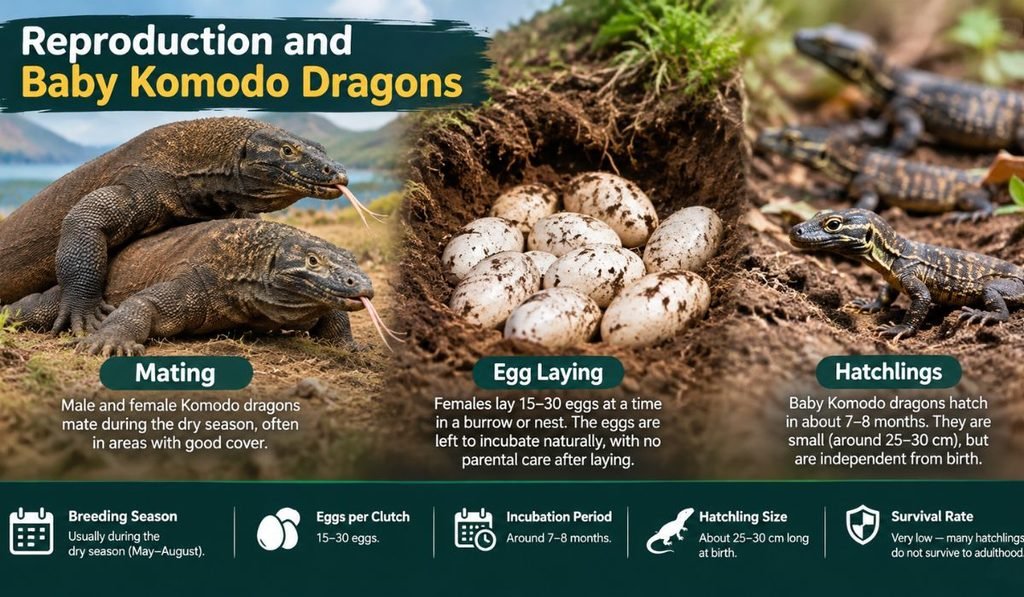
Reproduction is another fascinating area when studying komodo dragon facts. Breeding generally occurs during the warmer part of the year. Males may compete for access to females, sometimes using their bodies and strength to push against rivals.
Female Komodo dragons lay eggs in nests. They may use nesting sites such as abandoned bird nests or suitable areas in the ground.
A female can lay a relatively large clutch of eggs. The eggs remain in the nest for several months before young dragons hatch.
Baby Komodo dragons are much smaller than adults and face many dangers. Adult Komodo dragons can sometimes prey on younger individuals, so young dragons often spend significant time in trees. Their climbing ability provides protection while they are still small.
Are Komodo Dragons Dangerous?
Komodo dragons are powerful wild predators and should never be approached or handled by people. They have strong jaws, sharp teeth, claws, and venom-producing glands.
Although attacks on humans are uncommon, these animals can be dangerous when they feel threatened or when people enter areas where they are feeding or resting.
Understanding komodo dragon facts is important for appreciating these reptiles while also respecting their wild nature. Visitors to areas where Komodo dragons live should follow park rules and maintain a safe distance from the animals.
How Long Do Komodo Dragons Live?
Komodo dragons can live for several decades in suitable conditions. Their growth is relatively slow compared with many smaller lizards, and they continue developing for years as they mature.
Young dragons face higher risks from predators, competition, and limited food. Once they reach adulthood, their large size gives them greater protection from many potential threats.
Their long lives and slow reproduction make protecting adult animals especially important for the survival of wild populations.
Conservation of Komodo Dragons
Conservation is one of the most important komodo dragon facts because the species has a restricted natural range. Living on only a few Indonesian islands makes the species vulnerable to changes in habitat and food availability.
Threats can include habitat changes, natural disasters, reduced prey populations, human activity, and climate-related environmental changes.
Conservation programs in Indonesia help protect Komodo dragons and their habitats. Komodo National Park and other protected areas provide important refuges for the species.
Protecting the ecosystems where these reptiles live also helps preserve the animals they depend on for food.
Interesting Komodo Dragon Facts
Here are some quick komodo dragon facts to remember:
- Komodo dragons are the largest living lizards.
- Their scientific name is Varanus komodoensis.
- They are native to Indonesia.
- They are carnivorous reptiles.
- They have a long, forked tongue that helps detect chemical signals.
- Their powerful jaws contain sharp, serrated teeth.
- Komodo dragons have venom glands.
- Young Komodo dragons are capable climbers.
- Adults can reach around 3 meters in length.
- They can eat both live prey and carrion.
- Their strong tails can help with balance and defense.
- They are generally solitary animals.
- Their natural range is limited to a small number of Indonesian islands.
FAQ’s
1. What is the largest Komodo dragon?
The largest Komodo dragons can reach around 3 meters (10 feet) in total length. Some exceptionally large individuals can weigh well over 60 kilograms.
2. Where do Komodo dragons live?
Komodo dragons naturally live on several Indonesian islands, including Komodo, Rinca, Gili Motang, and parts of Flores.
3. What do Komodo dragons eat?
They eat meat and may prey on deer, wild pigs, smaller reptiles, birds, and other animals. They also consume carrion when available.
4. Are Komodo dragons venomous?
Yes. Komodo dragons have venom glands that produce compounds capable of affecting blood pressure, clotting, and blood loss after a bite.
5. How big can a Komodo dragon get?
Large adults can grow to approximately 3 meters long, including the tail. Males are generally larger and heavier than females.
6. Can Komodo dragons climb trees?
Young Komodo dragons are capable climbers and may spend considerable time in trees. Adult dragons become less likely to climb because of their increasing size and weight.
7. How fast can a Komodo dragon run?
Komodo dragons can move surprisingly quickly over short distances. Their speed is useful when they are pursuing or ambushing prey.
8. How long do Komodo dragons live?
Komodo dragons can live for several decades, although exact lifespan estimates vary between wild and captive animals.
Conclusion
Komodo dragons are extraordinary reptiles with a combination of size, strength, intelligence, and specialized hunting abilities rarely seen among lizards. From their limited Indonesian habitat to their impressive feeding habits, these animals have evolved to survive in challenging environments.
The most important komodo dragon facts show that these reptiles are not simply oversized lizards. Their venomous bite, powerful bodies, excellent sense of smell, and ability to consume a wide range of prey make them highly successful predators. Protecting their habitats and prey is essential for ensuring that future generations can continue to learn about these remarkable animals.

Hi, I’m Amelia, an SEO and content specialist with several years of experience researching and creating informative content for online audiences. At Animal Attack Facts, I focus on animal behavior, animal attacks on humans, and interesting facts about land animals, marine animals, birds, reptiles, and insects. My goal is to provide clear, useful, and engaging information that helps readers better understand wildlife and stay informed about animal encounters.
1 thought on “Komodo Dragon Facts: Habitat, Diet, Size, and Behavior”