
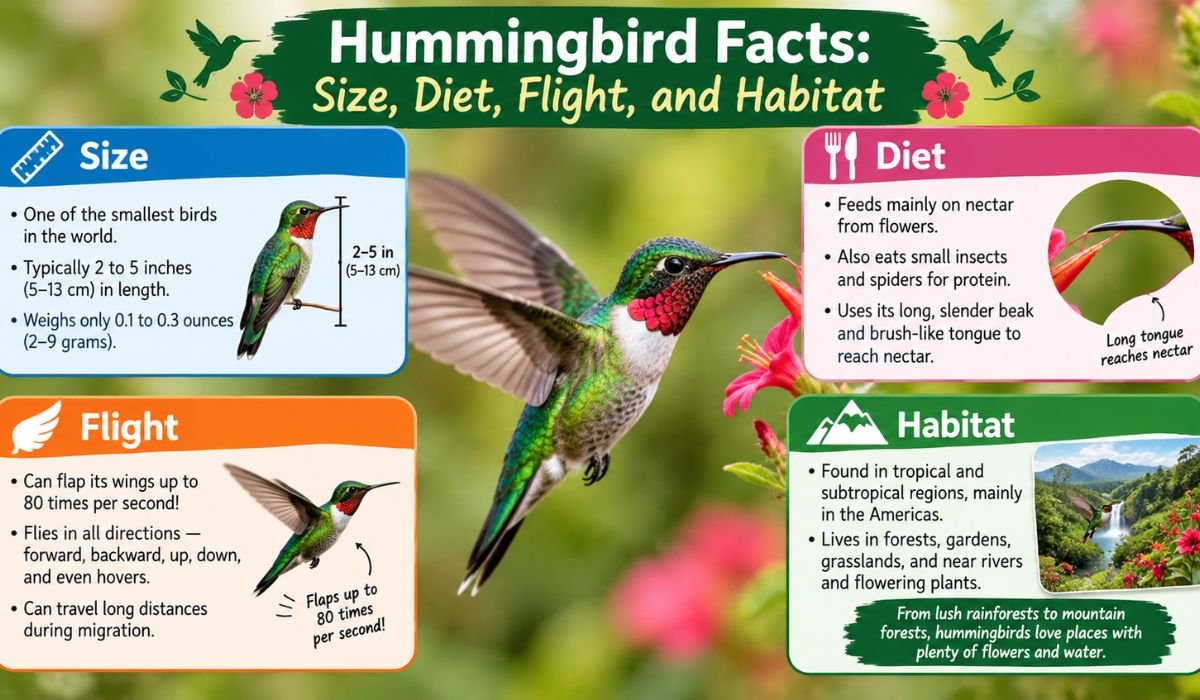
Hummingbirds are among the smallest and most fascinating birds in the world. Known for their rapid wingbeats, hovering ability, colorful feathers, and long beaks, these tiny birds have remarkable adaptations that help them survive. Learning hummingbird facts reveals how these birds feed, fly, migrate, and interact with their environment.
Although hummingbirds are tiny, they are energetic and highly specialized birds. They can hover in one place while feeding from flowers and can move quickly in different directions. Their unique flight abilities and fast metabolism make them different from most other birds. In this guide, we will explore their size, diet, flight, habitat, behavior, and other interesting characteristics.
Hummingbird Facts About Size and Appearance
One of the most interesting hummingbird facts is their extremely small size. Hummingbirds range considerably in size depending on the species. The bee hummingbird, for example, is the smallest known bird species, while some larger hummingbirds can reach several inches in length.
Their bodies are lightweight and adapted for fast movement. They have long, narrow bills that allow them to reach nectar deep inside flowers. Their tongues are also specially adapted for collecting nectar.
Many hummingbirds have bright, shimmering feathers. Male hummingbirds often have especially colorful feathers around the throat, called a gorget. These colors can appear especially vivid when sunlight reflects from the feathers.
Despite their small bodies, hummingbirds have strong muscles and excellent coordination. Their wings and compact body shape allow them to make rapid movements that would be difficult for most other birds.
Where Do Hummingbirds Live?
Hummingbirds are primarily found in the Americas. They occur from Alaska and Canada through the United States, Mexico, Central America, and South America. The greatest diversity of hummingbird species occurs in tropical regions.
Their habitats can include forests, mountains, grasslands, gardens, deserts, and areas near human settlements. Different species are adapted to different environmental conditions.
Some hummingbirds live in relatively cool mountain environments, while others prefer warm tropical forests. During migration, certain species travel considerable distances between breeding and wintering areas.
Gardens can also provide useful habitat when they contain suitable flowers, trees, shrubs, and safe places for birds to rest. However, natural habitats remain important because they provide a wider variety of food and shelter.
Hummingbird Facts About Their Diet
Another important part of hummingbird facts is their unusual diet. Flower nectar is one of their main sources of energy. Their long bills and specialized tongues allow them to collect nectar from flowers that many other birds cannot easily reach.
Hummingbirds also eat small insects and other tiny arthropods. These foods provide nutrients such as protein that nectar alone cannot provide. Insects can be especially important when hummingbirds are feeding young.
Because hummingbirds use so much energy while flying, they need to feed frequently. Their metabolism is extremely fast, allowing them to process food and maintain their high activity levels.
Hummingbirds naturally visit many different flowers. Their feeding behavior can also help pollinate plants because pollen may be transferred between flowers as they feed.
Read Related Post: Starfish Facts: Habitat, Diet, Body Parts, and More
How Do Hummingbirds Fly?
Perhaps the most remarkable hummingbird facts involve their flight. Unlike most birds, hummingbirds can hover in one place while feeding. Their wings move extremely rapidly, producing the characteristic humming sound that gives these birds their name.
Their wing structure and shoulder joints allow them to move their wings in a way that generates lift during both parts of the wing stroke. This helps them remain suspended in the air.
Hummingbirds can also fly forward, backward, upward, and sideways. Their ability to fly backward is particularly unusual among birds.
Their rapid flight requires enormous amounts of energy. This is why hummingbirds spend a significant amount of time feeding and resting between periods of intense activity.
Hummingbird Flight Speed and Energy
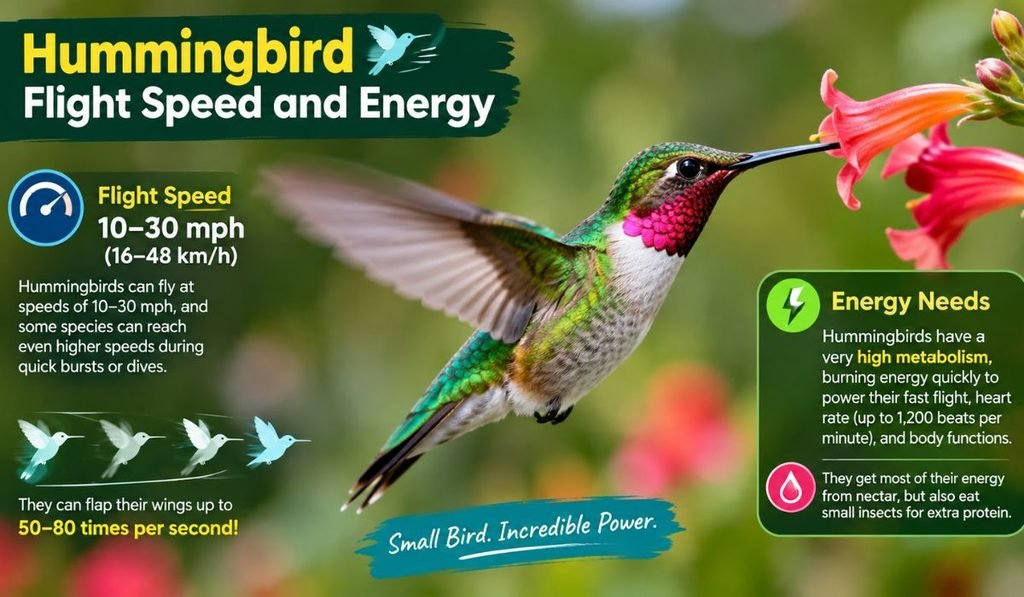
Some species can reach impressive speeds during short flights or courtship displays. Their small bodies allow them to change direction rapidly, helping them navigate dense vegetation and avoid obstacles.
Hummingbirds have very high metabolic rates compared with many other animals. They must consume enough food to support their constant energy demands.
At night or during periods when food is scarce, some hummingbirds can enter a state called torpor. During torpor, their body temperature and metabolic rate drop significantly, helping them conserve energy.
These adaptations demonstrate how specialized hummingbirds are for an active lifestyle. Their ability to combine lightweight bodies, powerful muscles, and rapid metabolism makes their flight especially impressive.
Hummingbird Behavior
Many hummingbird facts also relate to their behavior. Hummingbirds can be highly territorial, particularly around productive feeding areas. A bird may defend flowers or feeders from other hummingbirds.
They communicate through calls, movements, and visual displays. Males may perform aerial displays during courtship, sometimes flying rapidly through the air to attract females.
Hummingbirds are generally active during daylight hours. They spend their time feeding, flying between locations, resting, defending territories, and searching for suitable food.
Their excellent eyesight helps them locate flowers and detect movement. Their ability to remember productive feeding locations can also help them efficiently use their environment.
Hummingbird Nesting and Reproduction
Female hummingbirds usually build tiny cup-shaped nests using materials such as plant fibers, soft vegetation, and other natural materials. The nest may be placed on a small branch or another sheltered location.
One of the fascinating hummingbird facts is that the nest is remarkably small compared with the nests of many larger birds. Its size matches the tiny body of the adult bird and the small chicks.
The female generally handles nest construction and parental care. After the eggs hatch, she feeds the chicks until they become strong enough to leave the nest.
Young hummingbirds gradually develop their flight abilities. Once they become independent, they begin learning how to find food and navigate their surroundings.
Do Hummingbirds Migrate?
Migration is another interesting subject when studying hummingbird facts. Not every hummingbird species migrates, but several species make seasonal movements.
Some hummingbirds travel hundreds or even thousands of miles between breeding and wintering areas. Their migration routes may cross forests, mountains, grasslands, and other landscapes.
Before migration, hummingbirds need access to sufficient food so they can build up the energy needed for long journeys. During migration, flowering plants and other food sources provide essential energy.
Migration timing varies depending on the species and location. Weather, food availability, daylight, and seasonal changes can all influence movement.
How Long Do Hummingbirds Live?
The lifespan of a hummingbird varies by species and environmental conditions. Although their bodies are extremely small, some individuals can survive for several years in the wild.
Young birds face challenges such as predators, weather, food shortages, and habitat changes. Adult hummingbirds also need reliable food sources and suitable shelter to survive.
Their small size does not mean they are fragile in every situation. Hummingbirds have evolved specialized adaptations that help them cope with demanding environments.
Why Are Hummingbirds Important?
Hummingbirds play an important ecological role as pollinators. When they visit flowers for nectar, pollen can attach to their bodies and be carried to other flowers.
This helps plants reproduce and contributes to healthy ecosystems. Hummingbirds also form part of food webs, interacting with insects, plants, and predators.
Protecting flowering plants and natural habitats can help provide hummingbirds with food and shelter. Native plants are often particularly valuable because they can support local wildlife.
Interesting Hummingbird Facts
Here are some additional hummingbird facts worth remembering:
- Hummingbirds are native to the Americas.
- The bee hummingbird is the smallest known bird species.
- Hummingbirds can hover while feeding from flowers.
- Some hummingbirds can fly backward.
- Their wings can beat extremely rapidly.
- Nectar provides a major source of energy.
- Hummingbirds also eat small insects and other tiny arthropods.
- Some species migrate seasonally over long distances.
- Certain hummingbirds enter torpor to conserve energy.
- Their bright feathers can appear to shimmer in sunlight.
- Hummingbirds can be territorial around rich food sources.
- They are important pollinators for many flowering plants.
These characteristics make hummingbirds exceptional examples of adaptation among birds.
FAQ’s
1. What are the most interesting hummingbird facts?
Some of the most interesting hummingbird facts include their ability to hover, fly backward, beat their wings rapidly, and survive on a combination of nectar and tiny insects.
2. What do hummingbirds eat?
Hummingbirds mainly consume flower nectar for energy, but they also eat small insects and other tiny arthropods to obtain important nutrients.
3. Can hummingbirds fly backward?
Yes. One of the best-known hummingbird facts is that hummingbirds can fly backward. Their specialized wing and shoulder structure gives them exceptional control in the air.
4. Where do hummingbirds live?
Hummingbirds live throughout the Americas, with the greatest number of species found in tropical regions of Central and South America. Different species occupy habitats ranging from forests and mountains to gardens and open areas.
5. How fast do hummingbirds beat their wings?
Wingbeat rates vary among species and activities. During hovering and other demanding movements, their wings can beat extremely rapidly, producing the characteristic humming sound.
6. Do all hummingbirds migrate?
No. Some species remain in the same general region year-round, while others undertake seasonal migrations. Migration behavior depends on the species and its environment.
7. Why are hummingbirds important?
Hummingbirds are important pollinators. As they move between flowers while feeding on nectar, they can transfer pollen and help flowering plants reproduce.
Conclusion
Hummingbirds may be tiny, but their specialized abilities make them some of the most remarkable birds on Earth. From hovering flight and rapid wingbeats to specialized bills, high-energy diets, and seasonal migration, hummingbird facts show how these birds have evolved for an exceptionally active lifestyle.
Their role as pollinators also makes them valuable members of many ecosystems. Protecting natural habitats and maintaining suitable flowering plants can help provide these fascinating birds with the food and shelter they need. Whether you observe them in a forest, mountain habitat, or garden, hummingbirds offer an excellent example of how much remarkable biology can exist inside a very small bird.

Hi, I’m Amelia, an SEO and content specialist with several years of experience researching and creating informative content for online audiences. At Animal Attack Facts, I focus on animal behavior, animal attacks on humans, and interesting facts about land animals, marine animals, birds, reptiles, and insects. My goal is to provide clear, useful, and engaging information that helps readers better understand wildlife and stay informed about animal encounters.
1 thought on “Hummingbird Facts: Size, Diet, Flight, and Habitat”