
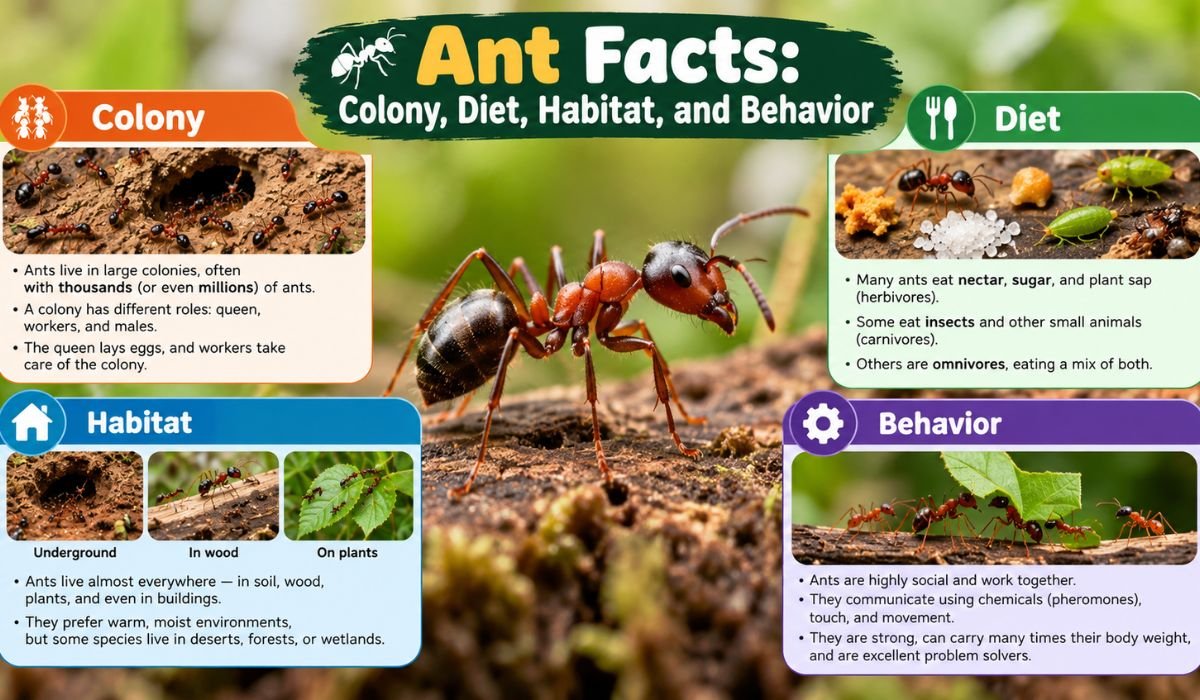
Ants are among the most successful and widespread insects on Earth. They live in organized colonies, communicate using chemical signals, and can work together to find food, protect their nest, and care for young. From tiny household ants to large tropical species, these insects have adapted to many different environments. Learning ant facts reveals how complex their social lives and survival strategies can be.
Ants belong to the insect family Formicidae and are closely related to bees and wasps. There are thousands of known ant species, and they can be found on almost every continent. Their colonies may contain only a few individuals or millions of ants, depending on the species.
What Are Ants?
Ants are social insects characterized by their segmented bodies, six legs, elbowed antennae, and strong jaws called mandibles. Like other insects, their bodies are divided into the head, thorax, and abdomen.
One of the most interesting ant facts is that individual ants usually have specialized roles within their colonies. Workers may gather food, maintain the nest, care for young, or defend the colony. In many species, queens are responsible for producing eggs.
Ants vary greatly in size, color, and behavior. Some species are only a few millimeters long, while others are considerably larger. Their colors can include black, brown, red, yellow, and combinations of these shades.
How Does an Ant Colony Work?
An ant colony functions as a highly organized social system. Instead of every ant performing every task, different members often specialize in particular jobs.
Most colonies include workers, reproductive individuals, and sometimes soldiers. Worker ants are generally responsible for everyday activities such as gathering food, cleaning the nest, caring for larvae, and protecting important areas.
A queen’s main role in many species is reproduction. Depending on the species, a colony may have one queen or multiple queens.
Some colonies can survive for many years because workers continually replace older members and young ants develop through different stages of their life cycle.
Ant Colony Roles
The division of labor is one of the most fascinating aspects of ant facts. Although colony structures differ among species, common roles include:
- Workers: Find food, maintain the nest, and care for developing ants.
- Queens: Produce eggs and help establish or maintain reproduction within the colony.
- Males: Usually have a reproductive role and participate in mating flights.
- Soldiers: In species with specialized soldiers, they may defend the colony using powerful mandibles or other adaptations.
The exact organization depends on the species. Some ants have remarkably specialized workers, while others have less obvious differences between individuals.
Where Do Ants Live?
Ants are extremely adaptable and live in many different habitats. They can be found in forests, grasslands, deserts, wetlands, gardens, agricultural areas, and urban environments.
Some species build underground nests with interconnected tunnels and chambers. Others create nests inside trees, beneath rocks, in rotting wood, or within plant structures.
Certain ants have developed unusual nesting strategies. For example, some species construct nests from plant material, while others live in close association with plants or other organisms.
These habitat adaptations are an important part of ant facts because they help explain why ants have become so widespread.
Read Related Post: Woodpecker Facts: Habitat, Diet, Behavior, and Adaptations
What Do Ants Eat?
Ant diets vary considerably from one species to another. Many ants are omnivorous and eat a mixture of insects, fruits, seeds, nectar, fungi, and other organic material.
Some ants primarily collect sugary liquids produced by plants or other insects. Others specialize in hunting insects and other small animals.
Leafcutter ants are particularly unusual because they collect pieces of leaves and use them to grow fungi inside their nests. The ants then feed on this cultivated fungus.
Some ants also consume dead animals or other organic matter, making them important scavengers in many ecosystems.
How Do Ants Find Food?
Ants use several methods to locate and collect food. Their antennae are extremely important because they help them detect chemical signals and identify objects in their surroundings.
When a worker discovers a useful food source, it may leave a chemical trail as it returns to the nest. Other ants can follow this trail to reach the food.
This chemical communication allows colonies to coordinate large numbers of workers without needing a central leader.
The ability to cooperate while searching for food is one of the most remarkable ant facts. A single ant may accomplish little on its own, but thousands of ants working together can efficiently exploit food sources.
How Do Ants Communicate?
Ants communicate primarily through chemical signals called pheromones. These chemicals can provide information about food, danger, territory, and other important situations.
An ant can release pheromones that other ants detect using their antennae. Different chemical signals can trigger different behaviors.
Ants may also communicate through physical contact, vibrations, and other signals. Antennae are particularly important because ants frequently touch or move them while interacting with nestmates.
Their communication system allows a colony to respond collectively to changing conditions.
How Do Ants Defend Their Colonies?
Ant colonies face threats from predators, competing ants, parasites, and environmental dangers. Many species have developed specialized defensive behaviors.
Worker ants may bite an intruder with their mandibles. Some species can also sting, spray chemicals, or release irritating substances.
Soldier ants, where present, may have larger heads and stronger jaws than ordinary workers. These physical adaptations help them defend entrances and important areas of the colony.
Colony defense is another example of how cooperation contributes to ant survival.
Ant Life Cycle
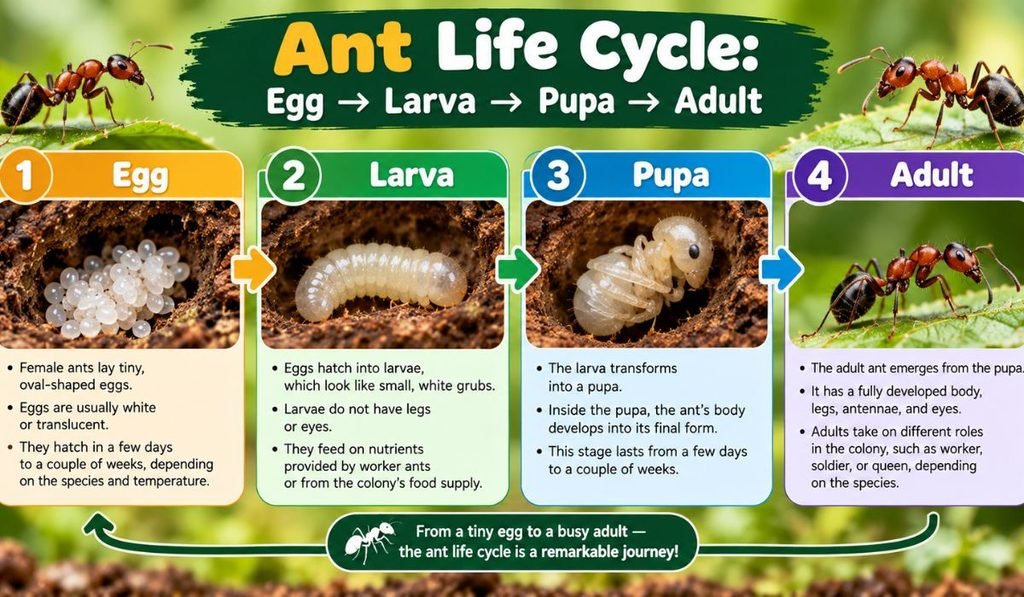
Ants undergo complete metamorphosis. Their life cycle generally includes four stages:
- Egg
- Larva
- Pupa
- Adult
The queen lays eggs, which hatch into larvae. Larvae are dependent on adult workers for food and care. They eventually develop into pupae before emerging as adult ants.
Adult ants then take on different roles depending on their species, age, colony needs, and physical characteristics.
The length of each stage varies between species and environmental conditions.
How Long Do Ants Live?
Ant lifespan depends heavily on the species and the individual’s role in the colony.
Workers may live from weeks to several years, depending on the species and environmental conditions. Queens can live considerably longer in some species, sometimes for many years.
Males generally have shorter lives because their primary role is reproduction.
One of the useful ant facts to remember is that an ant colony is not simply a group of identical insects. Different individuals can have very different lifespans and responsibilities.
Are Ants Important to the Environment?
Yes. Ants perform several important ecological functions.
They help break down organic material, move soil, disperse seeds, and influence populations of other insects. Their underground tunnels can also alter soil structure and help water and air move through the ground.
Some plants depend on ants to disperse their seeds. Ants may carry seeds away from parent plants, allowing them to grow in new locations.
Because of these activities, ants can have a significant influence on the ecosystems where they live.
Interesting Ant Facts
Here are some additional ant facts that show just how diverse these insects are:
- Ants are found on nearly every continent except Antarctica.
- Ant colonies can range from very small groups to enormous societies.
- Many ants use pheromones to communicate.
- Some ants farm fungi for food.
- Ants can work together to transport objects much larger than a single ant.
- Some species form bridges or living structures using their own bodies.
- Ants play important roles as predators, scavengers, and seed dispersers.
- Ants have been living in social colonies for millions of years.
- Different ant species have very different diets and nesting habits.
- Some ant species live in close relationships with plants or other insects.
Ants and Humans
Ants are common around homes, gardens, farms, and other human environments. Some species are considered beneficial because they eat other insects or help recycle organic material.
Other species can become household pests when they enter buildings in search of food or water. Certain ants may also damage structures, contaminate food, or protect plant pests such as aphids.
Understanding their behavior can help explain why ants often appear in groups rather than individually. Once one worker discovers a reliable food source, chemical communication can attract additional workers.
FAQ’s
What are the most interesting ant facts?
Some of the most interesting ant facts include their complex colony organization, chemical communication, specialized worker roles, and ability to cooperate when finding food and defending their nests.
How many ants live in a colony?
Colony size varies greatly by species. Some colonies contain only a small number of ants, while others can contain thousands, millions, or even more individuals.
What do ants eat?
Ant diets vary by species. Many ants eat insects, seeds, fruits, nectar, fungi, and other organic material. Some species have highly specialized diets.
Where do ants build their nests?
Ants may build nests underground, inside wood, beneath rocks, in trees, within plant structures, or in other protected locations. Their nesting behavior depends on the species and environment.
How do ants communicate?
Ants primarily communicate through chemical signals called pheromones. They can also use physical contact and vibrations to exchange information.
Are ants helpful to ecosystems?
Yes. Ants can help disperse seeds, recycle organic material, modify soil, and control populations of other small organisms. Their activities can influence many parts of an ecosystem.
How long can ants live?
Ant lifespan varies by species and role. Workers may live for weeks or years, while queens of some species can survive for many years.
Conclusion
Ants are small insects with remarkably complex social systems. Their colonies depend on cooperation, communication, specialized roles, and efficient use of available resources. From underground tunnels to tree nests, ants have adapted to an enormous range of habitats.
These ant facts show why ants are among the most successful social insects on Earth. Their ability to communicate chemically, find food collectively, defend colonies, and influence ecosystems makes them fascinating animals to study. Whether they are farming fungi, dispersing seeds, or working together to protect their nest, ants demonstrate how cooperation can help a species thrive.

Hi, I’m Amelia, an SEO and content specialist with several years of experience researching and creating informative content for online audiences. At Animal Attack Facts, I focus on animal behavior, animal attacks on humans, and interesting facts about land animals, marine animals, birds, reptiles, and insects. My goal is to provide clear, useful, and engaging information that helps readers better understand wildlife and stay informed about animal encounters.
1 thought on “Ant Facts: Colony, Diet, Habitat, and Behavior”