
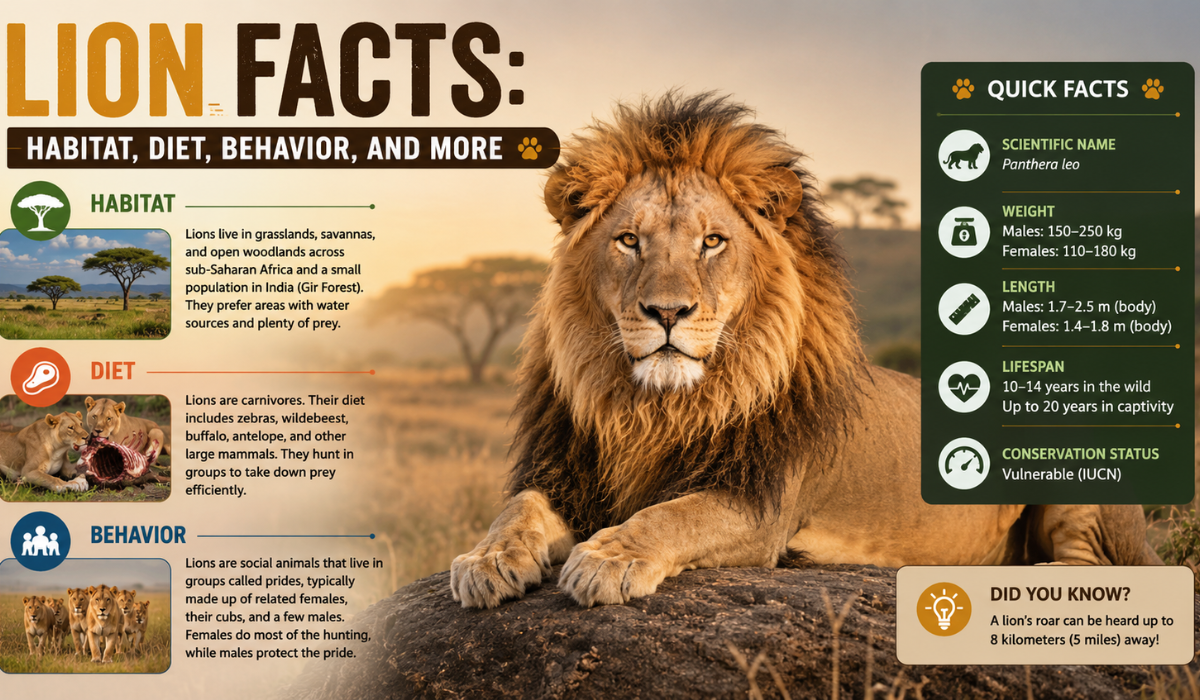
Lions are among the most recognizable wild animals on Earth. Known for their powerful bodies, distinctive manes, loud roars, and social behavior, these big cats have fascinated people for centuries. Unlike most other large cats, lions live in family groups called prides and often cooperate when raising young and finding food.
But there is much more to lions than their famous appearance. From their African grassland habitats to their complex social lives, lions have many fascinating adaptations that help them survive.
In this guide, we explore some of the most interesting lion facts, including where lions live, what they eat, how they behave, how they communicate, how long they live, and the threats they face in the wild.
Quick Lion Facts
- Scientific name: Panthera leo
- Animal group: Mammal
- Family: Felidae
- Order: Carnivora
- Diet: Carnivore
- Main habitat: Grasslands, savannas, open plains, scrub, and dry woodland
- Social group: Pride
- Average wild lifespan: Often around 10–16 years, depending on sex and conditions
- Main prey: Zebra, wildebeest, antelope, and other mammals
- Primary hunters: Lionesses
- Male’s most recognizable feature: Mane
- Conservation status: Vulnerable
- Main threats: Habitat loss, human-wildlife conflict, prey depletion, and disease
Smithsonian’s National Zoo identifies the lion as Panthera leo and notes that lions are among the world’s most social felines.
What Is a Lion?
A lion is a large carnivorous mammal belonging to the cat family, Felidae. Lions are members of the Panthera genus, which also includes tigers, leopards, and jaguars.
Lions are especially famous for their social lifestyle. While many large cats usually live alone, lions commonly live in groups called prides. A pride can contain related females, cubs, younger lions, and one or more adult males.
Lions have strong bodies, powerful forelegs, large jaws, and sharp teeth that help them capture and consume prey. Adult males usually have a prominent mane, although the color and size of a mane can vary according to factors such as age, genetics, and hormones.
Where Do Lions Live?
Most wild lions today live in Africa, particularly in parts of sub-Saharan Africa. They can be found in habitats ranging from open grasslands and savannas to areas of thick brush and dry thorn forest.
Lions generally avoid extremely dense tropical forests. Their preferred environments provide a combination of cover, water, and enough prey to support a pride.
There is also a small population of Asiatic lions in India’s Gir landscape. This population is geographically isolated from African lions and is an important part of the species’ remaining diversity.
Historically, lions had a much larger range. They once lived across parts of Africa, Europe, and Asia, and their relatives or historical populations also occupied areas far beyond their modern distribution.
What Do Lions Eat?
Lions are carnivores, meaning their natural diet consists primarily of other animals.
Their prey varies depending on where they live and what animals are available. Common prey includes:
- Wildebeest
- Zebra
- Antelope
- Buffalo
- Warthogs
- Other medium-sized and large mammals
Lions can also eat smaller animals when larger prey is unavailable. Smithsonian notes that lions may consume animals ranging from rodents to reptiles during periods when food is scarce.
Lions sometimes take advantage of opportunities created by other predators as well. They may steal kills from animals such as hyenas or leopards, although lions can also lose their own kills to competing predators.
Read Related Post: Lion Facts: Habitat, Diet, Behavior, and More
How Do Lions Hunt?
Lion hunting is often associated with teamwork. Lionesses are generally the primary hunters within a pride, although males can participate in hunts too.
A group of lions may approach prey from different directions, using the landscape and vegetation to get closer before making a coordinated attack.
Lions rely more on short bursts of speed and strength than on long-distance pursuit. Their powerful limbs and jaws are adapted for bringing down large prey.
However, hunting is not always successful. Lions may spend considerable time resting between hunting opportunities, and the availability of prey has a major influence on their survival and pride size.
Why Do Lions Live in Prides?
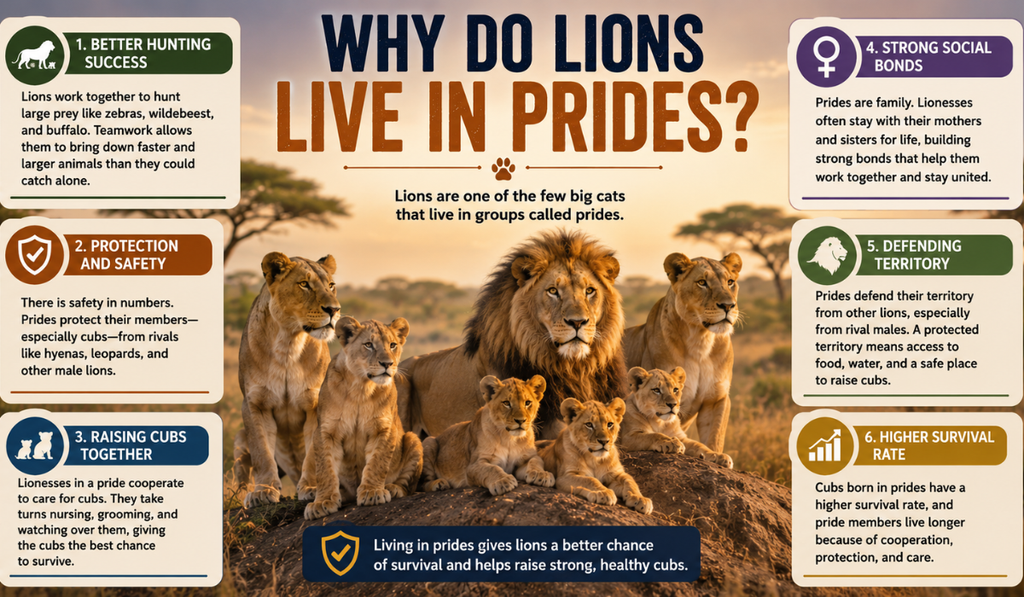
One of the most interesting lion facts is that lions are highly social compared with most other big cats.
A pride is generally made up of related females, their offspring, and one or more resident males. Pride size can vary considerably depending on factors such as food availability and local conditions.
Female lions often remain with their mothers’ pride for much of their lives. Young males usually leave their birth pride when they become old enough to compete with adult males.
Some young males form coalitions with brothers or other related males. These coalitions can later attempt to establish control over a pride.
Living socially provides several potential advantages. Lions can cooperate in hunting, protect young, defend territory, and interact with other members of their group.
Are Male or Female Lions Bigger?
Male lions are generally larger than females.
Adult males can reach around 10 feet (3 meters) in total length, including the tail, while females can reach roughly 9 feet (2.7 meters). Smithsonian reports male weights of approximately 330–550 pounds (150–250 kilograms), while females are generally smaller.
One of the most obvious differences between adult males and females is the mane.
Why Do Male Lions Have Manes?
The mane is one of the most recognizable features of a male lion.
Mane color can range from blond to reddish-brown and even very dark shades. Its appearance can change as a lion grows older, and genetics and hormones also influence its development.
The mane also plays an important role in how lions look to one another. A large, dark mane can make a male appear particularly impressive, although mane characteristics vary among individual lions and populations.
Young lions do not have the full mane seen in mature males.
How Do Lions Communicate?
Lions communicate using a combination of sounds, body language, scent marking, and physical interactions.
Their famous roar is one of the most recognizable animal sounds in the world. Lions can use vocalizations to communicate with pride members and advertise their presence.
They also use scent marking to communicate information about territory.
Roaring can travel long distances, helping lions signal to other groups that an area is occupied. Smithsonian reports that lion roars can be heard from several miles away under suitable conditions.
Lions also communicate through behaviors such as rubbing heads, grooming, postures, facial expressions, and various vocal sounds.
How Long Do Lions Sleep?
Lions spend a large part of their day resting.
Like many carnivores, lions can sleep and rest for long periods between periods of activity. Smithsonian’s Lion Cam notes that lions may spend up to about 20 hours a day resting and relaxing.
Resting helps conserve energy, which is especially important for animals that may need significant bursts of effort when hunting or defending their territory.
Lions are often more active during cooler parts of the day and may become particularly active around dusk, nighttime, and dawn.
How Long Do Lions Live?
Lifespan varies depending on whether a lion lives in the wild or under human care.
In the wild, lionesses may live to around 16 years under favorable conditions, while males often have shorter lifespans. Smithsonian notes that males rarely live beyond about 12 years in the wild, although individual lifespans vary.
Lions in zoos and other professional human-care facilities can live considerably longer. Some have reached their late teens or early twenties.
Factors affecting lifespan include food availability, injuries, disease, competition, environmental conditions, and access to safe habitat.
Lion Cubs and Reproduction
Lion cubs are born after a gestation period of roughly three and a half months.
A lioness commonly gives birth to between one and four cubs. Cubs are initially dependent on their mother and are vulnerable to starvation, predators, and other dangers.
Lionesses may raise cubs together, creating a social environment in which young lions interact with several adults and other cubs.
Cubs begin eating meat while they are still young, although they continue nursing for months. Their development from vulnerable cubs into independent young lions takes considerable time.
How Fast Can Lions Run?
Lions are capable of impressive bursts of speed, but they are not built for long-distance running.
Their powerful muscles allow them to accelerate quickly when pursuing prey. However, they generally depend on getting relatively close to their target before attempting a chase.
This is one reason cooperation, stealth, positioning, and patience are important parts of lion hunting behavior.
Do Lions Have Predators?
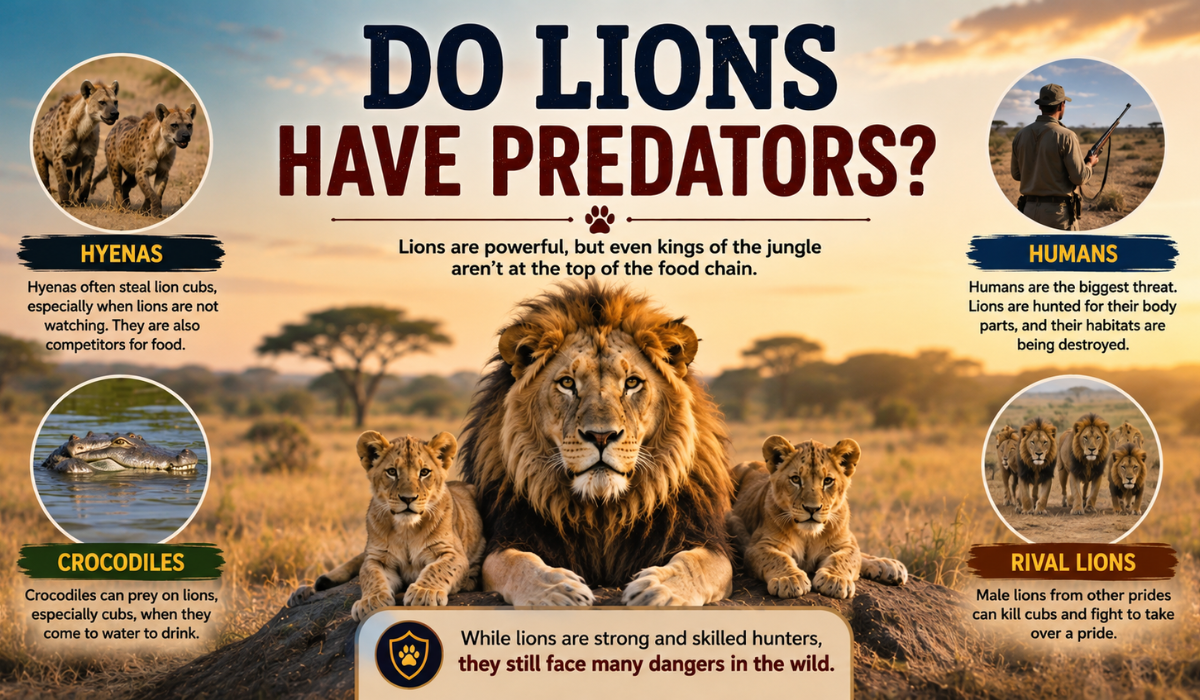
Adult lions are among the dominant predators in many of the ecosystems where they live, so healthy adults have relatively few natural enemies.
However, lions still face competition from other large predators, including hyenas and other lions.
Young cubs are much more vulnerable than adults. They can be threatened by predators, starvation, disease, and conflicts within or between prides.
Competition between lions themselves can also be intense because control of territory and access to food and mates are important for survival.
Are Lions Endangered?
Lions face serious conservation challenges despite their iconic status.
The International Union for Conservation of Nature classifies the African lion as Vulnerable. Smithsonian reported in 2026 that an estimated 20,000 lions remain in the wild and that wild lion populations have declined significantly.
Some of the biggest threats include:
- Habitat loss and fragmentation
- Declining wild prey populations
- Conflict between lions and people
- Disease
- Illegal or unsustainable hunting
- Loss of suitable territory
As human populations expand into areas used by wildlife, lions can come into greater contact with livestock and communities. This can create conflicts that are difficult for both people and wildlife.
Protecting large, connected habitats and maintaining healthy prey populations are important parts of lion conservation.
Why Are Lions Important to Their Ecosystems?
Lions are apex predators in many of the ecosystems where they live. Their presence can influence the behavior and populations of other animals.
By protecting lion habitat, conservation efforts can also protect many other species that share the same ecosystem.
Healthy lion populations therefore have value beyond the species itself. Conserving them can help preserve large landscapes, prey species, vegetation, and other wildlife.
15 Interesting Lion Facts
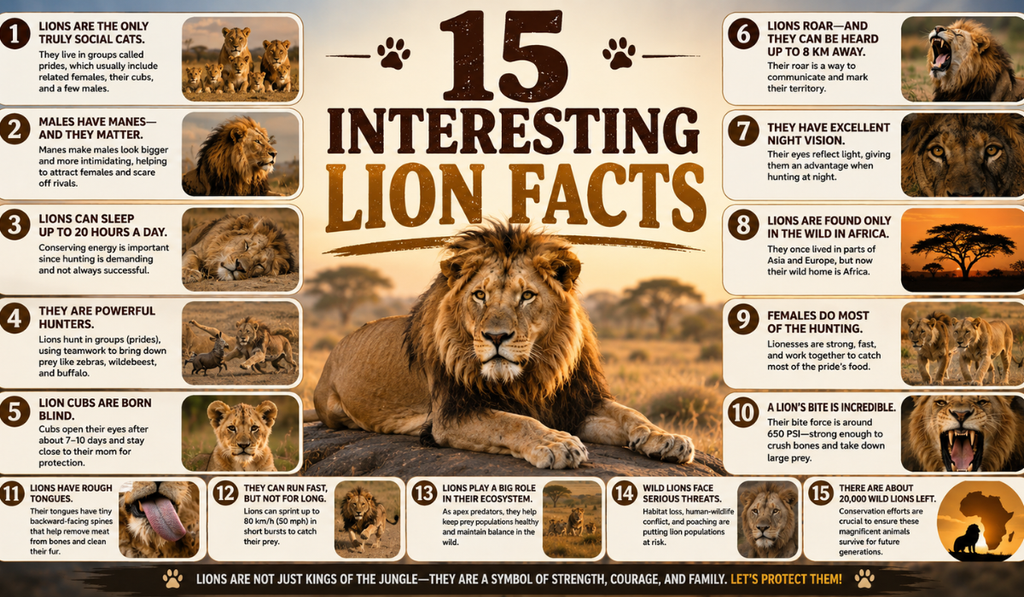
Here are some quick lion facts to remember:
- A lion’s scientific name is Panthera leo.
- Lions are mammals and members of the cat family.
- Lions are the most social of the big cats.
- A group of lions is called a pride.
- Lionesses are generally the primary hunters in a pride.
- Adult male lions usually have manes.
- Mane color and size can vary between individual males.
- Lions are carnivores.
- Lions commonly eat animals such as zebra, wildebeest, and antelope.
- Lions use roaring and scent marking to communicate and establish territory.
- Lions can spend much of the day resting.
- Female lions often remain with their birth pride.
- Young males commonly leave their birth pride as they mature.
- Most wild lions live in Africa, with a small population of Asiatic lions in India.
- African lions are currently classified as Vulnerable.
These characteristics make lions one of the most fascinating large predators on the planet.
FAQ’s
What is a lion’s scientific name?
The scientific name of the lion is Panthera leo. It belongs to the Felidae family and the Carnivora order.
Where do lions live?
Most wild lions live in Africa, particularly in sub-Saharan regions. A small population of Asiatic lions lives in India’s Gir landscape.
What do lions eat?
Lions are carnivores that primarily eat other animals. Common prey includes wildebeest, zebra, antelope, and other mammals.
Why do lions live in groups?
Lions live in prides, which can provide advantages for hunting, raising young, defending territory, and social interaction.
Are female lions the main hunters?
Yes. Lionesses are generally the primary hunters in a pride, although male lions may also participate in hunting.
How long do lions live?
Wild lifespans vary. Lionesses can live to around 16 years in favorable conditions, while males often have shorter lifespans. Lions under human care can live into their late teens or twenties.
Why do male lions have manes?
Male lions develop manes as they mature. Mane characteristics vary with age, genetics, and hormones, and the mane is an important visual characteristic of adult males.
Are lions endangered?
African lions are classified as Vulnerable, meaning they face a significant risk of population decline and extinction in the wild if major threats are not addressed.
Final Thoughts
Lions are much more than powerful predators with impressive roars. Their social behavior, cooperative hunting, communication, family structure, and adaptations make them one of the most remarkable mammals in the world.
Understanding these lion facts also highlights why protecting their habitats is so important. Wild lions need healthy ecosystems, sufficient prey, and safe spaces where prides can survive and reproduce.
Conservation efforts that protect lions can also protect the many other species and landscapes that share their environment. By learning more about these iconic big cats, we can better understand their role in nature and why their future matters.

Hi, I’m Amelia, an SEO and content specialist with several years of experience researching and creating informative content for online audiences. At Animal Attack Facts, I focus on animal behavior, animal attacks on humans, and interesting facts about land animals, marine animals, birds, reptiles, and insects. My goal is to provide clear, useful, and engaging information that helps readers better understand wildlife and stay informed about animal encounters.
1 thought on “Lion Facts: Habitat, Diet, Behavior, and More”