

Rabbits are small mammals known for their long ears, powerful hind legs, soft fur, and remarkable ability to move quickly. These animals belong to the family Leporidae and live in a variety of environments, including grasslands, forests, deserts and wetlands. Rabbits are herbivores that feed mainly on grasses, leaves, and other plant materials. Their keen senses, social behaviors and reproductive abilities help them survive in the wild. Learning rabbit facts provides a better understanding of their habitat, diet, behavior, life cycle and relationship with the environment.
What Are Rabbits?
Rabbits are mammals closely related to hares and pikas. They are found in many parts of the world, although different species occupy different geographical regions. Some rabbits live in underground burrows, while others shelter in thick vegetation or natural spaces that provide protection from predators.
Most rabbits have compact bodies, long ears, short tails, and strong hind legs adapted for running and jumping. Their large ears help detect sounds and regulate body temperature in certain species. Their eyes are positioned on the sides of their heads, giving them a wide field of vision to help identify potential threats.
Rabbits are known for their ability to reproduce quickly. They mature relatively early, and females can produce several litters in a year when conditions are favorable. This reproductive ability helps rabbit populations recover and grow, although survival depends on food availability, weather, and predation.
Rabbit Habitat: Where Do Rabbits Live?

Rabbits inhabit a wide range of environments, from open grasslands to wooded areas. Their preferred habitat depends on the species, climate, availability of food, and access to shelter.
Grasslands and Meadows
Grasslands provide rabbits with abundant grasses, herbs, and other plants. These open environments allow them to find food easily, while patches of tall grass and shrubs offer hiding places. Many rabbits create shallow depressions or use existing burrows to rest and escape danger.
Forests and Woodlands
Some rabbit species live in forests and wooded areas where shrubs, fallen branches, and dense vegetation provide cover. These habitats offer a variety of plants to eat and places to hide from predators. Rabbits often remain near the forest floor, where they can move through vegetation while staying protected.
Read Related Post: Turtle Habitat: Where Turtles Live and How They Survive
Deserts and Dry Regions
Certain rabbit species are adapted to arid environments. They may shelter beneath shrubs, use burrows, or remain in shaded areas during the hottest parts of the day. These behaviors help reduce exposure to extreme temperatures. Desert-dwelling rabbits depend on available vegetation for both food and moisture.
Wetlands and Shrublands
Rabbits may also inhabit areas near wetlands, streams, and dense shrublands. These environments can provide suitable vegetation and protective cover. However, they generally prefer places with enough dry ground for resting and shelter.
Where Do Wild Rabbits Make Their Homes?
Some rabbits dig underground burrows called warrens, which can contain multiple entrances and connected chambers. These burrows offer protection from predators and temperature extremes. Other species, including cottontail rabbits, usually rely on shallow nests, grass, brush piles, and naturally sheltered spaces rather than extensive burrow systems.
What Do Rabbits Eat?

Rabbits are herbivores, meaning their diet consists primarily of plant material. Their digestive systems are specially adapted to extract nutrients from fibrous foods that many other mammals cannot efficiently digest.
Grass and Hay
Grass is an important food source for many wild rabbits. They also eat hay when it is available. These fibrous foods support healthy digestion and help wear down their continuously growing teeth.
Leaves and Herbs
Rabbits feed on leaves, clover, dandelions, and various wild herbs. The exact plants they consume depend on the season and their habitat. During warmer months, fresh vegetation may be plentiful, while winter can require them to rely on tougher plant materials.
Twigs and Bark
When softer plants become scarce, some rabbits eat young twigs, buds, and bark. This behavior allows them to find nourishment during colder months when grasses and other vegetation may be less available.
Fruits and Vegetables
Wild rabbits may occasionally eat fallen fruits, roots, and other plant parts. However, sugary fruits are not a major component of their natural diet. Domestic rabbits also require a diet based mainly on grass hay, with suitable leafy greens and carefully measured pellets.
How Rabbits Digest Their Food
Rabbits have a specialized digestive system that helps them obtain nutrients from fibrous plants. They practice a behavior called cecotrophy, in which they produce and re-ingest soft, nutrient-rich droppings called cecotropes. This allows them to absorb vitamins, proteins, and other nutrients that were not fully obtained during the first passage through the digestive tract.
Rabbit Behavior and Social Life
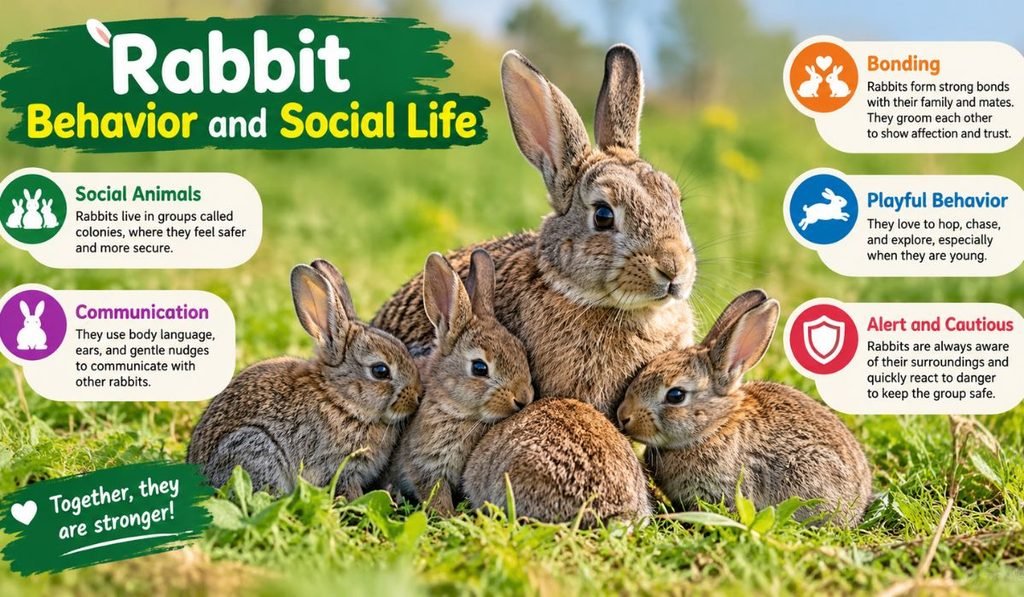
Rabbit behavior is shaped by their need to find food, avoid predators, reproduce, and protect themselves from environmental threats. Although many rabbits are social, their social structure varies by species and habitat.
Communication
Rabbits communicate through body movements, scent marking, and sounds. They may thump their hind feet against the ground to warn nearby rabbits of danger. Ear position and body posture can also indicate alertness, curiosity, discomfort, or fear.
Rabbits use scent glands to mark areas and communicate information to other rabbits. Their hearing and sense of smell are particularly important for detecting predators and recognizing their surroundings.
Running and Jumping
Rabbits have powerful hind legs that allow them to accelerate quickly and make sudden turns. When threatened, they often run in an unpredictable pattern to escape predators. Some rabbits also perform energetic jumps and twists, particularly when they feel safe and active.
Hiding From Predators
Rabbits are prey animals targeted by predators such as foxes, coyotes, hawks, owls, and certain snakes. Their main defenses include speed, camouflage, sharp senses, and access to hiding places. Many rabbits remain motionless when they sense danger, relying on their fur color to blend into the surroundings.
Activity Patterns
Many rabbit species are most active around dawn and dusk, a pattern known as crepuscular activity. These periods often provide cooler temperatures and reduced exposure to some predators. However, activity patterns vary depending on the species, season, and local conditions.
Social Behavior
Some rabbits live in groups, especially species that occupy extensive burrow systems. Others are more solitary or maintain individual home ranges. Social interactions can include grooming, scent marking, courtship, and competition for food or territory.
Rabbit Life Cycle: From Birth to Adulthood
The rabbit life cycle includes several stages, beginning with reproduction and continuing through infancy, growth, and adulthood. The timing of each stage varies among species and depends on environmental conditions.
1. Mating and Reproduction
Rabbits are known for their high reproductive potential. Many species can breed several times during favorable seasons. Female rabbits, called does, generally become sexually mature within a few months, although the exact age varies by species and body size.
After mating, the female undergoes a relatively short pregnancy. For many common rabbit species, gestation lasts approximately 28 to 32 days.
2. Birth and the Nesting Stage
A female rabbit typically gives birth in a sheltered nest lined with grass and fur. Baby rabbits are called kits. In many species, newborn kits are blind, have closed ears, and are covered with little or no fur.
The mother usually visits the nest briefly to feed her young, often once or twice a day. This limited attendance helps reduce the chance of attracting predators to the nest.
3. Growth and Development
Kits grow rapidly during their first weeks of life. Their eyes and ears open, fur develops, and they gradually become more active. They begin exploring their surroundings and eventually start eating solid plant material alongside their mother’s milk.
Many young rabbits leave the nest at around three to five weeks of age, depending on the species and their development.
4. Juvenile Stage
During the juvenile stage, young rabbits develop stronger muscles, improve their movement, and learn behaviors that help them survive. They gradually become more independent and begin relying on their own ability to find food and avoid danger.
5. Adulthood
Once sexually mature, rabbits can reproduce and establish their own home ranges or social relationships. Their adult lives depend on habitat quality, food supplies, weather, disease, and the presence of predators.
Wild rabbits often have shorter lives than rabbits kept in suitable domestic care because they face more environmental dangers.
Interesting Rabbit Facts
Rabbits have several distinctive features and behaviors that make them fascinating animals.
- Rabbit teeth never stop growing: Their incisors continue growing throughout life, and chewing fibrous plant material helps wear them down.
- Rabbits have a wide field of vision: Their side-positioned eyes help them detect movement across much of their surroundings.
- They can make impressive jumps: Strong hind legs help rabbits escape predators and move rapidly across uneven terrain.
- Baby rabbits are called kits: The young are born in nests and depend on their mothers for milk during early development.
- Rabbits practice cecotrophy: They re-ingest specialized soft droppings to obtain additional nutrients.
- Not all rabbits dig burrows: Some species use shallow nests, thick vegetation, or natural shelters instead.
- Rabbits are not rodents: They belong to the order Lagomorpha, which also includes hares and pikas.
- Their ears serve multiple purposes: Besides detecting sounds, rabbit ears help regulate body temperature in many species.
- Rabbits can be surprisingly quiet: They often rely on body language and scent rather than vocal communication.
- Domestic and wild rabbits differ: Domestic rabbits have been selectively bred for different sizes, coat colors, and temperaments, while wild rabbits retain adaptations suited to their natural environments.
Rabbit Predators and Survival Adaptations
Rabbits occupy an important position in many food chains. Their predators include mammals and birds of prey, and the specific threats vary by region.
Camouflage is one of their most useful survival adaptations. Brown, gray, or mottled fur helps many wild rabbits blend into soil, grass, and leaf litter. Their sensitive hearing allows them to detect approaching animals, while their wide field of vision helps them monitor the surrounding area.
Speed is another important defense. Rabbits can sprint, jump, and change direction quickly, making it more difficult for predators to catch them. Access to burrows, dense vegetation, and other shelters further improves their chances of survival.
Reproduction also contributes to population persistence. Although many young rabbits do not survive to adulthood, the ability to produce multiple litters can help populations maintain their numbers when food and habitat conditions are favorable.
The Role of Rabbits in the Ecosystem
Rabbits contribute to ecosystem health in several ways. As herbivores, they feed on grasses and other vegetation, influencing plant growth and the structure of habitats. Their grazing can affect plant diversity, particularly where rabbit populations are abundant.
Rabbits also serve as an important food source for numerous predators. Changes in rabbit populations can influence the availability of prey for animals such as foxes and birds of prey.
Burrowing species can modify soil structure and create underground spaces used by other organisms. Their droppings also return nutrients to the environment.
However, rabbits introduced into regions where they have few natural predators can become invasive. Large populations may damage crops, compete with native herbivores, and reduce vegetation. Their ecological impact therefore depends on the species, location, and balance of the local ecosystem.
Threats to Rabbit Populations
Although rabbits reproduce quickly, they can still face significant threats in the wild.
Habitat loss occurs when grasslands, forests, and other natural areas are converted into farms, roads, or urban developments. This reduces access to food, shelter, and breeding sites.
Predation is a natural part of rabbit ecology, but young rabbits and individuals living in exposed habitats are particularly vulnerable.
Disease can cause substantial population declines. Certain viral diseases, including myxomatosis and rabbit hemorrhagic disease, have affected rabbit populations in different parts of the world.
Climate and weather conditions also influence survival. Droughts can reduce food availability, while severe storms, floods, and extreme temperatures can affect nesting sites and access to shelter.
Human activities, including hunting, vehicle traffic, and the use of pesticides in some environments, may create additional risks for particular populations.
Protecting suitable habitats, maintaining native vegetation, and managing invasive populations responsibly can help support healthy ecosystems and the conservation of vulnerable rabbit species.
Frequently Asked Questions About Rabbits
Where do rabbits live in the wild?
Wild rabbits live in grasslands, forests, shrublands, deserts, and other habitats with suitable food and shelter. Some species dig burrows, while others hide in dense vegetation or shallow nests.
What do rabbits eat every day?
Wild rabbits primarily eat grasses, leaves, herbs, and other plant materials. Their diets change with the seasons and the vegetation available in their habitats.
How long do rabbits live?
Lifespan varies by species and living conditions. Many wild rabbits live only a few years on average because of predators, disease, and environmental challenges, although some survive longer. Domestic rabbits commonly live around 8 to 12 years with appropriate care.
How many babies can a rabbit have?
The number varies by species, age, and reproductive conditions. A litter may contain several kits, and some rabbits can produce multiple litters during a favorable breeding season.
Are rabbits nocturnal?
Rabbits are generally described as crepuscular because many are most active around dawn and dusk. However, their activity patterns can vary with habitat, weather, and predator pressure.
Are rabbits and hares the same animal?
No. Rabbits and hares are closely related but differ in several ways. Hares generally have longer legs, are often born with fur and open eyes, and usually give birth in simple nests above ground. Many rabbit species give birth to less-developed young in sheltered nests or burrows.
Why do rabbits thump their feet?
Rabbits may thump their hind feet to signal danger or express alarm. The sound can alert other rabbits nearby and is one part of their communication system.
Conclusion
Rabbits are adaptable mammals with specialized physical features, complex digestive systems, and behaviors that help them survive in different environments. Their habitats range from grasslands and forests to dry regions, while their plant-based diets provide the fiber needed for healthy digestion. Speed, camouflage, sensitive hearing, and sheltered nesting areas help them avoid predators.
Understanding rabbit facts also reveals their importance in the natural world. Rabbits influence vegetation, provide food for predators, and contribute to ecosystem processes. Although their reproductive abilities help many populations recover, habitat loss, disease, and other threats can still affect their survival. Protecting suitable habitats and understanding their ecological roles are important steps toward maintaining balanced and healthy ecosystems.

Hi, I’m Amelia, an SEO and content specialist with several years of experience researching and creating informative content for online audiences. At Animal Attack Facts, I focus on animal behavior, animal attacks on humans, and interesting facts about land animals, marine animals, birds, reptiles, and insects. My goal is to provide clear, useful, and engaging information that helps readers better understand wildlife and stay informed about animal encounters.
1 thought on “Rabbit Facts: Habitat, Diet, Behavior, and Life Cycle”