
Camels are among the most remarkable animals adapted to life in hot, dry environments. Their ability to travel long distances, survive with limited water, and tolerate extreme temperatures makes them especially well suited to deserts. There are three living camel species: the dromedary camel, which has one hump, the Bactrian camel, which has two humps, and the wild Bactrian camel, which is critically endangered.
These animals have played an important role in human transportation, trade, agriculture, and culture for thousands of years. Their thick coats, specialized feet, long eyelashes, and efficient water management help them cope with challenging environments. In this article, you will discover fascinating camel facts about their habitat, diet, behavior, physical adaptations, and life cycle.
What Are Camels?
Camels are large mammals belonging to the family Camelidae. They are closely related to llamas, alpacas, and vicuñas, although these relatives are mainly associated with South America.
The dromedary camel is the most common camel species and is found mainly in North Africa, the Middle East, and parts of Asia. Bactrian camels are adapted to colder desert regions of Central Asia.
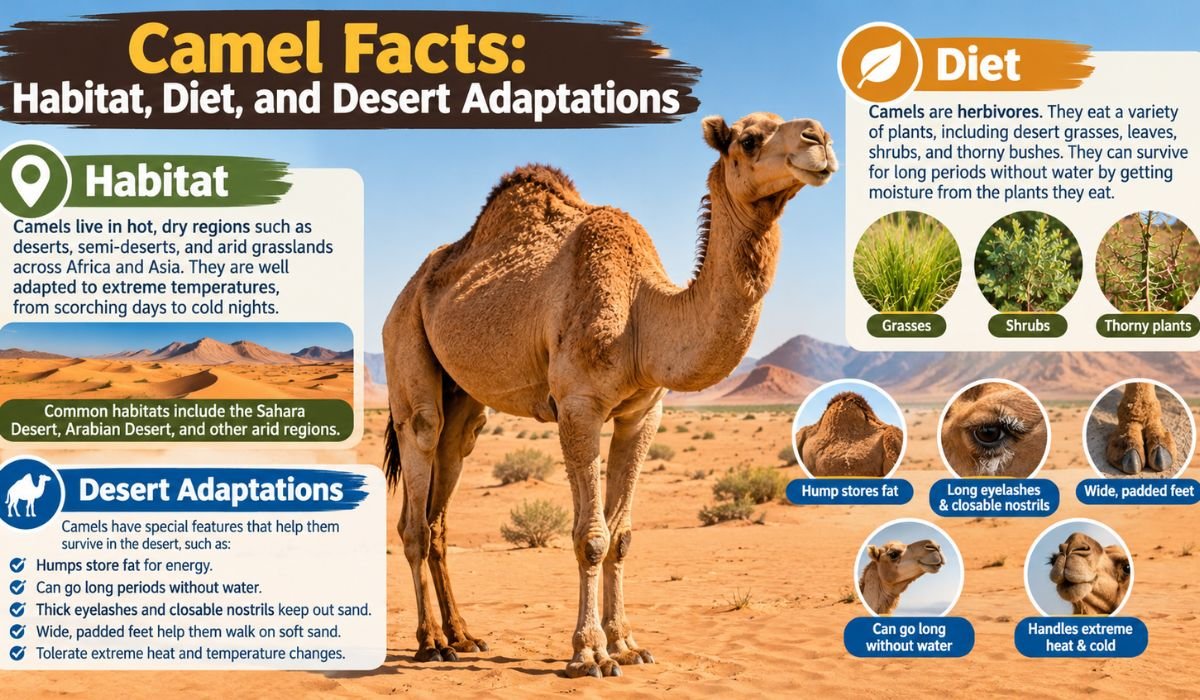
One interesting camel fact is that a camel’s hump does not store water. Instead, it stores fat. When food is scarce, the camel can use this stored fat as an energy source.
Camel Habitat
Camels are strongly associated with deserts, but they can live in several types of dry environments. Their habitats include sandy deserts, rocky deserts, semi-deserts, dry grasslands, and scrublands.
Dromedary camels are particularly well adapted to hot desert environments. They can be found in regions with extremely high temperatures and limited vegetation.
Bactrian camels are suited to harsher environments where temperatures can change dramatically between summer and winter. Wild Bactrian camels inhabit remote desert regions of China and Mongolia.
Their ability to survive in difficult environments is one of the most important camel facts. Instead of requiring a constant water supply, camels have physiological adaptations that allow them to conserve water efficiently.
What Do Camels Eat?
Camels are herbivores, meaning they primarily eat plants. Their diet can include grasses, leaves, shrubs, thorny plants, and other vegetation available in their environment.
A camel’s tough mouth allows it to eat plants that many other animals would avoid, including vegetation with sharp thorns. Camels can also feed on dry and coarse plant material.
When vegetation is plentiful, camels consume more food and can build up fat reserves in their humps. These reserves can later provide energy when food becomes difficult to find.
Another interesting camel fact is that camels have a specialized digestive system that allows them to extract nutrients from tough, fibrous vegetation.
Camel Humps: What Do They Store?
The hump is one of the most recognizable features of a camel. However, a common misconception is that the hump contains stored water.
In reality, the hump mainly stores fat. When a camel has access to plenty of food, its hump can become fuller. When the animal uses its stored fat during periods of limited food, the hump can become smaller and less firm.
The number of humps depends on the species. Dromedary camels have one hump, while Bactrian camels have two.
This is one of the most commonly searched camel facts, because the hump is directly connected to how these animals survive in environments where food and water may be unpredictable.
Read Related Post: Ladybug Facts: Habitat, Diet, Life Cycle, and Behavior
How Do Camels Survive Without Water?
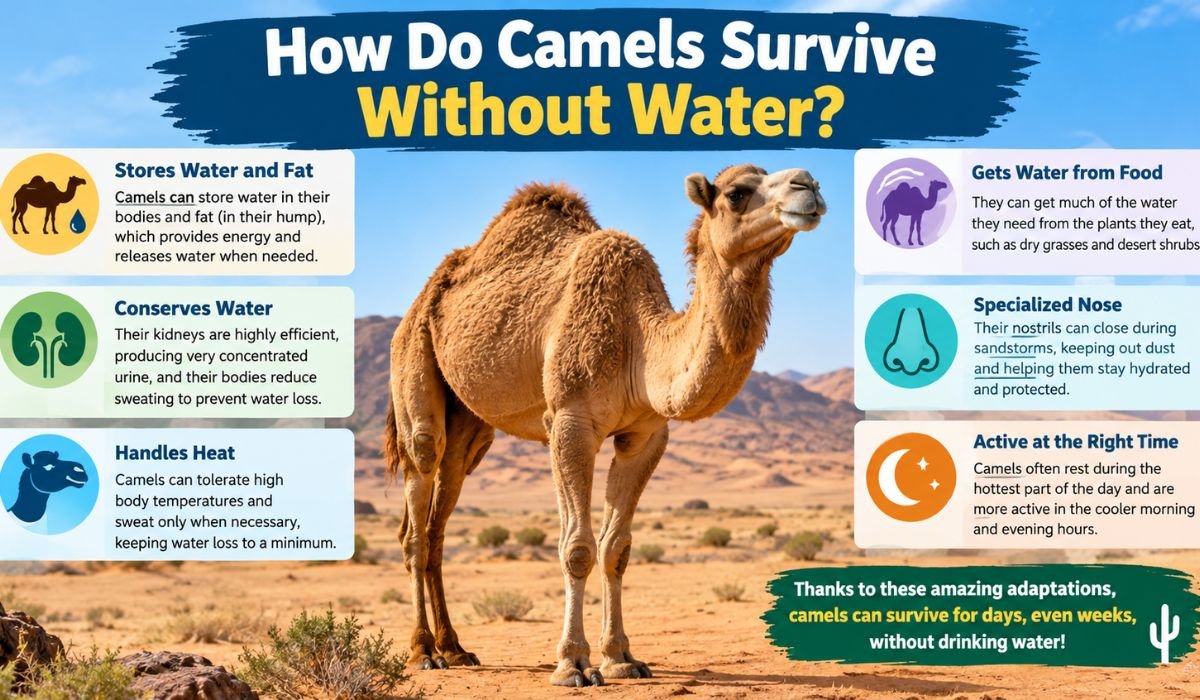
Camels have several adaptations that help them survive periods when water is unavailable. Their bodies are highly efficient at conserving water, allowing them to tolerate dehydration better than many other mammals.
When water becomes available, camels can drink large quantities relatively quickly. Their bodies then work to maintain a balance between water intake and water loss.
Camels also produce relatively concentrated urine and dry feces, reducing unnecessary water loss. Their body temperature can fluctuate within a wider range than that of many mammals, helping them reduce sweating during some conditions.
These adaptations work together rather than relying on a single special feature. This combination makes camels exceptionally suited to arid environments.
Camel Desert Adaptations
Camels have evolved numerous physical and physiological features that help them live in deserts.
Thick Eyelashes and Protective Eyes
Camels have long eyelashes and protective eyelids that help shield their eyes from blowing sand and dust. Their eyes are especially important when traveling through windy desert environments.
Wide, Soft Feet
A camel’s feet are broad and padded. This structure helps distribute its weight and prevents the animal from sinking deeply into loose sand.
Long Legs
Long legs keep much of a camel’s body farther away from the hot ground. They also give the animal a high viewpoint, helping it move across open terrain.
Efficient Water Conservation
Camels lose less water than many mammals living in similar environments. Their kidneys and digestive systems help conserve moisture.
Heat Tolerance
Camels can tolerate high temperatures and can allow their body temperature to change over a broader range. This reduces the need for constant sweating and helps conserve water.
These adaptations are among the most fascinating camel facts because they demonstrate how animals can become highly specialized for challenging habitats.
Camel Behavior
Camels are generally social animals and may live in groups. Their behavior can vary depending on the species, environment, and whether they are wild or domesticated.
Camels communicate using body movements, vocalizations, and other signals. They can produce various sounds, including grunts and calls.
They spend much of their time feeding and moving between areas where food and water are available. In harsh environments, efficient movement is essential because resources may be widely scattered.
Camels may also show defensive behavior when they feel threatened. Despite their reputation as slow animals, camels can move at considerable speeds when necessary.
How Fast Can a Camel Run?
Camels are capable of running much faster than many people expect. Depending on the species and circumstances, a camel can reach speeds of around 40–65 kilometers per hour for short periods.
They are also capable of maintaining a fast walking or running pace over longer distances. This endurance has historically made camels valuable for transportation across deserts.
Their ability to travel long distances while carrying loads is another important camel fact that has contributed to their relationship with humans.
Camel Life Cycle
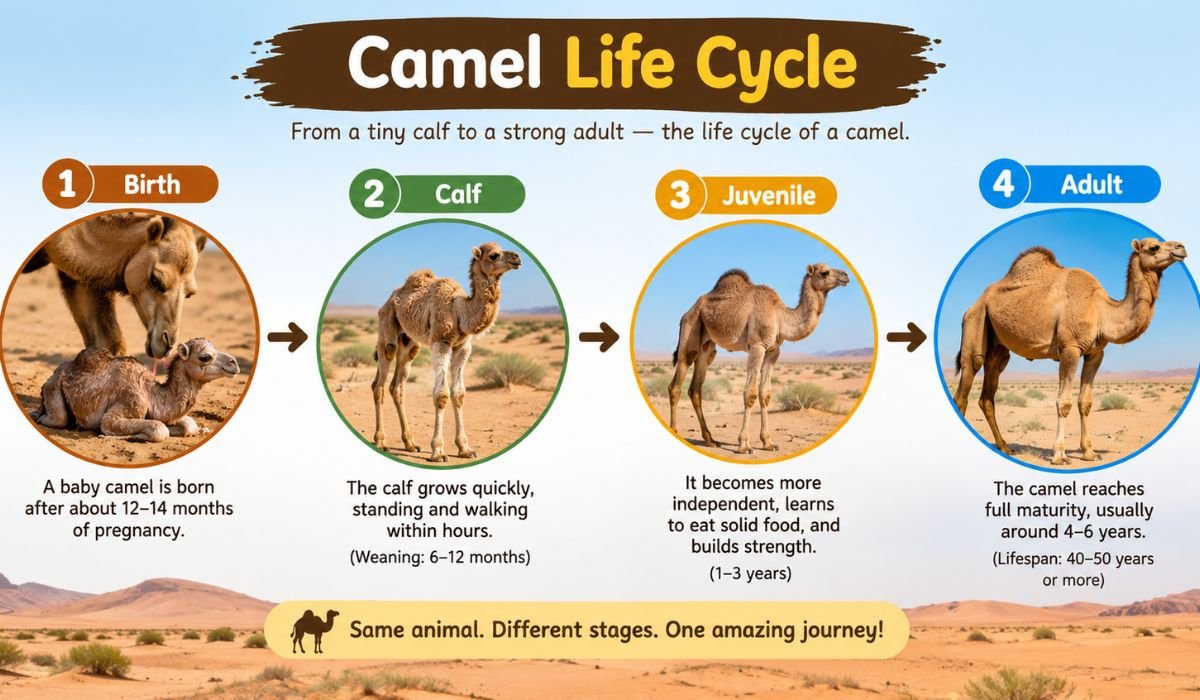
Camels reproduce sexually and usually give birth to a single calf after a long pregnancy. The exact gestation period varies by species but is generally around 12 to 14 months.
Newborn calves are relatively well developed and can stand and walk not long after birth. They remain dependent on their mothers for milk during their early development.
Young camels gradually begin eating solid vegetation as they grow. They continue developing physically before reaching adulthood.
With appropriate conditions, camels can live for several decades. Lifespan can vary according to species, environment, nutrition, disease, and care.
Dromedary vs. Bactrian Camels
The two most familiar camel species have several important differences.
| Feature | Dromedary Camel | Bactrian Camel |
| Number of humps | One | Two |
| Main environment | Hot deserts | Cold and dry regions |
| Native range | North Africa and parts of Asia | Central Asia |
| Coat | Generally shorter | Generally thicker |
| Cold tolerance | Lower | Higher |
One useful camel fact is that the two-humped Bactrian camel is particularly well adapted to severe continental climates, where summers can be hot and winters can be extremely cold.
Camels and Humans
Humans have domesticated camels for thousands of years. They have traditionally been used for transportation, carrying goods, producing milk, and supporting communities in dry regions.
Camels can travel through terrain where wheeled vehicles may have difficulty operating. This made them especially valuable for trade routes crossing deserts.
Today, camels continue to have economic and cultural importance in many parts of Africa, the Middle East, and Asia. They are also used in tourism, racing, agriculture, and milk production.
Are Camels Endangered?
Not all camel species have the same conservation status. Domestic dromedary and Bactrian camels are widespread because humans have bred and maintained them for centuries.
The wild Bactrian camel is much more threatened. Its natural population is restricted to remote areas of China and Mongolia, where it faces pressures such as habitat disturbance and competition for resources.
Protecting wild camel populations requires conservation of their natural habitats and careful management of human activities in their range.
Interesting Camel Facts
Here are some additional camel facts worth remembering:
- Dromedary camels have one hump.
- Bactrian camels have two humps.
- A camel’s hump stores fat, not water.
- Camels are herbivores.
- Their broad feet help them walk across loose sand.
- Long eyelashes help protect their eyes from dust and sand.
- Camels can conserve water very efficiently.
- They can tolerate large changes in body temperature.
- Camel calves can stand and walk soon after birth.
- Camels have been domesticated and used by humans for thousands of years.
- Some camel species are adapted to extremely hot deserts, while others tolerate very cold climates.
- Wild Bactrian camels are much rarer than domestic camels.
FAQ’s
1. Do camels store water in their humps?
No. One of the best-known camel facts is that their humps store fat rather than water. The stored fat provides an energy reserve when food is limited.
2. How many humps does a camel have?
Dromedary camels have one hump, while Bactrian camels have two. The number of humps is one of the easiest ways to distinguish these two types.
3. What do camels eat?
Camels eat grasses, leaves, shrubs, thorny plants, and other vegetation. Their tough mouths allow them to consume plants that can be difficult for other herbivores to eat.
4. Why can camels survive in deserts?
Camels have several adaptations, including efficient water conservation, heat tolerance, specialized feet, protective eyelashes, and the ability to store fat in their humps.
5. How long do camels live?
Camels can live for several decades when they have adequate food, water, and care. Lifespan varies depending on species and environmental conditions.
6. Are camels herbivores?
Yes. Camels are herbivorous mammals and mainly feed on plant material.
7. Can camels live in cold places?
Yes. Bactrian camels are particularly well adapted to cold and dry environments. Their thick coats help protect them from low temperatures.
8. What is the most important camel adaptation?
There is no single adaptation responsible for camel survival in deserts. Their ability to conserve water, tolerate heat, use stored fat, and move efficiently across difficult terrain works together to support survival.
Conclusion
Camels are extraordinary mammals whose bodies are specially adapted to challenging environments. From their fat-storing humps and broad feet to their efficient water conservation and heat tolerance, nearly every major feature contributes to their survival in dry regions.
The most interesting camel facts show that their desert survival is not based on one unusual ability but on a combination of adaptations. Dromedary and Bactrian camels also demonstrate how closely related animals can evolve different traits for hot deserts and cold, dry landscapes. Their long relationship with humans has made them important animals for transportation, agriculture, trade, and culture across many regions.

Hi, I’m Amelia, an SEO and content specialist with several years of experience researching and creating informative content for online audiences. At Animal Attack Facts, I focus on animal behavior, animal attacks on humans, and interesting facts about land animals, marine animals, birds, reptiles, and insects. My goal is to provide clear, useful, and engaging information that helps readers better understand wildlife and stay informed about animal encounters.
1 thought on “Camel Facts: Habitat, Diet, and Desert Adaptations”