
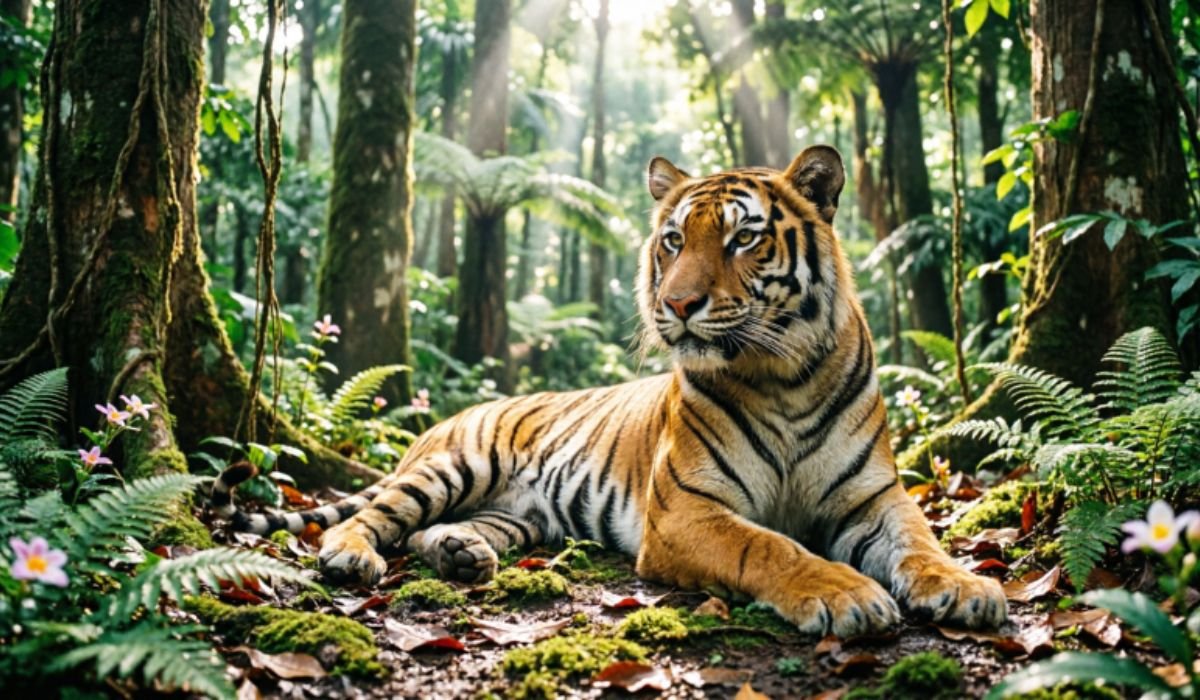
Tigers are among the most powerful and fascinating wild cats on Earth. These magnificent predators are known for their orange coats, dark stripes, muscular bodies, and impressive hunting abilities. Learning tiger facts gives us a better understanding of how these animals live, hunt, communicate, and survive in different environments.
The tiger (Panthera tigris) is the largest living member of the cat family. Tigers can survive in a variety of habitats, from tropical forests and grasslands to mangrove swamps and cold mountain regions. Although they are highly adaptable, wild tigers face serious threats from habitat loss, illegal hunting, and human-wildlife conflict.
In this article, we will explore important tiger facts, including their habitat, diet, behavior, physical characteristics, hunting techniques, reproduction, and conservation.
What Is a Tiger?
A tiger is a large carnivorous mammal belonging to the family Felidae. Its scientific name is Panthera tigris. Tigers are easily identified by their distinctive striped coats, powerful bodies, large paws, and long tails.
Unlike lions, which often live in social groups called prides, tigers are generally solitary animals. Adult tigers usually live and hunt alone, although females spend considerable time with their cubs.
One of the most interesting tiger facts is that every tiger has a unique stripe pattern. No two tigers have exactly the same markings, making their stripes useful for identification.
Tigers are also excellent swimmers. They are comfortable in water and may swim across rivers, cool themselves in ponds, or travel through wet habitats.
Where Do Tigers Live?
Wild tigers are native to Asia. Their historical range was much larger than it is today, but habitat loss and other human pressures have greatly reduced their distribution.
Today, wild tigers can be found in parts of South Asia, Southeast Asia, Russia, and China. Different tiger populations have adapted to very different environmental conditions.
Tiger Habitats

Tigers can live in several types of habitats, including:
- Tropical rainforests
- Grasslands
- Temperate forests
- Mangrove swamps
- Wetlands
- Mountain forests
- Cold and snowy regions
Tigers usually need three important things from their environment: adequate prey, water, and sufficient cover for resting and hunting.
These habitat requirements are among the most important tiger facts because protecting tiger habitat is essential for maintaining healthy wild populations.
What Do Tigers Eat?
Tigers are obligate carnivores, meaning they depend primarily on meat for nutrition. They usually hunt medium-sized and large mammals, although their exact diet depends on the prey available in their habitat.
Common prey includes:
- Deer
- Wild boar
- Wild cattle
- Antelope
- Wild pigs
- Monkeys
- Smaller mammals
Tigers are opportunistic predators. They do not always hunt the same species and can adjust their diet according to what is available.
Read Related Post: Crocodile Facts: Habitat, Diet, Behavior, and Adaptations
How Do Tigers Find Food?
Tigers have excellent senses that help them locate prey. Their hearing is particularly sensitive, and their eyesight is well adapted to low-light conditions.
They often hunt during periods of lower light, including dawn, dusk, and nighttime. However, hunting patterns can vary depending on habitat, prey activity, and individual behavior.
How Do Tigers Hunt?
Tigers are powerful hunters, but they usually do not depend on long-distance chases. Instead, they rely heavily on stealth and surprise.
A tiger may slowly approach prey while using vegetation, shadows, and natural terrain for cover. When it gets close enough, it can launch a sudden attack using its powerful legs, claws, and jaws.
Some of the most impressive tiger facts involve their hunting adaptations.
Tiger Hunting Adaptations
Powerful muscles: Tigers have strong bodies and muscular limbs that help them tackle large prey.
Sharp claws: Their retractable claws help them grip and hold onto prey.
Strong teeth: Large canine teeth help them capture and kill prey.
Excellent hearing: Tigers can detect sounds from their surroundings that may help them locate animals.
Low-light vision: Their eyes are adapted for seeing in relatively dim conditions.
Striped camouflage: Their coat pattern can help them blend into vegetation and shadows.
Instead of wasting energy chasing prey for long periods, tigers generally try to get as close as possible before making a short, powerful attack.
Tiger Behavior
Tigers are generally solitary and territorial animals. Adult males and females usually maintain separate territories, although their ranges can overlap.
Tigers communicate through scent marking, vocalizations, body language, and physical signs such as scratches on trees or the ground.
Territorial behavior helps tigers communicate with one another without requiring frequent direct contact.
Are Tigers Territorial?
Yes. Tigers maintain territories where they hunt, rest, and reproduce. The size of a territory depends on several factors, especially the availability of prey.
When food is abundant, a tiger may be able to survive within a smaller territory. In areas where prey is scarce, it may need to cover a much larger area.
This is another important point among tiger facts because habitat quality directly affects how much space these predators need to survive.
Can Tigers Swim?
Yes, tigers are excellent swimmers. Unlike many domestic cats, tigers often appear comfortable in water.
They may enter rivers, lakes, ponds, and other waterways to cool themselves during hot weather. They can also swim to cross rivers or move between different parts of their territory.
Their swimming ability is particularly useful for populations living in wetlands, forests, and areas with many rivers.
Tiger Size and Physical Features

Tigers are the largest living cats, although their size can vary considerably between individuals and populations.
Adult males are generally larger than females. Tigers have broad heads, powerful shoulders, muscular legs, large paws, and long tails.
Their tails help with balance when they move quickly or make sudden changes in direction.
Their orange or reddish coat provides a background for the distinctive dark stripes covering their body.
Why Do Tigers Have Stripes?
Tiger stripes provide camouflage. In forests and areas with tall vegetation, sunlight and shadows can create patterns that make the tiger’s outline harder to recognize.
The stripes also make each individual tiger visually unique.
Interestingly, the stripe pattern is not only found on the fur. The skin beneath a tiger’s coat also contains pigmentation corresponding to the visible pattern.
Tiger Cubs and Reproduction
Female tigers give birth to cubs after a pregnancy lasting roughly three and a half months. A litter can contain several cubs.
Newborn cubs are vulnerable and depend completely on their mother for food, warmth, and protection.
As they grow, cubs begin following their mother and observing her behavior. Eventually, they start learning how to move through the habitat and hunt.
How Long Do Tiger Cubs Stay With Their Mother?

Tiger cubs commonly remain with their mother for around 18 to 24 months. During this period, they develop the skills necessary for independent survival.
Young tigers must learn how to identify prey, move quietly, avoid danger, and use their physical abilities effectively.
The extended period of maternal care is one of the most fascinating tiger facts because survival requires more than physical strength. Young tigers also need experience.
How Fast Can a Tiger Run?
Tigers can move very quickly over short distances. Their muscular legs and powerful bodies allow them to accelerate rapidly when attacking prey or responding to danger.
However, tigers are not built for long-distance pursuit. Their hunting strategy depends more on stealth, patience, and surprise than on maintaining high speeds for extended periods.
Are Tigers Endangered?
Wild tiger populations have faced severe pressure from human activities. Habitat destruction, fragmentation, illegal hunting, and the illegal wildlife trade have all contributed to their decline.
Conservation programs have helped some tiger populations recover, but the species still requires continued protection.
Protecting forests, wetlands, grasslands, and prey populations is essential for tiger conservation.
Why Is Tiger Conservation Important?
Tigers are apex predators, meaning they occupy a high position in many food chains. Their presence can influence prey populations and contribute to ecosystem balance.
Protecting tiger habitats can also protect many other species that share the same ecosystems.
For this reason, tiger conservation is not only about saving one species. It can help preserve entire natural environments.
Interesting Tiger Facts
Here are some additional tiger facts that show how remarkable these animals are:
- Tigers are the largest living members of the cat family.
- Their scientific name is Panthera tigris.
- Every tiger has a unique stripe pattern.
- Tigers are generally solitary animals.
- They are carnivores that mainly eat other animals.
- Tigers are powerful swimmers.
- They can live in both hot and cold environments.
- Their stripes provide camouflage.
- Adult males are generally larger than females.
- Tiger cubs depend on their mothers for an extended period.
- Tigers use scent marking to communicate.
- Habitat loss is a major threat to wild tiger populations.
- Tigers play an important role as apex predators.
- Several historical tiger populations have become extinct.
- Conservation efforts are important for protecting remaining wild tiger populations.
FAQ’s
What are the most interesting tiger facts?
Some of the most interesting tiger facts include their status as the largest living cats, their unique stripes, excellent swimming ability, solitary lifestyle, powerful hunting skills, and ability to survive in different habitats.
What do tigers eat?
Tigers mainly eat meat. Their diet can include deer, wild boar, wild cattle, antelope, monkeys, and other mammals depending on the habitat.
Where do tigers live?
Wild tigers live in parts of Asia, including South Asia, Southeast Asia, Russia, and China. Their habitats range from tropical forests and grasslands to wetlands and cold forests.
Are tigers solitary animals?
Yes. Adult tigers generally live alone and maintain individual territories. Females stay with their cubs while raising them.
Can tigers swim?
Yes. Tigers are strong swimmers and can cross rivers and other bodies of water. They may also enter water to cool themselves.
How do tigers hunt?
Tigers usually rely on stealth and camouflage. They approach prey quietly and then use a short burst of speed and strength to make an attack.
Why do tigers have stripes?
Their stripes help them blend into vegetation and shadows. Each tiger’s stripe pattern is also unique.
How long do tiger cubs stay with their mother?
Tiger cubs generally stay with their mother for approximately 18 to 24 months while learning essential survival and hunting skills.
Why are tigers important?
Tigers help regulate prey populations and contribute to ecosystem balance. Protecting them also helps conserve the habitats shared by many other species.
Conclusion
Tigers are extraordinary predators with a combination of strength, intelligence, stealth, and adaptability. From their unique stripes and swimming ability to their solitary lifestyle and specialized hunting techniques, these animals have evolved many traits that help them survive.
The tiger facts discussed in this guide show why these big cats are so important to natural ecosystems. However, wild tigers cannot survive without healthy habitats, adequate prey, and effective conservation.
Understanding tiger facts is an important first step toward appreciating these remarkable animals and recognizing why protecting their habitats and wild populations matters.

Hi, I’m Amelia, an SEO and content specialist with several years of experience researching and creating informative content for online audiences. At Animal Attack Facts, I focus on animal behavior, animal attacks on humans, and interesting facts about land animals, marine animals, birds, reptiles, and insects. My goal is to provide clear, useful, and engaging information that helps readers better understand wildlife and stay informed about animal encounters.
1 thought on “Tiger Facts: Habitat, Diet, Behavior, and More”