
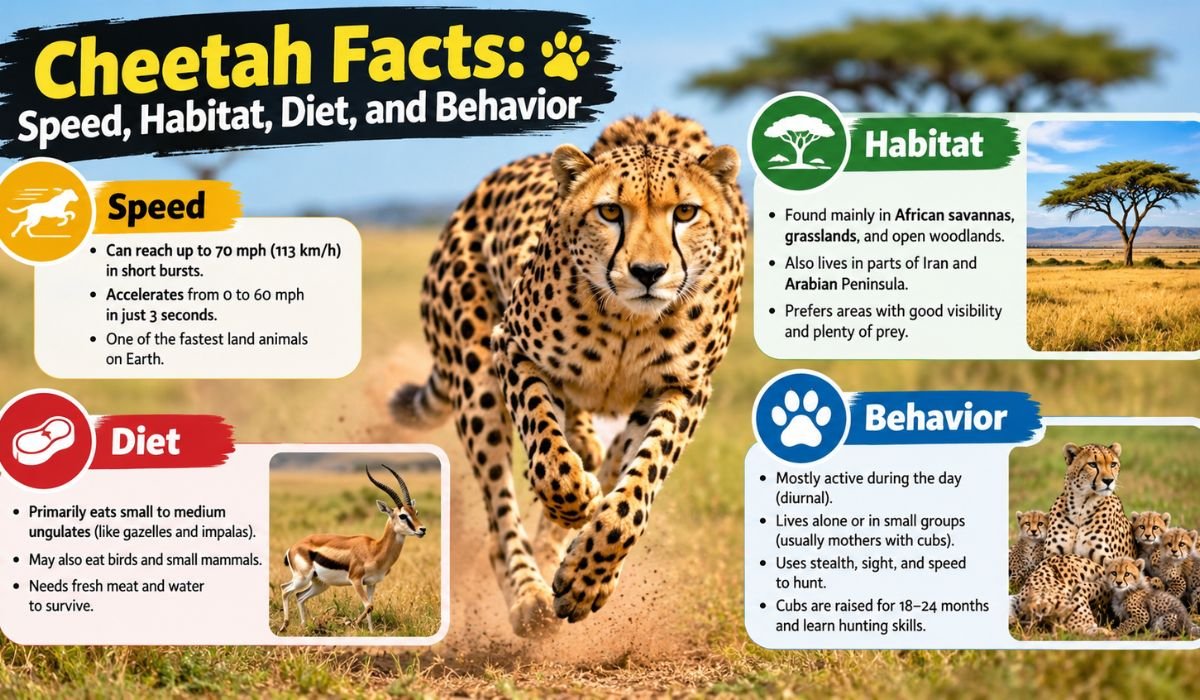
Cheetahs are famous for being the fastest land animals on Earth, but their incredible speed is only one part of what makes them fascinating. From their spotted coats and slender bodies to their unique hunting techniques, these big cats have evolved remarkable adaptations for life in open landscapes. Learning cheetah facts can help us understand how these animals survive, hunt, communicate, and raise their young.
Unlike many other big cats, cheetahs rely more on speed and agility than strength. They can accelerate rapidly when chasing prey, using their flexible spine, long legs, large nasal passages, and specialized feet to support high-speed movement. However, their speed comes with limitations, and they cannot maintain their fastest pace for very long.
Cheetah Facts About Speed and Physical Features
One of the most impressive cheetah facts is their extraordinary running ability. A cheetah can reach speeds of around 60–70 mph (97–113 km/h) during a short sprint, although exact top speeds can vary depending on the individual and conditions.
Cheetahs have several physical adaptations that help them run quickly. Their long legs provide a large stride, while their flexible spine allows their body to stretch and contract during a sprint. Their long tail acts like a rudder, helping them maintain balance and make sharp turns while chasing prey.
Their claws are also unusual compared with those of many other cats. Cheetah claws remain partly visible rather than retracting completely, providing extra traction when running. Their large nasal passages and lungs help support the intense breathing required during a high-speed chase.
A cheetah’s body is built for acceleration rather than prolonged endurance. After a short, intense chase, it needs time to recover before becoming active again.
Where Do Cheetahs Live?
Understanding cheetah facts also means looking at where these animals are found. Cheetahs primarily inhabit parts of Africa, especially regions with grasslands, savannas, open woodlands, and semi-arid landscapes.
Most wild cheetahs live in Africa, while a very small population of Asiatic cheetahs survives in Iran. Historically, cheetahs occupied a much larger geographic range across Africa and Asia, but their distribution has declined considerably.
Open habitats are particularly important because cheetahs depend on visibility and space when hunting. Tall vegetation can provide cover, but extremely dense forests are not ideal for their hunting style.
Cheetahs may live in protected areas, wildlife reserves, and landscapes outside formal protected areas. Their survival depends on having sufficient prey, suitable habitat, and safe areas where cubs can grow.
What Do Cheetahs Eat?
Another important group of cheetah facts concerns their diet. Cheetahs are carnivores and primarily hunt small to medium-sized animals.
Their prey can include gazelles, impalas, hares, young antelopes, and other appropriately sized mammals. The exact diet varies according to location and what prey is available.
Cheetahs generally depend on sight rather than smell when hunting. They often scan their surroundings before approaching potential prey. Once they identify a target, they may move closer while using vegetation or changes in the terrain for concealment.
The final chase is usually very short. Instead of fighting prey for a long period, a cheetah attempts to catch it quickly through acceleration and maneuverability.
How Do Cheetahs Hunt?
The hunting strategy of cheetahs is one of the most interesting cheetah facts. Their hunting process often begins with observation. A cheetah may spend time watching a group of prey animals before choosing a target.
Once a target is selected, the cheetah tries to get close enough to reduce the distance it needs to sprint. This is important because a high-speed chase requires enormous amounts of energy.
During the chase, the cheetah uses its flexible body and long tail to maintain control. Instead of relying on raw strength, it attempts to trip or destabilize its prey and bring the chase to an end.
Cheetahs often hunt during cooler parts of the day, such as early morning or late afternoon. Hunting at these times can help reduce the heat stress associated with intense physical activity.
Read Related Post: Sea Lion Facts: Habitat, Diet, Behavior, and More
Cheetah Behavior and Social Life
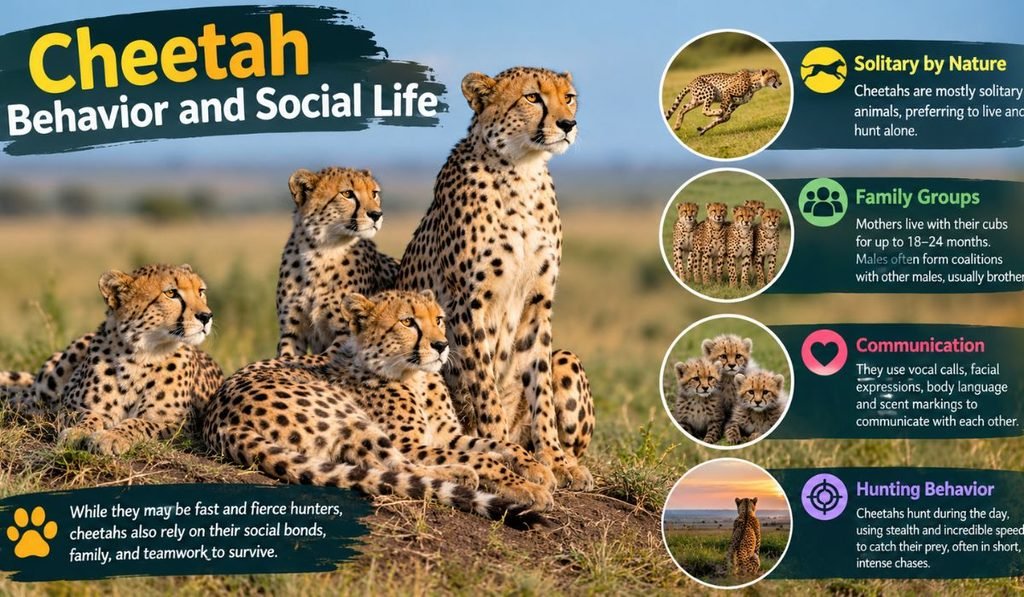
Cheetahs have social behaviors that differ from those of many other large cats. Females generally live alone or with their cubs, while males may live alone or form small groups called coalitions.
Male coalitions are often formed by brothers from the same litter. Living together can provide advantages when defending territories and competing with other males.
Females usually raise cubs without the assistance of males. They must find food while also protecting their young from predators.
Communication is another fascinating part of cheetah facts. Cheetahs can produce a variety of sounds, including purrs, chirps, growls, hisses, and other vocalizations. Their communication also involves body language and scent marking.
Cheetahs are not known for the loud roaring behavior associated with some other big cats. Their vocal and social communication reflects their different lifestyle and evolutionary adaptations.
Cheetah Cubs and Family Life
Female cheetahs usually give birth to several cubs after a pregnancy lasting roughly three months. Newborn cubs are small, vulnerable, and dependent on their mother.
One of the most remarkable cheetah facts about cubs is that they have a distinctive mantle of longer, grayish hair along their backs. This may provide camouflage and can make young cubs resemble the fierce-looking honey badger, potentially offering some protection from predators, although the exact protective role of the mantle is still discussed by researchers.
Cubs remain with their mother for many months while learning important survival skills. The mother teaches them how to move through their environment, recognize potential prey, and eventually hunt.
Young cheetahs face serious risks from predators. Lions, hyenas, and other large carnivores may kill cheetah cubs, making early survival difficult.
Cheetah Adaptations for Survival
Many cheetah facts demonstrate how specialized this species has become. Almost every part of the cheetah’s body contributes to its hunting strategy.
Its long legs help produce large strides. Its lightweight body supports rapid acceleration. Its flexible spine increases stride length, while its long tail provides balance during sudden changes in direction.
Cheetahs also have distinctive black tear-like markings running from the inner corners of their eyes toward their mouths. These markings are thought to help reduce glare from sunlight and may assist with visual focus during hunting.
Their spotted coats provide camouflage among grasses and vegetation. This helps them remain less noticeable while approaching prey.
However, specialization also creates challenges. Cheetahs are excellent sprinters but are less physically powerful than some other large predators. They can lose their kills to stronger animals such as lions and hyenas.
Are Cheetahs Endangered?
Conservation is an essential part of understanding cheetah facts. Cheetahs face several threats, including habitat loss, declining prey populations, conflict with people, and fragmentation of their natural range.
Because cheetahs require large areas of suitable habitat, the loss and fragmentation of open landscapes can make survival more difficult. Human development, agriculture, roads, and other changes to the environment can divide populations.
Cheetahs also face competition from larger predators. Cubs are particularly vulnerable to predators, which can affect population growth.
Conservation programs focus on protecting habitat, maintaining healthy prey populations, reducing human-wildlife conflict, and supporting research. Protecting connected landscapes is especially important because cheetahs naturally require extensive areas to move and hunt.
Interesting Cheetah Facts
Here are some quick cheetah facts to remember:
- Cheetahs are the fastest land animals.
- They can reach roughly 60–70 mph (97–113 km/h) in short bursts.
- Their long tail helps them balance while turning at high speed.
- Their claws provide traction while running.
- Cheetahs have distinctive black facial tear markings.
- They mainly eat meat and commonly hunt small to medium-sized prey.
- Females generally live alone except when raising cubs.
- Male siblings may form coalitions.
- Cheetah cubs have a distinctive grayish mantle of longer hair.
- Most wild cheetahs are found in Africa.
- A small population of Asiatic cheetahs survives in Iran.
- Cheetahs are highly specialized for short-distance, high-speed hunting.
FAQ’s
What are the most interesting cheetah facts?
Some of the most interesting cheetah facts include their exceptional speed, flexible spine, long tail, specialized claws, distinctive facial markings, and unique social behavior. They are built primarily for rapid acceleration and short sprints.
How fast can a cheetah run?
One of the best-known cheetah facts is that these animals can reach approximately 60–70 mph (97–113 km/h) during short bursts. They cannot maintain their maximum speed for an extended period.
What do cheetahs eat?
Cheetahs are carnivores that commonly eat small to medium-sized mammals. Their prey can include gazelles, impalas, hares, and young antelopes, depending on the region.
Where do cheetahs live?
Important cheetah facts about their habitat include that most wild cheetahs live in Africa, particularly in grasslands, savannas, and other open environments. A small Asiatic population remains in Iran.
Why are cheetahs so fast?
Cheetahs have several adaptations for speed, including long legs, a flexible spine, a lightweight body, large lungs, and a long tail that helps with balance and steering.
Are cheetahs social animals?
Cheetah social behavior varies by sex. Females are generally solitary except when raising cubs, while males may live alone or form coalitions, often with brothers.
Conclusion
Cheetahs are extraordinary predators whose bodies are perfectly adapted for speed, acceleration, and agility. Their specialized claws, flexible spine, long legs, powerful lungs, and balancing tail allow them to perform some of the fastest movements seen among land animals. At the same time, their dependence on open habitats and vulnerable young makes survival challenging.
These cheetah facts show that being the fastest animal on land does not mean being invincible. Cheetahs face habitat loss, competition from larger predators, declining prey, and other conservation challenges. Protecting their habitats and maintaining healthy ecosystems is essential for ensuring that these remarkable big cats continue to survive in the wild.

Hi, I’m Amelia, an SEO and content specialist with several years of experience researching and creating informative content for online audiences. At Animal Attack Facts, I focus on animal behavior, animal attacks on humans, and interesting facts about land animals, marine animals, birds, reptiles, and insects. My goal is to provide clear, useful, and engaging information that helps readers better understand wildlife and stay informed about animal encounters.
1 thought on “Cheetah Facts: Speed, Habitat, Diet, and Behavior”