
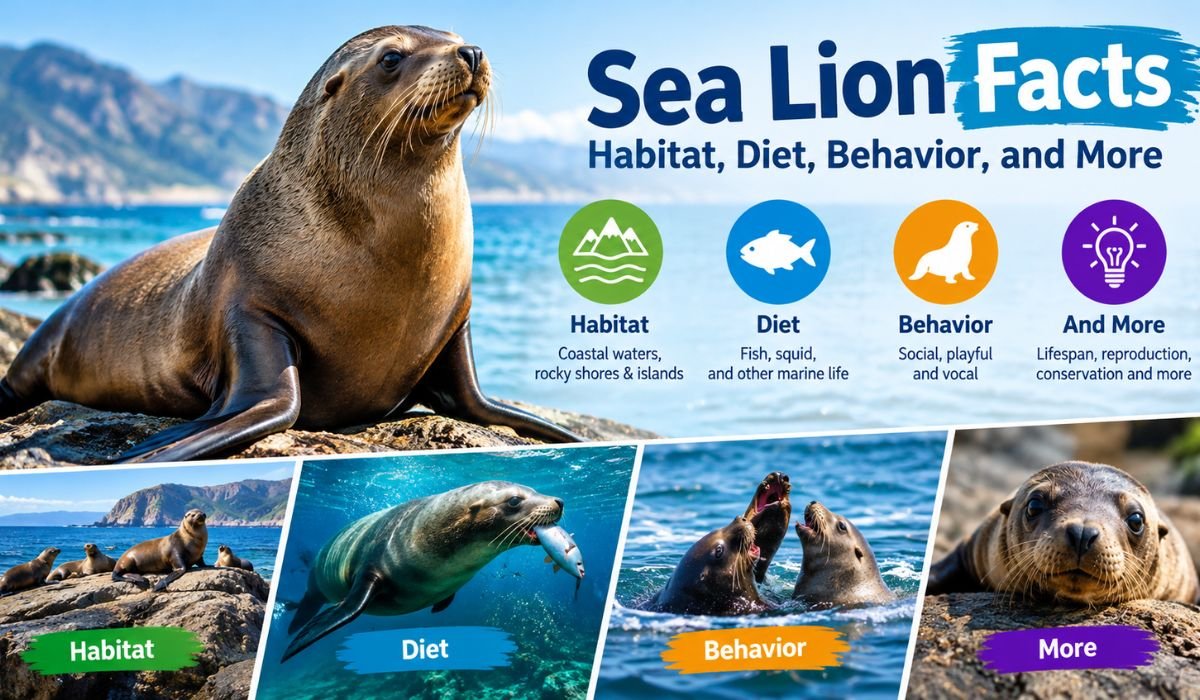
Sea lions are fascinating marine mammals known for their intelligence, playful behavior, powerful swimming abilities, and distinctive barking sounds. They belong to the eared seal family and are closely related to fur seals. Unlike true seals, sea lions have visible external ear flaps and can rotate their hind flippers forward, allowing them to move more easily on land.
Learning sea lion facts reveals how these animals survive in oceans, coastal habitats, and rocky shorelines. Sea lions spend much of their lives in water, where they hunt fish and other marine prey, but they regularly return to land to rest, socialize, and raise their young.
From their social colonies to their excellent underwater vision, sea lions have many adaptations that make them successful marine predators.
What Are Sea Lions?
Sea lions are marine mammals belonging to the family Otariidae. Several species live around the Pacific and Southern Hemisphere, including the California sea lion, Steller sea lion, South American sea lion, and Australian sea lion.
One of the most interesting sea lion facts is that these animals are pinnipeds, a group of marine mammals that includes seals, sea lions, and walruses.
Sea lions are adapted for both aquatic and terrestrial environments. Their streamlined bodies help them move efficiently through water, while their strong flippers allow them to climb onto beaches, rocks, and other resting areas.
Sea Lions vs. Seals
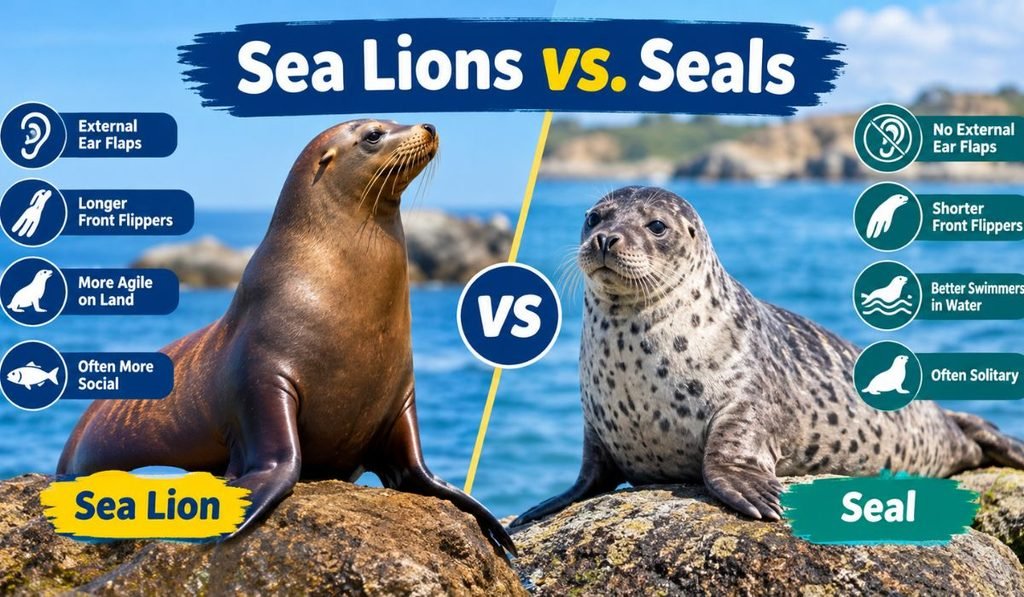
Sea lions and seals may look similar, but there are several differences between them.
- Sea lions have visible external ear flaps.
- Sea lions can rotate their hind flippers forward.
- They can walk or move more effectively on land.
- Sea lions are generally more vocal.
- True seals have smaller front flippers and move differently on land.
These differences make sea lions easy to distinguish once you know what to look for.
Where Do Sea Lions Live?
Sea lions live mainly along coastal regions of the Pacific Ocean and parts of the Southern Hemisphere. Their exact range depends on the species.
California sea lions are commonly found along the western coast of North America, while Steller sea lions inhabit northern Pacific waters. South American sea lions live along parts of the Pacific and Atlantic coasts of South America.
A key group of sea lion facts concerns their preference for coastal environments. They often use rocky shores, beaches, islands, and sheltered areas called haul-out sites.
Read Related Post: Falcon Facts: Speed, Habitat, Diet, and Behavior
What Is a Sea Lion Habitat Like?
A typical sea lion habitat provides access to both water and land. The ocean provides food, while beaches and rocky areas provide places for resting, breeding, and caring for pups.
Sea lions may travel considerable distances in search of food. Their ability to swim efficiently allows them to explore large areas of ocean.
What Do Sea Lions Eat?
Sea lions are carnivores and mainly eat fish and other marine animals. Their diet can vary according to species, location, season, and food availability.
Common prey includes:
- Fish
- Squid
- Octopuses
- Crabs
- Shrimp
- Other marine animals
One of the useful sea lion facts is that these animals are opportunistic hunters. Rather than depending on just one food source, they can consume different types of prey available in their environment.
How Do Sea Lions Hunt?
Sea lions use their excellent swimming abilities to pursue prey underwater. Their streamlined bodies reduce resistance, while powerful front flippers provide much of the propulsion.
They have strong eyesight and sensitive whiskers that can help them detect movement in the water. Some species can dive deeply and remain underwater for extended periods while searching for food.
How Do Sea Lions Behave?
Sea lions are highly social animals. They frequently gather in large groups on beaches, rocky shores, and islands.
Their social behavior is among the most interesting sea lion facts because colonies can contain many individuals. Sea lions communicate through barking, growling, body movements, and other vocalizations.
They may also interact through playful behavior, especially when young.
Are Sea Lions Intelligent?
Yes. Sea lions are considered intelligent marine mammals and have demonstrated strong learning abilities. They can learn tasks, remember patterns, and respond to training.
Their intelligence has made them valuable animals for scientific research into learning, memory, and animal behavior.
How Do Sea Lions Communicate?
Communication is an important part of sea lion social life. They use a variety of sounds to interact with one another.
Adult males can produce loud calls, while females and pups use different vocalizations. Mothers can recognize their pups through individual sounds, which is particularly important in crowded colonies.
Body posture and physical movements also provide information about dominance, aggression, and social interactions.
How Do Sea Lions Reproduce?
Sea lions generally gather in breeding colonies during particular seasons. Males may establish territories and compete for access to females.
After mating, females give birth to a single pup. Newborn pups depend heavily on their mothers for nourishment and protection.
One of the remarkable sea lion facts is the strong bond between mothers and pups. A mother can identify her own pup among many others in a noisy colony.
Sea Lion Pups
Sea lion pups are born on land and spend their early lives close to their mothers. They eventually learn swimming and hunting skills as they grow.
Young sea lions must develop the strength and coordination needed to survive independently in the marine environment.
How Long Do Sea Lions Live?
The lifespan of a sea lion varies depending on its species, environment, health, and other factors. Many sea lions can live for several decades under favorable conditions.
Survival can be affected by food availability, disease, injuries, pollution, predators, and interactions with human activities.
Understanding these sea lion facts helps explain why protecting healthy marine ecosystems is important for their long-term survival.
How Do Sea Lions Adapt to Ocean Life?
Sea lions have numerous adaptations that allow them to thrive in marine environments.
Their bodies are streamlined for swimming, and their flippers provide powerful movement through the water. A layer of body fat helps with insulation and energy storage.
They also have specialized eyes adapted to underwater vision and sensitive whiskers that can detect movements in the surrounding water.
Why Can Sea Lions Move on Land?
Unlike true seals, sea lions can rotate their hind flippers underneath their bodies. Their strong front flippers also help support their weight.
This adaptation allows them to move across beaches and rocky surfaces much more effectively than true seals.
Do Sea Lions Have Predators?
Adult sea lions are large and capable marine predators, but they can still face threats from other animals. Depending on their location, predators may include orcas and large sharks.
Young pups are generally more vulnerable than healthy adults.
Human activities can also create serious challenges. Pollution, habitat disturbance, fishing interactions, and changes in marine food supplies may affect sea lion populations.
Are Sea Lions Endangered?
The conservation status of sea lions differs by species. Some populations have experienced serious declines, while others have recovered or remain relatively stable.
For this reason, it is important to consider each species individually rather than treating all sea lions as having the same conservation status.
Protecting coastal habitats, maintaining healthy fish populations, reducing pollution, and minimizing harmful human interactions can all contribute to their conservation.
Interesting Sea Lion Facts
Here are some quick sea lion facts worth remembering:
- Sea lions are marine mammals.
- They belong to the eared seal family.
- Sea lions have visible external ear flaps.
- They can move on land using their flippers.
- They are strong and agile swimmers.
- Their diet mainly consists of marine animals.
- Sea lions are highly social.
- They communicate using different vocalizations.
- Mothers can recognize their pups by sound.
- Sea lions can learn and remember tasks.
- Different species live in different parts of the world.
- Many sea lions gather in large colonies.
- They return to land to rest and reproduce.
- Their whiskers can help detect movement in water.
- Some species can dive to considerable depths.
FAQ’s
Are sea lions dangerous?
Sea lions are wild animals and should always be observed from a safe distance. They can become defensive if people approach them too closely, especially when they are resting, breeding, or caring for young.
What do sea lions eat?
Sea lions mainly eat fish, squid, octopuses, and other marine animals. Their exact diet depends on the species and the food available in their habitat.
Can sea lions walk on land?
Yes. Sea lions can move on land using their strong flippers and rotating hind flippers. This ability distinguishes them from true seals.
Where do sea lions live?
Sea lions mainly inhabit coastal waters and shorelines around the Pacific Ocean and parts of the Southern Hemisphere. Their distribution varies between species.
How do sea lions communicate?
Sea lions communicate using barks, growls, other vocal sounds, and body movements. Mothers and pups can recognize each other’s individual calls.
Are sea lions social animals?
Yes. Sea lions are highly social and commonly gather in colonies. They interact with one another while resting, breeding, and raising young.
How long can sea lions stay underwater?
The amount of time a sea lion can remain underwater varies by species, activity, and diving conditions. Some species are capable of impressive dives while hunting.
What is the difference between seals and sea lions?
Sea lions have visible external ear flaps and can rotate their hind flippers forward to move on land. True seals lack these external ear flaps and move differently on land.
Conclusion
Sea lions are remarkable marine mammals with specialized adaptations for life in the ocean and on land. Their streamlined bodies, powerful flippers, social behavior, intelligence, and varied diet make them fascinating animals to study.
These sea lion facts also show why healthy marine ecosystems are essential to their survival. From coastal breeding colonies to deep hunting grounds, sea lions depend on productive oceans and safe resting areas throughout their lives.
By learning more about these animals and understanding the challenges they face, we can better appreciate the important role they play in marine ecosystems.

Hi, I’m Amelia, an SEO and content specialist with several years of experience researching and creating informative content for online audiences. At Animal Attack Facts, I focus on animal behavior, animal attacks on humans, and interesting facts about land animals, marine animals, birds, reptiles, and insects. My goal is to provide clear, useful, and engaging information that helps readers better understand wildlife and stay informed about animal encounters.
1 thought on “Sea Lion Facts: Habitat, Diet, Behavior, and More”