
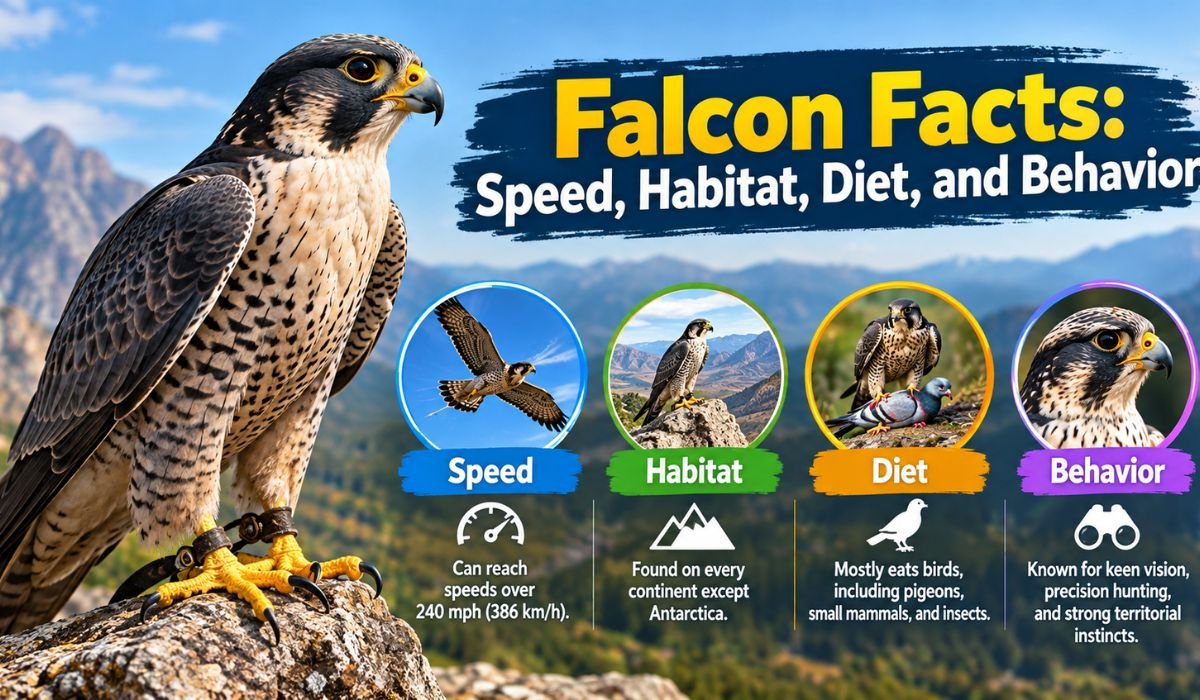
Falcons are among the most impressive birds of prey in the world, famous for their incredible speed, sharp eyesight, and powerful hunting abilities. From open grasslands and deserts to mountains and coastal regions, different falcon species have adapted to a wide range of environments.
These birds belong to the family Falconidae and include species such as the peregrine falcon, gyrfalcon, and American kestrel. In this guide, we explore fascinating falcon facts about their speed, habitat, diet, behavior, physical features, and hunting techniques.
Falcon Facts About Physical Features
Falcons have several physical adaptations that make them highly effective aerial predators. Their bodies are generally streamlined, allowing them to move quickly through the air while chasing prey.
Most falcons have long, pointed wings, a relatively short tail, and strong legs equipped with sharp talons. Their hooked beaks are specially adapted for tearing food. A distinctive feature of many falcons is a small tooth-like projection on the upper edge of the beak called a tomial tooth. It can help the bird deliver a precise bite to prey.
Sharp Eyesight
One of the most important falcon facts is that these birds have exceptional vision. Their eyesight allows them to detect potential prey from considerable distances. Their eyes are adapted for spotting movement while flying at high speeds.
Body Size
Falcon size varies greatly between species. The tiny American kestrel is much smaller than large species such as the gyrfalcon. Males are often smaller than females, a characteristic known as sexual size dimorphism.
Falcon Facts About Speed
Speed is one of the characteristics that makes falcons especially famous. The peregrine falcon is widely recognized as the fastest bird in the world when performing a hunting dive, called a stoop.
During a steep dive, a peregrine falcon can reach speeds of more than 300 kilometers per hour under suitable conditions. This extraordinary speed allows it to intercept flying prey in midair.
However, speed is not the same for every species. Some falcons rely more on maneuverability, surprise, or sustained flight than extreme diving speed.
Read Related Post: Gorilla Facts: Habitat, Diet, Behavior, and Family Life
How Do Falcons Fly So Fast?
Their streamlined bodies reduce air resistance, while their pointed wings help them move efficiently through the air. During a dive, falcons can partially fold their wings close to their bodies, creating a shape that helps them accelerate rapidly.
Their powerful flight muscles and specialized feathers also contribute to their impressive aerial abilities.
Falcon Habitat and Distribution
Falcons can live in many different habitats around the world. Depending on the species, they may be found in mountains, forests, deserts, grasslands, wetlands, coastlines and even cities.
Peregrine falcons, for example, have adapted to cliffs as well as urban environments where tall buildings can provide nesting locations. Other species prefer wide-open landscapes where they can easily search for prey.
Where Do Falcons Live?
Different falcon facts reveal just how adaptable these birds can be. Falcons occur on almost every continent except Antarctica. Their distribution varies by species, with some living mainly in particular regions and others having very broad ranges.
Some falcons are permanent residents, while others migrate between breeding and wintering areas.
Falcon Diet and Feeding Habits
Falcons are carnivorous birds that primarily eat other animals. Their diet depends on the species, habitat, and availability of prey.
Many falcons specialize in catching birds, while others consume insects, rodents, reptiles, amphibians, or small mammals. The American kestrel, for example, can eat insects as well as small vertebrates.
Peregrine falcons are particularly well known for catching birds in flight. Their prey can include pigeons, ducks, shorebirds, and other appropriately sized birds.
How Falcons Catch Their Food
A key part of falcon facts is their remarkable hunting technique. Falcons often use elevated positions or aerial observation to locate prey. Once they identify a target, they may rapidly accelerate toward it.
A peregrine falcon can use a high-speed stoop to approach flying prey from above. Other falcons may chase prey directly or use quick turns and bursts of speed.
Their talons help them seize prey, while their beaks are used to kill and consume it.
Falcon Behavior
Falcons display a variety of interesting behaviors. Many species are active during the day and spend significant amounts of time flying, hunting, resting, or watching their surroundings.
They can be territorial, particularly during the breeding season. A pair may defend an area containing suitable nesting and feeding opportunities.
Communication
Falcons communicate through calls, body movements, and other behaviors. Their vocalizations can be particularly noticeable during breeding and when adults interact with young.
Parents also use behaviors to communicate with their chicks and may encourage them during the process of learning to fly and hunt.
Hunting Behavior
Another fascinating aspect of falcon facts is the precision involved in their hunting. Falcons do not simply depend on speed. They combine excellent eyesight, timing, maneuverability, and knowledge of their environment.
Their hunting methods vary considerably between species, allowing different falcons to specialize in different prey and habitats.
Falcon Reproduction and Nesting
Falcons generally form breeding pairs, although social behavior can differ among species. Many species return to suitable nesting territories year after year.
Unlike many birds that build elaborate nests, some falcons use existing structures. Peregrine falcons often nest on cliff ledges or tall buildings and may simply scrape a shallow depression into a suitable surface.
Eggs and Chicks
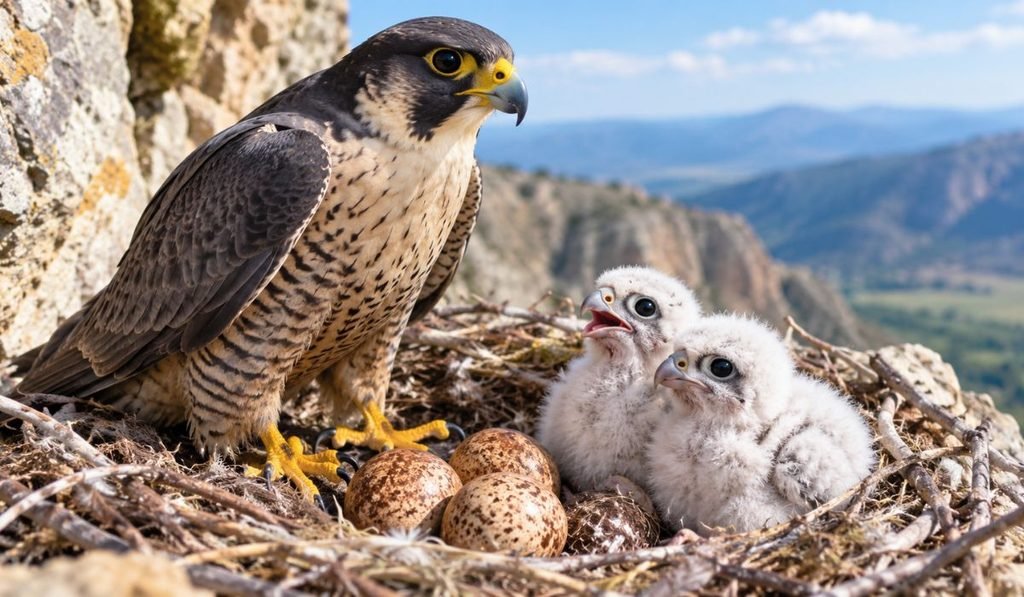
The number of eggs varies by species. Both parents can contribute to incubation and chick care, although the division of responsibilities differs.
Young falcons depend on their parents for food while developing their feathers and learning important survival skills. Eventually, the chicks begin flying and practicing hunting techniques.
Falcon Adaptations for Survival
Falcons possess numerous adaptations that help them survive as predators. Their excellent eyesight allows them to locate prey, while their powerful muscles support rapid and controlled flight.
Their sharp talons provide a secure grip, and their hooked beaks help them process food efficiently.
Some species have also demonstrated remarkable adaptability to human-modified environments. Urban peregrine falcons are an excellent example of how certain birds can take advantage of buildings and other structures that resemble natural cliffs.
Adaptation to Different Environments
The diversity of falcon facts shows how flexible these birds can be. Some species are suited to cold northern environments, while others live in warmer regions. Their feathers, behavior, migration patterns, and hunting strategies can vary according to local conditions.
Falcons and Their Relationship With Humans
Falcons have had a long cultural relationship with humans. Falconry, the practice of training birds of prey to assist with hunting, has existed for thousands of years in different parts of the world.
Today, falcons are also valued for their ecological importance. As predators, they help regulate populations of prey species and form an important part of many food webs.
Peregrine falcons have also become a well-known example of successful wildlife conservation. Their populations declined significantly in parts of the world during the 20th century because of pesticide exposure and other pressures, but conservation efforts helped many populations recover.
Interesting Falcon Facts
Here are several quick falcon facts that highlight what makes these birds remarkable:
- The peregrine falcon is famous for its extremely fast hunting dives.
- Falcons are found on every continent except Antarctica.
- Different species occupy habitats ranging from deserts to mountains and cities.
- Many falcons have long, pointed wings designed for efficient flight.
- Falcons have excellent eyesight for locating prey.
- Their diets can include birds, insects, rodents, reptiles, and other small animals.
- Some falcons migrate long distances between breeding and wintering grounds.
- Peregrine falcons can use tall buildings as nesting locations.
- Falcons play an important role as predators in ecosystems.
- Falcon species vary considerably in size, appearance, behavior, and hunting strategy.
Are Falcons Endangered?
The conservation status of falcons differs from one species to another. Some species have healthy populations, while others face threats from habitat loss, pollution, climate-related changes, illegal hunting, and reduced prey availability.
Conservation programs, habitat protection, monitoring, and responsible wildlife management can help protect vulnerable populations.
Learning falcon facts can also increase awareness of why protecting birds of prey and their habitats is important.
FAQ’s
What is the fastest falcon?
The peregrine falcon is the best-known fast-flying falcon. During its hunting dive, it can reach speeds exceeding 300 kilometers per hour under suitable conditions.
What do falcons eat?
Falcons are carnivores. Depending on the species, they may eat birds, insects, rodents, reptiles, amphibians, and other small animals.
Where do falcons live?
Falcons live in many parts of the world and occupy habitats including mountains, grasslands, deserts, forests, wetlands, coastal areas, and cities.
How do falcons hunt?
Many falcons locate prey using their excellent eyesight and then use speed, maneuverability, and sharp talons to capture it. Some species specialize in aerial hunting.
Can falcons live in cities?
Yes. Some species, especially peregrine falcons, have adapted to urban environments. Tall buildings can provide nesting locations similar to the cliffs they use in natural habitats.
How long do falcons live?
Lifespan varies among species and individuals. Wild falcons can face threats from predators, disease, accidents, food availability, and environmental conditions, so lifespan is not identical across all species.
Conclusion
Falcons are remarkable birds of prey with specialized bodies, powerful flight abilities, sharp eyesight, and sophisticated hunting strategies. From the incredible diving speed of the peregrine falcon to the adaptability of species living in different environments, these birds demonstrate how evolution can produce highly effective aerial predators.
The most interesting falcon facts show that speed is only one part of their success. Their vision, intelligence, maneuverability, hunting skills, and ability to adapt to changing environments all contribute to their survival. Understanding these fascinating birds also highlights the importance of protecting their habitats and maintaining healthy ecosystems for future generations.

Hi, I’m Amelia, an SEO and content specialist with several years of experience researching and creating informative content for online audiences. At Animal Attack Facts, I focus on animal behavior, animal attacks on humans, and interesting facts about land animals, marine animals, birds, reptiles, and insects. My goal is to provide clear, useful, and engaging information that helps readers better understand wildlife and stay informed about animal encounters.
1 thought on “Falcon Facts: Speed, Habitat, Diet, and Behavior”