
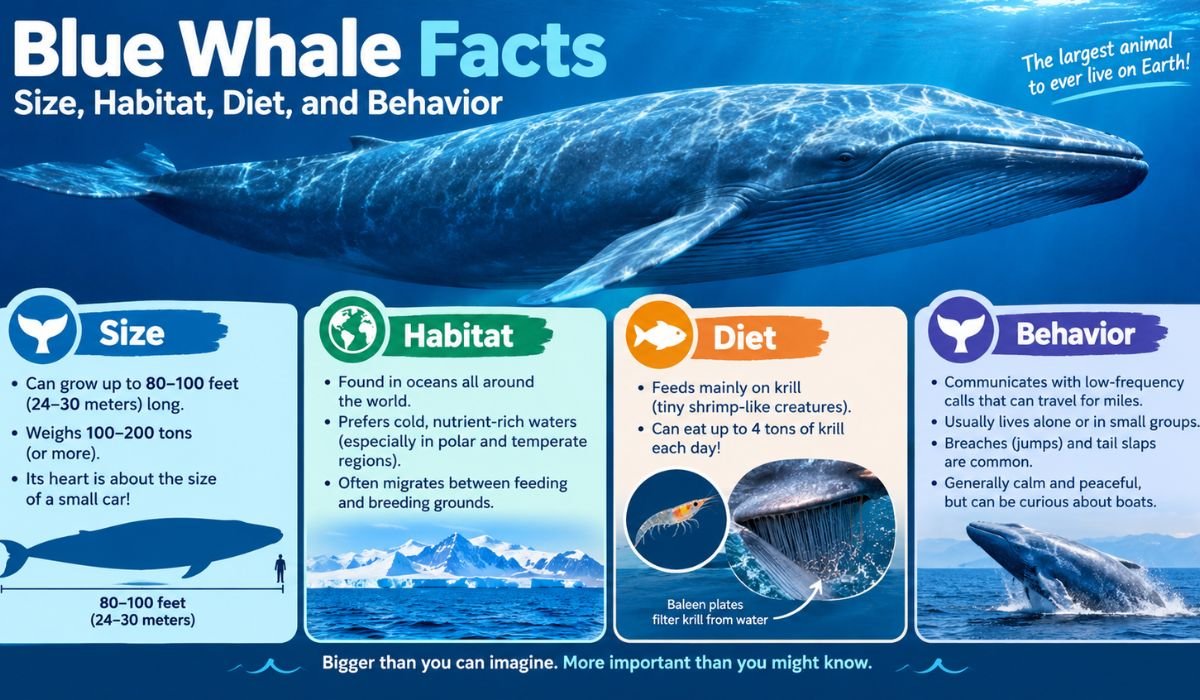
Blue whales are the largest animals known to have ever lived on Earth. These enormous marine mammals are famous for their incredible size, powerful tails, and distinctive blue-gray coloring. Despite their massive bodies, blue whales mainly feed on tiny animals called krill. Learning about blue whale facts reveals how these giants survive in oceans around the world, migrate across vast distances, and communicate through powerful low-frequency sounds.
From their extraordinary size to their feeding habits and behavior, blue whales have many remarkable characteristics. This guide explores their habitat, diet, physical features, life cycle, and other interesting blue whale facts.
What Are Blue Whales?
Blue whales are baleen whales belonging to the family Balaenopteridae. Their scientific name is Balaenoptera musculus. Like other baleen whales, they do not have teeth. Instead, they have baleen plates that allow them to filter small prey from seawater.
There are several populations of blue whales found in different parts of the world’s oceans. They generally spend warmer months feeding in productive waters and may migrate toward warmer regions for breeding and reproduction.
One of the most remarkable blue whale facts is that their enormous size does not require them to eat large animals. Their primary food is tiny krill, which they consume in huge quantities.
Blue Whale Size and Physical Features
Size is one of the most impressive characteristics of blue whales. Adult blue whales can reach lengths of around 80 to 100 feet, with some individuals becoming even larger. Their weight can reach well over 100 tons.
Their bodies are long and streamlined, helping them move efficiently through the ocean. Their skin usually appears blue-gray, although the color can look different underwater.
Important physical features include:
- A long, streamlined body
- A broad, powerful tail fluke
- Small dorsal fins compared with their body size
- Baleen plates instead of teeth
- Two blowholes on top of the head
- A large mouth capable of holding enormous volumes of water
Another fascinating blue whale fact is that their heart is extremely large compared with the hearts of most other animals.
Where Do Blue Whales Live?
Blue whales live in oceans around the world. They can be found in the Atlantic, Pacific, Indian, and Southern oceans.
Their distribution changes throughout the year. Many populations migrate between feeding grounds in colder, nutrient-rich waters and breeding areas in warmer waters.
Blue whales are generally associated with open ocean environments, although they may travel through coastal waters when food is abundant.
Blue Whale Habitat
Blue whale habitat depends heavily on the availability of food. During feeding seasons, they often travel to areas where ocean conditions support large concentrations of krill.
Cold and temperate waters can become important feeding areas because they may contain high levels of nutrients. Warmer waters are often associated with breeding and calving periods.
Their ability to travel thousands of miles makes migration an important part of their survival strategy.
Read Related Post: Deer Facts: Habitat, Diet, Behavior, and Life Cycle
What Do Blue Whales Eat?
Blue whales are filter feeders. Their main food is krill, which are tiny shrimp-like crustaceans found throughout the world’s oceans.
When feeding, a blue whale may open its enormous mouth and take in a large volume of seawater containing krill. It then pushes the water back out through its baleen plates while the krill remain inside the mouth.
A blue whale can consume several tons of krill during periods of intense feeding.
This is one of the most surprising blue whale facts because the largest animal on Earth depends primarily on some of the smallest creatures in the ocean.
How Blue Whales Feed
Blue whales often use a feeding method called lunge feeding. They accelerate toward dense groups of prey and engulf huge amounts of water and krill.
Their expandable throat grooves allow the mouth and throat region to stretch as they take in water. After closing their mouths, they force the water through their baleen plates.
This specialized feeding system allows blue whales to obtain large amounts of food efficiently.
Blue Whale Behavior
Blue whales are generally found alone or in small groups rather than in large permanent social groups. However, several individuals may gather in areas where food is especially abundant.
Their behavior includes feeding, traveling, diving, resting, and communicating through powerful sounds.
One of the most interesting blue whale facts is that their vocalizations can travel extremely long distances through the ocean.
Blue whale calls are among the loudest sounds produced by animals. These low-frequency sounds may help individuals communicate across large distances, although scientists are still studying the full meaning of their vocalizations.
How Deep Can Blue Whales Dive?
Blue whales are capable divers, although they do not usually spend all of their time at extreme depths.
They can remain underwater for significant periods while searching for food. During feeding dives, they may descend to depths where krill concentrations are found.
Before diving, a blue whale typically breathes at the surface. It then submerges and uses its large body and powerful tail to move through the water.
After returning to the surface, it exhales through its blowholes, creating the tall spout commonly associated with these whales.
Blue Whale Reproduction and Life Cycle
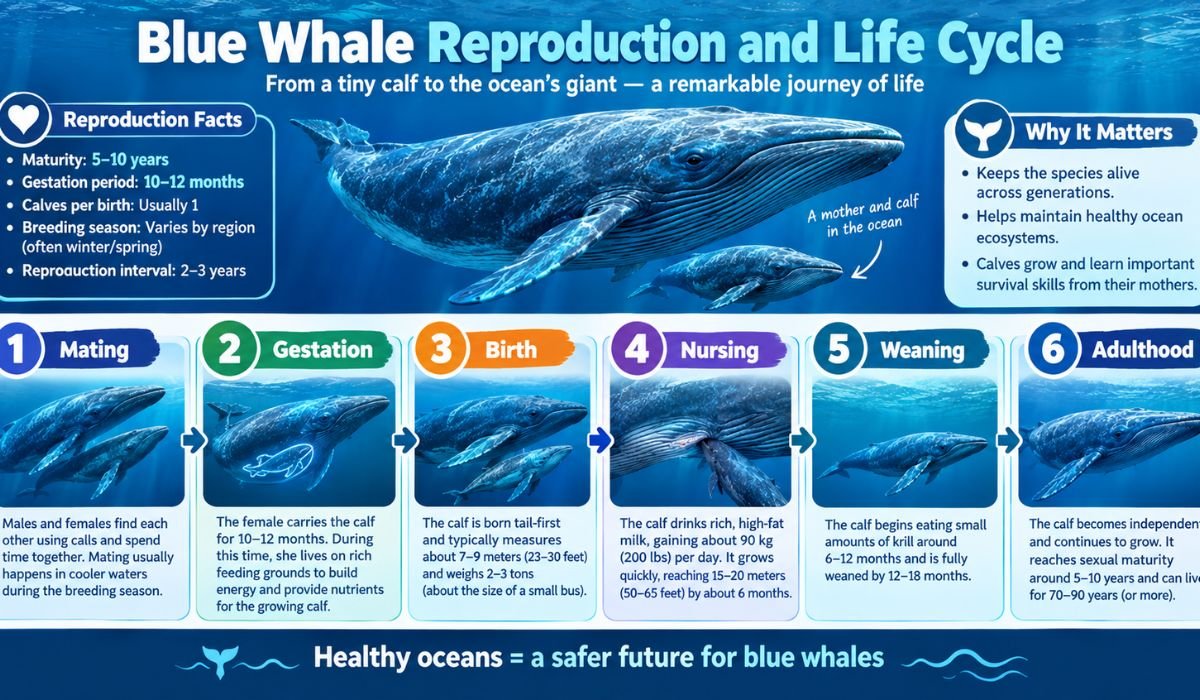
Blue whales reproduce through sexual reproduction, with females giving birth to live calves.
Pregnancy lasts roughly 10 to 12 months. A mother generally gives birth to a single calf, which is already very large at birth.
Newborn calves grow rapidly because they receive highly nutritious milk from their mothers. This rapid growth helps young whales develop the size and strength needed for life in the ocean.
Young blue whales remain dependent on their mothers during the early stages of life before becoming increasingly independent.
How Long Do Blue Whales Live?
Blue whales can live for many decades. Scientists estimate that they may live around 70 to 90 years, although determining the exact age of individual whales can be difficult.
Their long lives give them extended opportunities to migrate, reproduce, and experience changing ocean conditions.
Are Blue Whales Endangered?
Blue whales were heavily affected by commercial whaling during the 20th century. Their enormous size and valuable body products made them targets for large-scale hunting.
International protections helped reduce commercial whaling and allowed some populations to recover from extremely low numbers.
However, blue whales still face threats from human activities. These can include ship strikes, entanglement in fishing gear, underwater noise, pollution, and changes in ocean ecosystems.
Conservation organizations and researchers continue monitoring blue whale populations and working to understand their movements and threats.
Why Are Blue Whales Important to the Ocean?
Blue whales are important parts of marine ecosystems. As large predators that consume enormous quantities of krill, they participate in the movement of nutrients through ocean food webs.
Their waste can also contribute nutrients to marine environments, supporting microscopic organisms such as phytoplankton.
Phytoplankton are important because they form the foundation of many marine food chains and contribute significantly to global oxygen production.
This connection is another fascinating aspect of blue whale facts: even an animal that spends most of its life far offshore can influence the wider marine ecosystem.
10 Interesting Blue Whale Facts
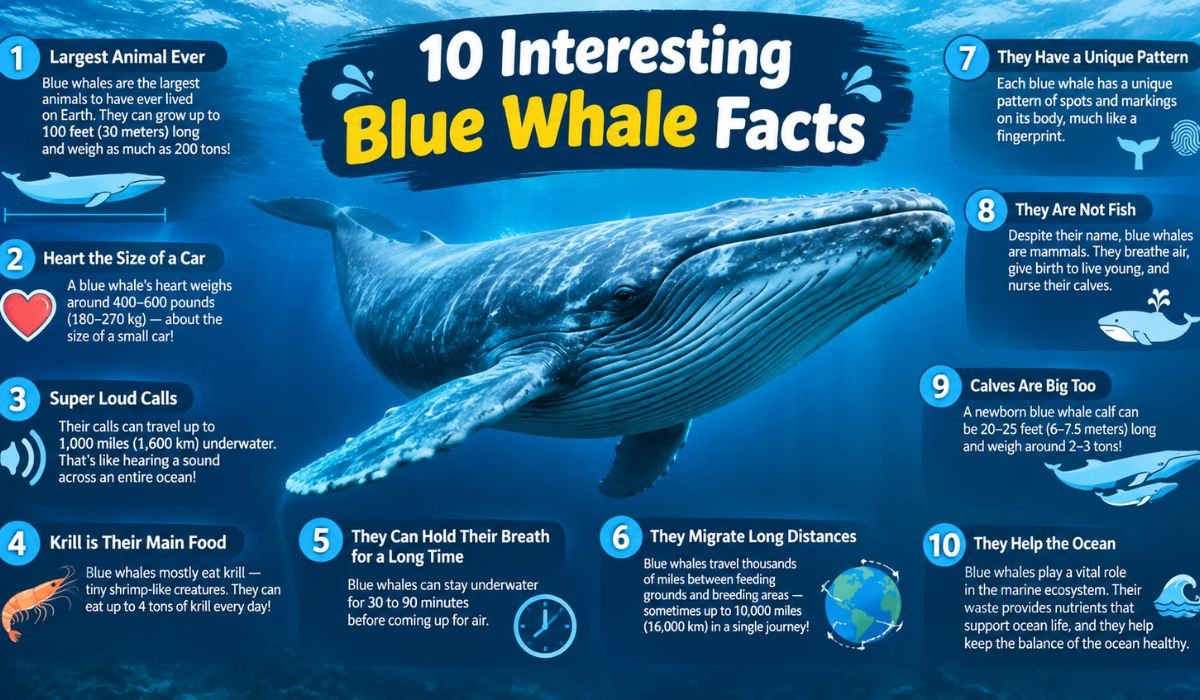
Here are some quick blue whale facts worth remembering:
- Blue whales are the largest animals known to have lived on Earth.
- Their scientific name is Balaenoptera musculus.
- They are baleen whales rather than toothed whales.
- Their main food is tiny krill.
- They can migrate across enormous distances.
- Blue whales have two blowholes.
- Their powerful vocalizations can travel long distances underwater.
- Females give birth to live calves.
- Blue whales were severely affected by commercial whaling.
- Modern conservation efforts have helped protect them from commercial hunting.
Blue Whale vs. Other Whales
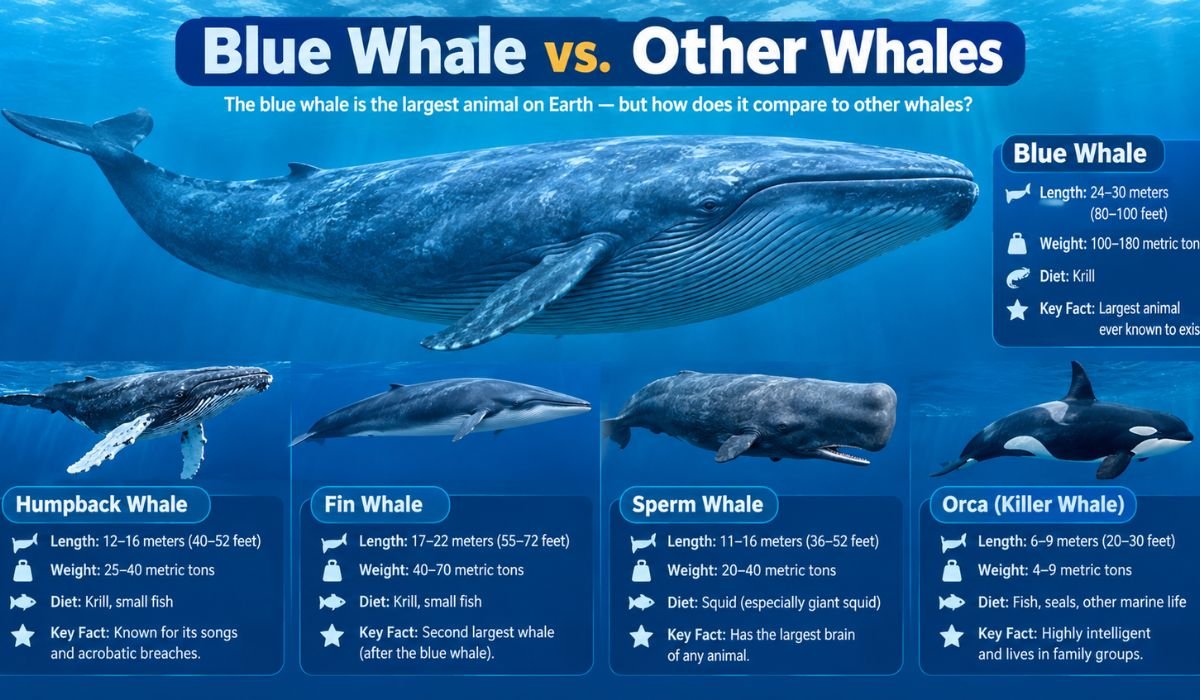
Blue whales belong to the same broad group as several other baleen whales, including humpback whales, fin whales, and sei whales.
The most obvious difference is their enormous size. Blue whales generally have a much larger body than most other whale species.
Their feeding strategy is also highly specialized. Like other baleen whales, they filter prey from seawater, but their enormous bodies allow them to consume very large quantities of krill during feeding periods.
Understanding these differences helps explain why blue whale facts are so remarkable compared with facts about other marine mammals.
FAQ’s
What is the largest blue whale ever recorded?
Blue whales can reach extraordinary lengths and weights, although exact records vary because measuring these enormous animals accurately is difficult. Some exceptionally large individuals have been reported at more than 90 feet long.
What do blue whales eat?
Blue whales primarily eat krill. They filter huge amounts of seawater through their baleen plates to capture these tiny crustaceans.
Where do blue whales live?
Blue whales live in oceans around the world. Their populations migrate between productive feeding areas and warmer breeding regions.
How big is a blue whale?
Adult blue whales can reach around 80 to 100 feet in length, with exceptionally large individuals exceeding those measurements. They can weigh more than 100 tons.
How long do blue whales live?
Blue whales may live for approximately 70 to 90 years, although determining the exact lifespan of wild individuals is challenging.
Are blue whales dangerous to humans?
Blue whales are enormous wild animals, but they are not generally considered aggressive toward humans. Their feeding behavior is focused primarily on small prey such as krill.
How do blue whales communicate?
Blue whales produce powerful low-frequency sounds. These vocalizations can travel long distances underwater and are believed to play an important role in communication.
How do blue whales sleep?
Blue whales must continue surfacing to breathe, so they do not sleep in the same way humans do. They can rest while remaining capable of surfacing for air.
Conclusion
Blue whales are extraordinary marine mammals whose enormous size, specialized feeding system, long migrations, and powerful communication make them one of the most fascinating animals on Earth. Their dependence on tiny krill demonstrates how different parts of an ocean ecosystem can be closely connected.
From their impressive physical features to their life cycle and conservation challenges, blue whale facts show why these giants are so important to marine ecosystems. Protecting their habitats and reducing human-related threats can help ensure that blue whales continue to inhabit the world’s oceans for generations to come.

Hi, I’m Amelia, an SEO and content specialist with several years of experience researching and creating informative content for online audiences. At Animal Attack Facts, I focus on animal behavior, animal attacks on humans, and interesting facts about land animals, marine animals, birds, reptiles, and insects. My goal is to provide clear, useful, and engaging information that helps readers better understand wildlife and stay informed about animal encounters.
1 thought on “Blue Whale Facts: Size, Habitat, Diet, and Behavior”