

Iguanas are fascinating reptiles found in warm regions where sunlight, vegetation, and suitable shelter help them survive. Their habitats vary by species, but many iguanas live in tropical forests, coastal areas, grasslands, and places near rivers.
Some species spend most of their time in trees, while others live among rocks or near the ground. Understanding the iguana habitat helps explain how these reptiles find food, regulate their body temperature, avoid predators, and adapt to different environments.
Where Do Iguanas Live?
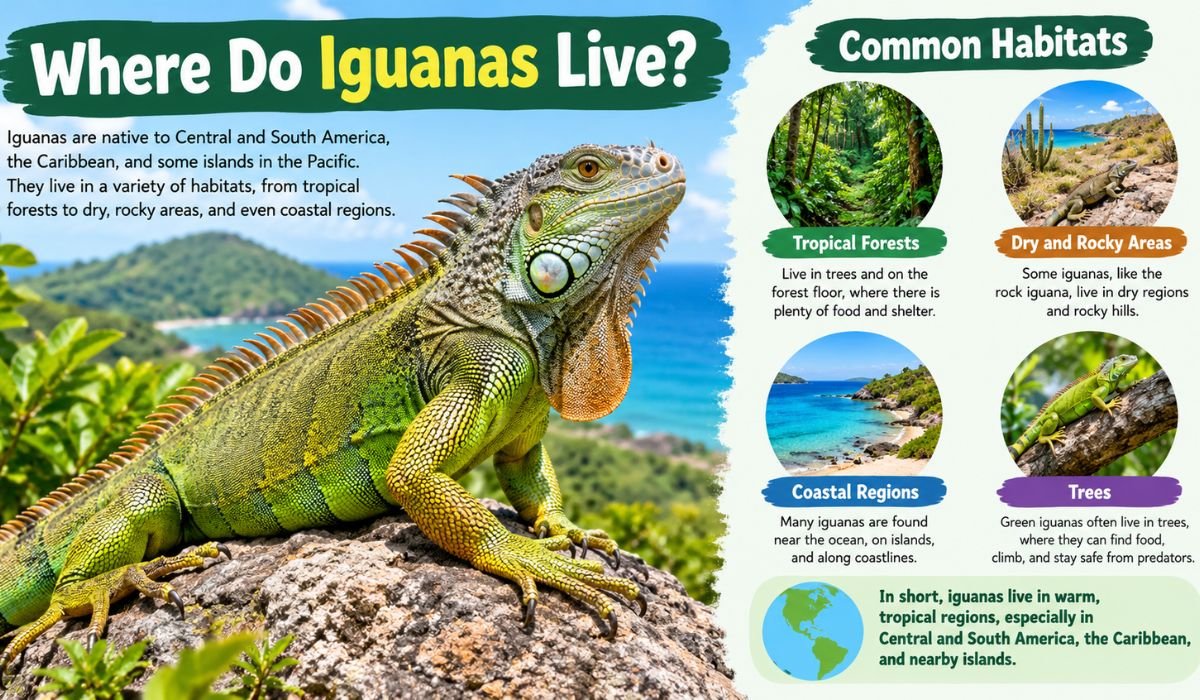
Iguanas live mainly in tropical and subtropical regions of the Americas, the Caribbean, and certain nearby islands. Their distribution depends on the species and its environmental needs.
Green iguanas, one of the most widely recognized species, are native to Central America, South America, and parts of the Caribbean. They are also found in introduced populations in places such as Florida and other warm regions.
Different iguana species occupy different environments, including forests, dry landscapes, rocky coastlines, and islands. Most need access to warmth and suitable places to hide.
Tropical Rainforests
Tropical rainforests provide excellent habitats for many iguanas. These environments offer warm temperatures, abundant leaves, and numerous trees for climbing and resting.
Green iguanas frequently live in trees near rivers, streams, and other water sources. Their strong limbs, sharp claws, and long tails help them move through branches and maintain balance.
The dense vegetation also provides shelter from predators and suitable places to rest during the day.
Coastal Areas and Islands
Some iguanas live along coastlines and on islands. These habitats may contain sandy beaches, rocky shores, shrubs, and patches of vegetation.
Marine iguanas, which are native to the Galápagos Islands, are specially adapted to coastal environments. They spend time on rocky shores and enter the ocean to feed on marine algae.
Other island iguanas inhabit dry forests and scrublands, where they find plants to eat and rocks or burrows to use as shelter.
Dry Forests and Grasslands
Not every iguana lives in a dense rainforest. Some species inhabit dry forests, scrublands, and relatively open landscapes.
These environments may experience long periods without rain, so iguanas must use available shade and shelter to manage heat and conserve energy.
Rock crevices, fallen branches, bushes, and underground burrows can provide protection from extreme temperatures and predators.
Read Related Post: Flamingo Habitat: Where Flamingos Live and What They Eat
What Makes an Ideal Iguana Habitat?

An ideal iguana habitat provides the environmental conditions necessary for feeding, resting, sheltering, and reproduction. Although requirements vary between species, several features are particularly important.
Warm Temperatures and Sunlight
Iguanas are ectothermic reptiles, meaning their body temperature depends largely on external heat sources. They often bask in sunlight to warm themselves before becoming more active.
Sunlit branches, rocks, and open areas allow iguanas to absorb heat. They also need shaded places where they can cool down when temperatures become too high.
Suitable temperatures are essential because excessive heat or prolonged cold can interfere with their normal activities.
Access to Water
Water is important for hydration and, in some species, feeding and escaping predators. Many green iguanas live near rivers, lakes, or streams, where they can drink and quickly enter the water if threatened.
However, not all iguanas depend on freshwater habitats. Some species live in dry environments and obtain part of their water from food.
Marine iguanas are an unusual example because they forage in seawater but return to land to warm themselves and rest.
Vegetation and Food Sources
Vegetation plays a major role in the iguana habitat. Many iguanas are primarily herbivorous and eat leaves, flowers, fruits, and other plant material.
Trees provide food and resting places for arboreal species, while shrubs and low-growing plants support iguanas living closer to the ground.
A habitat with diverse vegetation can provide food throughout different seasons and offer hiding places when predators are nearby.
Safe Shelter and Hiding Places
Iguanas need places to retreat when threatened or when environmental conditions become uncomfortable.
Tree branches, hollow logs, rock crevices, dense bushes, and burrows can serve as shelters. Some species use underground tunnels, particularly for nesting or protection.
The availability of suitable shelter helps iguanas avoid predators and cope with changing temperatures.
How Do Iguanas Survive in Their Habitat?

Iguanas possess several physical and behavioral adaptations that help them survive in their natural environments. These adaptations differ among species but generally support movement, temperature regulation, feeding, and protection.
Climbing and Moving Through Trees
Many iguanas are excellent climbers. Their strong limbs and sharp claws allow them to grip tree bark and move across branches.
Green iguanas spend much of their time in trees, where they can reach leaves and fruit while staying above many ground-level threats.
Their long tails help with balance, and some species can use their tails defensively when necessary.
Camouflage and Protection
Iguanas often blend into their surroundings. Green iguanas can be difficult to spot among leaves and branches, while species living in rocky environments may have colors that help them blend with stones and dry vegetation.
Camouflage can make it harder for predators to detect them.
When threatened, iguanas may remain still, hide in vegetation, flee into trees, or escape into water if it is available.
Regulating Body Temperature
Because iguanas rely on environmental heat, they change their behavior to maintain a suitable body temperature.
They may bask in the sun during cooler periods and move into shade during the hottest parts of the day. Some species also use warm rocks or sheltered locations to retain heat.
This behavior helps them remain active without overheating or becoming too cold.
Swimming and Escaping Predators
Several iguana species are capable swimmers. Green iguanas may jump from branches into water and swim away from danger using their powerful tails.
Marine iguanas are particularly well adapted to swimming underwater to forage for algae. Their flattened tails help propel them through the water.
Swimming ability is useful for species living near rivers, lakes, or coastal environments, although its importance varies by species.
What Do Iguanas Eat in Their Natural Habitat?
Most iguanas eat plant-based foods, although their diets differ depending on the species and available resources.
Green iguanas primarily consume leaves, flowers, and fruits. Their diets may change with seasonal plant growth and food availability.
Some iguanas eat a wider range of foods during particular stages of life, while marine iguanas feed mainly on marine algae.
The natural habitat influences which foods are available. Rainforest iguanas may find leaves and fruits in trees, while island species may depend on shrubs, flowers, and other plants adapted to dry conditions.
Access to suitable food is essential for growth, reproduction, and long-term survival.
Where Do Iguanas Sleep and Nest?

Iguanas choose resting and nesting locations that provide safety and suitable environmental conditions.
Sleeping Places
Many tree-dwelling iguanas rest on branches, often in locations where they can remain relatively hidden. They may choose stable branches surrounded by foliage for protection.
Ground-dwelling species can use rock crevices, burrows, or dense vegetation. These shelters help protect them from predators and uncomfortable weather.
The exact sleeping location depends on the species, local climate, and availability of safe resting places.
Nesting Areas
Female iguanas commonly seek protected locations to lay their eggs. Depending on the species, nesting sites may include sandy soil, loose earth, or underground burrows.
Green iguanas typically dig nests in suitable soil, where eggs can develop under appropriate environmental conditions.
The temperature, moisture, and structure of the nesting area can affect egg development. Habitat disturbance may reduce the availability of suitable nesting sites.
Do Iguanas Live in Deserts?
Some iguanas live in dry environments, but not all species are adapted to desert conditions.
Desert iguanas, for example, inhabit arid regions of the southwestern United States and northwestern Mexico. They are adapted to high temperatures, limited rainfall, and sparse vegetation.
These reptiles may use burrows and shaded areas to avoid excessive heat. They also feed on plants available in their environment.
Green iguanas, by contrast, are more commonly associated with tropical and subtropical habitats that provide suitable vegetation and warmth.
Therefore, the answer depends on the species: certain iguanas thrive in dry landscapes, while others depend on forests, islands, or coastal environments.
Can Iguanas Survive in Cold Climates?
Iguanas generally prefer warm environments and can struggle in prolonged cold conditions.
As ectothermic animals, they depend on external heat to maintain normal body functions. When temperatures fall, their movement and activity can slow considerably.
Some species tolerate cooler conditions better than others, but prolonged exposure to unsuitable temperatures can threaten their survival.
In regions with cold winters, introduced iguana populations may seek sheltered locations during colder periods. Their ability to survive depends on the severity and duration of the cold, access to shelter, and the species involved.
How Human Activities Affect Iguana Habitats
Human activities can change or destroy the environments iguanas need to survive. Habitat loss is a major concern for many reptile species, particularly those with restricted distributions.
Deforestation and Urban Development
Clearing forests for agriculture, roads, and buildings can remove trees, food sources, and nesting areas. This is especially harmful to iguanas that depend on forest vegetation.
Urban development can also divide natural habitats into smaller, isolated areas, making it more difficult for animals to move between suitable locations.
Pollution and Coastal Disturbance
Pollution can damage rivers, coastal environments, and the vegetation iguanas depend on. Coastal construction and heavy human activity may also disturb nesting and resting areas.
Marine iguanas are particularly dependent on healthy coastal ecosystems because they forage on marine algae.
Climate Change
Climate change can affect iguana habitats by altering temperatures, rainfall patterns, vegetation, and coastal conditions.
Changes in environmental temperatures may also influence nesting conditions and reproductive success in some species.
Protecting natural habitats, preserving vegetation, reducing pollution, and supporting conservation programs can help iguanas continue to survive in their native environments.
FAQ’s
Where do iguanas live naturally?
Iguanas naturally live in parts of Central America, South America, the Caribbean, and nearby islands. Depending on the species, they inhabit tropical forests, dry forests, rocky coastlines, scrublands, and other warm environments.
Do iguanas live in trees or on the ground?
Many iguanas, including green iguanas, spend much of their time in trees. Other species spend more time on the ground or among rocks. Their preferred habitat depends on their adaptations and food sources.
Do iguanas need water to survive?
Yes, iguanas need water for normal body functions. Some live near rivers and streams, while others obtain moisture from their food and use water sources when available. Marine iguanas also enter the ocean to feed.
What temperature do iguanas prefer?
Temperature preferences vary by species. Many tropical iguanas thrive in warm environments with opportunities to bask and cool down. They need access to both suitable warmth and cooler shelter to regulate their body temperature.
Where do iguanas lay their eggs?
Many female iguanas lay their eggs in nests dug into suitable soil or sand. The location provides protection and conditions that allow the eggs to develop.
Can iguanas live in forests and deserts?
Yes, different species occupy different environments. Some iguanas live in tropical forests, while others are adapted to dry forests, scrublands, and deserts.
What threatens iguana habitats?
Major threats include deforestation, urban development, pollution, climate change, and the destruction of nesting areas. Introduced predators and competition from non-native species can also affect certain populations.
Conclusion
The iguana habitat varies widely depending on the species, ranging from tropical rainforests and riverbanks to dry forests, deserts, and rocky coastlines. These reptiles survive through adaptations such as climbing, camouflage, swimming, and behavioral temperature regulation.
Access to suitable food, shelter, and nesting areas is essential for their survival. Protecting natural environments and reducing habitat destruction can help preserve iguanas and the ecosystems they depend on.

Hi, I’m Amelia, an SEO and content specialist with several years of experience researching and creating informative content for online audiences. At Animal Attack Facts, I focus on animal behavior, animal attacks on humans, and interesting facts about land animals, marine animals, birds, reptiles, and insects. My goal is to provide clear, useful, and engaging information that helps readers better understand wildlife and stay informed about animal encounters.
1 thought on “Iguana Habitat: Where Iguanas Live and How They Survive”