
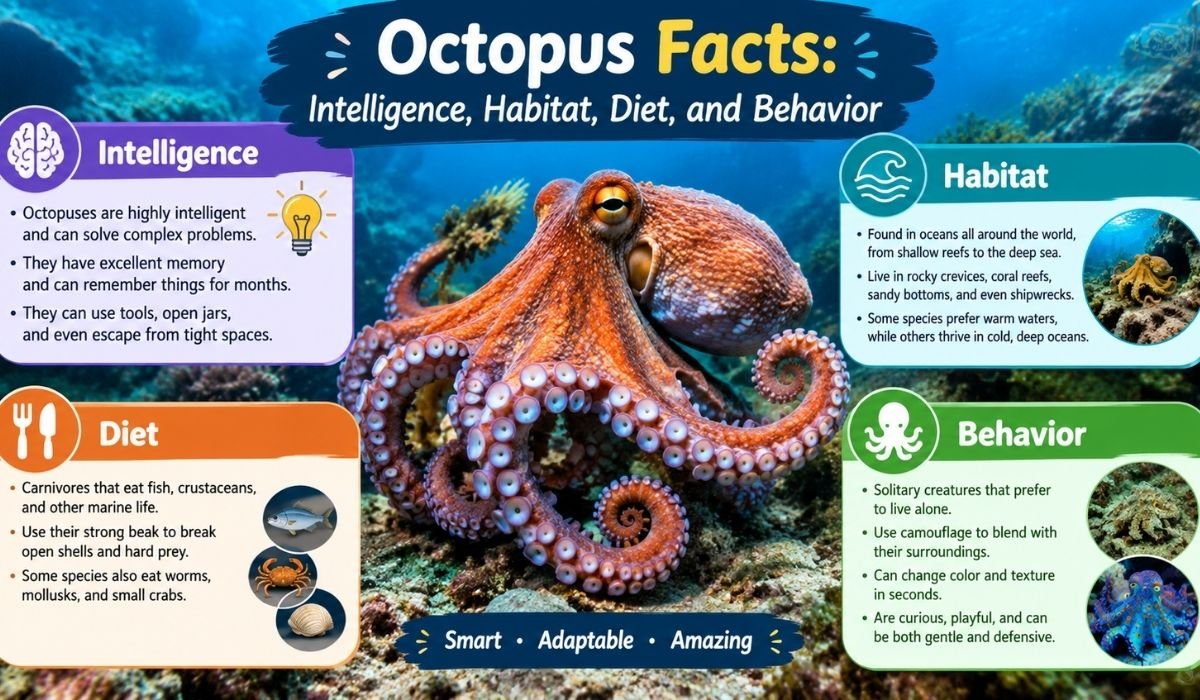
Octopuses are among the most fascinating creatures in the ocean. Their flexible bodies, remarkable intelligence, unusual appearance, and ability to change color make them very different from most other marine animals. These soft-bodied cephalopods have adapted to a wide variety of underwater environments, from shallow coastal waters to the deep ocean. Learning octopus facts can help explain how these animals survive, hunt, communicate, and avoid predators.
Unlike fish, octopuses do not have bones, allowing them to squeeze through surprisingly small spaces. They also have three hearts, blue blood, and eight highly flexible arms covered with thousands of sensitive suckers. Some species can change their color and texture within seconds, making them excellent at camouflage. In this article, we explore their intelligence, habitat, diet, behavior, physical features, and other interesting octopus facts.
What Is an Octopus?
An octopus is a marine animal belonging to the class Cephalopoda, which also includes squid, cuttlefish, and nautiluses. There are hundreds of known octopus species, ranging greatly in size, appearance, and habitat.
Octopuses have eight arms rather than tentacles. Their arms are extremely flexible and contain numerous suckers that help them touch, taste, grip, and manipulate objects. Their body consists mainly of soft tissue, with a hard beak being one of their most important solid structures.
One of the most interesting octopus facts is that these animals have a highly developed nervous system. A large portion of their neurons are located in their arms, allowing individual arms to perform complex movements and respond to their surroundings.
Octopus Intelligence
How Smart Are Octopuses?
Octopuses are considered some of the most intelligent invertebrates. Their intelligence is particularly impressive because their evolutionary history is very different from that of mammals and birds.
They can learn from experience, solve certain problems, remember information, and explore unfamiliar objects. Some octopuses have demonstrated the ability to open containers and navigate through challenging environments.
Their intelligence helps them find food, escape predators, and adapt to changing surroundings. Researchers continue to study their nervous systems because they provide an unusual example of complex intelligence outside the vertebrate world.
How Do Octopuses Use Their Arms?
An octopus does not simply use its arms as eight identical limbs. Each arm contains a large network of neurons and sensory receptors. This allows the arms to gather information and perform movements while still being coordinated by the animal’s central nervous system.
The suckers can detect chemical and physical information. This means an octopus can effectively interact with objects through touch and chemical sensing.
These abilities are among the most remarkable octopus facts, showing how specialized their bodies are for exploration and survival.
Read Related Post: Snake Facts: Types, Habitat, Diet, and Behavior
Where Do Octopuses Live?
Octopuses are found in oceans throughout the world. Different species occupy different environments depending on their adaptations.
They can live around coral reefs, rocky coastlines, sandy seabeds, seagrass habitats, and deep-sea environments. Some species prefer relatively shallow water, while others live thousands of meters below the surface.
Most octopuses spend much of their time near the seafloor. They often hide inside holes, beneath rocks, or within natural crevices.
Octopus Habitat and Shelter
Because octopuses have soft bodies and lack a protective shell, finding suitable shelter is extremely important. They may use natural holes and cracks in rocks or create shelters using available materials.
Some individuals have been observed carrying objects such as shells or other debris and using them as protection. Their ability to squeeze through narrow openings gives them access to hiding places that many predators cannot reach.
Habitat is therefore an important part of understanding octopus facts, because an octopus’s survival depends heavily on its ability to find food and avoid danger within its environment.
What Do Octopuses Eat?
Octopuses are carnivorous predators. Their diets vary depending on the species and the food available in their habitat.
Common prey includes crabs, shrimp, lobsters, fish, clams, snails, and other marine organisms. Smaller species may concentrate on smaller prey, while larger octopuses can capture larger animals.
How Do Octopuses Hunt?
Octopuses use several strategies to capture prey. Their flexible arms and suckers allow them to grab and hold animals. Once prey is captured, the octopus uses its hard beak to bite through or tear food.
Many species rely heavily on camouflage when hunting. An octopus may remain hidden and wait for suitable prey to approach before making a quick movement.
Some species can also explore holes and narrow spaces with their arms, giving them access to prey that might otherwise be difficult to reach.
These hunting techniques are among the most useful octopus facts for understanding why these animals are such successful marine predators.
Octopus Camouflage and Defense
One of the best-known characteristics of octopuses is their ability to change their appearance. Specialized skin cells called chromatophores help many species rapidly alter their coloration.
Some octopuses can also modify the appearance of their skin, creating textures that make them resemble rocks, coral, sand, or other objects.
How Do Octopuses Escape Predators?
Camouflage is only one defense mechanism. When threatened, an octopus may release a cloud of ink into the surrounding water. The ink can interfere with a predator’s ability to see clearly and may provide an opportunity for the octopus to escape.
An octopus can also rapidly move through the water using jet propulsion. By forcing water through a structure called the siphon, it can produce a quick burst of movement.
These defensive abilities demonstrate how octopus facts are closely connected to the animal’s remarkable adaptations.
Octopus Behavior
Octopuses are generally solitary animals. Many species spend much of their lives alone, interacting with others primarily during mating.
They are curious and active animals that often explore their surroundings using their arms and suckers. Their behavior can change depending on environmental conditions, food availability, and potential threats.
Some octopuses spend considerable time inside dens. Others regularly move around their habitat searching for food.
Can Octopuses Communicate?
Octopuses do not communicate using human-like language, but they can use body coloration, patterns, posture, and movement to send signals.
Changes in appearance may occur during interactions with predators, prey, or other octopuses. Researchers continue to investigate how these visual signals function in different species.
Octopus Physical Features
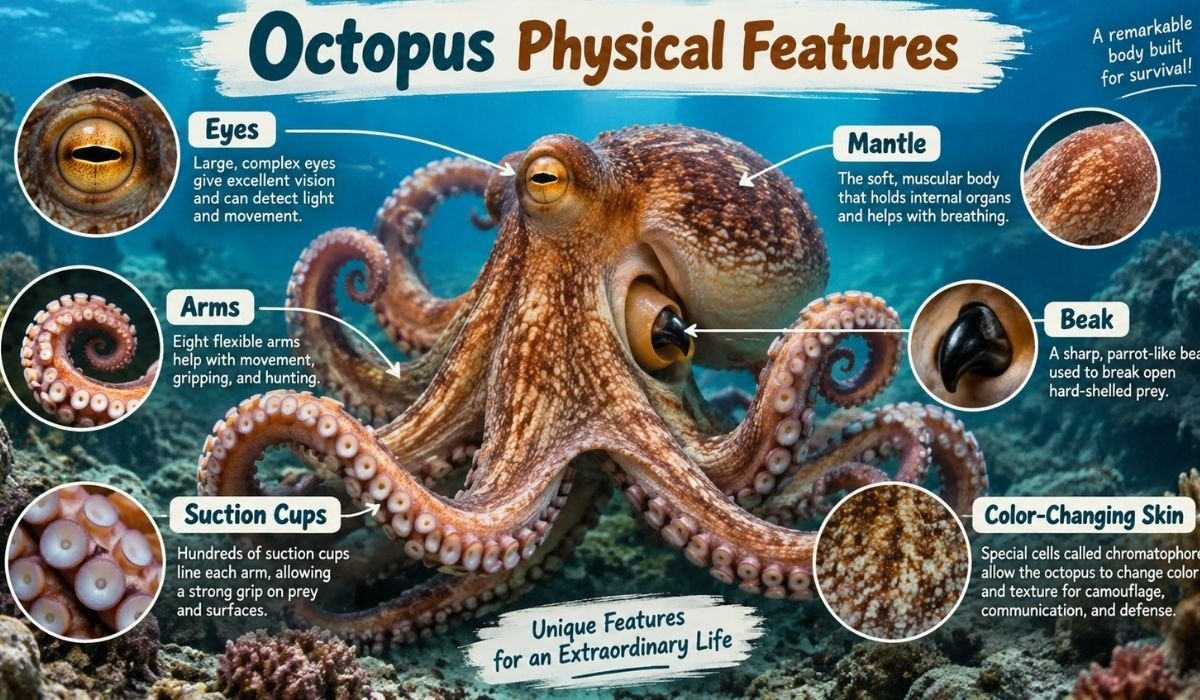
Octopuses have several unusual physical characteristics.
An adult octopus has eight arms, and many species have thousands of suckers across those arms. Their suckers provide grip and sensory information.
Another fascinating feature is their circulatory system. Octopuses have three hearts and blue blood. Their blood contains a copper-based protein called hemocyanin, which helps transport oxygen.
Their lack of bones provides another major advantage. Because their bodies are soft and flexible, they can squeeze through openings much smaller than their overall body size might suggest.
These unusual characteristics make physical adaptations some of the most fascinating octopus facts.
How Do Octopuses Reproduce?
Octopus reproduction varies among species, but mating generally involves specialized structures on one of the male’s arms.
After mating, females of many species lay eggs and protect them. In several species, the female remains with her eggs and helps protect them until they hatch.
A particularly important aspect of octopus life history is that many species reproduce only once before dying. However, reproduction and lifespan vary among species, so this pattern does not apply identically to every octopus.
How Long Do Octopuses Live?
Octopus lifespans vary significantly by species. Many have relatively short lives compared with other marine animals, with some living only around one to two years.
Larger or deep-sea species may live longer. Factors such as species, temperature, food availability, and reproductive strategy can influence lifespan.
Short lifespans combined with rapid growth make the life cycle of octopuses particularly interesting to scientists studying marine ecosystems.
Are Octopuses Dangerous?
Octopuses generally avoid humans and are not considered a major threat to people. Most species are small or relatively harmless.
However, a few species possess venom that can be medically significant. The blue-ringed octopuses are particularly well known because they contain potent venom and can be dangerous when handled.
The safest approach around wild marine animals is always to observe them without touching or disturbing them.
Interesting Octopus Facts
Here are some quick octopus facts to remember:
- Octopuses have eight arms.
- They have three hearts.
- Their blood is blue because it uses hemocyanin to transport oxygen.
- They are invertebrates and have no internal skeleton.
- Many species can change color rapidly.
- Some can alter their skin texture for camouflage.
- They are carnivorous predators.
- Their suckers provide both gripping and sensory abilities.
- Many octopuses are solitary animals.
- They can use jet propulsion to move quickly.
- Their arms contain a large number of neurons.
- Some species are capable of complex problem-solving.
- Many species live relatively short lives.
These octopus facts reveal why octopuses are considered some of the most unusual animals in the marine world.
FAQ’s
How many hearts does an octopus have?
An octopus has three hearts. Two pump blood toward the gills, while the third pumps oxygenated blood to the rest of the body.
Why is octopus blood blue?
An octopus has blue blood because its blood uses hemocyanin, a copper-containing protein, to transport oxygen. Hemocyanin works differently from the iron-based hemoglobin found in humans.
Can an octopus change color?
Yes. Many octopus species can rapidly change their color and patterns using specialized skin cells. This ability helps with camouflage, communication, and defense.
Do octopuses have bones?
No. Octopuses are soft-bodied invertebrates and do not have bones. Their flexible bodies allow them to squeeze through surprisingly small openings.
What do octopuses eat?
Octopuses mainly eat other marine animals, including crabs, shrimp, fish, clams, snails, and other small organisms.
Are octopuses intelligent?
Yes. Octopuses are among the most intelligent invertebrates. They can learn from experience, explore their surroundings, and solve certain problems.
Where do octopuses live?
Octopuses live in oceans around the world. Depending on the species, they can be found in shallow coastal waters, coral reefs, rocky habitats, sandy areas, and the deep sea.
Conclusion
Octopuses are extraordinary marine animals with a combination of intelligence, flexibility, camouflage, and specialized hunting abilities. Their three hearts, blue blood, eight arms, sensitive suckers, and soft bodies make them highly unusual members of the animal kingdom.
From exploring their surroundings to escaping predators and capturing prey, octopuses have developed impressive adaptations for life in the ocean. The more scientists study them, the more fascinating their behavior becomes.
These octopus facts show that octopuses are not simply unusual-looking sea creatures. They are highly adapted predators with complex nervous systems and remarkable survival strategies. Understanding their biology and behavior gives us a better appreciation for the incredible diversity of life beneath the ocean’s surface.

Hi, I’m Amelia, an SEO and content specialist with several years of experience researching and creating informative content for online audiences. At Animal Attack Facts, I focus on animal behavior, animal attacks on humans, and interesting facts about land animals, marine animals, birds, reptiles, and insects. My goal is to provide clear, useful, and engaging information that helps readers better understand wildlife and stay informed about animal encounters.
1 thought on “Octopus Facts: Intelligence, Habitat, Diet, and Behavior”