
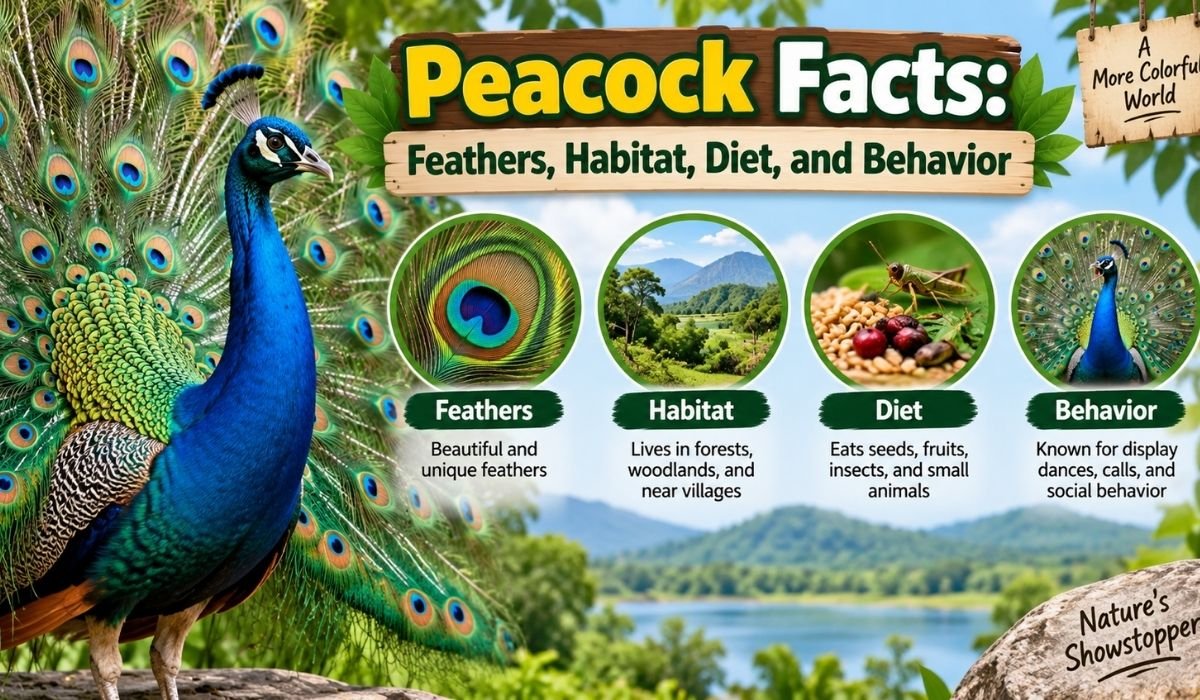
Peacocks are among the most recognizable birds in the world, famous for their brilliant feathers, impressive courtship displays, and distinctive calls. Although the word “peacock” technically refers to a male peafowl, it is commonly used when discussing these beautiful birds in general. They belong to the pheasant family and are native to parts of Asia, with some species now living in other regions because humans have introduced them.
There is much more to these birds than their colorful appearance. From their unusual feathers and feeding habits to their social behavior and natural habitats, peacock facts reveal how well adapted these birds are to their surroundings. They can walk and run surprisingly well, fly when necessary, and use their keen senses to detect potential danger.
In this guide, we will explore fascinating peacock facts, including their feathers, habitat, diet, behavior, reproduction, and important adaptations.
Peacock Facts About Species and Appearance
There are three recognized species of peafowl: the Indian peafowl, green peafowl, and Congo peafowl. The Indian peafowl is the species most people picture when they think of a peacock.
Male peafowl are called peacocks, while females are called peahens. Young peafowl are known as peachicks. The males are generally more colorful and have the spectacular train of elongated upper-tail feathers used during courtship.
Indian Peafowl
The Indian peafowl is native to the Indian subcontinent. Males typically have iridescent blue and green plumage, while females are generally brownish or grayish with green and blue areas.
Green Peafowl
Green peafowl are native to Southeast Asia. Unlike Indian peafowl, both males and females can have striking green plumage. Their populations have declined significantly in parts of their natural range.
Congo Peafowl
The Congo peafowl was discovered by science relatively recently compared with the other two species. It lives in the forests of Central Africa and has a very different appearance from the familiar Asian peafowl.
These differences are among the most interesting peacock facts, showing that “peacock” can refer to birds with very different appearances and lifestyles.
Read Related Post: Octopus Facts: Intelligence, Habitat, Diet, and Behavior
Peacock Feathers and Their Famous Display
One of the most famous peacock facts is that the spectacular “tail” displayed by a male is not actually his true tail. The colorful fan consists mainly of elongated upper-tail coverts.
These feathers contain eye-like markings called ocelli. When a male raises and spreads his train, the markings become highly visible.
Why Do Peacocks Display Their Feathers?
The primary purpose of the display is courtship. A male may spread his train, vibrate his feathers, and move around a female during breeding season.
The display is an example of sexual selection. Females can evaluate males based on characteristics of their display, although researchers have studied many different factors that may influence mate choice.
The feathers are beautiful but also expensive for the bird to maintain. A large train can make movement more difficult and may attract attention from predators. This makes the display an interesting example of how reproductive success can shape animal appearance.
Peacock Facts About Habitat
Wild peafowl live in a variety of environments, depending on their species. Indian peafowl can inhabit forests, woodland edges, grasslands, agricultural areas, and regions close to human settlements.
They generally prefer places where food and water are available and where vegetation provides cover.
Green peafowl are associated with forests, grasslands, and other habitats in Southeast Asia. Congo peafowl are forest-dwelling birds found in Central Africa.
An important part of peacock facts is that these birds are adaptable. Indian peafowl, in particular, can live close to people when suitable food, water, and shelter are available.
Where Do Peacocks Sleep?
Peafowl commonly roost in trees at night. Getting above the ground provides protection from many terrestrial predators.
Despite their impressive size and heavy-looking feathers, peafowl can fly short distances and use their wings to reach tree branches or escape immediate threats.
Peacock Diet and Feeding Habits
Peafowl are omnivorous birds with a varied diet. Their food can include seeds, grains, fruits, berries, flowers, leaves, insects, and other small animals.
They spend considerable time searching the ground for food. Their strong legs and feet help them scratch through soil, leaf litter, and vegetation while looking for edible items.
What Do Peacocks Eat?
A wild peafowl may eat:
- Seeds and grains
- Fruits and berries
- Insects
- Small reptiles
- Small amphibians
- Plant shoots
- Flowers
- Leaves
- Other small invertebrates
These feeding habits are another example of peacock facts that demonstrate their adaptability. Eating both plant and animal foods allows them to take advantage of different food sources throughout the year.
Peacock Behavior and Communication
Peafowl are social birds and can form groups, particularly outside the breeding season. Their behavior can change depending on the season, availability of food, and presence of predators.
They communicate using a variety of vocalizations. Their calls can be loud and carry considerable distances.
Male peafowl may become particularly noticeable during breeding periods because of their displays and calls.
How Do Peacocks Defend Themselves?
Peafowl are not powerful predators, and their main defenses include alertness, running, flying into trees, and using their surroundings for cover.
Their strong legs can also be useful when confronting a threat. However, avoiding danger is generally safer than fighting a predator.
Their ability to quickly detect threats is one reason peacock facts are so interesting from a behavioral perspective.
Peacock Reproduction and Life Cycle
During the breeding season, males perform elaborate displays to attract females. A male may raise his train, spread the feathers into a large fan, and shake or vibrate them.
After mating, the female is responsible for most of the nesting and chick-rearing duties.
Peahens usually build nests in concealed locations on or near the ground. They lay a clutch of eggs and incubate them until they hatch.
The chicks are able to walk soon after hatching and follow their mother while searching for food. The mother provides protection and guides them toward suitable feeding areas.
Young peafowl gradually develop their adult plumage as they mature. Males eventually grow the long ornamental train that makes them famous.
Peacock Facts About Flight
Although peafowl are large birds with long feathers, they are capable of flight. They usually do not fly long distances like eagles or other specialized flying birds.
Instead, they often use short bursts of flight to escape predators, reach trees, cross obstacles, or move between nearby locations.
Their flight can be powerful but relatively brief. Much of their daily activity takes place on the ground, where they search for food and interact with other birds.
Predators and Threats
Wild peafowl face threats from various predators, especially when they are young. Depending on the species and location, predators can include large mammals, birds of prey, and reptiles.
Peafowl rely on their eyesight, hearing, vocalizations, speed, and ability to fly into trees to reduce the risk of predation.
Habitat loss can also threaten wild populations. Green peafowl, in particular, have experienced serious population declines in parts of Southeast Asia because of habitat destruction and hunting.
Understanding these peacock facts highlights why protecting natural habitats is important for wild populations.
Peacock Adaptations
Peafowl have several adaptations that help them survive in their environments.
Their strong legs allow them to walk and run efficiently while searching for food. Their wings provide short-distance flight, and their sharp awareness helps them detect approaching threats.
Their varied diet allows them to use both plant and animal food sources. Their ability to live in different habitats also contributes to their success in areas where conditions are suitable.
The male’s elaborate feathers are primarily connected with reproduction rather than survival. This is one of the most remarkable peacock facts because the feature people associate most strongly with the bird is closely connected to attracting mates.
FAQ’s
1. What are the most interesting peacock facts?
Some fascinating peacock facts include that peacocks are male peafowl, their famous train is made primarily of elongated upper-tail coverts, and they can fly despite their large size and elaborate feathers.
2. Are peacocks male or female?
A peacock is specifically a male peafowl. The female is called a peahen, while young birds are called peachicks.
3. Why do peacocks have colorful feathers?
Male peafowl use their colorful train primarily during courtship displays. The feathers contain eye-like markings called ocelli that become visible when the train is spread.
4. What do peacocks eat?
Peafowl are omnivores. Their diet can include seeds, grains, fruits, insects, plants, and various small animals.
5. Can peacocks fly?
Yes. Peafowl can fly, but they generally use short flights rather than sustained long-distance flight. They may fly into trees to roost or escape danger.
6. Where do wild peacocks live?
Indian peafowl are native to the Indian subcontinent, while green peafowl occur in Southeast Asia and Congo peafowl live in Central Africa.
7. Do peacocks live in trees?
Peafowl spend much of their time on the ground, but they commonly roost in trees at night. This can help protect them from ground-based predators.
8. Are peacocks endangered?
Conservation status differs by species. Indian peafowl have a broad distribution, while green peafowl have faced substantial population declines and are considered threatened.
Conclusion
Peafowl are remarkable birds with a combination of beauty, adaptability, and complex behavior. Their spectacular feathers are mainly associated with courtship, while their strong legs, keen senses, varied diet, and ability to fly help them survive in the wild.
The most useful peacock facts also show that these birds are not simply decorative animals. Different species occupy different habitats, from Asian forests and grasslands to Central African forests, and each has adaptations suited to its environment.
From their impressive feather displays to their omnivorous diets and tree-roosting habits, peacock facts provide a fascinating look at one of the world’s most recognizable birds. Learning about their natural behavior and habitats also helps us better understand the importance of conserving wild peafowl populations.

Hi, I’m Amelia, an SEO and content specialist with several years of experience researching and creating informative content for online audiences. At Animal Attack Facts, I focus on animal behavior, animal attacks on humans, and interesting facts about land animals, marine animals, birds, reptiles, and insects. My goal is to provide clear, useful, and engaging information that helps readers better understand wildlife and stay informed about animal encounters.
1 thought on “Peacock Facts: Feathers, Habitat, Diet, and Behavior”