
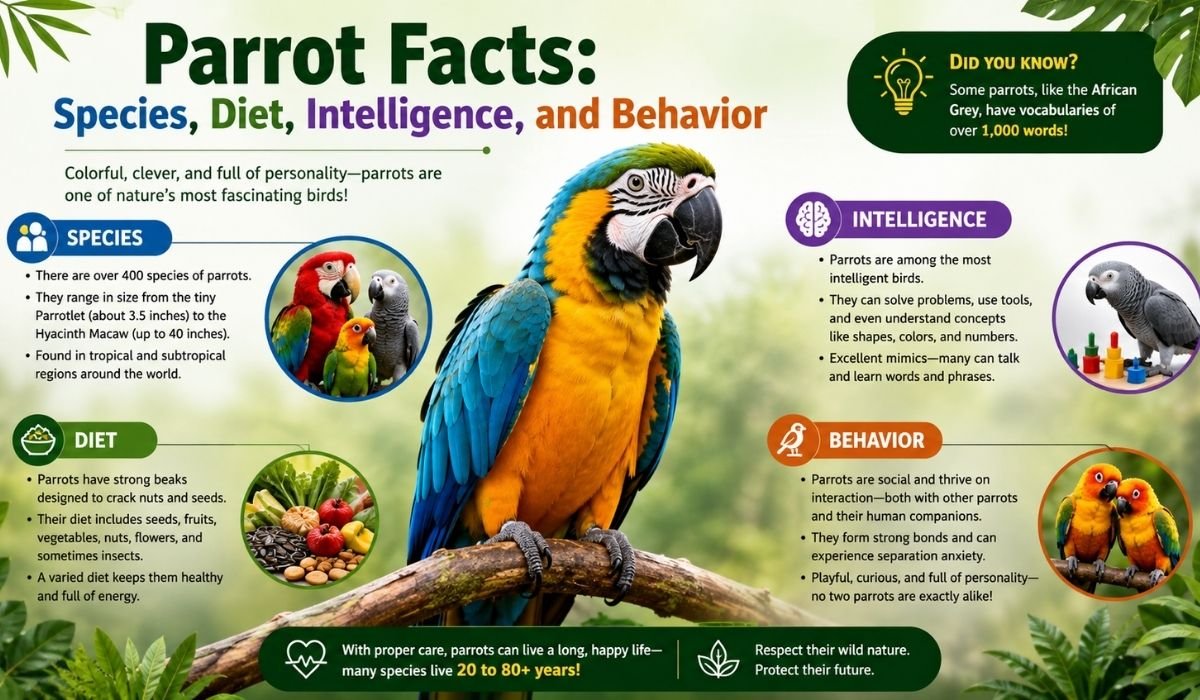
Parrots are among the most fascinating birds in the world, known for their colorful feathers, curved beaks, remarkable intelligence, and ability to imitate sounds. From tiny parrotlets to large macaws, these birds live in a wide range of habitats and display surprisingly complex behaviors. Learning parrot facts can help us understand why parrots are so successful in nature and why they have fascinated people for centuries.
There are more than 400 recognized parrot species, found mainly in tropical and subtropical regions. Although many people associate parrots with talking, their abilities go far beyond copying human speech. They use sounds, body language, social interactions, and problem-solving skills to communicate and survive.
What Are Parrots?
Parrots are birds belonging to the order Psittaciformes. They are easily recognized by their strong, curved bills, zygodactyl feet, and often brightly colored plumage. Their feet have two toes pointing forward and two pointing backward, giving them an excellent grip on branches and food.
One of the most interesting parrot facts is that their beaks are highly versatile. A parrot can use its beak to crack nuts, peel fruits, climb, manipulate objects, and defend itself.
Most parrots are highly social. Many species live in pairs, family groups, or large flocks, depending on the species and environment.
Parrot Species
Parrots come in many different sizes, colors, and shapes. Some are small enough to fit comfortably in a person’s hand, while others have wingspans of more than a meter.
Macaws
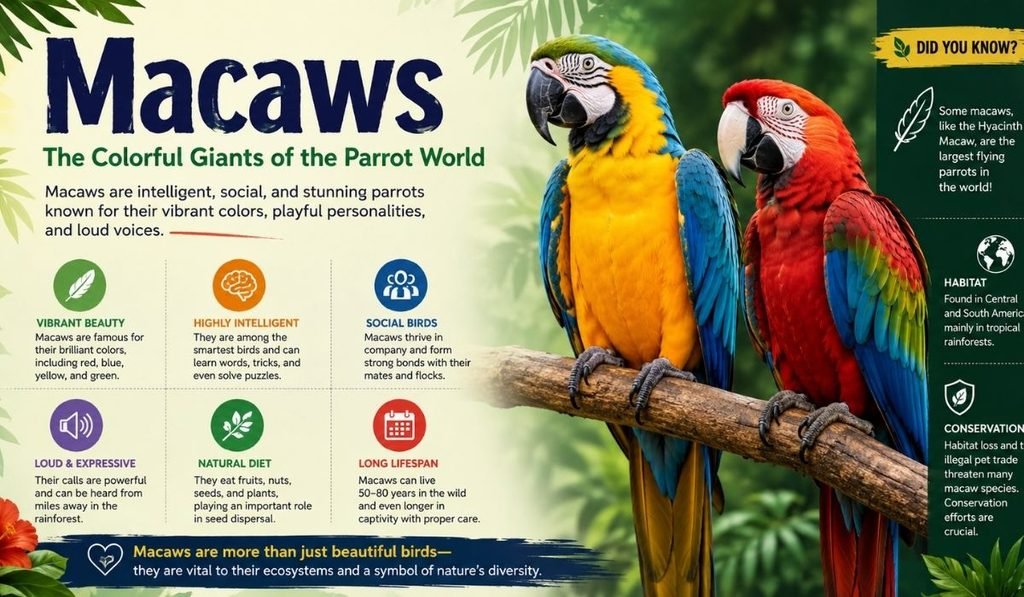
Macaws are among the largest and most colorful parrots. They are native primarily to Central and South America. Blue-and-yellow macaws, scarlet macaws, and hyacinth macaws are well-known examples.
Their large bills allow them to break open tough nuts and seeds. Many macaws also have long tails that help them balance while flying and climbing.
Cockatoos
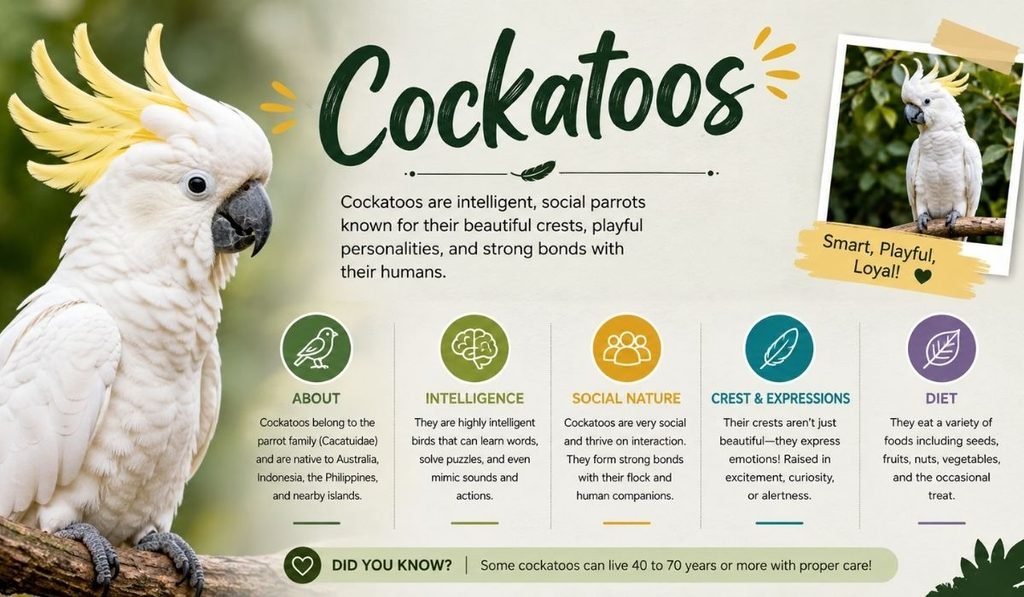
Cockatoos are recognizable by their crests, which they can raise or lower depending on their mood and behavior. They are native mainly to Australia, Indonesia, New Guinea, and nearby islands.
Cockatoos are intelligent and social birds. Some species are particularly skilled at manipulating objects and solving problems.
Read Related Post: Shark Facts: Types, Habitat, Diet, and Behavior
African Grey Parrots
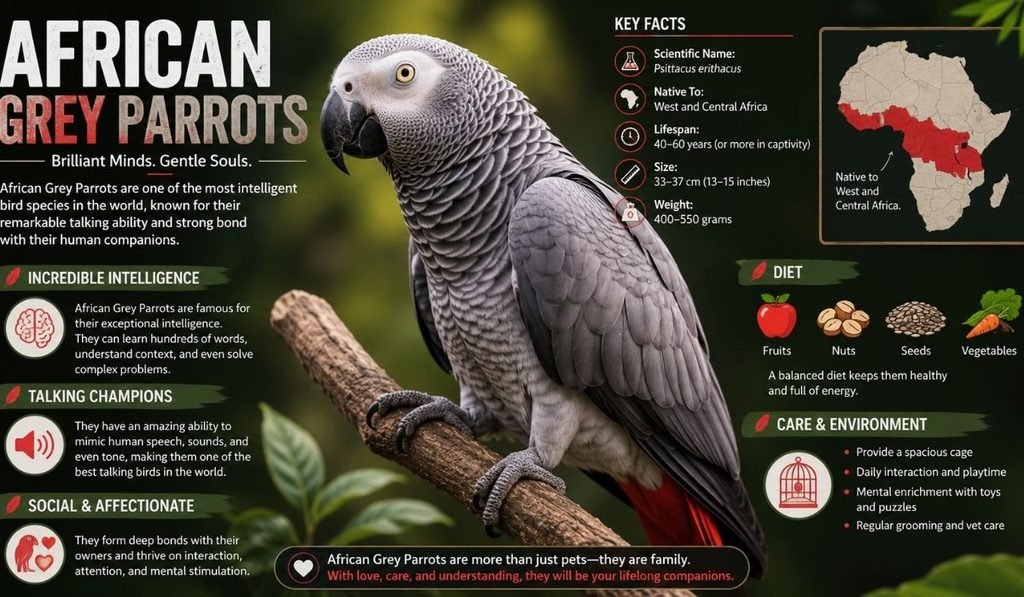
African grey parrots are famous for their impressive vocal abilities and intelligence. They have gray feathers and bright red tails.
One of the most remarkable parrot facts is that African grey parrots can learn and reproduce many different sounds. Research has also shown that some individuals can associate vocal labels with objects and concepts.
Parakeets and Budgerigars
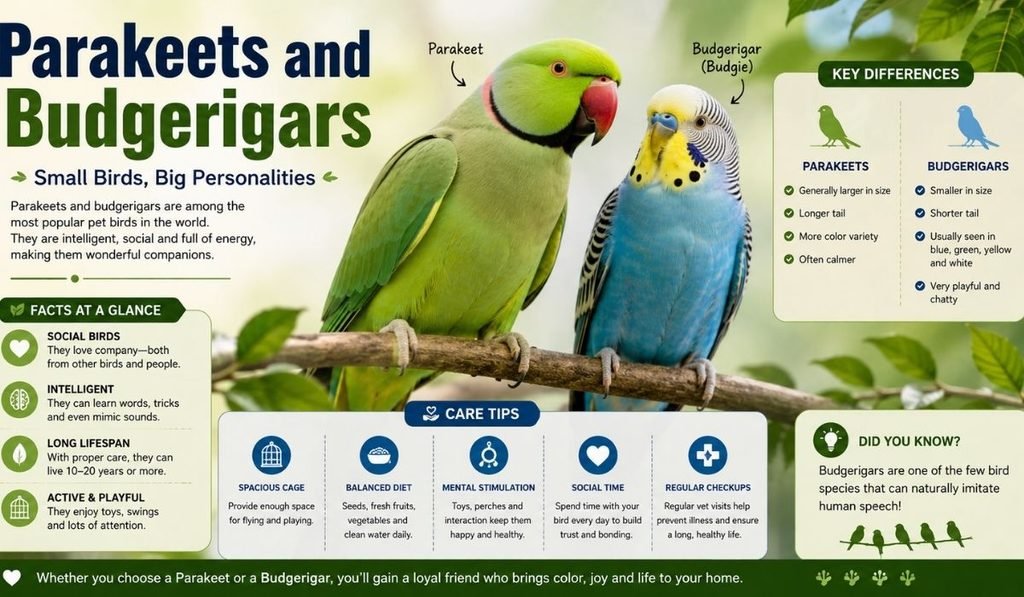
Budgerigars, often called budgies, are small parrots native to Australia. They usually travel in flocks and communicate using calls and body movements.
Despite their small size, budgerigars are active, social, and capable of learning a variety of sounds.
Where Do Parrots Live?
Parrots are found across several regions of the world, especially tropical and subtropical areas. South America, Central America, Australia, Southeast Asia, and parts of Africa contain many parrot species.
Their habitats include rainforests, woodlands, savannas, grasslands, and even dry regions.
Some parrots have adapted remarkably well to challenging environments. The kea of New Zealand, for example, lives in mountainous areas and is well suited to cold conditions.
How Parrots Adapt to Their Environment
Different parrot species have specialized features that help them survive. Strong bills allow them to access hard foods, while their gripping feet help them climb trees and handle food.
Their intelligence also contributes to survival. Parrots may remember food locations, recognize individuals, and learn behaviors from other members of their group.
What Do Parrots Eat?
Most parrots have diets based largely on plant material. Depending on the species and habitat, they may eat fruits, seeds, nuts, flowers, buds, leaves, and nectar.
Some parrots also consume insects or other small food items occasionally.
Fruits and Seeds
Fruits provide parrots with carbohydrates, water, and other nutrients. Seeds and nuts can provide energy and fats.
A parrot’s powerful beak is particularly useful when eating foods protected by hard shells.
Why Their Beaks Are So Powerful
A parrot’s upper bill is curved and strong, while the lower bill helps hold and process food. The tongue also plays an important role in moving food around inside the mouth.
These adaptations allow parrots to handle foods that many other birds cannot easily access.
Parrot Intelligence
One of the most interesting areas of parrot facts involves intelligence. Parrots are considered some of the most intelligent birds.
Their intelligence can be seen through problem-solving, memory, social learning, communication, and object manipulation.
Can Parrots Understand Human Speech?
Parrots can learn to imitate human speech remarkably well. However, simply repeating a word does not necessarily mean the bird understands it in the same way humans do.
Some parrots can learn associations between sounds, objects, actions, or situations. Their ability varies considerably among individuals and species.
How Parrots Solve Problems
Parrots may manipulate objects with their beaks and feet to reach food or investigate their surroundings. Some species can learn through observation and experience.
Their curiosity is another important characteristic. In the wild, investigating new objects and situations can help them discover food and understand their environment.
How Do Parrots Communicate?
Communication is essential to parrot social life. Parrots use calls, whistles, movements, posture, and vocal imitation to interact with others.
A flock may use different calls to maintain contact while members are flying or feeding.
Vocal Communication
Parrots can produce a wide variety of sounds. These sounds may help them identify members of their group, warn others about potential dangers, or maintain contact.
Some species are especially talented at imitating sounds from their surroundings.
Body Language
Parrots also communicate without making sounds. Feather position, posture, head movements, and other behaviors can provide clues about what a bird is experiencing.
This makes observing a parrot’s entire behavior more useful than focusing only on its vocalizations.
Parrot Social Behavior
Parrots are generally social animals. Many species form strong relationships with mates, relatives, and other flock members.
They may feed together, travel together, groom one another, and communicate frequently.
Some parrots form long-term pair bonds. Parents can also spend considerable time caring for their young until they become more independent.
Why Do Parrots Live in Groups?
Living in groups can provide several advantages. Flocks can help birds locate food, detect predators, and exchange information.
Young parrots may also learn important survival behaviors by observing older birds.
How Long Do Parrots Live?
Lifespan varies greatly between species. Smaller parrots may live for around a decade or more, while some larger species can live for several decades under suitable conditions.
This variation is an important part of parrot facts, because size, species, environment, genetics, and overall care can all influence lifespan.
In the wild, survival can be affected by predators, disease, food availability, habitat loss, and environmental changes.
Interesting Parrot Facts
Here are some fascinating parrot facts that show how unusual these birds are:
- Parrots have strong, curved bills adapted for cracking and processing food.
- Their feet are specialized for gripping branches and handling objects.
- Many parrot species are highly social.
- Some parrots can imitate human speech and environmental sounds.
- Parrots use both vocalizations and body language to communicate.
- Macaws are among the largest parrots.
- Budgerigars are small parrots native to Australia.
- African grey parrots are especially well known for their intelligence.
- Some parrots can use objects to solve problems.
- Parrots are found on several continents, with many species concentrated in tropical regions.
Threats Facing Parrots
Despite their adaptability, many parrot species face serious threats in the wild. Habitat destruction can reduce the availability of nesting sites and food.
Illegal wildlife capture and trade have also affected some populations. Climate change, introduced predators, disease, and changes to ecosystems can create additional challenges.
Conservation programs aim to protect habitats, reduce illegal capture, and support threatened populations.
Why Parrot Conservation Matters
Parrots play important roles in their ecosystems. Many species eat fruits and help spread seeds from one location to another.
Protecting parrots therefore helps preserve the wider ecosystems in which they live. Protecting forests and other natural habitats can benefit parrots along with countless other species.
FAQ’s
What are the most interesting parrot facts?
Some of the most interesting parrot facts include their advanced problem-solving abilities, strong curved bills, specialized feet, social behavior, and impressive ability to imitate sounds.
Are parrots intelligent birds?
Yes. Parrots are among the more intelligent birds. They can learn through observation, remember information, manipulate objects, and in some cases associate sounds with objects or situations.
What do parrots eat?
Most parrots eat fruits, seeds, nuts, flowers, buds, leaves, or nectar. Diet varies according to species and habitat.
Where do parrots live?
Parrots are mainly found in tropical and subtropical regions, including parts of Central and South America, Africa, Australia, and Asia. A few species live in cooler environments.
Can all parrots talk?
No. Not every parrot can imitate human speech. Some species and individuals are much better vocal mimics than others.
Why do parrots have curved beaks?
Their curved bills help them crack seeds and nuts, process fruits, climb, and manipulate objects. The bill is one of their most important survival adaptations.
Conclusion
Parrots are remarkable birds with a combination of intelligence, physical adaptations, social behavior, and communication skills that make them unique. From colorful macaws to clever African grey parrots and energetic budgerigars, each species has developed traits suited to its environment.
These parrot facts show that parrots are much more than colorful birds that can imitate human speech. Their powerful beaks, specialized feet, social relationships, problem-solving abilities, and important ecological roles make them fascinating members of the bird world. Understanding parrots also highlights why protecting their habitats and wild populations is so important.

Hi, I’m Amelia, an SEO and content specialist with several years of experience researching and creating informative content for online audiences. At Animal Attack Facts, I focus on animal behavior, animal attacks on humans, and interesting facts about land animals, marine animals, birds, reptiles, and insects. My goal is to provide clear, useful, and engaging information that helps readers better understand wildlife and stay informed about animal encounters.
1 thought on “Parrot Facts: Species, Diet, Intelligence, and Behavior”