
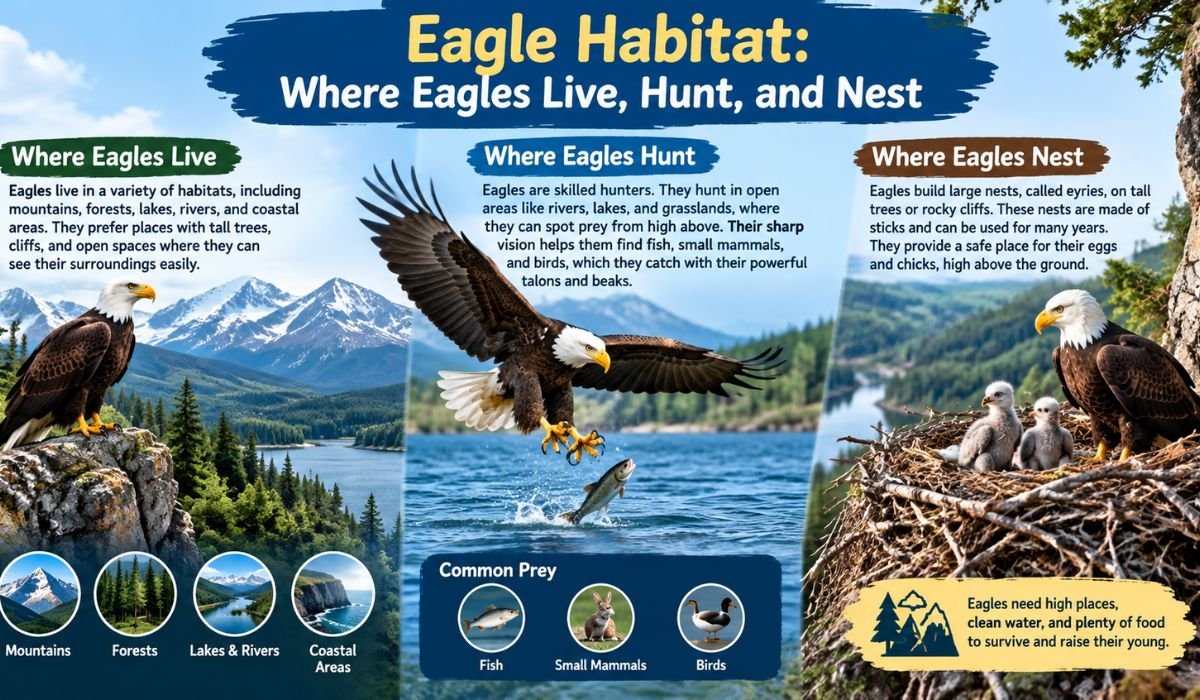
Eagles are powerful birds of prey found in many parts of the world. Their strong wings, sharp eyesight, hooked beaks and powerful talons make them highly effective hunters. But where do these impressive birds live? Understanding eagle habitat helps explain how different eagle species find food, build nests, raise young, and survive in changing environments.
Eagles can live in mountains, forests, grasslands, deserts, wetlands, coastal regions, and areas near rivers and lakes. Their preferred environment depends on the species and the availability of food, water, shelter, and suitable nesting locations.
What Is an Eagle Habitat?
An eagle habitat is the natural environment where an eagle lives and carries out essential activities such as hunting, nesting, resting, and raising its young. A suitable habitat must provide enough prey and safe locations for nesting.
Although different eagle species have different preferences, most require open areas where they can search for prey from the air. They also need elevated places, such as tall trees, cliffs, or rocky ledges, where they can build nests or rest.
The quality of an eagle habitat can strongly affect an eagle’s ability to survive and reproduce.
Where Do Eagles Live?
Eagles are found on several continents, including North America, South America, Europe, Asia, Africa, and Australia. Some species have very large ranges, while others are restricted to particular regions.
Common environments include:
- Mountains and rocky cliffs
- Forests and woodland
- Grasslands and open plains
- Rivers and lakes
- Wetlands and marshes
- Coastal areas
- Deserts and dry regions
- Islands and remote landscapes
For example, bald eagles are strongly associated with areas near water because fish are an important part of their diet. Golden eagles, on the other hand, are commonly found in mountainous and open landscapes where they can hunt mammals.
Mountain Eagle Habitat
Mountains provide excellent living conditions for several eagle species. High cliffs give eagles secure locations for nesting and resting while also providing wide views of the surrounding landscape.
Mountainous eagle habitat often includes rocky slopes, valleys, alpine meadows, and open areas. Eagles can use rising air currents around mountains to soar while using relatively little energy.
Golden eagles are particularly well adapted to mountainous environments. They may build nests on cliffs or in tall trees and hunt animals such as rabbits, ground squirrels, and other small or medium-sized prey.
Mountain habitats can also provide protection from some predators and human disturbance.
Forest Eagle Habitat
Forests are another important environment for eagles. Large trees can provide strong branches that support the birds’ large nests.
Forest-dwelling eagles may hunt from high branches, fly through open spaces, or move toward nearby grasslands and wetlands in search of prey. The structure of the forest can influence how easily an eagle can hunt.
An ideal forest eagle habitat usually contains mature trees, nearby open hunting areas, and a reliable supply of prey. Rivers and lakes located within or near forests can make these areas even more valuable.
However, extensive deforestation can reduce available nesting sites and alter the availability of prey.
Read Related Post: Whale Habitat: Where Whales Live and How They Survive
Eagle Habitat Near Rivers and Lakes
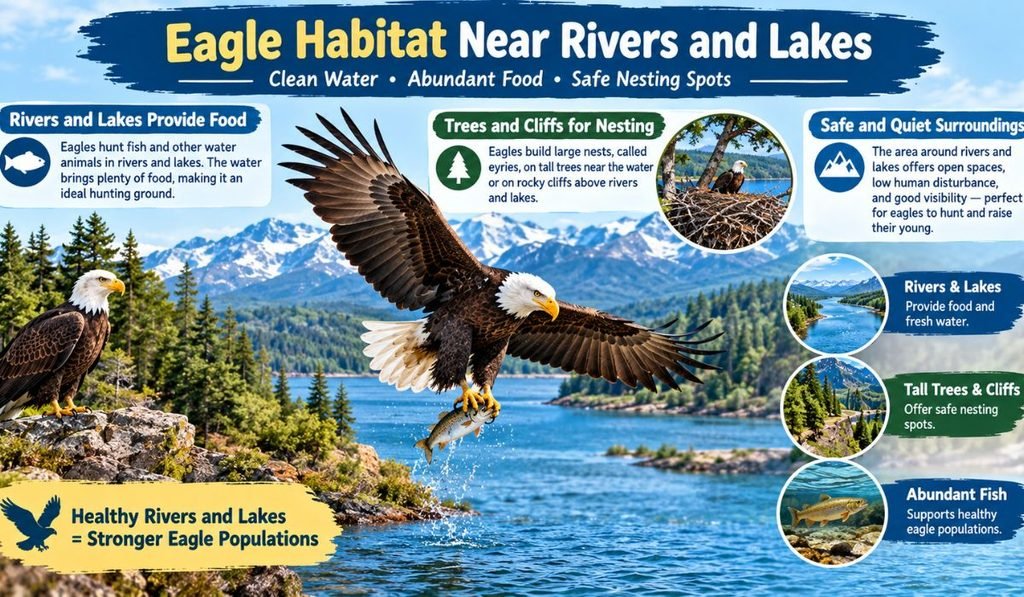
Many eagles are closely associated with freshwater environments. Rivers and lakes provide important food sources, particularly fish and waterfowl.
Bald eagles are a well-known example. They frequently live near large bodies of water where fish are abundant. They may build nests in tall trees overlooking lakes, rivers, or coastal areas.
A water-based eagle habitat can provide several advantages:
- Reliable food supplies
- Tall trees for nesting
- Open areas for flying
- Access to water
- Good visibility for hunting
When food becomes scarce in one location, some eagles may move to other areas where prey is more plentiful.
Coastal Eagle Habitat
Coastal environments can support eagle populations because they often contain abundant fish, birds, and other prey. Eagles may live near beaches, estuaries, islands, and coastal forests.
Coastal eagle habitat is particularly important for species that depend heavily on fish. Eagles may hunt over shallow water, tidal areas, or nearby rivers.
Trees and cliffs near the coast can provide elevated nesting locations. In some regions, however, coastal development can reduce suitable habitat and disturb nesting birds.
Grassland and Open Eagle Habitat
Open landscapes are valuable to eagles because they allow birds to spot prey from above. Grasslands, savannas, and agricultural areas may support rodents, rabbits, reptiles, and other animals that eagles can hunt.
Eagles often use tall trees, poles, rocky outcrops, or other elevated locations as observation points. From these locations, they can scan large areas for potential prey.
An open eagle habitat is especially useful for species that hunt terrestrial animals. However, large areas of completely open land may lack suitable nesting locations, so nearby trees or cliffs can be important.
Desert Eagle Habitat
Some eagle species can survive in dry and desert environments. These areas may seem difficult for large birds of prey, but deserts can provide prey such as rodents, reptiles, and birds.
Rocky cliffs and mountains are especially valuable in desert regions because they provide nesting locations and elevated viewpoints.
In desert eagle habitat, access to food and water can vary greatly. Eagles may travel considerable distances while hunting and can use their strong wings to cover large areas efficiently.
What Do Eagles Need in Their Habitat?
A successful eagle habitat generally provides several essential resources.
Food
Eagles need sufficient prey to maintain their energy and feed their young. Depending on the species, prey can include fish, mammals, birds, reptiles, and carrion.
Nesting Sites
Eagles build large nests in locations that provide safety and stability. Trees, cliffs, and rocky ledges are common nesting sites.
Open Hunting Areas
Open spaces allow eagles to use their excellent eyesight to locate prey. These areas may include rivers, lakes, grasslands, wetlands, or mountain valleys.
Water
Water is particularly important for species that feed heavily on fish or water-associated animals. Rivers, lakes, and coastal environments can therefore support productive eagle populations.
Safety
Eagles need relatively secure locations where they can raise their young. Excessive human disturbance near nesting sites can make an otherwise suitable habitat less useful.
Where Do Eagles Build Their Nests?
Nesting behavior varies between species, but eagles generally select locations that offer safety and a good view of the surrounding area.
Many eagles build nests high in large trees. Others prefer cliffs or rocky ledges. Island and coastal species may also nest in trees or on elevated rocky surfaces.
Eagle nests can become extremely large because birds may reuse and add material to them over many years. A suitable nesting location can therefore become an important part of an eagle habitat for a long time.
How Eagles Hunt in Their Habitat
Eagles are highly adapted for aerial hunting. Their excellent vision allows them to detect prey from considerable distances, while their broad wings help them soar over large areas.
Different species use different hunting strategies. Some eagles search for fish near water, while others hunt mammals across grasslands or mountains.
Thermal air currents can also help eagles remain airborne without constantly flapping their wings. This allows them to cover large areas while searching for prey.
The relationship between hunting behavior and eagle habitat is important because different environments provide different types of prey and hunting opportunities.
How Eagle Habitat Changes With the Seasons
Some eagles remain in the same general region throughout the year, while others migrate between breeding and wintering areas.
Seasonal changes can affect food availability, weather, water levels, and nesting conditions. An area that provides abundant prey during one season may become less productive during another.
Migrating eagles may travel long distances between suitable habitats. Protecting both breeding grounds and wintering areas is therefore important for species that move seasonally.
Threats to Eagle Habitat
Eagles can face several threats when their natural environments are altered.
Habitat Loss
Deforestation, construction, mining, agriculture, and urban expansion can reduce suitable habitat.
Human Disturbance
Frequent activity near nests can disturb breeding eagles and may cause them to avoid otherwise suitable locations.
Pollution
Pollution can affect water quality and prey populations, creating problems for eagles that depend on aquatic ecosystems.
Loss of Prey
When fish, mammals, birds, or reptiles decline, eagles may struggle to find enough food.
Climate and Environmental Changes
Changes in temperature, rainfall, water levels, and prey distribution can gradually alter an eagle habitat.
How Can Eagle Habitats Be Protected?
Protecting eagle habitats requires preserving the places where these birds feed, nest, and raise their young.
Conservation efforts can include protecting forests and wetlands, maintaining healthy rivers and lakes, preserving nesting areas, and reducing disturbance around active nests.
Wildlife reserves and protected areas can provide safe environments for eagle populations. Monitoring eagle numbers and studying their movements can also help conservationists identify important habitats.
Protecting prey species is equally important because eagles depend on healthy ecosystems for food.
Frequently Asked Questions About Eagle Habitat
What is the best eagle habitat?
The best eagle habitat provides abundant prey, suitable nesting locations, open hunting areas, and relatively low levels of disturbance. The ideal environment differs among eagle species.
Do eagles live near water?
Yes, many eagle species live near rivers, lakes, wetlands, or coastal areas. Water can provide fish and other prey, making these locations valuable habitat.
Do eagles live in forests?
Yes. Several eagle species use forests, particularly areas containing mature trees suitable for nesting. Forests may also provide mammals and birds for food.
Do eagles live in mountains?
Yes. Mountains are important habitats for several eagle species. Rocky cliffs provide nesting sites, while valleys and open slopes can provide hunting opportunities.
Where do eagles build nests?
Eagles commonly build nests in tall trees, cliffs, or rocky ledges. The exact nesting location depends on the species and the local environment.
Can eagles live in deserts?
Some eagle species can survive in dry and desert environments. Rocky terrain can provide nesting sites, while rodents, reptiles, and birds can provide food.
Why is eagle habitat important?
An appropriate eagle habitat provides everything eagles need to survive, including food, nesting sites, shelter, and space for hunting. Healthy habitats support successful breeding and stable populations.
Conclusion
Eagles can survive in a remarkable variety of environments, from mountain cliffs and forests to grasslands, wetlands, deserts, and coastal regions. Each species has specific habitat requirements based on its diet, nesting behavior, and hunting strategy.
A healthy eagle habitat must provide reliable food, secure nesting locations, suitable hunting areas, and protection from excessive disturbance. Rivers, lakes, forests, and open landscapes can all play important roles in supporting eagle populations.
Protecting these environments is essential for maintaining healthy eagle populations. By conserving natural landscapes and the prey species that eagles depend on, we can help ensure these powerful birds continue to thrive in the wild.

Hi, I’m Amelia, an SEO and content specialist with several years of experience researching and creating informative content for online audiences. At Animal Attack Facts, I focus on animal behavior, animal attacks on humans, and interesting facts about land animals, marine animals, birds, reptiles, and insects. My goal is to provide clear, useful, and engaging information that helps readers better understand wildlife and stay informed about animal encounters.
1 thought on “Eagle Habitat: Where Eagles Live, Hunt, and Nest”