
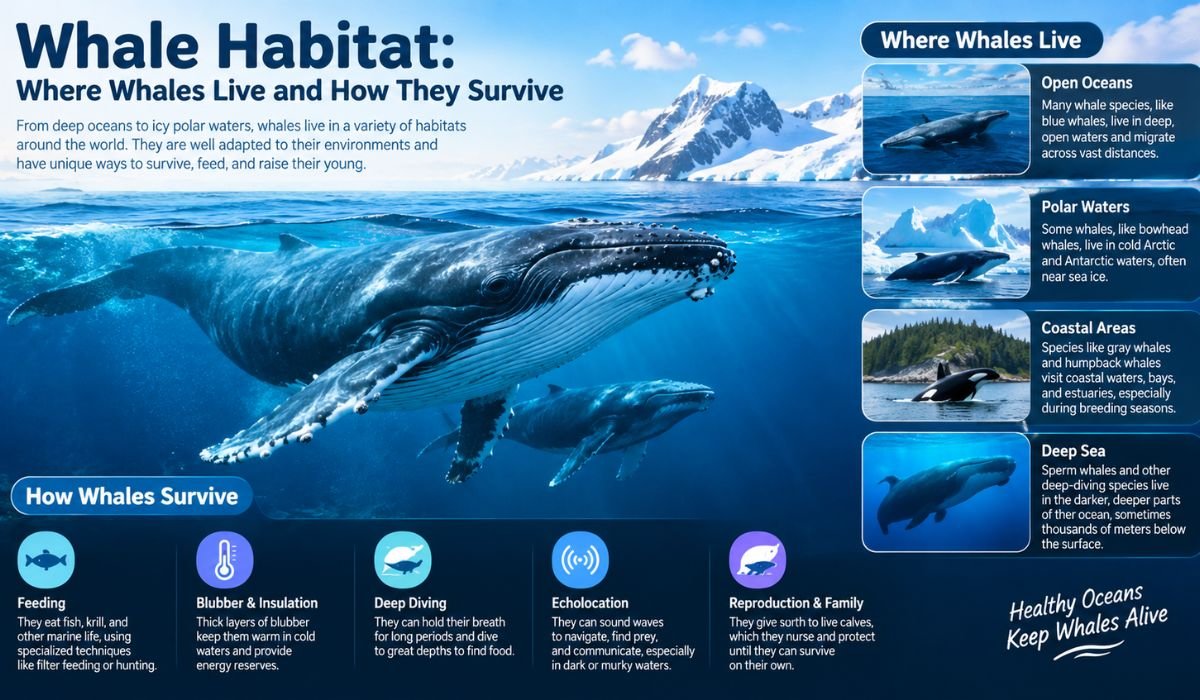
Whales are among the largest animals on Earth, yet they live in a wide variety of marine environments. From icy polar waters to warm tropical seas, different whale species have adapted to very different conditions. Understanding the whale habitat helps explain how these remarkable mammals find food, migrate, reproduce, and survive in the world’s oceans.
Although whales spend their entire lives in water, they do not all live in the same areas. Some species prefer cold, nutrient-rich waters, while others travel through tropical and temperate oceans. Their habitats can also change throughout the year as whales migrate between feeding and breeding grounds.
What Is a Whale Habitat?
A whale habitat is the marine environment where whales live, feed, migrate, and reproduce. Because whales are marine mammals, their habitats are primarily found in oceans and seas rather than freshwater environments.
The ideal habitat depends on the species. Factors such as water temperature, food availability, ocean depth, seasonal conditions, and breeding requirements all influence where whales spend their time.
Some whales remain in certain regions for much of the year, while others travel thousands of miles between different habitats.
Where Do Whales Live?
Whales live in oceans around the world. They can be found in the Atlantic, Pacific, Indian, Arctic, and Southern oceans, as well as connected seas and coastal waters.
A whale habitat may include:
- Open ocean waters
- Coastal areas
- Continental shelf regions
- Deep ocean environments
- Polar waters
- Tropical and subtropical seas
- Temperate marine regions
The distribution of each species is different. For example, blue whales can travel through many parts of the world’s oceans, while bowhead whales are strongly associated with Arctic waters.
Whale Habitat by Ocean Region
Whales occupy several major ocean regions, each offering different environmental conditions.
Polar Whale Habitats
Some whale species are particularly well adapted to cold polar waters. Arctic species such as bowhead whales have specialized adaptations that help them survive in extremely cold environments.
Antarctic waters are also important feeding grounds for several whale species. During productive seasons, these waters can contain abundant krill and other prey.
Temperate Whale Habitats
Temperate oceans support many whale species. These areas often experience seasonal changes in temperature and food availability.
Some whales visit temperate waters mainly for feeding, while others pass through them during long-distance migrations.
Tropical Whale Habitats
Warm tropical and subtropical waters are also important parts of a whale habitat. Certain species travel into warmer waters for breeding and raising their young.
These regions can provide relatively favorable conditions for calves because warmer water may reduce the amount of energy they need to maintain body temperature.
Read Related Post: Fox Facts: Habitat, Diet, Behavior, and Adaptations
Why Do Whales Migrate?
Migration is one of the most important behaviors connected to a whale habitat. Many whale species move between feeding areas and breeding areas during different parts of the year.
Cold waters often provide abundant food, while warmer waters may offer suitable conditions for reproduction and raising calves.
A typical migration pattern may involve:
- Traveling toward productive feeding grounds.
- Spending months feeding and building energy reserves.
- Migrating toward warmer breeding areas.
- Giving birth and caring for calves.
- Returning to feeding grounds.
Not every whale species follows exactly this pattern, but seasonal movement is common among many large whales.
Whale Habitat and Food Availability
Food is one of the biggest factors determining where whales live.
Different species have different diets. Some feed mainly on tiny organisms such as krill, while others consume fish, squid, or other marine prey.
For example, baleen whales filter food from seawater using baleen plates instead of teeth. Their feeding grounds are often located where prey becomes highly concentrated.
A productive whale habitat may contain large amounts of:
- Krill
- Small schooling fish
- Squid
- Zooplankton
- Other marine organisms
Ocean currents play an important role because they transport nutrients that support marine food webs.
How Do Whales Survive in Their Habitat?
Whales have developed numerous adaptations that allow them to survive in marine environments.
Blubber
A thick layer of blubber helps whales conserve body heat. This is particularly important for species living in cold ocean waters.
Blubber also serves as an energy reserve. During periods when food is scarce, stored energy can help whales survive.
Streamlined Bodies
Whales have streamlined bodies that allow them to move efficiently through water. Their powerful tails provide propulsion, while their flippers help with steering and stability.
This body design is especially useful for species that travel long distances during migration.
Efficient Breathing
Whales breathe air through blowholes located on top of their heads. This allows them to surface and breathe without lifting their entire bodies out of the water.
Different species can remain underwater for different lengths of time, depending on their size, behavior, and activity.
Deep-Ocean Whale Habitat
Not all whales spend most of their time near the surface or coastline. Some species regularly dive into deep ocean environments.
Sperm whales are particularly well known for deep diving. They can descend to great depths while searching for prey such as squid.
Deep-water environments can provide access to food that is unavailable in shallow coastal areas. Whales that specialize in deep diving have adaptations that allow them to handle pressure and conserve oxygen during extended dives.
Coastal Whale Habitats
Some whales frequently occur near coastlines, especially when food is plentiful in shallow or continental shelf waters.
Coastal areas can serve as feeding, migration, and breeding environments depending on the species.
However, coastal whale habitat can also expose whales to greater human activity. Shipping traffic, fishing equipment, underwater noise, pollution, and habitat changes can affect whales in these areas.
Whale Habitat and Seasonal Changes
Ocean conditions change throughout the year, and whales often respond to these changes.
Seasonal changes can affect:
- Water temperature
- Food availability
- Ocean currents
- Sea ice
- Breeding conditions
- Migration routes
A whale may therefore use several different habitats during its life rather than remaining in one location.
For many migratory species, the connection between feeding and breeding habitats is essential to survival.
Different Whale Species Have Different Habitats
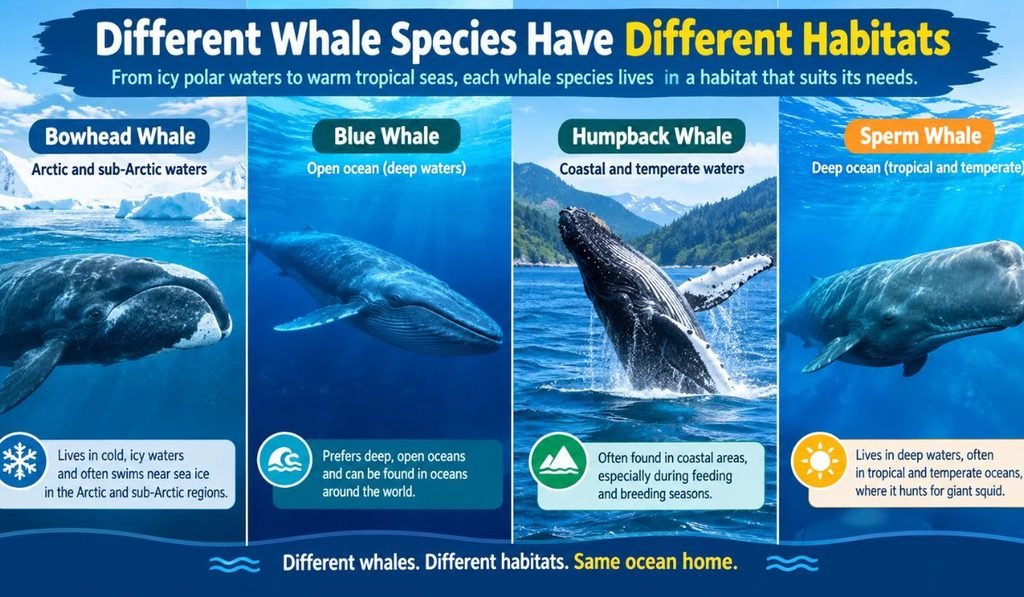
There is no single whale habitat shared equally by every species.
Blue Whales
Blue whales are widely distributed throughout the world’s oceans. They often travel to areas where seasonal concentrations of krill provide abundant food.
Humpback Whales
Humpback whales are famous for their long migrations. Many populations feed in colder, productive waters and migrate toward warmer regions for breeding.
Sperm Whales
Sperm whales are associated with deep ocean waters where they can hunt deep-diving prey such as squid.
Bowhead Whales
Bowhead whales are strongly associated with Arctic waters and have adaptations that help them survive in cold environments.
Gray Whales
Gray whales are known for long migrations between feeding and breeding areas. Some populations travel along coastal routes during migration.
Threats to Whale Habitat
Whale habitats face several environmental and human-related threats.
Ocean Pollution
Plastic waste, chemicals, oil pollution, and other contaminants can damage marine ecosystems and affect the animals that whales depend on for food.
Climate Change
Changes in ocean temperature, sea ice, currents, and prey distribution can alter traditional whale habitats.
When prey moves to different areas, whales may need to travel farther to find enough food.
Ship Traffic
Busy shipping routes can create risks for whales, particularly in coastal and migration areas. Underwater noise from vessels can also interfere with whale communication and behavior.
Fishing Activity
Whales can become entangled in fishing gear. Changes in fisheries can also affect the availability of important prey species.
Protecting marine ecosystems is therefore an important part of protecting whales.
How Can Whale Habitat Be Protected?
Protecting whales requires protecting the marine environments they depend on.
Important conservation measures include:
- Reducing ocean pollution
- Protecting important feeding areas
- Protecting breeding and nursery areas
- Reducing dangerous interactions with fishing gear
- Managing ship traffic in important whale areas
- Reducing harmful underwater noise
- Monitoring whale populations and migration routes
- Addressing climate-related changes in marine ecosystems
Marine protected areas can also help conserve important sections of a whale’s range.
Frequently Asked Questions About Whale Habitat
Where is the main whale habitat?
The main whale habitat is the world’s oceans and seas. Different species occupy different regions, including polar, temperate, tropical, coastal, and deep-ocean environments.
Do whales live in warm or cold water?
Whales can live in both warm and cold water. Some species are strongly associated with polar regions, while others regularly visit tropical or subtropical waters.
Where do whales go during winter?
It depends on the species. Many migratory whales move toward warmer waters during breeding season, while others remain in colder regions throughout the year.
Do whales live in deep water?
Yes. Some whales spend significant amounts of time in deep ocean waters. Sperm whales, for example, are specialized deep-diving hunters.
Do whales live near the coast?
Some whales regularly use coastal habitats, especially during migration or when food is abundant. Other species spend much more time in the open ocean.
Why do whales migrate?
Many whales migrate because different regions provide better feeding and breeding conditions at different times of the year.
What threatens whale habitat?
Pollution, climate change, ship traffic, fishing activity, underwater noise, and changes in prey availability can threaten whale habitats.
Conclusion
The whale habitat is not limited to one part of the ocean. Whales live across a remarkable range of marine environments, from tropical seas and coastal waters to deep oceans and polar regions. Each species has adaptations that help it survive in its particular environment.
Food availability, water temperature, ocean currents, breeding conditions, and seasonal changes all influence where whales travel. Protecting these habitats is essential because healthy ocean ecosystems provide whales with the food and conditions they need to survive.
By reducing pollution, protecting important marine areas, managing human activities, and responding to climate change, we can help preserve the diverse habitats that whales depend on.

Hi, I’m Amelia, an SEO and content specialist with several years of experience researching and creating informative content for online audiences. At Animal Attack Facts, I focus on animal behavior, animal attacks on humans, and interesting facts about land animals, marine animals, birds, reptiles, and insects. My goal is to provide clear, useful, and engaging information that helps readers better understand wildlife and stay informed about animal encounters.
1 thought on “Whale Habitat: Where Whales Live and How They Survive”