
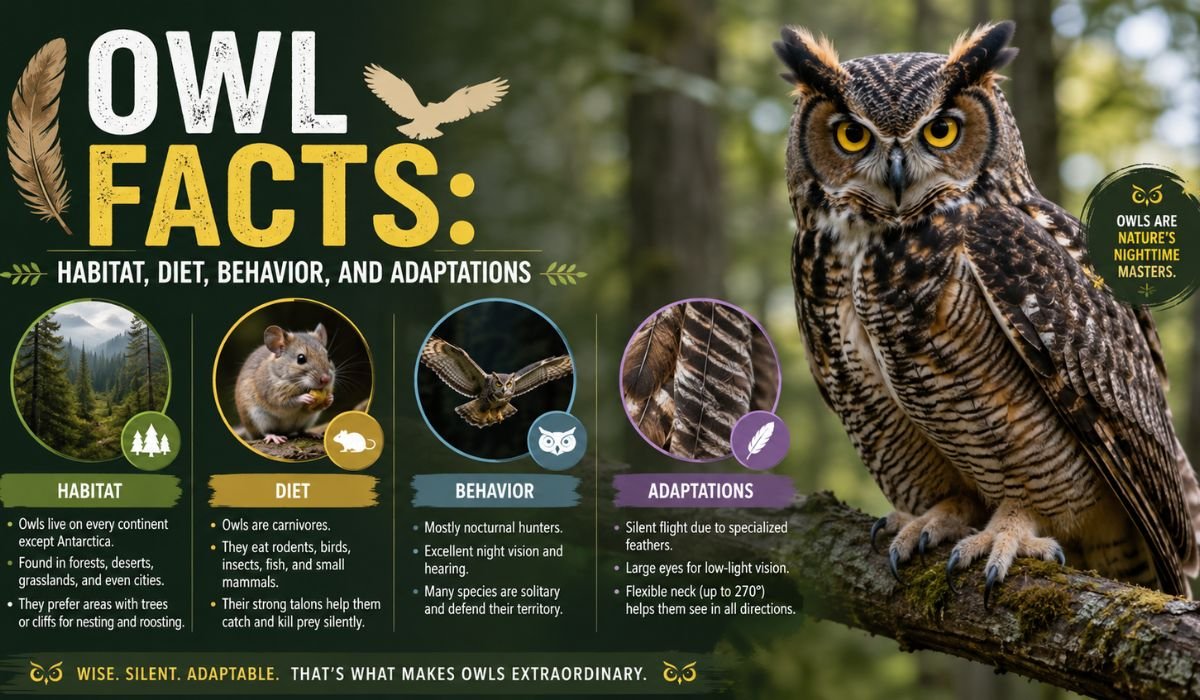
Owls are among the most fascinating birds in the world. Known for their large eyes, silent flight, and remarkable hunting skills, they have adapted to many different environments.
From dense forests and open grasslands to deserts and snowy regions, owls can survive in habitats where many other birds would struggle. Learning owl facts helps us understand how these nocturnal predators find food, avoid danger, communicate, and raise their young.
Owl Facts and Physical Features
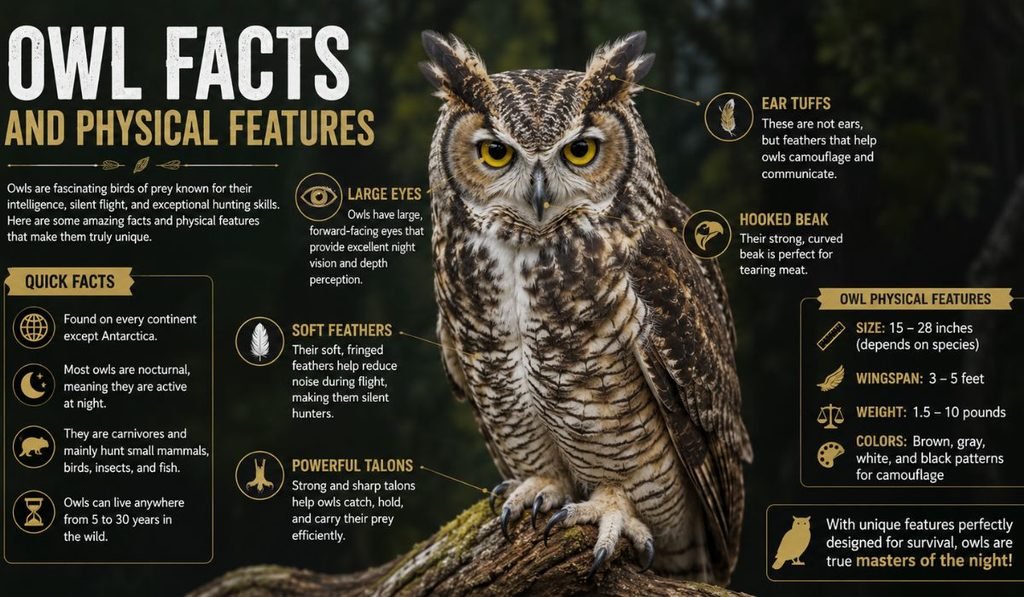
One of the most useful owl facts is that their large, forward-facing eyes are built for hunting. These eyes give owls excellent depth perception, which is especially useful when judging distances in low light. Unlike humans, owls cannot move their eyeballs freely. Instead, they can rotate their heads to look in different directions.
An owl’s facial disc is another important adaptation. The arrangement of feathers around the face helps collect and direct sound toward the ears. This allows many owl species to locate prey using sound, even when vegetation or darkness makes the prey difficult to see.
Owls also have strong, curved talons and hooked beaks. Their feet are designed to grip prey securely, while the beak is useful for tearing food.
Owl Habitat and Distribution
Owls live on every continent except Antarctica. Their habitats range from tropical rainforests to temperate woodlands, mountains, farms, wetlands, deserts, and Arctic tundra.
An important part of owl facts is how habitat provides food, shelter, and safe places for nesting. Tree cavities, cliffs, abandoned nests, rocky ledges, and even buildings can become nesting sites. Some owls have adapted particularly well to areas influenced by people and may live near farms, parks, or rural communities.
Habitat preferences often depend on the species. For example, a forest-dwelling owl may rely on mature trees for nesting, while a grassland species may use burrows or ground-level shelters.
What Do Owls Eat?
Diet is another important part of owl facts, because food choices vary by species. Most owls are carnivores, although the exact food they eat depends on their size, species, and habitat. Common prey includes mice, rats, voles, rabbits, bats, small birds, frogs, lizards, snakes, and insects.
Small owl species often concentrate on insects and other tiny animals, while larger species can capture bigger prey. Owls usually swallow smaller prey whole. Parts that cannot be digested, such as bones, fur, feathers, and some hard insect material, are later compressed into pellets and regurgitated.
Owl pellets can help researchers identify what an owl has eaten and better understand local food webs.
Read Related Post: Dolphin Facts: Habitat, Diet, Intelligence, and Behavior
Owl Hunting Behavior
One of the best-known owl facts is their nighttime hunting, but not every owl is strictly nocturnal. Some species are active during the day, while others may hunt during dawn and dusk. Their hunting strategy is closely connected to the environment and the behavior of their prey.
Many owls begin by sitting quietly on a perch and watching or listening for movement. Once they detect prey, they can fly toward it with impressive accuracy. Their broad wings and specialized feathers help reduce the sound produced during flight. This allows them to approach prey more quietly than many other birds.
Hearing is especially important. An owl may detect a small animal moving beneath leaves, grass, or snow and then use its sound to estimate the prey’s location. In some species, the ears are positioned asymmetrically, which can improve the bird’s ability to determine where a sound is coming from.
Owl Behavior and Communication
Despite their reputation as silent birds, owls communicate in several ways. Calls are used to defend territories, attract mates, warn others, and communicate with young. Different species produce different sounds, including hoots, whistles, screeches, and other vocalizations.
Owls also communicate through posture, feather movements, and head movements. Young owls can make begging sounds to encourage parents to provide food.
Most owls are solitary outside the breeding season, although social behavior varies between species. Pairs may remain together during nesting and cooperate in raising chicks. Territorial behavior is also common, especially when food and suitable nesting locations are limited.
Adaptations That Help Owls Survive
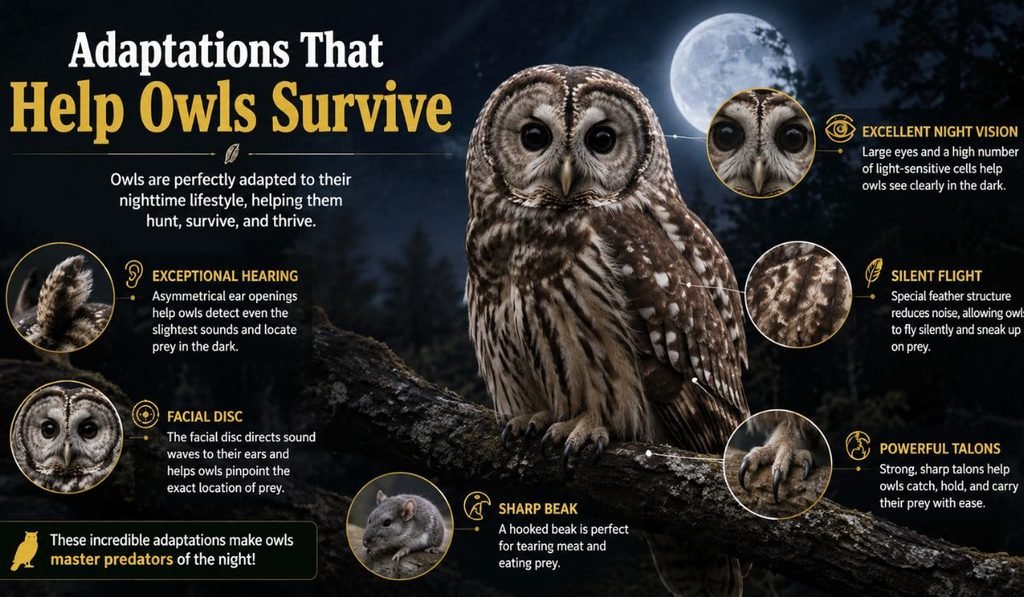
Many owl facts become even more interesting when looking at their adaptations. Their bodies are highly specialized for finding and catching prey.
Excellent low-light vision: Large eyes collect available light efficiently, helping owls see in dim conditions.
Sensitive hearing: Specialized ear structures and the facial disc help many owls locate sounds with great precision.
Silent flight: The structure of their wing feathers reduces turbulence and noise, allowing them to approach prey quietly.
Powerful talons: Strong feet and sharp claws help owls capture and hold prey.
Flexible neck: Owls have an unusually flexible neck structure that allows them to turn their heads far around without moving their bodies.
Camouflage: Many species have feathers that blend into tree bark, rocks, grass, or other surroundings. Staying hidden can protect owls from predators and help them remain unnoticed by prey.
How Do Owls Reproduce?
Breeding behavior varies among owl species. Once a pair forms, the birds select a nesting location that offers protection and access to food.
Owls may lay several eggs, but the number differs between species and environmental conditions. The female often spends much of the early incubation period on the eggs, while the male may bring food to the nest. After hatching, the parents continue feeding and protecting the chicks.
Young owls depend on their parents while growing and developing hunting skills. Eventually, they leave the nest and begin learning how to survive independently.
Interesting Owl Facts
There are hundreds of owl species around the world, and they are divided into two main living families: Tytonidae, which includes barn owls, and Strigidae, which includes typical owls.
Here are some additional owl facts worth knowing:
- Not all owls are active at night.
- Owls cannot rotate their heads a full 360 degrees.
- Many owls have three toes pointing forward and one pointing backward, but they can reposition a toe when gripping prey.
- Owl eyes are relatively large compared with the size of their skulls.
- Some owl species use abandoned nests rather than building their own.
- Owls can help control populations of rodents and other small animals.
- Owl pellets are regurgitated rather than passed through the digestive system as ordinary waste.
- Some owls can live in deserts, while others survive in extremely cold environments.
These owl facts show how diverse these birds are. Their appearance may seem similar across species, but their lifestyles and habitats can be very different.
Threats to Owls
These owl facts also show why habitat protection matters. Habitat loss can reduce the availability of nesting sites and prey. Cutting down mature trees, converting grasslands, and disturbing nesting areas can make survival more difficult for some species.
Other threats include collisions with vehicles, exposure to pollutants, reduced food supplies, and disturbance during breeding. Climate and environmental changes may also affect prey populations and suitable habitat.
Conservation efforts can help by protecting forests, grasslands, wetlands, and other natural areas. Preserving old trees and nesting sites can be particularly important for species that depend on tree cavities. Wildlife-friendly land management can support owl populations.
FAQ’s
Are owls nocturnal?
Many owl facts relate to their activity patterns: many owls are nocturnal, meaning they are most active at night. However, some species hunt during the day or around dawn and dusk.
How far can an owl turn its head?
An owl can turn its head roughly 270 degrees from one side to the other. Special adaptations in the neck and blood vessels help it make this movement safely.
What is an owl’s main food?
Many owls eat small mammals such as mice and voles. Depending on the species, they may also eat birds, insects, reptiles, amphibians, fish, or other animals.
Why do owls have large eyes?
Large eyes help collect light, improving vision in dim conditions. Their forward-facing position also provides strong depth perception for hunting.
Do owls build nests?
Some owls build or reuse nests, but many use tree cavities, cliffs, burrows, or abandoned nests made by other birds.
Conclusion
Owls are highly adapted predators with remarkable senses, specialized feathers, powerful feet, and behaviors that help them survive in many environments. From forests and grasslands to deserts and cold regions, different species have developed unique ways to find food and raise their young.
Understanding owl facts also highlights the importance of protecting the habitats these birds depend on. Whether you are interested in wildlife, bird behavior, or natural ecosystems, owls offer an excellent example of how evolution can shape an animal for survival.

Hi, I’m Amelia, an SEO and content specialist with several years of experience researching and creating informative content for online audiences. At Animal Attack Facts, I focus on animal behavior, animal attacks on humans, and interesting facts about land animals, marine animals, birds, reptiles, and insects. My goal is to provide clear, useful, and engaging information that helps readers better understand wildlife and stay informed about animal encounters.
1 thought on “Owl Facts: Habitat, Diet, Behavior, and Adaptations”